
Radio Control: Soaring
Byron Blakeslee 3134 N. Winnebago Dr. Sedalia, CO 80135
Anyone for Electrics?
With Bob Kopskis' blessing, this month I'll go slightly afield and talk about electric gliders. It's timely because many soaring enthusiasts don't realize how good electric-powered gliders are these days. I didn't — until last fall.
Jason Perrin joined our club and demonstrated his F3E electric glider. Jason, a student at the University of Colorado, Boulder, had just placed second at the 1990 F3E World Championships in Austria. The U.S. Team finished second out of eleven countries, a surprising result against traditional European powerhouses. If you missed the report, see Cal Ettel's article in the January 1991 issue of Model Aviation.
Jason's all-composite, 82-inch-span F3E ship looked impossibly heavy at first — about the size of a two-meter glider with ailerons, elevator, and motor. It had an Astro 60 FAI cobalt motor, 27 cells, weighed almost six pounds, and had a wing loading of about 24 oz./sq. ft. After charging, Jason threw the plane, engaged the motor, and pulled up elevator. The ship climbed out vertically and accelerated — out of sight in about seven seconds. Jason ran the motor roughly 12 seconds; he reported the motor produced about 10 lb of thrust. With the motor off, the glider streaked around the field at roughly 60 mph. Thermaling as we usually think of it was largely impossible; Jason flew fast circles in patches of lift (perhaps 50 yards in diameter) and the ship stayed up. The performance made clear how far electric gliders have come — tremendous L/D and efficiency at speed.
A quick note on F3E competition: distance and duration tasks are flown in the same flight, and scoring is only for gliding (motor off) time. Competitors want rocket-like climbs to minimize motor run time and fast gliding speed for the distance task — hence the high wing loading (FAI limit around 24 oz./sq. ft.). F3E ships can lap a 150-meter distance course in about three minutes; top F3B gliders take about four minutes.
Jason's demo got me thinking. My earlier electrics with seven cells had sedate climb rates. I like electrics for winter flying (no winch on muddy fields) and for flying in smaller spaces. While an F3E-level ship like Jason's is extreme for most of us, there are intermediate options.
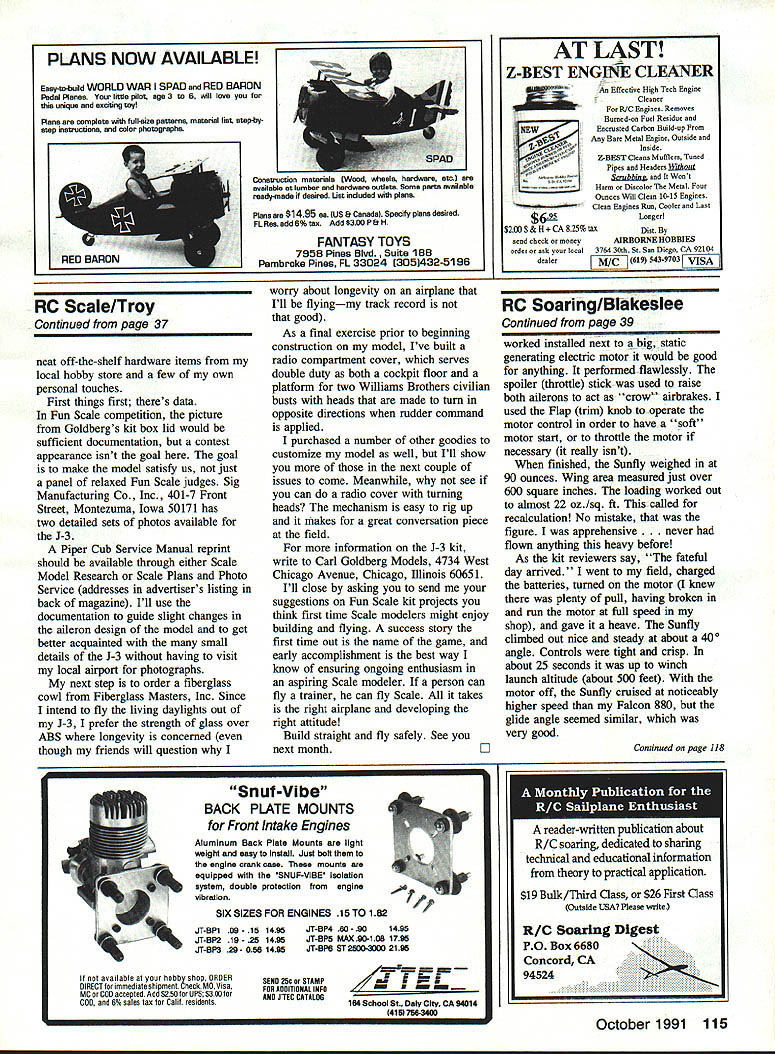
I studied hobby catalogs (Graupner Electro-UHU up to the Aeronaut Sunfly) and watched a video. I ordered the Sunfly tape and couldn't resist. The Sunfly in the video had a Graupner Ultra 1600 motor and 16 cells; in consultation with Hobby Lobby owner Jim Martin I opted for a bit less power: an Ultra 1200 motor with two seven-cell 900 SCR battery packs in series (14 cells total) and a Simprop P-90 motor controller. A TRC Impulse 4 charger completed the package.
I won't pretend electrics are cheap. Besides the kit, quality electric components can add up. However, good equipment lasts and usually performs far better than economy bargains.
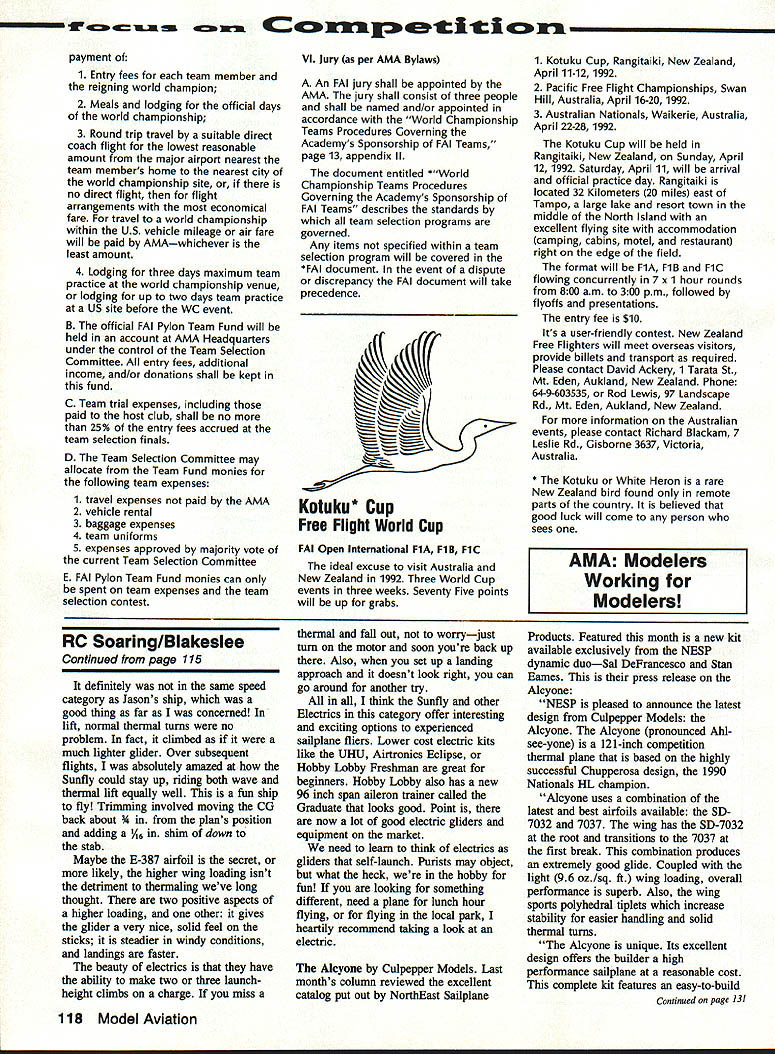
The Sunfly kit (95-inch span) arrived — it's Freudenthaler's 1988 F3E World Champion ship (world-champ ships were larger back then). The kit is largely prebuilt: wing leading edges and tips, aileron finishing, stab shaping, etc., require work but much is done. The white gel-coated fiberglass fuselage is excellent — looks painted, no finishing required. The wing halves are balsa with foam cores and glass cloth; I built the wing in one piece and reinforced the center section with glass and uni-carbon (the plans show a two-piece option, but I chose one-piece because of the plane's weight).
For covering I used Hobby Lobby's Oracover film. I prefer dope-and-fabric, but Oracover was the quickest and easiest I've used. The technique I used: tack a strip down the middle with a low-heat iron (use a sock over the iron), then work the shrink outward toward the edges. Final shrink with the iron removes minor wrinkles and adheres the covering around tips beautifully. This was especially helpful on the Sunfly because the Eppler 837 airfoil has a slight undercamber on the bottom surface, which makes the old "tack the edges first" method difficult.
Control hardware: JR X-347 radio, JR NRE-321 servos for elevator and rudder, Futaba S-33s for the ailerons. The X-347 performed flawlessly even when installed near a big static-generating electric motor. I used the spoiler (throttle) stick to raise both ailerons as "crow" airbrakes and mapped the Flap (trim) knob to the motor control for a soft motor start or slight throttle control.
Final weights and loading: the finished Sunfly weighed 90 oz.; wing area measured just over 4.08 sq. ft., giving a wing loading of almost 22 oz./sq. ft. That sounded heavy to me, but I went to the field, charged batteries, and launched. The Sunfly climbed steadily at about a 40° angle and reached winch-launch altitude (about 500 ft) in ~25 seconds. With the motor off it cruised noticeably faster than my Falcon 880, but its glide angle seemed similar — very encouraging.
Flight impressions: thermaling in lift was no problem; the Sunfly climbed like a lighter glider and rode both wave and thermal lift well. Trimming required moving the CG about 1/4 inch aft of the plan's position and adding a 3/8 inch shim of down to the stab. Possible reasons for the good thermalling performance: the E-387 airfoil or that higher wing loading may not be as detrimental to thermalling as traditionally thought.
Advantages of the higher wing loading I found:
- Gives the glider a solid, positive feel on the sticks.
- Makes the glider steadier in windy conditions.
- Results in faster landings.
Advantages of electrics in general:
- Ability to make multiple launch-height climbs on a single charge.
- If you miss a thermal, you can just motor back up.
- You can go around on approach if the landing setup isn't right.
Overall, the Sunfly and other electrics in this category offer interesting, exciting options for experienced sailplane fliers. Lower-cost electric kits (Graupner Electro-UHU, Airtronics Eclipse, Hobby Lobby Freshman) are great for beginners. Hobby Lobby also offers a new 96-inch-span trainer called the Graduate. The point: there are now many good electric gliders and components on the market.
We should think of electrics as gliders that self-launch. Purists may object, but we're in the hobby for fun. If you want something different, need a plane for lunch-hour flying, or want to fly in the local park, consider an electric.
---
The Alcyone — Culpepper Models
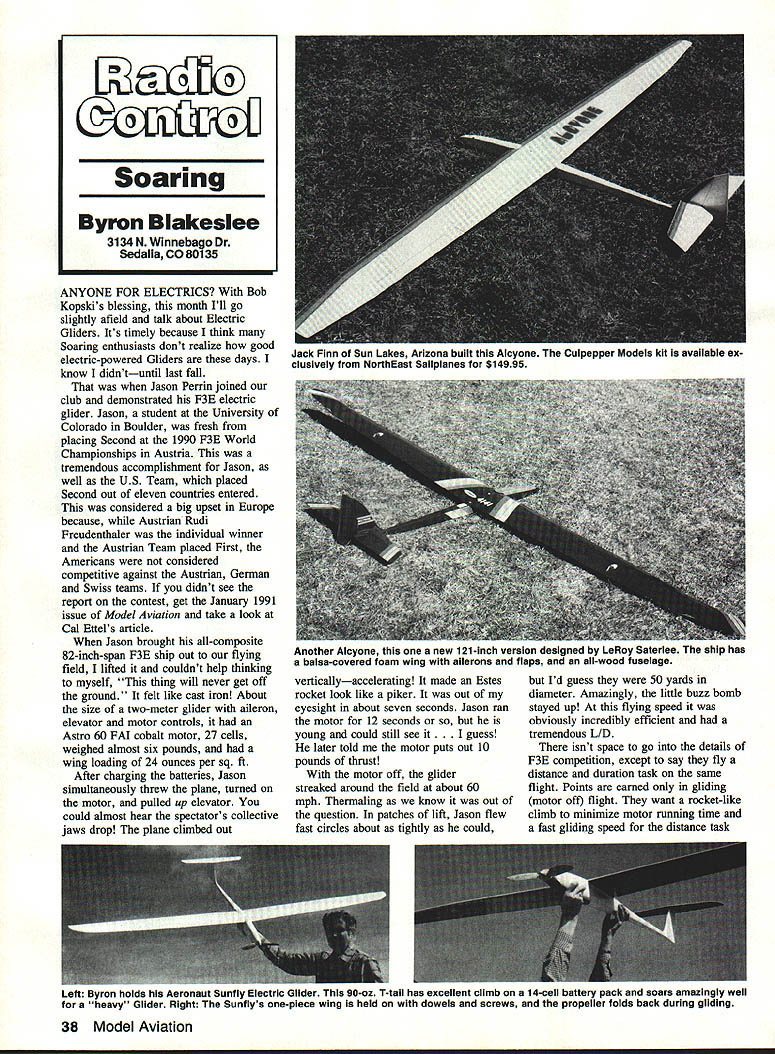
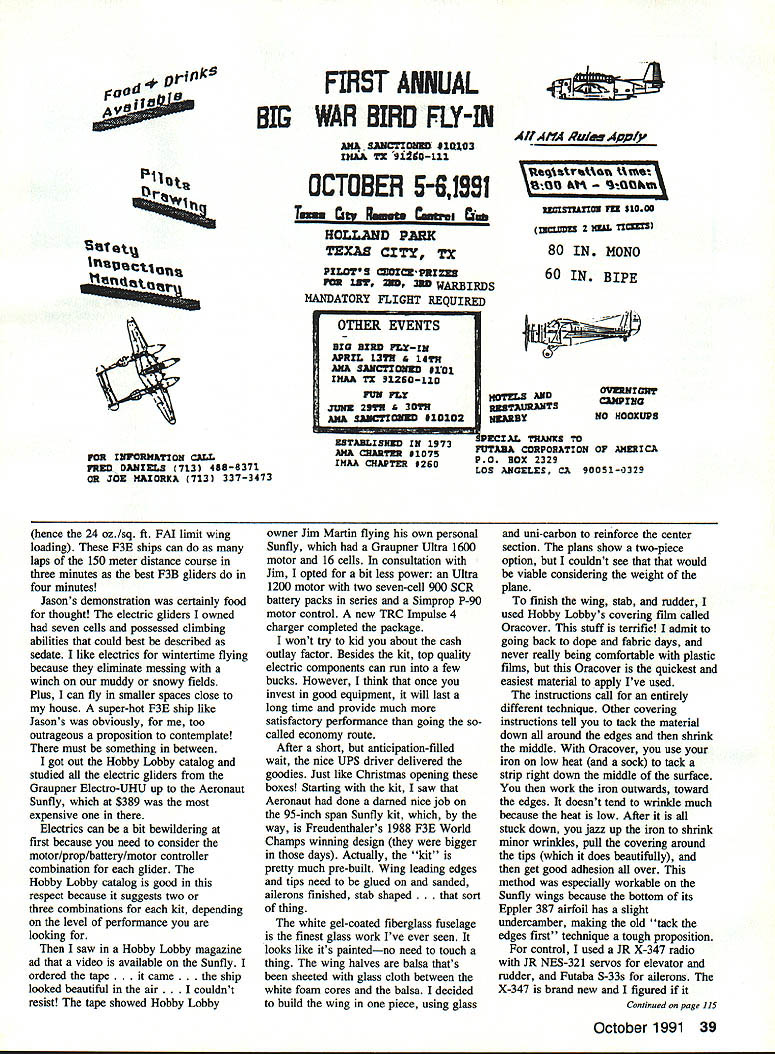
- The Alcyone (pronounced Al-see-own) is a 121-inch competition thermal plane based on the successful Chupperosa design (1990 Nationals HL champion).
- Airfoils: SD-7032 at the root transitioning to SD-7037 at the tip.
- Wing loading: light — about 9.6 oz./sq. ft.
- Features: polyhedral tips for stability, balsa/spruce/plywood fuselage, foam core wings, outstanding plans and instructions, extensive hardware package.
- Controls: ailerons, flaps, elevator, and rudder. Requires only three servos for surface control (unlike many planes in this class that require six), reducing expense.
- The camber distribution provides roughly 80–90% of the speed range of full trailing-edge camber without the expense of a four-servo wing.
- Clean lines and strong spar construction result in excellent tow performance (winch or hi-start).
- Kit price: $149.95.
Recommendation: The Alcyone is an excellent choice for the intermediate builder/flier and looks like a good first foam-wing aileron/flap thermal ship. It can be flown with a four-channel radio and offers strong performance for the cost.
---
Aerospace Composite Products (ACP) — Vacuum Bagging and Catalog Items
- ACP's catalog features a wide range of high-tech materials; EZ LAM epoxy laminating resin is recommended for its very low viscosity, excellent cloth wetting, near-clear color, and minimal odor.
- Vacuum bagging is becoming popular; ACP provides Vacuum Bagging Instructions for Foam Wings (four pages of step-by-step how-to).
- ACP offers the EZ VAC vacuum-bagging kit ($72.00 plus S&H). The kit includes:
- An electric diaphragm pump preset for six inches of mercury (~3 psi).
- Nine feet of 18-inch-wide bag material.
- A fitting for attaching the tube to the bag.
- 12 feet of 18-inch-wide breather felt.
- 25 feet of sealant tape.
- The pump draws a constant six inches of mercury, which is suitable for bagging white foam wing cores. Blue foam cores often require more powerful pumps (~15 inches).
- Vacuum bagging provides uniform, controlled pressure for skinning foam cores with balsa or hardwood veneers and is much easier than clamping or piling heavy weights on the workpiece.
To request the ACP catalog (and ask for the bagging instructions), send two postage stamps to: Aerospace Composite Products P.O. Box 16621 Irvine, CA 92714 Telephone: 714/250-1107
---
Dodgson Saber Prefab Spar
Bob Dodgson now offers prefabricated spars for Saber kits:
- Price: $65 extra with the kit; $79 plus shipping total if you already have the kit.
- Description: Manufactured in a jig from Douglas fir with plywood shear web and built-in dihedral breaks. The spar is fully faired and ready to install — you fit it to the wing halves, epoxy it in place, and finish as required.
Transcribed from original scans by AI. Minor OCR errors may remain.

