
Radio Control: Soaring
Byron Blakeslee 3134 N. Winnebago Dr. Sedalia, CO 80135
Greco Modi 900
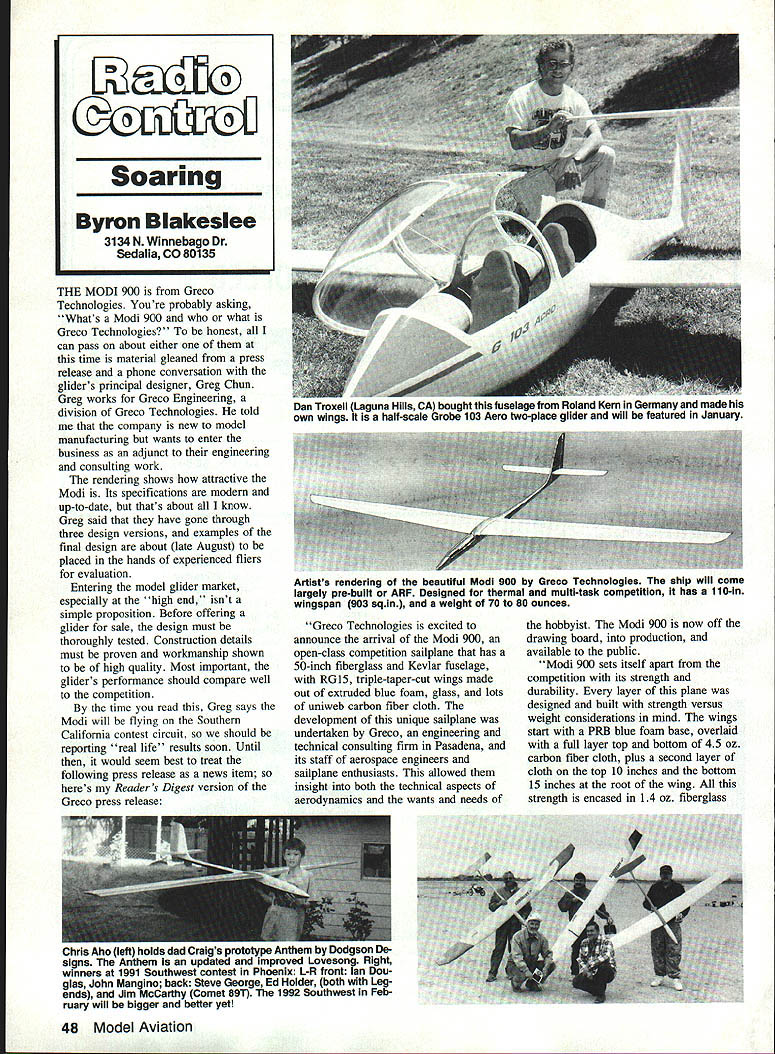
THE MODI 900 is from Greco Technologies. You're probably asking, "What's a Modi 900 and who or what is Greco Technologies?" To be honest, all I can pass on about either one of them at this time is material gleaned from a press release and a phone conversation with the glider's principal designer, Greg Chun. Greg works for Greco Engineering, a division of Greco Technologies. He told me that the company is new to model manufacturing but wants to enter the business as an adjunct to their engineering and consulting work.
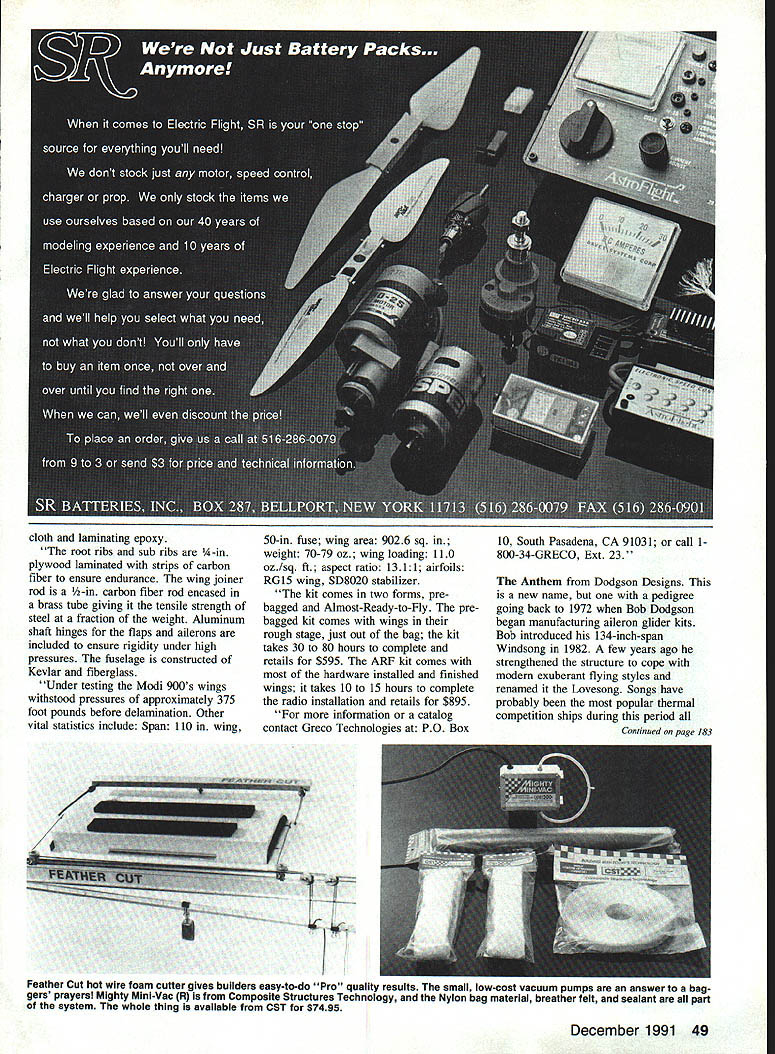
The rendering shows how attractive the Modi is. Its specifications are modern and up-to-date, but that's about all I know. Greg said that they have gone through three design versions, and examples of the final design were, as of late August, to be placed in the hands of experienced fliers for evaluation.
Entering the model glider market, especially at the "high end," isn't a simple proposition. Before offering a glider for sale, the design must be thoroughly tested. Construction details must be proven and workmanship shown to be of high quality. Most important, the glider's performance should compare well to the competition.
By the time you read this, Greg says the Modi will be flying on the Southern California contest circuit, so we should be reporting "real life" results soon. Until then, treat the following as a Reader's Digest version of Greco's press release:
- Greco Technologies announces the Modi 900, an open-class competition sailplane.
- Features: 50-inch fiberglass and Kevlar fuselage; RG15, triple-taper-cut wings built of extruded blue foam, glass, and uniweb carbon fiber cloth.
- Developed by Greco (an engineering and consulting firm) with aerospace engineers and sailplane enthusiasts.
- The Modi 900 is off the drawing board, into production, and available to the public.
Greco states the Modi 900 sets itself apart with strength and durability. Every layer was designed with strength versus weight considerations in mind.
- Wing construction:
- PRB blue-foam base
- Full top and bottom layer of 4.5 oz. carbon fiber cloth
- Second layer of cloth on top 10 inches and bottom 15 inches at the root
- Encased in 1.4 oz. fiberglass cloth laminating epoxy
- Root ribs, sub-ribs, 1/4-in. plywood laminated strips and carbon fiber for endurance
- Wing joiner rod: 1/2-in. carbon fiber rod encased in a brass tube for high tensile strength
- Aluminum shaft hinges for flaps and ailerons
- Fuselage: Kevlar and fiberglass
Under testing, Modi 900 wings withstood pressures of approximately 375 foot-pounds before delamination.
Other statistics:
- Span: 110 in.
- Wing area: 903 sq. in.
- Weight: 70–80 oz.
- Wing loading: 1.10 oz./sq. ft.
- Aspect ratio: 13:1
- Airfoils: RG15
Kit/options:
- Stabilizer kit comes in two forms — pre-bagged Almost-Ready-to-Fly (ARF) and pre-bagged kit.
- Kit: wings in the rough stage (just out of the bag). Kit takes 30–80 hours to complete. Retail: $595.
- ARF: hardware installed and finished wings; takes 10–15 hours to complete radio installation. Retail: $895.
For information and a catalog contact: Greco Technologies, P.O. Box 10, South Pasadena, CA 91031; 1-800-34-GRECO, ext. 23.
---
Dodgson Designs — The Anthem
The Anthem is from Dodgson Designs. This is a new name, but one with a pedigree going back to 1972 when Bob Dodgson began manufacturing aileron glider kits. Bob introduced his 134-inch-span Windsong in 1982. A few years ago he strengthened the structure to cope with modern exuberant flying styles and renamed it the Lovesong. The Lovesong has probably been the most popular thermal competition ship during this period.
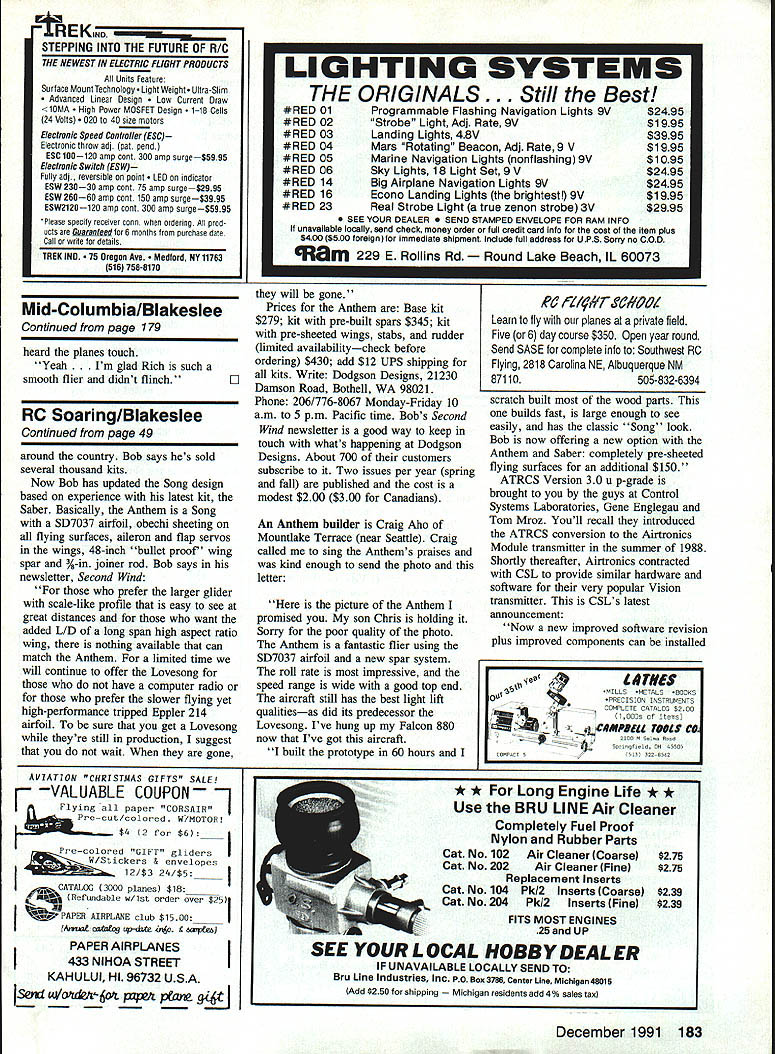
Now Bob has updated the Song design based on experience with his latest kit, the Saber. Basically, the Anthem is a Song based on the SD7037 airfoil, with all flying surfaces, aileron and flap servos in the wings, a 48-inch "bullet proof" wing spar and a 3/16-in. joiner rod. Bob says in his newsletter, Second Wind:
"For those who prefer the larger glider with a scale-like profile that is easy to see at great distances and for those who want the added L/D of a long-span high aspect ratio wing, there is nothing available that can match the Anthem. For a limited time we will continue to offer the Lovesong for those who do not have a computer radio or for those who prefer the slower flying yet high-performance tripped Eppler 214 airfoil. To be sure that you get a Lovesong while they are still in production, I suggest that you do not wait. When the wings are gone, they will be gone."
Prices:
- Base kit: $279
- Kit with pre-built spars: $345
- Kit with pre-sheeted wings, stabs, and rudder (limited availability — check before ordering): $430
- Add $12 UPS shipping for all kits
Order from: Dodgson Designs, 21230 Damson Road, Bothell, WA 98021. Phone: 206/776-8067 (Mon–Fri 10 a.m. to 5 p.m. Pacific).
Bob's Second Wind newsletter: about 700 customers subscribe. Two issues per year (spring and fall). Cost: $2.00 ($3.00 for Canadians).
An Anthem builder, Craig Aho of Mountlake Terrace (near Seattle), praised the design and sent a photo and letter:
- The Anthem uses the SD7037 airfoil and a new spar system.
- Excellent roll rate and wide speed range with a good top end.
- Retains the best light-lift qualities of the Lovesong.
- Craig built the prototype in 60 hours, scratch-built most wood parts.
- New option from Bob: completely pre-sheeted flying surfaces for an additional $150.
---
Feather Cut Hot Wire Foam Wing Machine (Tekoa)
The Feather Cut Hot Wire Foam Wing Machine is produced by Tekoa, The Center of Design (Roger and Blayne Chastain). Roger asked if I'd like to try his machine; I had never cut cores before, though I'd seen it done on video and in person. The machine arrived well packed and went together in about an hour following clear instructions.
Machine overview:
- Two main parts of blue-anodized extruded aluminum.
- Larger extrusion ("body"): 51 inches long, mounts to the edge of a workbench. Mounted on it are two horizontal and two vertical rollers that slide in tracks and fix in place with wing nuts. The rollers adjust for different wing sizes and hold the cores during cutting.
- Cutter head mounted on a vertical extrusion, rides on an aluminum slide with two seals to keep wire tension relatively constant.
- The machine is sturdy and functional. It will cut cores up to 50 inches long and almost any width and taper.
How it works:
- Rollers guide two very flexible (22-gauge) power wires that connect to the hot cutting wire with alligator clips. The other ends connect to a low-voltage power source. The power wires heat the cutting wire and pull it through the foam block.
- The smaller extrusion ("control arm"): 48 inches long, pivoted at the left end of the body. Purpose:
- Compensate for differences in power wire travel when cutting tapered cores.
- Provide the pull on the power wires via a 16-ounce lead weight mounted near the middle that, by gravity, provides the motive force.
- Taper adjustment: the control arm has a graduated scale from 0 to 100. The root end power wire is always attached at 100; the tip wire attaches at the calculated number.
The hot wire is mounted in the "bow":
- A 27-inch length of 3/4 in. x 2 in. wood with 10-inch-long 1/4 in. diameter music wire "legs" on each end.
- Wrap 0.018-inch T-370 cutting wire around one leg, bend the legs together a specified distance, and wrap around the other leg. The bend provides proper tension.
- Roger says his cutting wire is "special" — neither nichrome nor stainless leader wire.
Bow length and options:
- Standard bow cuts cores up to about 26 inches long.
- Designers commonly use multiple core sections per wing panel; foam typically comes in 24-inch-wide pieces.
- You can make a longer bow from lumber or purchase upcoming aluminum foldable bows (28, 40, 52 inches) from Roger.
Cutting methods — three approaches:
- By hand (bow by hand) — straightforward but requires practice and steady speed (and often a helper) for consistent cuts.
- Electric motor drive — sophisticated, requires experience to regulate speed and heat; risk of burning foam (too hot/slow) or dragging (too cold/fast).
- Gravity feed (Feather Cut) — simplicity: set the heat, cutting proceeds automatically at its own pace, suited to new users.
Feather Cut novel features:
- Sliding lead weights on the bow legs: when cutting the bottom profile slide weights toward the hot wire for better contact; when cutting the top profile slide them back for less downforce.
- Bow operates horizontally with a small "tawl" wheel in the middle to roll across the work surface. Older vertical bow methods used springs or rubber bands and introduced adjustment errors.
Templates:
- The hardest part is making templates. Roger recommends Chuck Anderson's Airfoil Plot Program to draw full-size airfoil profiles on a computer printer ($25).
- Glue printed airfoil plots to horizontal grade Formica with 3M No. 77 spray adhesive, cut them out with a jigsaw, and accurately sand and polish the surface the hot wire rides on.
- Each airfoil template is made in two matching halves: one pair for the bottom cut and one pair for the top cut. The Feather Cut machine always cuts on the top surface of the template, so two-piece templates are required.
- Two-piece templates register on the work surface and prevent twists.
Typical template usage:
- Pin the bottom templates (leading edge cut first) to the ends of the foam block. Pre-cut the core planform by hand using the hot wire bow and Formica triangles as supports.
- Clamp the top templates to the block and set the small roller "tawl" in the center of the bow to roll on the Formica.
- Start with the wire in the top template groove and feed down to the bottom template groove as you push the bow forward; at the end the wire will be above the top template again.
- Ensure templates rest squarely on a perfectly flat work surface and the foam is well weighted down.
- The bottom cut is made first, then replace bottom templates with top ones for the top cut. Template pairs must have exactly matching pin holes to reuse the same holes in the foam.
Notes:
- The hot wire cuts about .010 undersize. If you vacuum bag cores with glass/carbon fiber, this undersize allows for skin thickness.
- Once templates are made, the Feather Cut machine is easy to use. Set the hot wire on the templates, adjust four rollers, attach power wires and control arm, turn on the power supply — cutting proceeds at about an inch per minute with a satisfying sizzling noise.
Power supply:
- Any low-voltage supply (up to 28 V) will work (e.g., Variac). Roger's Thermal Generator simplifies operation:
- Fool-proof wire temperature control
- Automatically senses resistance and supplies proper power to heat wire to about 212°–225°F
- Adjust a knob to center a dial needle
Recommended foam:
- Dow PRB (Plaster Ready Board) blue material: density 2 lb/cu ft, rated 25 psi, open cell structure — preferred over blue Dow Square Edge insulating foam.
- Dow HI-15 High Load board: rated 115 psi, 6 lb/cu ft — for very strong wings but harder to locate.
Tapered core note:
- For a wing root of 10 inches and tip of 9 inches, you might think the taper ratio should be 90% on the control arm. However, you clip the power wires to the hot wire one inch from either end of the foam block, so the root power wire actually travels a little more than 10 inches and the tip wire a little less than nine inches. To determine actual lengths, place your pre-shaped foam block on paper, project each end one inch with a straightedge and pencil, then measure the projected ends.
Ordering:
- Feather Cut machine: $139.50 plus $8.50 S&H.
- Thermal Generator: $94.50 plus $4.50 S&H.
Order from: Tekoa, The Center of Design, 3219 Canyon Lake Drive, Hollywood, CA 90068. Phone/Fax 213/469-5584.
---
New Low-Cost Vacuum Pumps
My April piece about making a vacuum pump from a refrigerator compressor generated a lot of interest. But knowing what I do now, I wouldn't have bothered making one!
Both Composite Structures Technology (CST) and Aerospace Composite Products (ACP) now sell low-cost, continuous-run pumps that work great. Their only drawback is they pull a maximum of six inches of mercury — adequate for most foam work (six inches is the most you should use on white foam).
- CST "Mighty Mini-Vac":
- Price: $69.95 alone, $74.95 for a set (both plus $6.00 S&H).
- Set includes three yards of nylon bagging tube, sealant, breather strip, and a T-fitting.
- Toll-free: 1-800-338-1CST.
- ACP "E-Z Vac":
- Price: $65.00 alone, $75.00 for a set (both plus $4.00 S&H).
- Set includes a hose fitting that attaches to flat bag surfaces and two Quick-Seal clips.
- Address: Box 16621, Irvine, CA 92714. Phone 714/250-1107.
I tested a Mighty Mini-Vac set on wood veneer skins for Thermal Eagle wings and was impressed. With my finger over the hose it pulled six inches of mercury; connected to a bag with a small pinhole leak it read just under five inches — still adequate.
Other bagging items:
- CST 3.5-ounce unidirectional carbon fiber fabric: 10 inches wide, $12.00 per lineal yard. Thin (.005 inch) and good under lightweight glass for wings.
- Quick-Seal clips (ACP): reusable 3/8-inch solid plastic rod inside a U-shaped plastic channel 20 inches long. Place the bag over the channel and push the rod in to form a seal. Price: $3.50 each.
- ACP also offers pumps preset to dispense correct ounce-per-stroke ratios for resin/hardener for E-Z Lam.
---
League of Silent Flight (LSF) — New Address
LSF President Bob Steele reports a new permanent mailing address:
- 10173 St. Joe Road, Ft. Wayne, IN 46835.
The old Winfield, IL P.O. box will forward mail for a year (until August 1992). Mail turnaround time should return to 7–14 days. Members may phone Bob at 219/485-1145.
---
Mankato Model Soaring Society
A newly formed club in North Mankato, Minnesota. Bob Botha is the driving force and has permission to use a nice 40-acre sod farm as a flying field. Interested sailplane pilots (electrics welcome) in the area should call Bob at 507/345-1832 evenings or weekends.
---
Southwest Winter Soaring Contest
The Southwest Winter Soaring Contest will be sponsored by the Central Arizona Soaring League and held in Phoenix on January 24–25. It will be two one-day contests flying modified Triathlon and precision duration tasks. For more information, write:
- Chuck Wheeler, P.O. Box 2472, Chandler, AZ 85244.
Transcribed from original scans by AI. Minor OCR errors may remain.

