

Radio Control: Soaring
Byron Blakeslee 3134 N. Winnebago Dr. Sedalia, CO 80135
The Grob 103 Acro
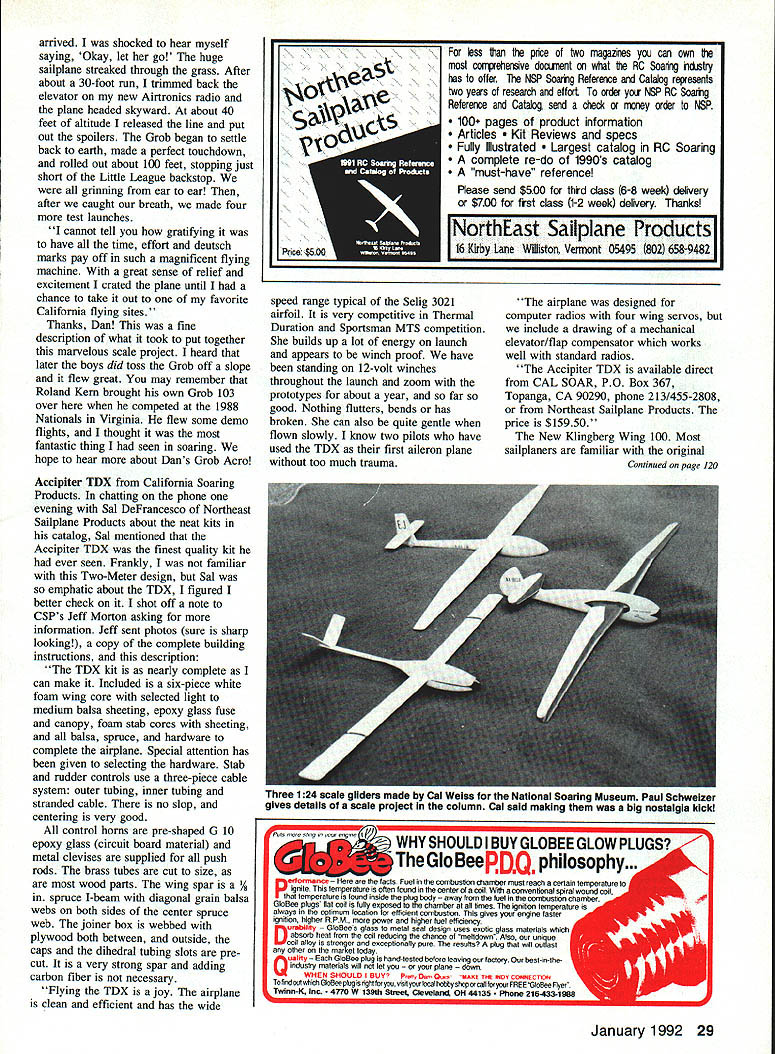
THE GROB 103 ACRO monster-scale ship built by Dan Troxell has to grab your attention! Everybody loves big gliders and this 1:2.4 scale Grob is about as large a one as you'll ever see. Dan, from Laguna Hills, California, is known for favoring these big scale jobs and kindly sent a description of the project.
The odyssey of the monstrous Grob 103 Acro began in September 1990 with a visit to my brother in Brussels, Belgium. After a day visiting, he and I headed south to explore the legendary flying sites of Germany and search for those outrageous models. We were not disappointed.
When we pulled into Roland Kern's shop near Stuttgart and first saw the Grob 103 fuselage, I could not believe my eyes. I knew it was big, but this was something else again. After a pleasant visit, and forking over lots of deutsche marks, we packed the fuse into the blazer and headed down the autobahn at Mach II. (On the autobahn you don't see the speedometer between the on‑ramp and the off‑ramp!)
After we got back to Brussels, Joe agreed to crate the Grob and ship it back to the States. I returned home to wait patiently. The crate was finished one week after the beginning of Desert Storm and air freight had all but come to a standstill. Joe managed to get it on Israeli Airlines (they had space since tourism to Tel Aviv was a little slow around January 15th). Then security from Brussels airport called to check me out and ask if they could run the crate through a metal detector to make sure it wasn't a SCUD missile. A week later, I had my crate.
I had bought a lot of goodies from Herr Kern to make the building easier: a fiberglass rudder, giant spoilers, elevator foam cores, and four sheets of obeche each 12 feet long. However, I still had to scratch‑build those giant wings! I drew out the Quaebeck airfoils and had them enlarged. Then I made the plywood templates and cut the foam cores. I made a trip to the aircraft supply shop for a five‑foot‑long joiner tube, four 3/4 in. by 1 1/2 in. by 9 ft. long spruce spars, some aircraft plywood for shear‑webs, glass cloth, and ten boxes of Hobby‑Poxy II. Voila — there were the most beautiful (and only) 24‑foot wings I had ever seen!
Each wing weighed 12 pounds, so I had to keep the fuselage under 31 pounds to stay within the AMA 55‑pound limit. I tried to build everything strong, but light. With the giant SR battery pack, the pilots, nose weight and a beautiful paint job from the local Cadillac body shop, the total came to 53 pounds. I finished it off with great Vinyl‑Rite letters. We charged it up with my new ACE charger and set off for some test glides.
The site was an enormous deserted athletic field. We set the plane in one corner, with Dale, the "anchor" man, sitting behind the rudder hanging onto the fin with all his might. Ray and Dave hauled back the Hobby Lobby "garden hose" bungee and Keith steadied the wing. I couldn't believe the big moment had arrived. The huge sailplane streaked through the grass. After about a 30‑foot run, I trimmed back elevator, the new Airtronics radio and the plane headed skyward to about 40 feet altitude. I released the line and put out the spoilers. The Grob began to settle back to earth, made a perfect touchdown and rolled out about 100 feet, stopping just short of a Little League backstop. Grinning ear to ear after I caught my breath, I made four test launches.
I cannot tell you how gratifying it is to have the time, effort and deutsche marks pay off in such a magnificent flying machine. A great sense of relief and excitement. I crated the plane until the chance to take it out to my favorite California flying sites.
Thanks, Dan, for a fine description of what it took to put together this marvelous scale project. I later heard the boys did toss the Grob off a slope and it flew great. You may remember Roland Kern brought his own Grob 103 over and competed in the 1988 Nationals in Virginia and flew some demo flights. I thought it was the most fantastic thing I've seen soaring. I hope to hear more about Dan's Grob Acro.
Accipiter TDX from California Soaring Products
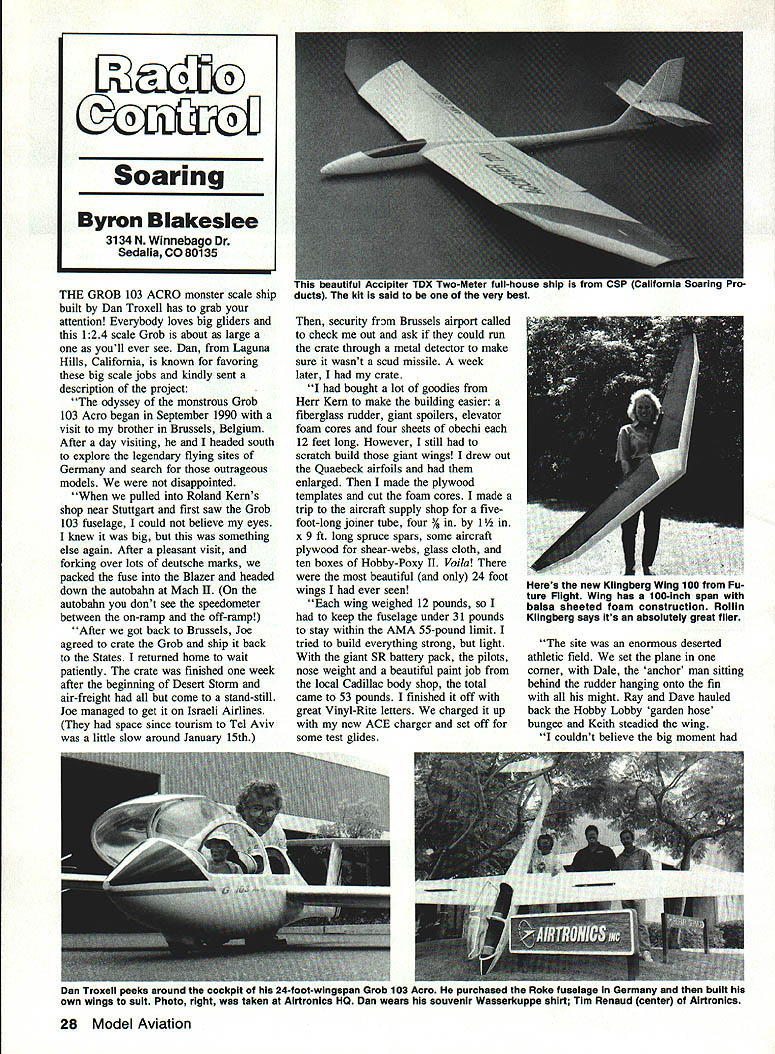
In chatting on the phone one evening with Sal DeFrancesco of Northeast Sailplane Products about the neat kits in his catalog, Sal mentioned that the Accipiter TDX was the finest quality kit he had ever seen. Frankly, I was not familiar with this Two‑Meter design, but Sal was so emphatic about the TDX I figured I better check on it. I shot off a note to CSP's Jeff Morton asking for more information. Jeff sent photos (sure is sharp looking!), a copy of the complete building instructions, and this description:
"The TDX kit is as nearly complete as I can make it. Included is a six‑piece white foam wing core with selected light to medium balsa sheeting, epoxied glass fuse and canopy, foam stab cores with sheeting, and all balsa, spruce, and hardware to complete the airplane. Special attention has been given to selecting the hardware. Stab and rudder controls use a three‑piece cable system: outer tubing, inner tubing and stranded cable. There is no slop, and centering is very good.
All control horns are pre‑shaped G‑10 epoxy glass (circuit board material) and metal clevises are supplied for all push rods. The brass tubes are cut to size, as are most wood parts. The wing spar is a 1/8 in. spruce I‑beam with diagonal grain balsa webs on both sides of the center spruce web. The joiner box is webbed with plywood both between, and outside, the caps and the dihedral tubing slots are pre‑cut. It is a very strong spar and adding carbon fiber is not necessary.
"Flying the TDX is a joy. The airplane is clean and efficient and has the wide speed range typical of the Selig 3021 airfoil. It is very competitive in Thermal Duration and Sportsman MTS competition. She builds up a lot of energy on launch and appears to be winch proof. We have been standing on 12‑volt winches throughout the launch and zoom with the prototypes for about a year, and so far so good. Nothing flutters, bends or has broken. She can also be quite gentle when flown slowly. I know two pilots who have used the TDX as their first aileron plane without too much trauma.
"The airplane was designed for computer radios with four wing servos, but we include a drawing of a mechanical elevator/flap compensator which works well with standard radios.
"The Accipiter TDX is available direct from CAL SOAR, P.O. Box 367, Topanga, CA 90290, phone 213/455‑2808, or from Northeast Sailplane Products. The price is $159.50."
The New Klingberg Wing 100
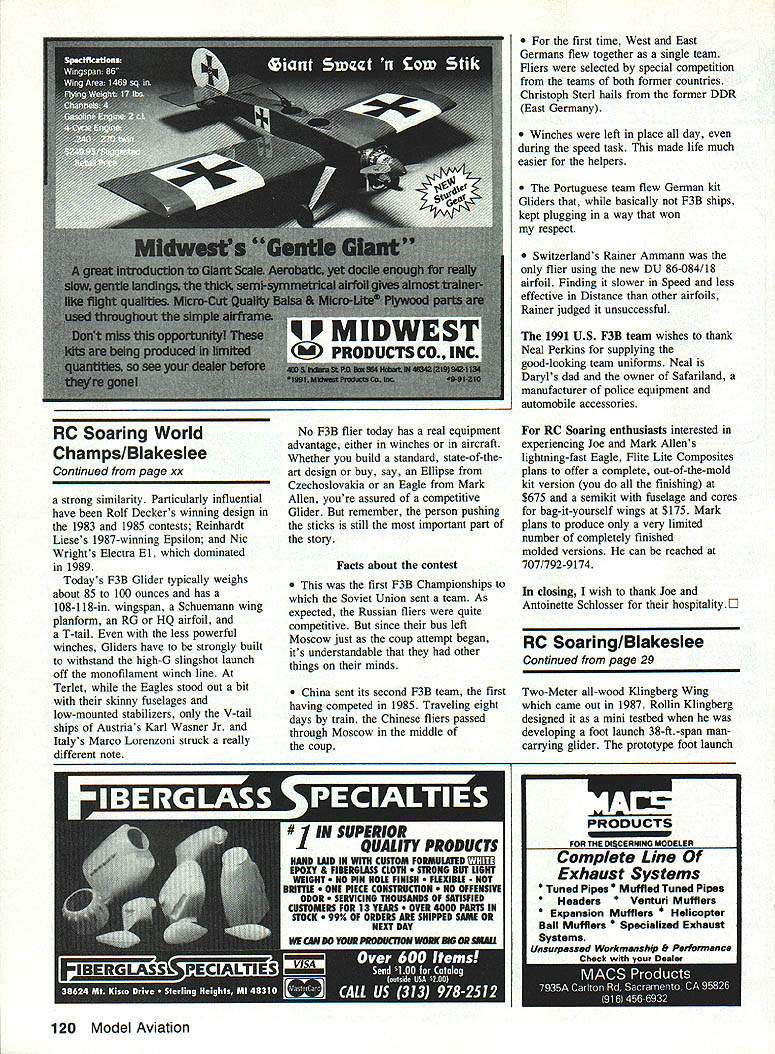
Future Flight Wing has a 100‑inch span balsa‑sheeted foam construction. Rollin Klingberg says it's an absolutely great flier.
"The Klingberg Wing 100 is the eagerly awaited follow on to the original Klingberg Wing. Several years of research and testing have resulted in a high performance glider with definite contest winning qualities. The KW 100 features a balsa‑sheeted foam core wing of 100 in. span and 1,200 sq. in. area, with a nominal weight of under four pounds. Its special features include custom designed airfoils for a wide speed range, removable outer wing panels, strip elevons and flaps, in‑flight adjustable CG and the Autoyaw control system. The kit comes complete with extra wide UNIMAX balsa sheeting and all hardware. For more detailed information write to Future Flight, 1256 Prescott Ave., Sunnyvale, CA 94089. Phone 408/735‑8260."
Rollin also sent more information on construction:
"The new Wing is quite a bit different in construction. It was designed for maximum performance so built‑up just didn't make the grade. As you see in the newsletter, it has foam cores with full balsa sheeting, so no jigging is required. The kit's sheeting is full width, with many of the sheeting sections precut. In addition, the instructions for the new Wing are written so the model can be built on several different levels of complexity, from novice to expert. I'm hoping this will allow more people to have access to a great flying wing."
Rollin's new newsletter is Future News, "A Future Flight News and Product Guide Publication." FN will communicate hints and tips, aerodynamics, new products, and all kinds of information from Future Flight. Rollin reports, "In recent flight testing against the Airtronics Legend, the K.W. 100 has shown a better float without giving up the high speed end. I think that in the contest season of 1992 we will see a new glider configuration in the winner's circle."
F3B and Contest Notes
There is a strong similarity in today's top F3B glider designs. Particularly influential have been Rolf Decker's winning design in the 1983 and 1985 contests; Reinhardt Liese's 1987‑winning Epsilon; and Nic Wright's Electra E1, which dominated in 1989.
Today's F3B glider typically weighs about 85 to 100 ounces and has a 108–118‑inch wingspan, a Scheumann wing planform, an RG or HQ airfoil, and a T‑tail. Even with the less powerful winches, gliders have to be strongly built to withstand the high‑G slingshot launch of the monofilament winch line. At Terlet, while the Eagles stood out a bit with their skinny fuselages and low‑mounted stabilizers, only the V‑tail ships of Austria's Karl Wanzen Jr. and Italy's Marco Lorenzoni struck a really different note.
No F3B flier today has a real equipment advantage, either in winches or in aircraft. Whether you build a standard, state‑of‑the‑art design or buy, say, an Ellipse from Czechoslovakia or an Eagle from Mark Allen, you're assured of a competitive glider. But remember, the person pushing the sticks is still the most important part of the story.
Facts about the contest:
- This was the first F3B Championships to which the Soviet Union sent a team. As expected, the Russian fliers were quite competitive. But since their bus left Moscow just as the coup attempt began, it's understandable that they had other things on their minds.
- China sent its second F3B team, the first having competed in 1985. Traveling ten days by train, the Chinese fliers passed through Moscow in the middle of the coup.
- For the first time, West and East Germans flew together as a single team. Fliers were selected by special competition from the teams of both former countries. Christoph Sterl hails from the former DDR (East Germany).
- Winches were left in place all day, even during the speed task. This made life much easier for the helpers.
- The Portuguese team flew German kit gliders that, while basically not F3B ships, kept plugging in a way that won my respect.
- Switzerland's Rainer Ammann was the only flier using the new DU 86‑084/18 airfoil. Finding it slower in speed and less effective in Distance than other airfoils, Rainer judged it unsuccessful.
The 1991 U.S. F3B team wishes to thank Neal Perkins for supplying the good‑looking team uniforms. Neal is Daryl's dad and the owner of Safariland, a manufacturer of police equipment and automobile accessories.
For RC soaring enthusiasts interested in experiencing Joe and Mark Allen's lightning‑fast Eagle, Flite Lite Composites plans to offer a complete, out‑of‑the‑mold kit version (you do all the finishing) at $675 and a semi‑kit with fuselage and cores for bag‑it‑yourself wings at $175. Mark plans to produce only a very limited number of completely finished molded versions. He can be reached at 707/792‑9174.
In closing, thanks to Joe and Antoinette Schlosser for their hospitality.
The Easy Eagle from Ace RC — Modifications by Pete Carr
Since it was introduced just over a year ago, I've heard many reports praising the Easy Eagle Two‑Meter trainer as being a fine all‑around glider. NSS President Pete Carr sent an interesting letter about the mods he did on his Easy Eagle:
"The ship is an Ace Easy Eagle which is a Harley Michaelis design. While the kit makes an excellent trainer, I wanted the fuselage design and wing planform as a basis for a more competitive Two‑Meter aircraft. Changes to the kit were as follows:"
- HQ‑2.5/9 airfoil (2.5% camber — 9% thick)
- Fully sheeted rib and spar wing
- Wing joiners made from 1/8" radio circuit board
- Tail moment lengthened 3.0 inches
- Fiberglassed fuselage to wing trailing edge
- Diamond airfoil full flying stab
- Futaba 9VAP radio for control mixing
- TaylorCraft adjustable towhook
"The objective was to increase the unballasted speed in the launch, zoom, and in thermal search. The wing is about 1/2 thinner than stock and aside from the faster speed, it flies like any other Two‑Meter ship. The flaps are very effective with coupling to elevator in the ping and zoom. In lift about five° of flap slows the ship for easy thermalling. On landing approach, they slow the ship to a crawl at 90° deflection. Auto elevator compensation is used, but the ship will hit the ground and bounce back into the air due to the great extra lift. To prevent this, a pair of Carl Goldberg #461 wing skids were reverse mounted to the underside of the nose. Contact with the ground now stops the ship immediately.
"At first glance the fuselage looks unusually high. This helps keep the flaps clear of the ground on landing. They are driven from a Royal Mini servo and no gear problems have been encountered.
"Many Two‑Meter designs use spoilers for landing control. Flaps accomplish this too, but also work for you in the launch and in lift. For the same weight, the flap arrangement is much more versatile. These modifications would work well on several other Two‑Meter designs. I'd be interested to hear from anyone who tries them on another kit."
Pete's address is: 329 Little Ave., Ridgeway, PA 15553. Tel. 814/772‑4851.
A Special Request From Paul Schweizer
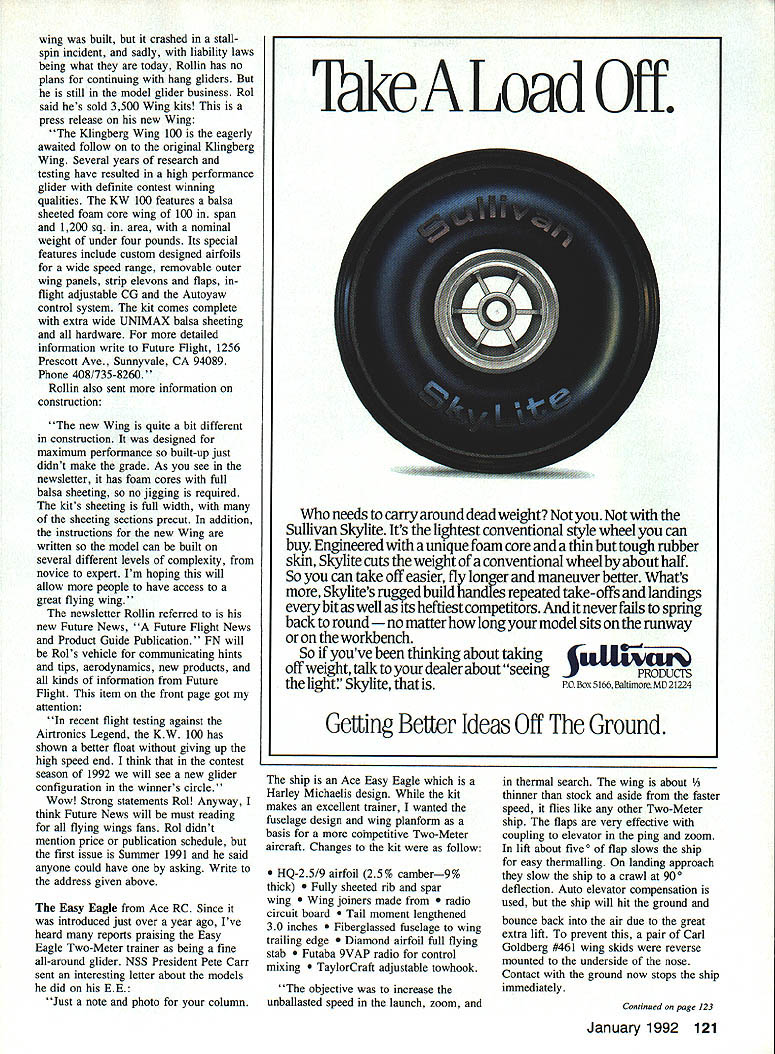
Paul Schweizer, Chairman of the Exhibit Committee of the National Soaring Museum (Elmira, NY), wrote asking if modelers would help with two special model exhibits in 1992 and 1993.
The first is a collection of 120 model sailplanes at 1:24 and 1:25 scale that will show the evolution of gliders and sailplanes through the years. They have about half the models assigned to those who designed or built the sailplanes, others to friends and soaring enthusiasts. A "Sponsor" category has been created for those who want to give the NSM a model but who are not model builders. Model builders who have interest in having one of their models in this special exhibit will have the model builder and sponsor's name inscribed on the plaque that gives the detail on each model.
The 1993 project is two 1/2 or 1/4 scale models. One is the Pruefling glider that Ralph Barnaby flew to earn the first U.S. soaring C Award. The second is the Blue Mouse that Wolfgang Klemperer flew to earn the first C in the World. These models will be on exhibit at the 1993 SSA Convention in Seattle, then featured at the NSM for the rest of 1993. Barnaby and Klemperer were born in 1893, and they both made many contributions to soaring over the years.
Model builders or sponsors interested in these projects should contact: Exhibit Committee, National Soaring Museum, R.D. No. 3 Harris Hill, Elmira, NY 14903. Tel. 607/734‑3821.
Nationals Planning and NSS News
NSS President Pete Carr sent details of what will happen at Westover AFB (Chicopee, Massachusetts) June 20–29. All RC flying will be on the Base and radio frequencies are being allocated among categories. Word is that these same frequency assignments will be used when the Nationals go to Muncie, so if there's a Nationals in your future it'll pay to check the glider frequencies now.
The flying schedule gives Soaring four full days and three mornings. Pete said there were quite a few compromises that had to be made as to who will fly where and when. Pete, along with Ken Barker (Down East SS, Maine) and John Nilsson (Toms River Club, Massachusetts) negotiated to get as much Soaring on the schedule as possible. Remember, the NSS is the Special Interest Group that represents Soaring to the AMA; therefore it plays an important role in looking out for our interests.
Other NSS news:
- Pete Carr announced that he would not seek reelection and that he's nominating Bob Massmann for the NSS Presidency. Pete said, "I feel that based on his long time membership in NSS, his experience at the Secretary/Treasurer level and his desire to improve the organization, Bob is qualified for the office."
- Pete is nominating Bob's wife Kathy for Secretary/Treasurer, saying, "Kathy would be the best qualified choice for the office."
Kathy Massmann wrote:
"Bob and I have been quite visible lately at a lot of contests, including the Nationals and trade shows trying to get the word out about the NSS. Unfortunately, the word we've been getting back is not good. Suffice it to say, 'the rumors of our demise have been greatly exaggerated.' It's disappointing to be so excited about the changes in the organization, wanting to spread the word, only to get hit with, 'You mean they're still around?' Or, 'Why would I want to join again? They've never done anything for me.' Pete, Jim, Dave Manley, Bob and I have worked our tails off (or at least our fingers, punching these computer keyboards) only to have doors slammed in our faces when we say 'NSS'.
"The new Beginners Column in Sailplane is really attracting attention and the new Review Column is going to be great once we get it off the ground. We have a whole line of NSS merchandise just like the 'Big Boys.' We're hoping to get even more involved in liaison work between the AMA and the soaring community."
The new NSS address and membership information:
- NSS membership dues: $15.00 (U.S.), $20.00 (overseas)
- Mailing address: 282 Jodie Lane, Wilmington, Ohio 45177
Miscellaneous Announcements
1992 Segelflug Bildkalender: Time again to remind you to order your 1992 German soaring calendar. The Bildkalender has 12 beautiful 9 x 12 inch full‑color soaring photographs. Price: $14.95 plus $5.00 ($6.75 outside the U.S.) for UPS shipping and packaging. Mastercard or Visa accepted. Quantities are limited. Order from AeroSmithing, 4420 Davenport Ct., Charlotte, NC 28226. Tel. 704/365‑0621.
New newsletter from CST: Gail Gewain of Composite Structures Technology sent a copy of CST's new publication, Tech Notes.
"Vacuum bagged composite wing skins on foam cores are quickly growing in popularity. CST's Tech Notes describes the process and has photos showing the techniques and materials used. If you're interested in advanced composite construction methods, send for Tech Notes."
Transcribed from original scans by AI. Minor OCR errors may remain.

