
Radio Control: Soaring
Dan Pruss
IT'S BEEN SAID before but it's worth repeating and being reminded. If there is one thing our sport has going for it, it is the flexibility of model design and competition events. To further bear the latter out, Neal Nolte sent an idea that Bob Clarke and he, along with the Cordova Model Masters, used for two contests this past year.
The task was simply a seven-minute precision duration with spot landing for a bonus. (For newcomers, the precision duration is based on a point per second of flight time up to seven minutes. Perfect flight score, therefore, would be 420 points.) Now the task by itself isn't unique, but each contestant's highest and lowest rounds were scratched. This not only threw out a "bad air" flight but eliminated the chance of a flier running away from the pack with perhaps the only good luck flight. As Nolte pointed out the five rounds of flying with a hi-lo throw-out attacked the same effects of the man-on-man (one-on-one) contests, namely the chance effects of air variation.
Nolte further pointed out that the contests can be run with less manpower and frequency problems than a man-on-man contest. As was pointed out in this column some months back, there are many advantages to the one-on-one concept but the Achilles' heel of the system lies in the possibility of a two-, three-, or four-way fly-off for top spot and all fliers are found to be on the same frequency.
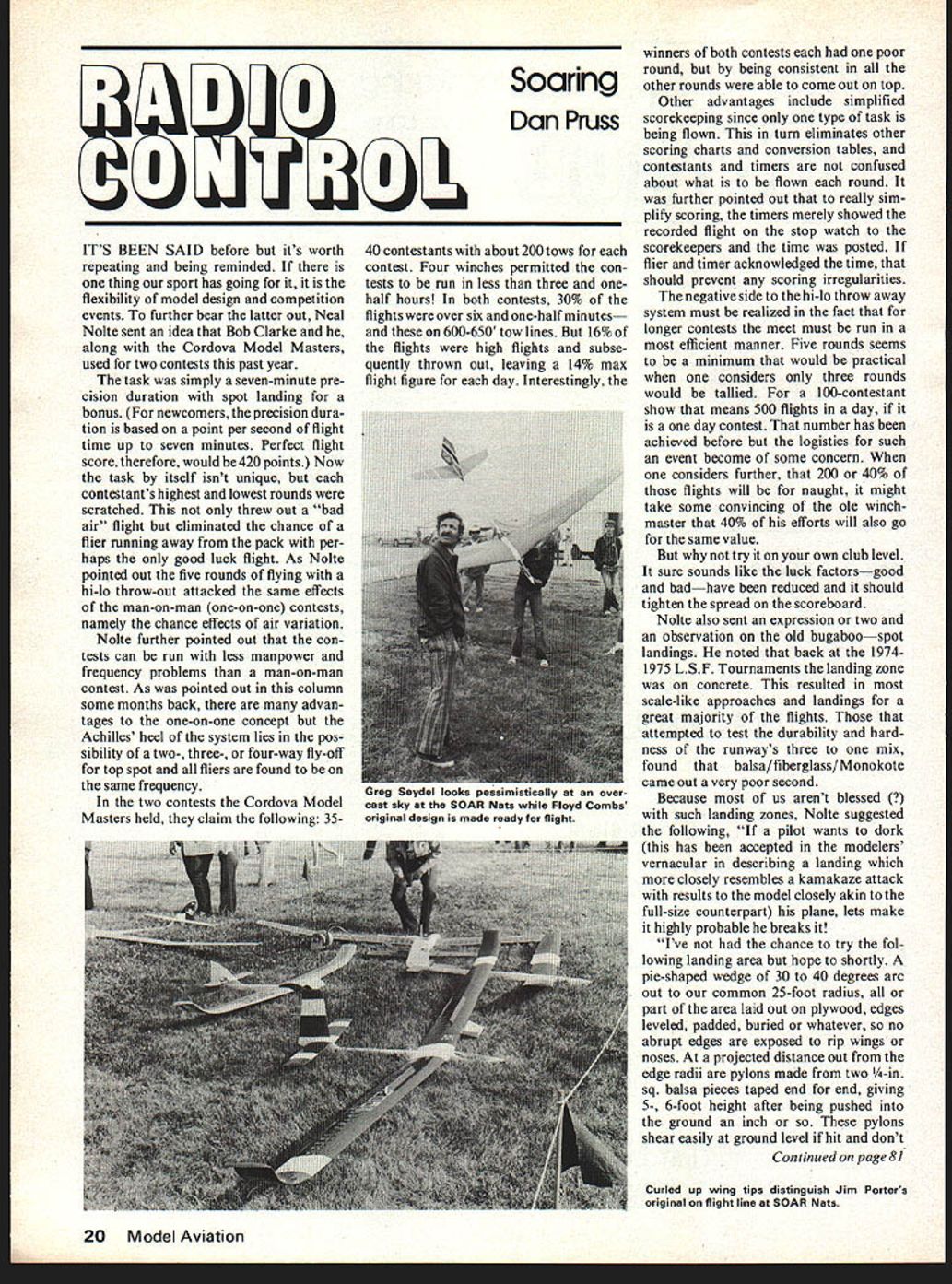
In the two contests the Cordova Model Masters held, they claim the following: 35-40 contestants with about 200 tows for each contest. Four winches permitted the contests to be run in less than three and one-half hours! In both contests, 30% of the flights were over six and one-half minutes — and these on 600-650' tow lines. But 16% of the flights were high flights and subsequently thrown out, leaving a 14% max flight figure for each day. Interestingly, the winners of both contests each had one poor round, but by being consistent in all the other rounds were able to come out on top.
Other advantages include simplified scorekeeping since only one type of task is being flown. This in turn eliminates other scoring charts and conversion tables, and contestants and timers are not confused about what is to be flown each round. It was further pointed out that to really simplify scoring, the timers merely showed the recorded flight on the stop watch to the scorekeepers and the time was posted. If flier and timer acknowledged the time, that should prevent any scoring irregularities.
The negative side to the hi-lo throw-away system must be realized in the fact that for longer contests the meet must be run in a most efficient manner. Five rounds seems to be a minimum that would be practical when one considers only three rounds would be tallied. For a 100-contestant show that means 500 flights in a day, if it is a one-day contest. That number has been achieved before but the logistics for such an event become of some concern. When one considers further, that 200 or 40% of those flights will be for naught, it might take some convincing of the ole winchmaster that 40% of his efforts will also go for the same value.
But why not try it on your own club level. It sure sounds like the luck factors—good and bad—have been reduced and it should tighten the spread on the scoreboard.
Nolte also sent an expression or two and an observation on the old bugaboo—spot landings. He noted that back at the 1974-1975 L.S.F. Tournaments the landing zone was on concrete. This resulted in most scale-like approaches and landings for a great majority of the flights. Those that attempted to test the durability and hardness of the runway's three to one mix, found that balsa/fiberglass/Monokote came out a very poor second.
Because most of us aren't blessed (?) with such landing zones, Nolte suggested the following, "If a pilot wants to dork (this has been accepted in the modelers' vernacular in describing a landing which more closely resembles a kamikaze attack with results to the model closely akin to the full-size counterpart) his plane, let's make it highly probable he breaks it!"
"I've not had the chance to try the following landing area but hope to shortly. A pie-shaped wedge of 30 to 40 degrees arc out to our common 25-foot radius, all or part of the area laid out on plywood, edges leveled, padded, buried or whatever, so no abrupt edges are exposed to rip wings or noses. At a projected distance out from the edge radii are pylons made from two 1/4-in. sq. balsa pieces taped end for end, giving 5-, 6-foot height after being pushed into the ground an inch or so. These pylons shear easily at ground level if hit and don't disrupt the flight path even if they don't shear off.
Nolte goes on further to say, "A 10-mph wind may be too much for the balsa, but I recently took part in a contest put on by Merced R/C who used them, and I was very impressed by their effectiveness. (Threading a 12-foot wing through a 15-foot pylon gate was rather fun too.) To gain landing points, then, I'd propose a pilot must enter through the pylon gate without touching them and then land on a hard surface so that the entire fuselage comes to rest within the wedge boundaries."
"To me this cuts out the approach-from-any-angle situation we have now, the pylons demanding a restricted approach line. The hard surface will foster smoother, scale-like touchdowns rather than a crash dive. Requiring the entire fuselage to be inside the wedge will force the pilots to maximize their chances at scoring by landing on the plywood area. The amount of landing points awarded would be up to the CD. I'm not sure how good the balsa pylons will work if frozen in the ground during the winter, but they can be buried slightly more to compensate. I think one must consider what one wants to reward—controlled, scaled landings vs. grazing the pylon to get closer."
100 mph? Of course, with only two days flying time at a contest this size, it's hard to set things up any other way.
The facilities at the Winter Nats are fantastic. It takes place on an old WW-II base with miles of good runways. At one end many large aircraft are stored by various airlines. The strip is also used by the forest service. Would you believe they have a WW-II B-17 equipped for forest fire fighting, as well as many other modern aircraft for this purpose? There is an excellent cafeteria on the base as well as a coffee and sandwich shop right on the flight line, and on the end of the field on which the contest was held. I have attended many contests from coast to coast including many AMA Nats, but the Tucson Winter Nats has to have the finest facilities for an RC contest and is a CD's dream. Speaking of CDs, Bill Hempel and Chuck Taylor, and all the people of the Tucson R/C Club, are to be commended on the fine job they do each year.
One of the side benefits of the Winter Nats at Tucson is a fine Air Museum; a lot of the aircraft are WW-II vintage—many need restoring. One of the exceptions is a B-24J which this reporter called home for over 600 hours of flying time back in '44-'45. The old "Libby" looks as if it could take off right now. But most of the aircraft are in dire need of restoration. The outdoor museum was started within the last two or three years.
They have many unusual aircraft, such as several large amphibians. There are several B-26's, or A-26 as they were called in WW II, B-25's, a P-63, many cargo craft including a C-46 and C-47. There are B-29's and, of course, several early jets, and some interesting little-known helicopters. It's gratifying that, after 30 years since WW II, there is a mood (and I suppose money) throughout the country to restore and preserve as many as possible aircraft of that era.
In the years following 1946 many fine historical aircraft ended on the scrap pile and were lost forever. This is especially true of Japanese aircraft of WW II; one of the most famous, or, from our standpoint, infamous, airplanes of the war was the Zero. It was produced in great numbers from 1935 to 1945. In this country there are no airworthy Zeros left and very few static ones. WW II's Spitfires, P-51's and ME-109's are all flying, well-kept machines but, because of short-sightedness, there are no true Zeros—only makeshift AT-6-type Zeros. It's truly a shame!
For you who want to get a chance at full retract points, you should retract the tail wheel (if it did on the full-size bird). My old scale friend from Lincoln, Nebraska, Don Neill, has worked out a very successful retracting tail-wheel unit which he uses many times. The latest was in his superb F6F Hellcat he flew at the 1976 AMA Scale Nats. I have seen this unit firsthand and it really works. The drawings speak for themselves.
Radio Control: Soaring
ing farther out in the wedge and trying to slide farther into the point of the wedge.
Nolte goes on. "Finally, while a dork landing now pays off as long as you don't shed parts or break something off, a dork at the point of any wedge isn't very likely to produce a score since the dork usually is a result of too much approach speed and tends to produce cartwheels or ground loops which should in most cases put some part of the fuselage outside the boundary radii."
Taking Nolte's figures of a 25-foot by 30 degrees the landing zone would be about 164 square feet which translates into over five sheets of 1/4-in. plywood. Cutting these into small enough sections for ease of transporting and then assembling so the joints wouldn't disrupt a smooth landing might cause the club field director some concern. But it's worth a try.
Get the lead in! In the February issue this column described a proven method for a permanent nose ballast made of B-B shot. Since then this scribe has used the B-B shot in a rather simple yet most effective way to make ballast modules.
For improved L/D or better penetrating capabilities when wing loadings are relatively light, the adding of ballast to the center of gravity is used and the method of ballasting varies with modelers. Most common is a slug of lead cut to fit a fuselage compartment. More sophisticated methods include custom fit bars of various weights so the desired overall ballast can be made up of the smaller modules. Lead-filled brass tubes that slide into the wings—parallel and close to the main spars—work well also.
However, for a simple ballast solution, acquire some small plastic bags. Bags of 5 inches by 1 1/2 inches work very well. For added insurance against punctures take three bags and put one inside the other. Eight ounces of shot produces a "soft" lead packet of approximately 3 1/4 x 1 1/4 inches. By rolling the top of the bag over several times and stapling the fold you have a secure packet. Of course, the packets can be made up to any weight and three or four different sizes are recommended. This allows combinations in selecting an overall ballast weight. These "soft" packs have the advantage of being able to absorb shock should a hard landing occur. Their pillow-like shape won't localize a sudden load such as bolted down lead bars do, and the overall effect is a much more gentle treatment to your sailplane's structure.
While you're making ballast you might want to have your wing-loading figures handy. Make up a chart for three columns: ballast, weight, and wing loading. Under the ballast column put the numbers in ounces of ballast you might be using for varying conditions. Under the weight column list the planes' all up weights for the respective ballast weights. Next to those figures under wing loading list the various respective figures. (Wing loading per square foot can easily be computed by dividing the overall weight by the wing area in square feet.) Tape the chart under the canopy floor or in the ballast compartment for ready reference.
As for the right combinations only you, with practice under varying wind conditions—can determine that.
Dan Pruss, Rt. 2, Box 490, Plainfield, IL 60544.
Transcribed from original scans by AI. Minor OCR errors may remain.

