


Radio Control: Soaring
Byron Blakeslee 3134 N. Winnebago Dr. Sedalia, CO 80135
LOTS OF VARIED and interesting news to pass on this month!
Scale flying in Switzerland — Robin Lehman (preview)
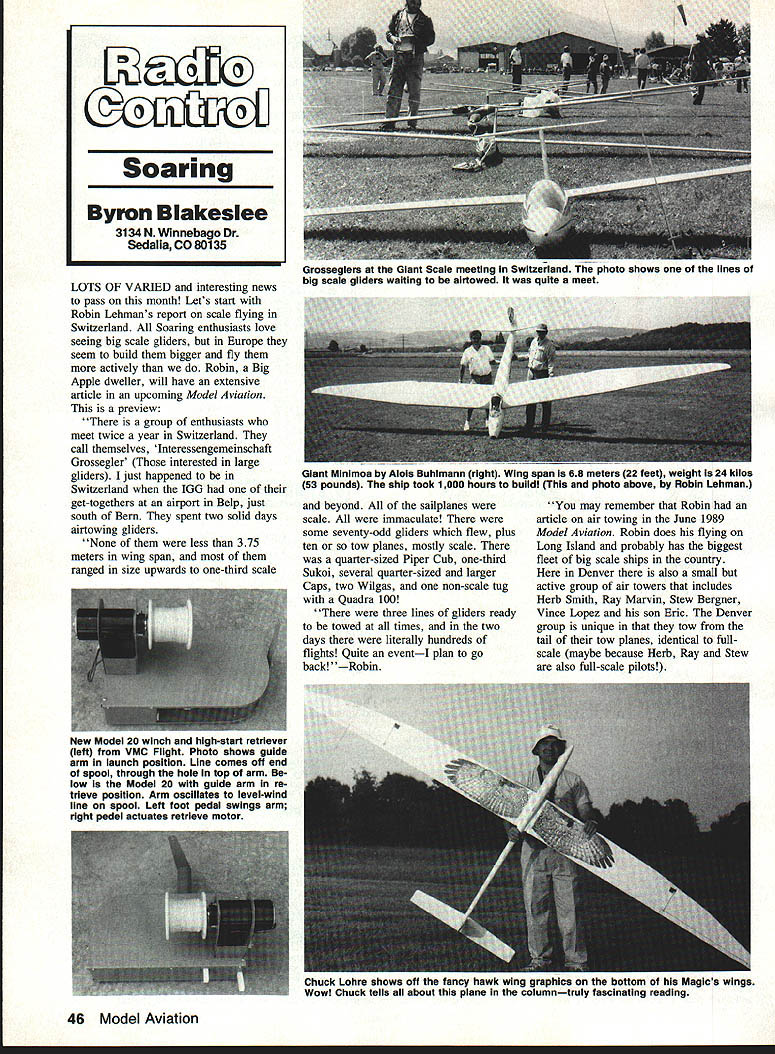
There is a group of enthusiasts who meet twice a year in Switzerland. They call themselves Interessengemeinschaft Grossegler (those interested in large gliders). I happened to be in Switzerland when the IGG had one of their get-togethers at the airport in Belp, just south of Bern. They spent two solid days airtowing gliders.
None of them were less than 3.75 meters in wingspan, and most ranged in size up to one-third scale sailplanes. All were immaculate! About seventy-odd gliders flew, plus ten tow planes, mostly scale. There was a quarter-sized Piper Cub, a one-third Sukhoi, several quarter-sized and larger Caps, two Wilgas, and one non-scale tug with a Quadra 100.
There were three lines of gliders ready to be towed at all times, and over the two days there were literally hundreds of flights! Quite an event—I plan to go back! —Robin Lehman
Robin will have an extensive article in an upcoming Model Aviation. You may remember his air-towing article in the June 1989 Model Aviation. Robin flies on Long Island and probably has one of the largest fleets of big-scale ships in the country.
Denver air-tow group
Here in Denver there is a small but active group of airtow pilots that includes Herb Smith, Ray Marvin, Stew Bergner, Vince Lopez and his son Eric. The Denver group is unique in that they tow from the tail of their tow planes—identical to full-scale practice—perhaps because Herb, Ray and Stew are also full-scale pilots.
Normal RC practice is to connect the tow line near the tug's center of gravity (usually at the wing trailing edge). A high-wing glider cannot throw the tug out of control by flying too high or too low. The Denver pilots have no problems towing from the tail. Herb, for example, has a beautifully detailed third-scale Super Cub that pulls a third-scale ASW 20. He says the secret is to fly the tug smoothly, make coordinated turns, and tell the glider pilot where the tug is going so the glider pilot can maintain position right behind.
VMC Flight: Model 20 retrieval system
Ernie Barter of VMC Flight sent a video of his partner Dick Benson's new retriever, the Model 20. Watching it retrieve both high-starts and winch lines gives the impression of a well thought-out, engineered machine.
Description
- The unit resembles a small winch arm mounted off the side of the spool. The arm guides the line off the end of the spool during launch.
- When the glider releases, the operator steps on a foot lever and the arm swings around the front of the spool; stepping another lever turns the spool motor.
- The arm helps level-wind the line back onto the spool.
- There is a small propeller attached to the retrieval line about 3 feet ahead of the tow ring; its purpose is to spin the twist out of the line.
Claims and performance (from VMC Flight)
- The Model 20 handles both high-start and winch launch systems.
- It is a standup, foot-operated, hands-off, self-contained system.
- Launch and retrieval take about a minute; the rig is ready for the next launch quickly.
- The unit pulls the line back to the ground at about 25 mph, reducing drift in windy conditions or when flying narrow ridges with obstructions.
- The system has been tested with extreme launches (Mark Tribes launching a Mueller Comet 89T) and reportedly handled over 150 continuous rapid-fire retrievals without a hitch.
- Includes an untwisting device (patent applied for), custom ball-bearing main motor, guide wiper action, low motor power consumption, light weight, portability, and ease of operation.
Price and ordering
- Priced at $319.00. Comes complete with instructional video, retrieval line, untwisting device, and battery hookup leads.
- Power requirement: any 12-volt auto or deep-cycle battery. Direct connection to a winch battery is practical.
- 30-day unconditional money-back guarantee; 90-day guarantee against defects except for the retrieval line.
- Toll-free order number: 1-800-225-0364 (7 a.m. to 5 p.m. Pacific). Info: 408/973-3333 (ask for Ernie).
- Address: VMC Flight, 18971 Fernbrook Ct., Saratoga, CA 95070.
A first production batch of 100 units was awaiting delivery of motors; motors were expected in December, so a first-hand report should follow when units are available.
Model 20 operation notes (video observation)
- The operator uses left foot pedal to swing the arm right; the right pedal actuates the retrieve motor.
- The arm guides the line off the spool during launch, then swings to the front to facilitate retrieval and level-wind the line.
Magic Lessons by Chuck Lohre (part 1)
Chuck Lohre is newsletter editor for the Cincinnati Soaring Society and sent a detailed report on his experiences with the Magic 138-inch unlimited soaring glider by Frank Weston. The report is lengthy; this is the first half. Chuck will continue next month.
That day last November when I received R/C Soaring Digest and Model Aviation magazines and both had information about the Magic, I knew this was exactly the high-tech construction and performance sailplane I was looking for. If I never built a built-up wing or used iron-on coverings again it would be too soon. I ordered the Spectra epoxy-bagged version ($500 vs. $300) because I didn't want to invest time and money in the skills and equipment to bag my own.
Construction features that sold me:
- All-Kevlar male-molded fuselage
- Epoxy-bonded Spectra directly over foam wings
- Servos in the wings
- T-tail and slip-on nose cone access
Performance specs (reported)
- 29:1 lift-to-drag ratio (L/D)
I also bought a new radio, the Airtronics Vision, popular at the Nationals and full of features. UPS delivered the kit and I worked every free hour to get it built for my club's May contest. Frank Weston’s instructions were great and he was readily available for questions.
Flight testing
- First hand-launch glides were excellent—“it just glided and glided.”
- High-start launch was also impressive.
- I needed to learn radio programming and trimming for this glider.
On contest day the Magic flew well and achieved above-average air times, but I still had to learn to land it. Later that day a thermal developed; I was far downwind and had to penetrate back. The Magic had excellent penetration but I slowed too much near the tree line, spun, hit a tree about 30 feet up, and then dropped out of sight. To my surprise, there were no major structural breaks and only minimal damage. After a few minutes of repair I was back flying.
Learning thermalling and controls
- I had to learn to use rudder and opposite aileron in thermals as in full-scale gliders.
- The outside wing produces more drag (travels faster and produces more lift); the airplane will slip and the fuselage will rotate away from the turn as soon as you let off on the rudder.
- Because of extra lift on the outside wing, bank angle tends to increase and requires slight opposite aileron.
- Programming about 5% of flaps coupled to elevator in thermal turns yields about four or five degrees of flap, the correct amount for slower flying speeds; you also get more "up" with a little down elevator.
Contest experience and CG
- In June I flew in sanctioned contests in Dayton (DARTS Club). My launches were higher than anyone else's—even without zooming—with a CG at the tow hook (40% as per plans).
Flying approaches and flap use
- With certain airfoil/fuselage combinations you can side slip or just approach fast. Flying a very slippery glass-like plane (e.g., a Grob, L/D 32:1) you won't be able to land by side-slipping because there is very little drag increase at speed. For such planes you must approach at the lowest practical speed (about 1½ times stall speed plus half the wind), then use spoilers for landing control.
- The Magic behaves differently with flaps: its flaps act primarily as drag generators when flying fast rather than for low-speed landing, which seems contradictory during landing.
- For “too-hot” landing speed problems, using a full 90° of flaps has proven effective.
A repair lesson
- During practice in strong convection, a very strong thermal threw the plane into a steep dive; I panicked and pulled full up elevator. The right wing panel bent up 30° at the end of the 24-inch spruce spar. Applying flaps helped maintain wing shape and allowed a gentle landing. Frank shipped a new set of wings with a 42-inch spar the next day. On reflection, I should have used flaps to slow the dive first rather than trying to pull out at high speed.
Chuck's Magic Lessons will be continued next month.
F.Y.I. Quiet Flight (reference book)
Quiet Flight is a new reference book compiled and published by Don Edberg, RCM's Soaring Editor and two-time F3B Team pilot. It is intended as a comprehensive, quick-reference directory for RC soaring and electric flight.
Contents and features
- Information on RC systems, sailplane and electric kits, construction and finishing materials, launching apparatus, instructional materials, and many other categories.
- Listings include both large manufacturers and small cottage industries—over 350 manufacturers.
- Over 10,000 lines of data in 312 pages.
- Items are listed by category (e.g., look up "towhooks" in the index rather than searching each manufacturer).
Ordering information
- Full-size softbound book, retail $19.95 including shipping and handling (CA residents add 7.75% sales tax).
- Order from Dynamic Modeling, 4922 Rochelle Avenue, Irvine, CA 92714-2941.
- Phone orders: 1-800-SEND-FYI (orders only); information: 714/552-1812.
- Clubs and groups: buy four copies, get one free (20% discount).
New magazine: Silent Flight
Silent Flight is a new English-language full-size magazine devoted exclusively to RC soaring and electrics. Published in England by Argus Specialist Publications (publisher of Radio Control Models & Electronics and Radio Modeler), the first issue was dated Autumn 1991. It will be published quarterly.
Contents of the first issue include:
- Slope soaring, vintage gliders, F3F slope racing, power scale slope soaring
- F3J & thermal soaring, electrics, F3B, new products, and world news
- Articles on the "Thermic Prowler" Open-class sailplane from Czechoslovakia, Norman Dean's ASK 18 from Cliff Charlesworth plans, and a report on the experimental German SB13 full-scale flying wing
Subscriptions (U.S. orders)
- Wise Owl Worldwide Publications, 4314 West 238th Street, Torrance, CA 90505.
- $24.00 for one year (includes a free binder); $48.00 for two years (includes binder and an extra free copy). Higher per-copy cost reflects shipping.
Visibility of aircraft color schemes — Wayne Angevine
Visibility is an important criterion when choosing a color scheme for a sailplane. Because we fly far away and high up, a good color scheme can mean the difference between a successful flight and a lost airplane.
Key points
- Common color-visibility tables often rank light colors as most visible and dark colors least visible. For gliders viewed against the sky, this is generally not correct.
- Research in atmospheric visibility shows that maximum visibility against the sky is often achieved with a black airplane; the lighter the color, the shorter the distance over which the plane can be distinguished from the sky.
- The discrepancy between common tables and actual glider visibility likely arises because those tables are intended for ground-based objects (e.g., ambulances, vehicles) against ground backgrounds, not for small objects viewed against sky.
Practical recommendations
- Consider painting at least half of the underside of the plane in a dark color (black, red or dark blue) and include at least one white or light panel for contrast against dark clouds.
- Avoid breaking color into many small pieces—large, solid panels are easier for the eye to resolve at distance.
- Make the top and bottom of the leading edge the same color (or at least both dark) so that when you see only the leading edge (low and flying toward you), you retain maximum apparent cross-section.
- For slope soarers concerned about visibility against the ground, different considerations apply and some of the above recommendations may be reversed.
—End of this month’s Soaring report.
Transcribed from original scans by AI. Minor OCR errors may remain.

