
Radio Control: Soaring
Byron Blakeslee 3134 N. Winnebago Dr. Sedalia, CO 80135
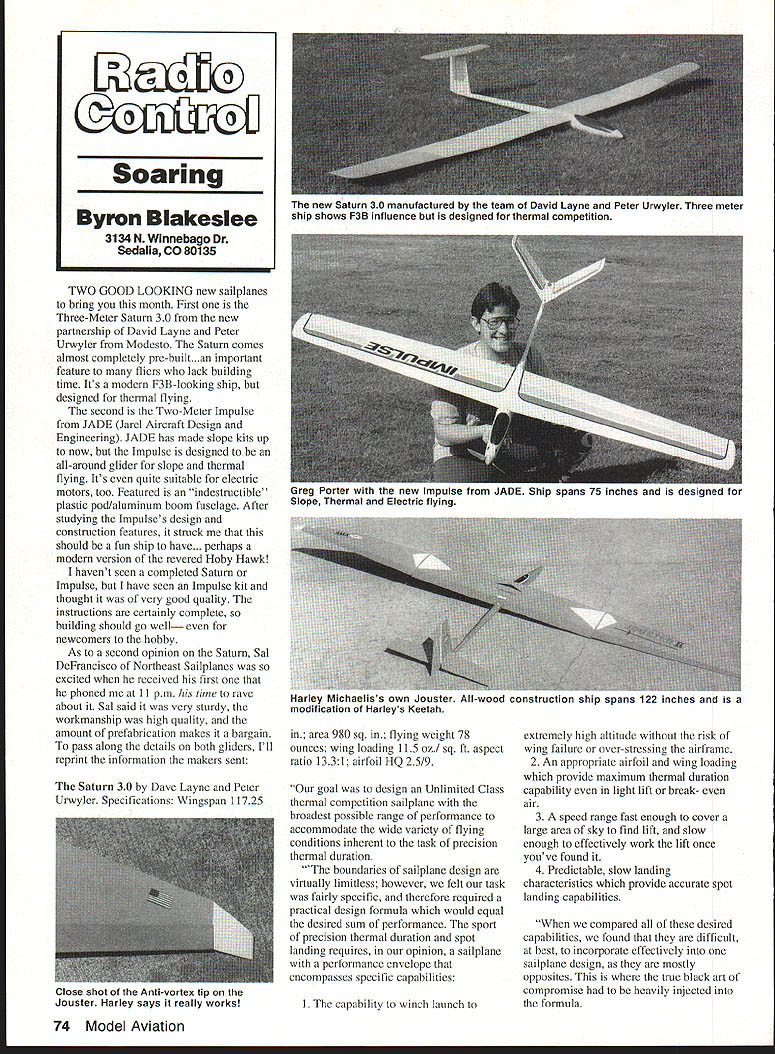
TWO GOOD-LOOKING new sailplanes to bring you this month. First is the three-meter Saturn 3.0 from the new partnership of David Layne and Peter Urwyler of Modesto. The Saturn comes almost completely pre-built—an important feature for many fliers who lack building time. It's a modern F3B-looking ship, but designed for thermal flying.
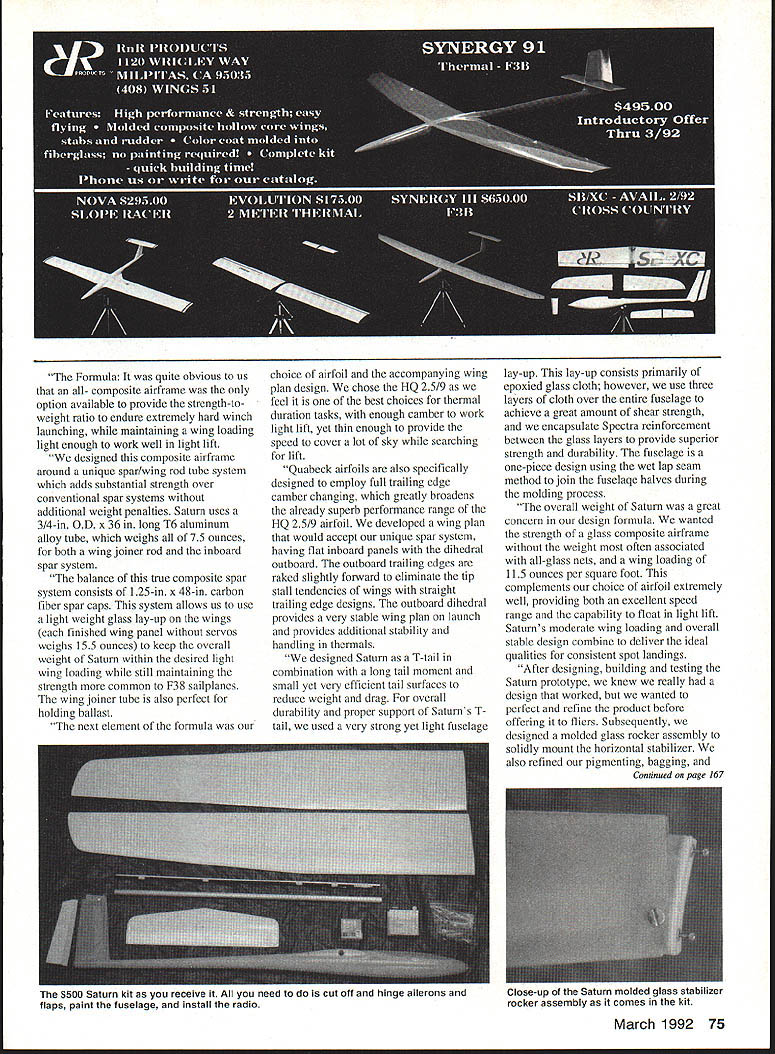
The second is the two-meter Impulse from JADE (Jarel Aircraft Design and Engineering). JADE has made slope kits up to now, but the Impulse is designed to be an all-around glider for slope and thermal flying. It's even quite suitable for electric motors. It features an "indestructible" plastic pod/aluminum boom fuselage. After studying the Impulse's design and construction, it struck me that this should be a fun ship to have—perhaps a modern version of the revered Hobby Hawk!
I haven't seen a completed Saturn or Impulse, but I have seen an Impulse kit and thought it was very good quality. The instructions are complete, so building should go well—even for newcomers to the hobby. As to a second opinion on the Saturn, Sal DeFrancisco of Northeast Sailplanes was so excited when he received his first one that he phoned me at 11 p.m. his time to rave about it. Sal said it was very sturdy, the workmanship high quality, and the amount of prefabrication makes it a bargain.
To pass along the details on both gliders, I'll reprint the information the makers sent.
Saturn 3.0 — Dave Layne & Peter Urwyler (Modesto)
Specifications
- Wingspan: 117.25 in.
- Area: 980 sq. in.
- Flying weight: 78 ounces
- Wing loading: 11.5 oz./sq. ft.
- Aspect ratio: 13.3:1
- Airfoil: HQ 2.5/9
Goal / Design Our goal was to design an Unlimited Class thermal competition sailplane with the broadest possible range of performance to accommodate the wide variety of flying conditions inherent to the task of precision thermal duration and spot landing.
The sport of precision thermal duration and spot landing requires, in our opinion, a sailplane with a performance envelope that encompasses these specific capabilities:
- The capability to winch-launch to extremely high altitude without the risk of wing failure or over-stressing the airframe.
- An airfoil and wing loading that provide maximum thermal-duration capability even in light lift or break-even air.
- A speed range fast enough to cover a large area of sky to find lift, and slow enough to effectively work the lift once you've found it.
- Predictable, slow landing characteristics to provide accurate spot-landing capability.
These needs are often opposites; the true "black art" is the compromise required to balance them.
The Formula It was obvious that an all-composite airframe was the only option to provide the strength-to-weight ratio to endure extremely hard winch launches while maintaining a wing loading light enough to work well in light lift.
We designed a unique spar/wing-rod tube system that adds substantial strength without significant weight penalty. Saturn uses a 3/4-in. O.D. x 36 in. long T6 aluminum alloy tube (7.5 ounces) as both the wing joiner rod and the inboard spar system. The balance of the composite spar system consists of 1.25-in. x 1/8-in. carbon-fiber spar caps. This system allows a lightweight glass lay-up on the wings—each finished wing panel without servos weighs 15.5 ounces—keeping overall wing loading low while maintaining strength more common to F3B sailplanes. The wing joiner tube also serves well for holding ballast.
We chose the HQ 2.5/9 airfoil as one of the best choices for thermal duration tasks: enough camber to work in light lift yet thin enough to provide speed for covering a lot of sky. Quabeck airfoils are designed to employ full trailing-edge camber changing, which broadens the performance range of the HQ 2.5/9. The wing plan accepts our spar system, with flat inboard panels and 8° dihedral outboard. The outboard trailing edges are raked slightly forward to eliminate usual stall tendencies of straight trailing-edge wings. The outboard dihedral provides a very stable wing on launch and additional stability and handling in thermals.
Saturn is a T-tail combined with a long tail moment and small but efficient tail surfaces to reduce weight and drag. For durability and proper T-tail support, we used a strong yet light fuselage lay-up consisting primarily of epoxied glass cloth, with three layers of cloth over the entire fuselage to achieve shear strength, and encapsulated Spectra reinforcement between glass layers for superior strength and durability. The fuselage is a one-piece design using the wet-lay seam method to join the halves during molding.
Weight was a major concern. We wanted the strength of a glass composite airframe without the weight usually associated with all-glass ships, targeting a wing loading of 11.5 oz./sq. ft. (compare to F3B sailplanes at 18–20 oz./sq. ft.). The light wing loading combined with our airfoil choice provides an excellent speed range and the capability to float in light lift. Saturn's moderate wing loading and overall stable design combine to deliver ideal qualities for consistent spot landings.
The Result The sum of our formula is, in our opinion, a perfect blend of compromises. Saturn's ultra-strong airframe is a thrill to launch. Its HQ 2.5/9 airfoil and stable wing plan are exciting to fly, responding to the lightest lift or moving out across the sky in search of lift. Landings are predictable, slow, and stable.
The Kit The Saturn kit is complete. We install the wing rod tube and locator pin tube in the fuselage to ensure proper wing incidence. We prefit and finish the wing roots with plywood for a perfect wing-to-fuselage fit. A hole is drilled down through each wing for the servo wires. We install the molded glass stabilizer rocker assembly in the fin to ensure proper stabilizer alignment. All hardware needed to finish Saturn is included, right down to the custom tow hook and wing hinge tape.
The stab and rudder flying surfaces are ready to assemble to the fuselage right out of the box. You simply cut the flaps and ailerons from the wing panels, finish-sand the leading edges, install the linkages and your radio. Painting the pigmented wings and tail surfaces is optional.
Price & Delivery
- Saturn is available for $500, plus shipping.
- Delivery time: currently six weeks.
Ordering / Contact Layne/Urwyler 2821 Lou Ann Dr., Suite B211 Modesto, CA 95350 Phone: 209/544-8779 (8 a.m. to 5 p.m.) and 529/8457 (5 p.m. to 8 p.m.)
Who are Layne/Urwyler? David Layne has been involved in RC soaring for many years. Peter Urwyler brings experience in new product development and marketing, along with years of soaring experience. They decided to design and manufacture a European-style high-performance sailplane in Modesto, California. Their focus is to provide the finest quality high-performance sailplanes for thermal soaring competition. Layne/Urwyler are currently testing a new Saturn 2.5 (100-inch span) standard-class sailplane, which should be available in the spring.
Impulse — Jarel Aircraft Design & Engineering (JADE)
A letter from Richard Jarel, chief at JADE: "Being an avid reader of your column, I thought the rest of your readers might be interested in JADE's newest kit, Impulse. So far, the nationwide response to the Impulse has been phenomenal! Over 300 kits have been sold, and we're just now starting our advertising campaign! I've enclosed a copy of the building instructions, believing that they could explain more about this innovative design than I could in a letter."
CrashGuard Also enclosed were samples of JADE's new "CrashGuard" thermoplastic alloy. The material is extremely tough. In the raw state it's almost 1/16 inch thick; vacuum forming reduces the thickness in some areas by up to 20%. It resists cording, tearing and puncture—short of a direct hit on a boulder. Rich guarantees that if you ever ruin a fuselage for any reason, return it and he'll send you a new one for $10 plus S&H.
Specifications
- Wingspan: 74.5 in.
- Wing area: 550 sq. in.
- Aspect ratio: 10:1
- Weight: 38 oz.
- Wing loading: 10 oz./sq. ft. and up
- Price: $79.95 (add $4.00 S&H if ordering direct)
Events Sometime this spring, JADE will sponsor an Impulse-only slope race. Other "Impulse-only" events under consideration include F3B- and F3E-type affairs, with two possible classes—Stock and Modified.
Construction & Features
- Pod/boom: The pod is vacuum-formed CrashGuard in left and right halves. Two CrashGuard formers inside the pod hold the aluminum-tube boom. Poly-Zap is the recommended adhesive for bonding these parts. Sanding the four pieces to fit prior to gluing is the most care-intensive step; the rest of the construction should proceed quickly.
- Tail/skid moldings: CrashGuard tail and skid moldings glue to the top and bottom of the boom at the tail end. Each has 3/4-inch wide flanges that securely attach the V-tail stabs and automatically position them at the correct incidence—a helpful feature for V-tails.
- Wing: One-piece wing is conventional balsa sheeting over white foam cores. Airfoils are SD6006 transitioning to 53021 at the tip, with washout cut into the cores. Leading edges are basswood dowels for slope durability; tips are molded CrashGuard units. Mini or micro servos mount in the wings to directly drive the strip ailerons.
- Modularity: The Impulse concept encourages mix-and-match components—regular and electric fuselages; stock, extra-length, or beefed-up/glassed wings. If the slope wind doesn't blow, winch-launch or turn on the motor.
- Radio: Although a simple two-channel radio could be used, a computer radio makes flying the Impulse much easier—electronic V-tail mixing, aileron differential, flaperons and elevator compensation coupled to flaps are all useful features.
Additional Options If you want to speed getting your Impulse in the air, bagged blue-foamed wings are available for $85 from Bob Ratzlaff of Aerial Model Aircraft Products: Bob Ratzlaff 1641 S. Ellsmer Ave. Los Angeles, CA 90019 Phone: 213/965-9504
Ordering / Contact Jarel Aircraft Design & Engineering (JADE) 12136 Braddock Dr. Culver City, CA 90230 Phone: 213/390-1348
Thanks to Richard Jarel for the information and CrashGuard samples. The CrashGuard material and the building instructions are very interesting—this is a tough, thoughtful design that should appeal to a wide range of fliers.
Transcribed from original scans by AI. Minor OCR errors may remain.

