


Radio Control: Soaring
Byron Blakeslee 3134 N. Winnebago Dr., Sedalia, CO 80135
SCALE GROB revisited
Remember the photos of the giant Grob in January's column? Dan Troxell told of buying a 1:2.4-scale Grob fuselage in Germany, shipping it to California, and building his own wings. With a 24-ft wingspan, this must be one of the largest sailplane "kits" you can get. Dan made the fuselage in the G-103 Twin II version with two fixed front wheels and flew the Grob successfully from hi-start launches and off the slope.
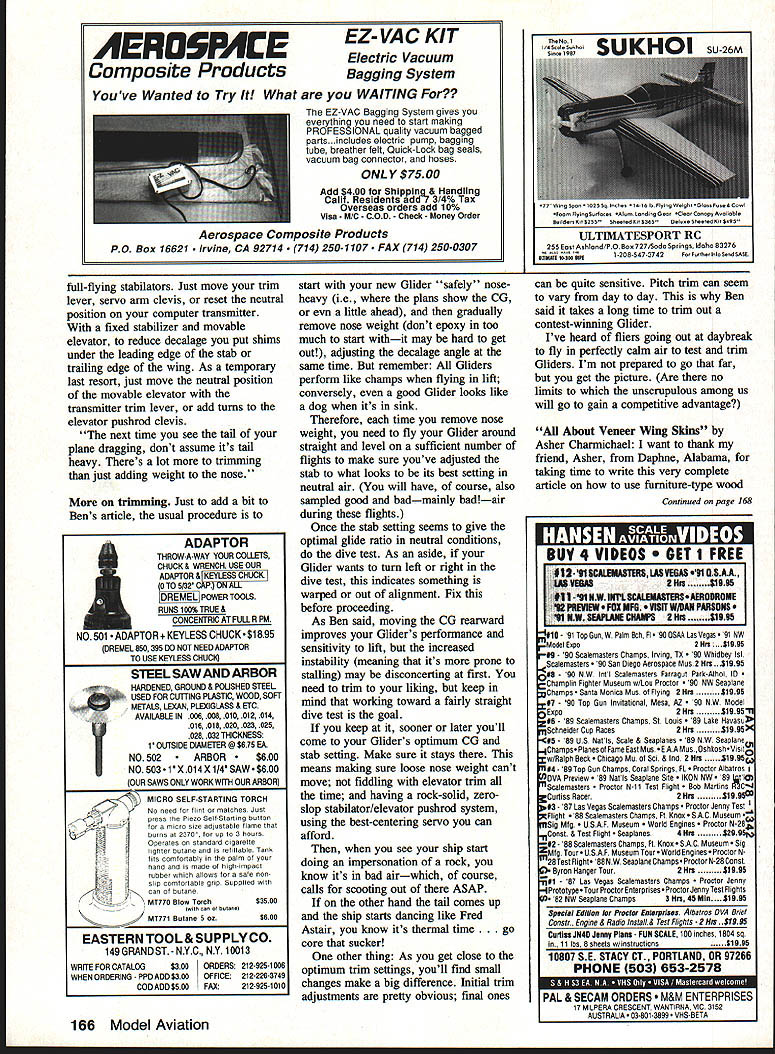
Another Scale nut who had to have a giant Grob is Robin Lehman of New York, who probably has the biggest fleet of quarter-scale and larger sailplanes in the country (about 20 at last count). He aero-tows his ships—the safest way to get these big Scale birds in the air. Robin described his visit to a Giant Scale Glider meet in Switzerland in my February column and kindly sent photos plus this letter:
"I was happy to see the pictures of Dan Troxell's big Grob in the January Model Aviation. I now have that beautiful large sailplane and use it for aero-towing. My tow plane is a Robin 99 with a Quadra 80 in the nose. For the first flight, I wasn't sure how long it would take to become airborne, so the first flight was done at an airport with a concrete runway. As it turned out, the Grob was airborne within 80 ft., and it proved to be a real floater. It's the easiest glider I have ever flown. It looks just like the full-size thing in the air.
"Interestingly, Dan made the wings based on the German Krause company's Libelle. This is a 3½-size glider, which is much smaller than the Grob—but a real floater as well. I had the opportunity to see one of the Roland Kern-manufactured all-glass Grobs while at the aero-tow meet in Belp, Switzerland this summer. The wing section Roland uses on his factory version is a copy of the full-size section and doesn't float anywhere near as well as Dan's wing, which uses the Quabeck 3/13 airfoil. Roland's also flies quite a bit faster. Roland demonstrated his Grob at the 1988 Nats in Virginia, I believe, but Dan's version really has to be seen to be believed."
Hobby Lobby catalog and new items
The new Hobby Lobby catalog No. 19 is now available. It's free in the U.S.A. by calling (615) 373-1444. This is one of the best "wish books" you can get—especially good for German Scale kits, electric kits, electric motors, and gadgets you can't find elsewhere. Several new items caught my eye:
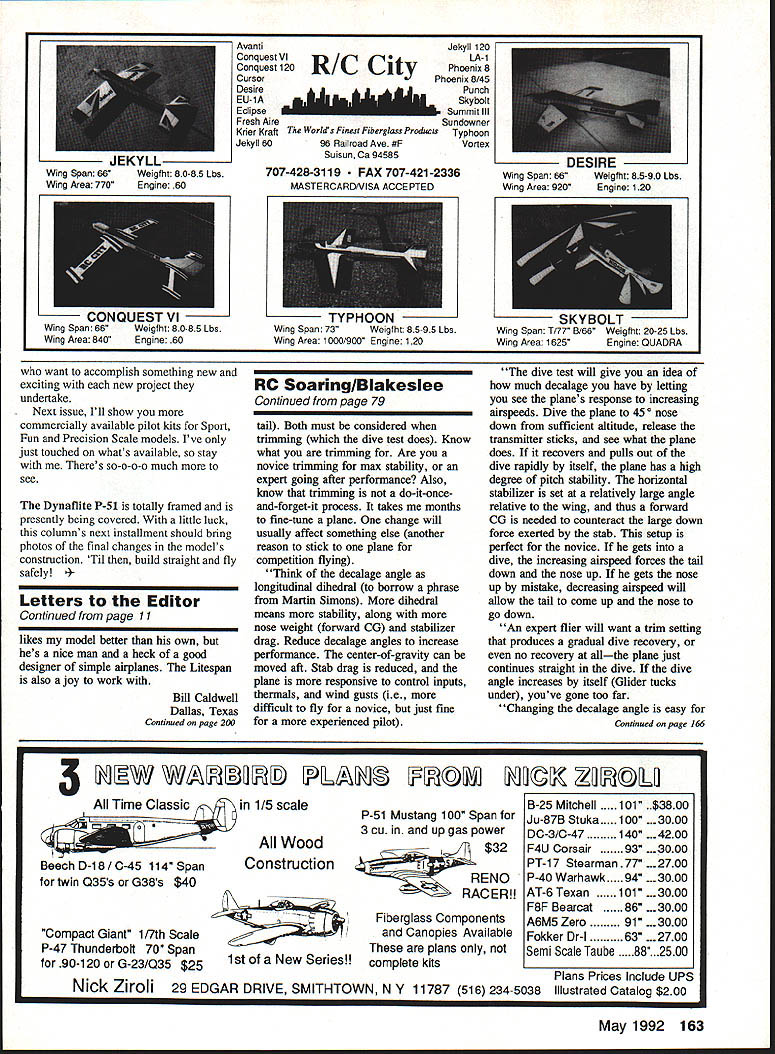
- A plastic servo mounting set for installing servos in wings—the modern way to operate ailerons and/or flaps. Each pack of four retails for less than $6. The mounting lugs are used to secure the servo so you don't have to cut them off; screws and washers hold the servos and can also secure a cover plate or fairing.
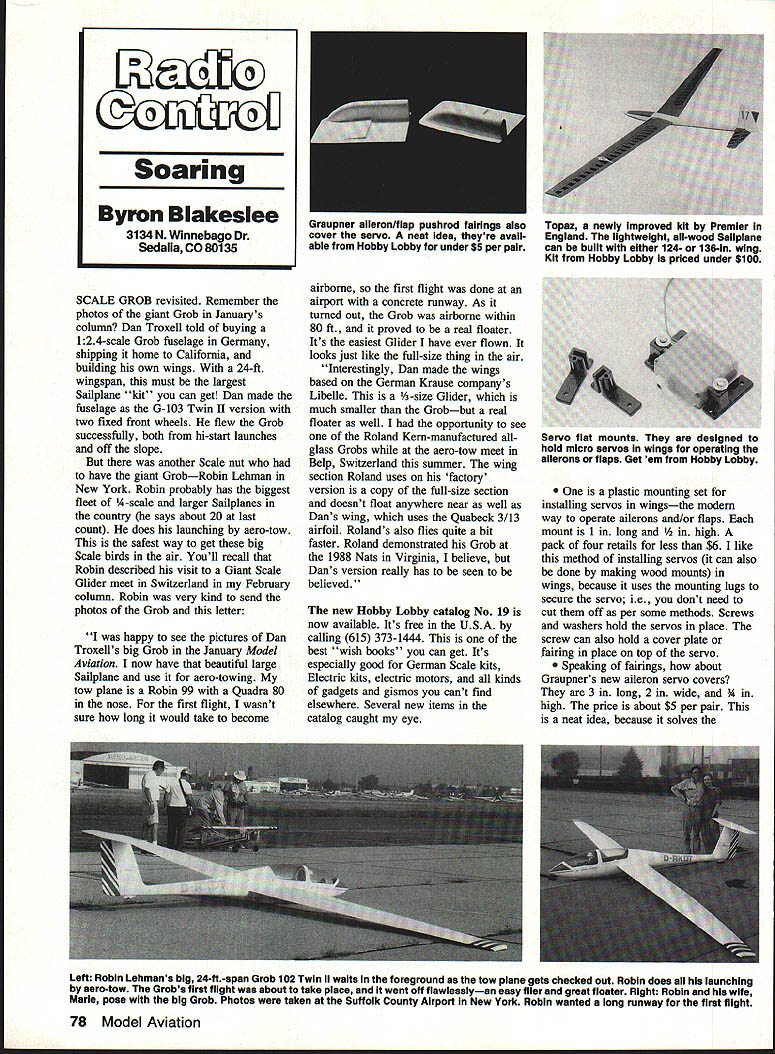
- Graupner aileron servo covers: about 3 in. long, 2 in. wide, and 3/4 in. high; roughly $5 per pair. They solve the problem of covering servo arm/pushrod holes.
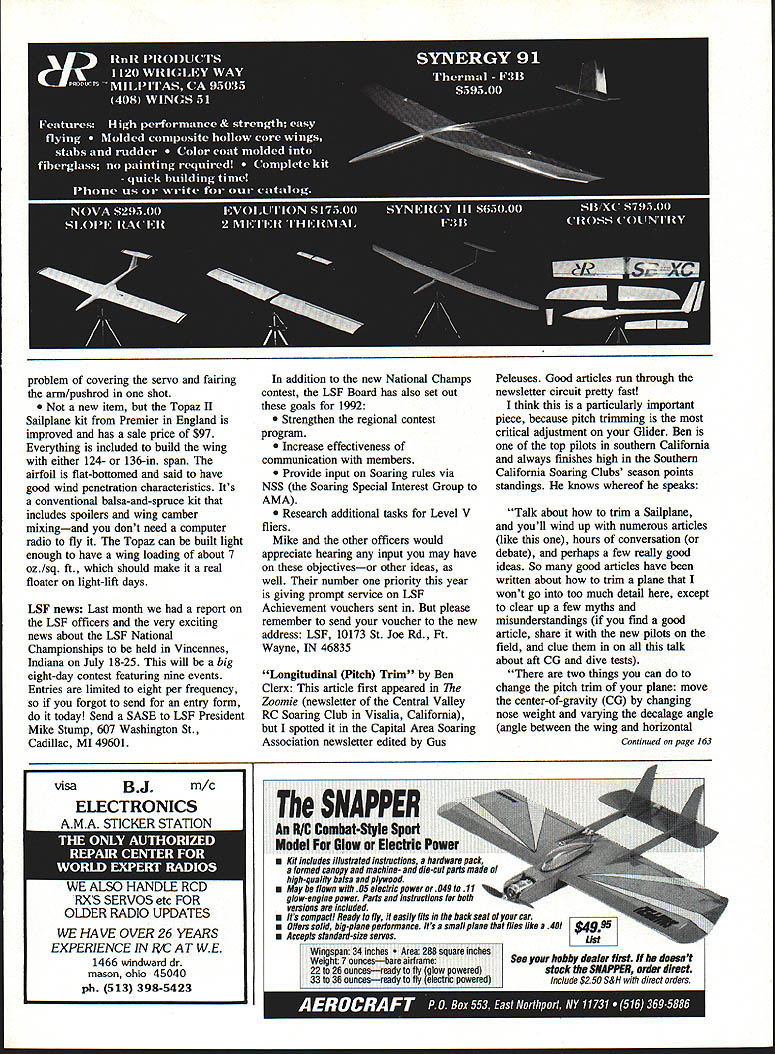
- Topaz, a newly improved kit by Premier in England: a lightweight, all-wood sailplane available with either a 124- or 136-in. wing. It uses a flat-bottomed airfoil said to have good wind-penetration characteristics. The conventional balsa-and-spruce kit includes spoilers and wing camber mixing and can be built light enough for ~7 oz/sq ft wing loading—making a good floater for light-lift days.
LSF news
The LSF National Championships will be held at Vincennes, Indiana, July 18–25. It will be a big eight-day contest featuring nine events. Entries are limited to eight per frequency. If you forgot to send an entry form, send an SASE to:
Mike Stump, LSF President 607 Washington St., Cadillac, MI 49601
The LSF Board has also set goals for 1992:
- Strengthen the regional contest program
- Increase the effectiveness of communication with members
- Provide input on soaring rules via the NSS Soaring Special Interest Group
- Research additional tasks for Level V fliers
Send any input or ideas to the officers. Their number one priority this year is giving prompt service on LSF Achievement vouchers. Please remember to send vouchers to the new address:
LSF 10713 St. Joe Rd. Ft. Wayne, IN 46835
"Longitudinal (Pitch) Trim" — Ben Clercx
This article first appeared in The Ozone (newsletter of the Central Valley RC Soaring Club, Visalia, CA) and was reprinted in the Capital Area Soaring Association newsletter. Pitch trimming is the most critical adjustment on your glider. Ben Clercx, one of southern California's top pilots, offers practical guidance:
- The basic ways to change pitch trim are to move the center-of-gravity (CG) by changing nose weight and to vary the decalage angle (the angle between the wing and the horizontal tail). Both must be considered when trimming; the dive test checks their combined effect.
- Know what you are trimming for: maximum stability for a novice, or performance (more sensitivity and responsiveness) for an experienced pilot. Trimming is not a one-time process—it can take months to fine-tune a competition ship. One change often affects something else.
Dive test procedure:
- From sufficient altitude, dive the plane to about 45° nose-down.
- Release the transmitter sticks and observe behavior.
- If the plane recovers and pulls out rapidly by itself, it has a high degree of pitch stability (large decalage, requiring a forward CG)—good for novices.
- If the plane recovers gradually or not at all (continues straight), it's a less stable, higher-performance setup. If the dive angle increases by itself (the glider tucks under), you've gone too far aft.
Adjusting decalage:
- Full-flying stabilator: change the neutral position via trim lever, servo arm clevis, or the transmitter.
- Fixed stabilizer and movable elevator: reduce decalage by shimming under the leading edge of the stabilizer or under the trailing edge of the wing. As a temporary measure, use transmitter trim or add turns to the elevator pushrod clevis.
Additional practical trimming advice:
- Start new gliders safely nose-heavy (as recommended in the plans or a bit forward) and gradually remove nose weight while adjusting decalage.
- After each weight change, fly straight-and-level in neutral air over several flights to evaluate the stab setting.
- If the dive test produces left/right turning, check for warps or alignment issues and fix them before proceeding.
- Moving the CG rearward typically improves performance and sensitivity to lift but increases instability and stall tendency.
- Secure nose weight so it cannot move, avoid constant fiddling with elevator trim, and use a rock-solid, zero-slip stabilator/elevator pushrod system and a good centering servo.
- Small adjustments become progressively more sensitive as you approach optimum trim; some pilots trim in very calm conditions for final refinements.
If your ship suddenly acts like a rock, you’re in bad air—get out. If the tail comes up and the ship dances, it’s thermal time—go core it!
Veneers for wing skins (Asher's article — part one)
Asher has been experimenting with using hardwood veneers for wing skins over foam cores—a technique common in Europe and increasingly used here. His experience and tips are extensive; because the article is long, I print half this month and will conclude it next month.
Summary and key points from Asher:
- After building about 10 sailplanes in six years, and trying rib-and-spar and foam-and-balsa methods, Asher wanted wings that were hard-surfaced, durable (resisting fingernail dents and wrinkles), lightweight, and not film-covered.
- He experimented with glass, Kevlar, carbon, Spectra, and exotic composites but found them heavy, fragile at competitive weights, or cosmetically unsatisfying unless painted (which adds weight).
- Veneer proved attractive: thin hardwood veneer glued to a foam core with epoxy and vacuum-bagged produces a hard, durable surface that sands and finishes nicely and can be kept light enough for thermal soaring while strong enough for sporty flying.
- Veneer is fragile and requires care: typical thickness ranges from 1/80 to 1/36 in. (about .020 to .027 in). The core and all fittings must be very smooth and flush to avoid telegraphing through the veneer.
- Wood species matter: closer-grained, light woods produce lighter skins; open-grained woods like obeche can cause finish problems and allow epoxy migration.
- For open-grained veneers (obeche), seal the side that contacts the core. Butyrate dope works as a sealer: apply, squeegee off, repeat twice, allow ample drying time, and etch lightly with 150-grit sandpaper to improve adhesion. The veneer may curl toward the doped side as it cures, but this doesn't harm the skinning process.
- Close-grained domestic veneers are available, but U.S. veneer mills often cut thicker veneers (~1/32 in.), and higher-density woods increase weight.
- Paper-backed veneers (about 1/64 in.) exist but require even greater care preparing the core; the paper can soak epoxy and add weight, and delamination from the paper backer has been reported when using lacquer finishes.
Veneer considerations by species and properties:
- Holly (density 35–38 lb/ft3): very attractive, almost pure white, but hard to find in wide sheets for large wings.
- Maple (38–42 lb/ft3) or cherry (35–38 lb/ft3): available in needed widths but heavier.
- Poplar (28–32 lb/ft3): meets weight and width needs but is less visually appealing.
- Obeche: light, close-grained, easy to work, commonly used—but its open grain may cause surface finish issues unless sealed.
Veneer suppliers referenced by Asher:
- Dave's Wood Products, #7 Creekpark Ct., Roswell, GA 30076. Phone: (404) 642-0645. (obeche)
- Certainly Wood, 11753 Big Tree Rd., Rt. 20A, East Aurora, NY 14052. Phone: (716) 655-0206. (domestic and imported veneer)
Asher's article will be concluded next month with more techniques, tips, and findings.
Scale Slope Fun Fly
Scale glider fans: the biennial Scale RC Soaring event will be held May 29–31 in Richland, Washington. Spend three days flying your Scale sailplane (or PSS ship) on some of the best slopes in the country. Spectators are welcome.
Information: Tri City Soarers 2626 Eastwood Ave., Richland, WA 99352 Official hotel: Cavanaugh's Inn; phone 1-800/THE-INNS for reservations.
International Western Great Race
This annual cross-country race will be held at Taft, California, May 15–17. It has been placed on the official FAI calendar: if representatives from five countries compete, the race will count toward recognition of F3H by the FAI as an official World Championship event (as F3J will this year). X-C fans should support the race.
Information: Myles Moran 10428 Oso Ave., Chatsworth, CA 91311 Phone: 1-818/882-4867
Transcribed from original scans by AI. Minor OCR errors may remain.

