
Radio Control: Soaring
Byron Blakeslee 3134 N. Winnebago Dr. Sedalia, CO 80135
TIPS on tips
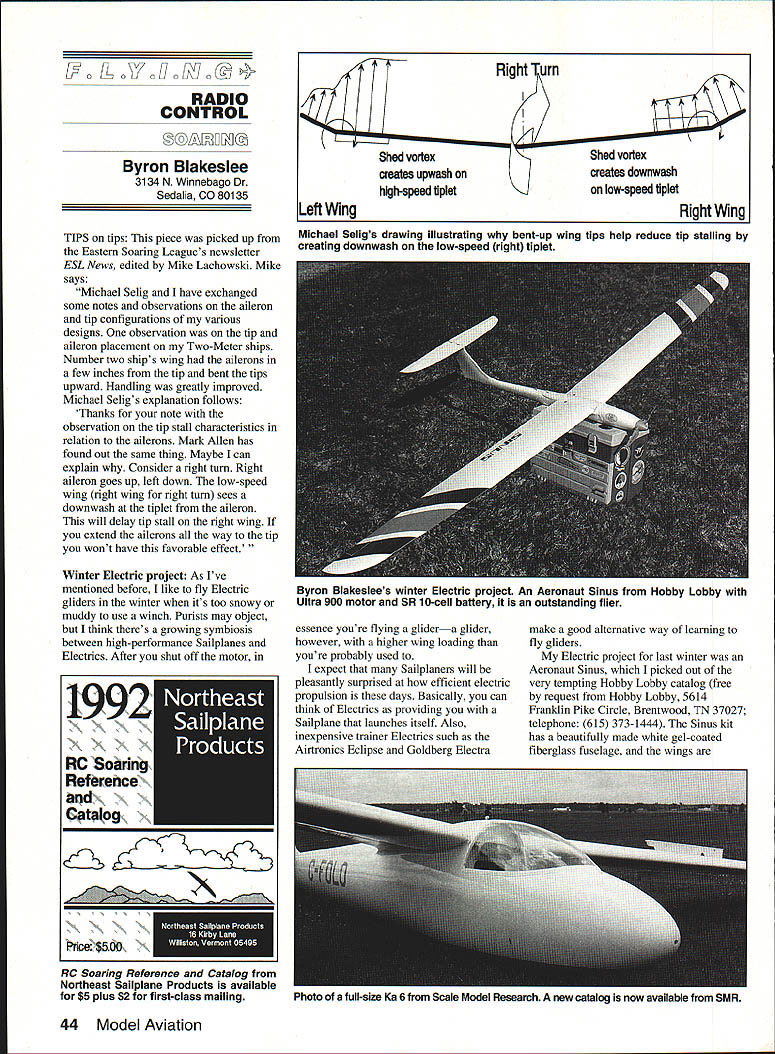
I picked up this item from the Eastern Soaring League newsletter (ESL News), edited by Mike Lachowski. Mike and Michael Selig exchanged notes on aileron/tip configurations. One observation: on some two-meter ships, placing the ailerons a few inches inboard from the tip and bending the tips upward greatly improved handling.
Michael Selig's explanation: "Consider a right turn. The right aileron goes up, the left down. At low speed the right wing (the low wing in the right turn) sees a downwash at the tiplet from the aileron. This delays tip stall on the right wing. If you extend the ailerons all the way to the tip you won't have this favorable effect."
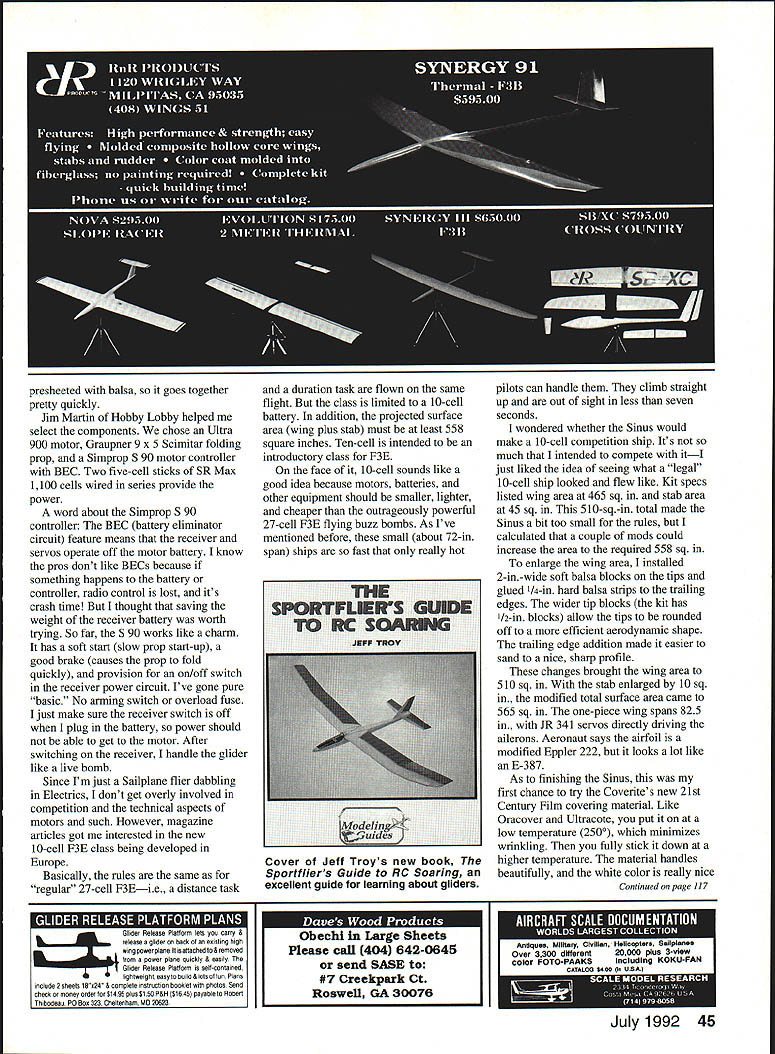
Winter Electric project — Aeronaut Sinus
I like to fly electric gliders in winter when fields are snowy or muddy. Electrically launched sailplanes are essentially gliders after the motor is shut off, though with higher wing loading than many are used to. Cheap trainer electrics (Airtronics Eclipse, Goldberg Electra) are good alternatives for learning sailplane flying.
Last winter I built an Aeronaut Sinus from the Hobby Lobby catalog. The kit has a white gel-coated fiberglass fuselage; the wings are presheeted balsa and go together quickly. Hobby Lobby (free catalog on request) — Hobby Lobby, 5614 Franklin Pike Circle, Brentwood, TN 37027; (615) 373-1444.
Components selected (with Jim Martin, Hobby Lobby):
- Ultra 900 motor
- Graupner 9 x 5 Scimitar folding prop
- Simprop S-90 motor controller with BEC (battery eliminator circuit)
- Two five-cell S.R. Max 1100 cells wired in series
A word about the Simprop S-90 (BEC): the receiver and servos run off the motor battery. Pros dislike BECs because if the battery or controller fails you lose radio control, but I wanted to save the weight of a separate receiver battery. So far the S-90 has worked well: soft start (slow prop start-up), a good brake so the prop folds quickly, and provision for an on/off switch in the receiver power circuit.
I kept the installation simple — no arming switch and no overload fuse. My safety habit: make sure the receiver switch is off when plugging in battery power, then switch the receiver on only when ready to fly. After switching on the receiver I treat the model like a live bomb.
#### 10-cell F3E background and the Sinus conversion The new 10-cell F3E class in Europe follows the same tasks as 27-cell F3E (distance and duration in the same flight) but limits equipment to a 10-cell battery. Projected surface area (wing plus stab) must be at least 558 sq. in. The 10-cell idea is to make an introductory F3E class with lighter, cheaper gear than the powerful 27-cell "buzz bombs." Small (~72 in span) ships are extremely fast and climb very quickly.
The Sinus kit listed wing area 465 sq. in. and stab area 45 sq. in. — a bit under the 558 sq. in. requirement. To increase area I made these mods:
- Installed 2-in.-wide soft balsa blocks on the tips (kit had 1/2-in. blocks), rounding tips to a more efficient shape.
- Glued 1/4-in. hard balsa strips on the trailing edges to allow fine sanding to a sharp profile.
Results:
- Wing area increased to 510 sq. in.
- Stab enlarged by ~10 sq. in.
- Total projected area ≈ 565 sq. in. (meets the 10-cell requirement)
- One-piece wing span: 82.5 in.
- Ailerons driven directly by JR 341 servos
- Aeronaut lists the airfoil as a modified Eppler 22 (visually similar to an E-387)
#### Covering, weight, and finishing I used Coverite's 21st Century Film (like Oracover/Ultracote). Apply at low temperature to avoid wrinkling, then fully stick at a higher temperature. The material handled well; white finish was opaque and attractive. I also tried a Coverite pocket thermometer — handy tool.
Finished weight: 56 oz. Wing loading: 15.8 oz./sq. ft. — heavy by classic sailplane standards, but normal for this type of electric glider.
#### Flying impressions
- Climbs: respectable, around a 40° angle. I can get about three climbs to typical winch-launch altitude from one battery charge.
- Glide: fast glide with a high lift-to-drag ratio; very efficient at higher speeds and Reynolds numbers. Keep speed up in any lift.
- Restart: when you run out of lift you can restart the motor and be back aloft quickly — a different kind of flying that can spoil you.
- Visibility: small, fast ships go out of sight quickly. The Sinus is stable and generally returns to view, but small size can be a disadvantage when it's on the sides of the circle.
#### Final remarks on the 10-cell class Friends in Germany point out that, as in 27-cell F3E, winners will likely push to the maximum allowable wing loading (up to FAI limits, e.g., 24 oz./sq. ft.) to gain cruising speed and lap count. That is achieved with big motors, big props, and batteries capable of high current — which may defeat the “beginner” intent of the class. A possible fix might be to impose a wing-loading limit (for example, 16 oz./sq. ft.) in addition to the 10-cell restriction.
Northeast Sailplane Products (NSP) 1992 catalog
The 1992 NSP catalog is a comprehensive reference for sailplanes, accessories, and radio equipment, with many new write-ups and contributed articles. To order:
- Send $5 plus $2 for first-class mail to: NSP, 16 Kirby Lane, Williston, VT 05495
- Tel: (802) 658-9482
Flight-log note (Ron Stanfield)
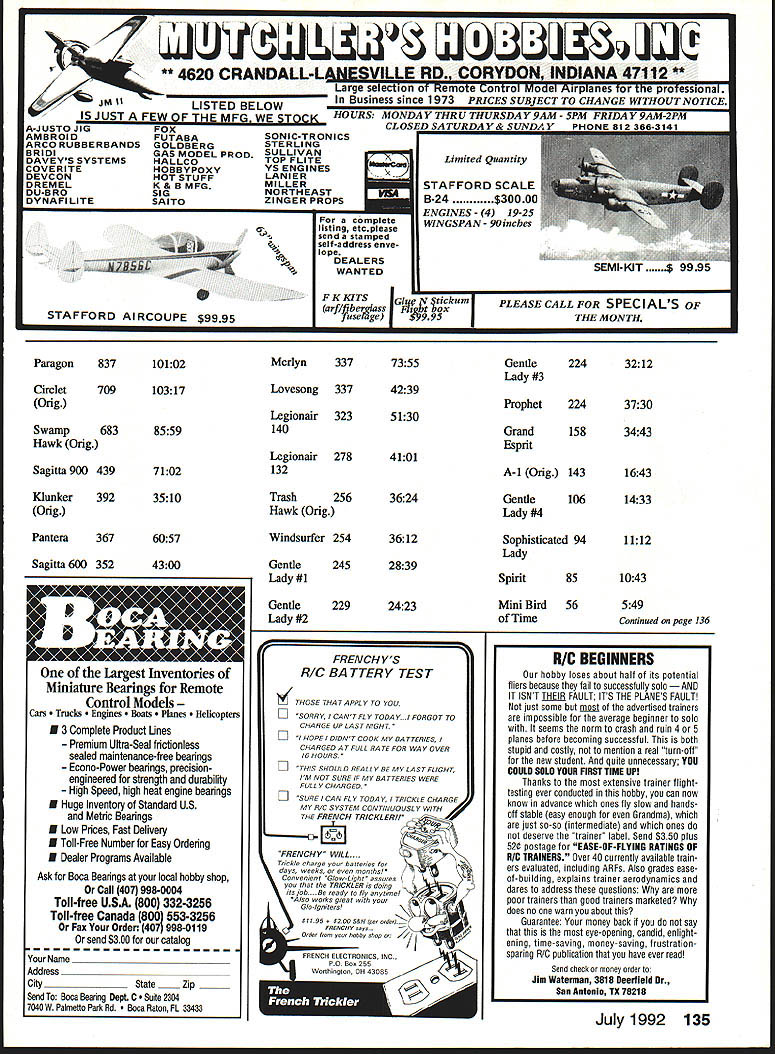
Following an April column on Jim McGee's 500+ flying hours, Ron Stanfield of Maumelle, Arkansas, sent a note about his own logkeeping. Highlights Ron reported:
- He records date, airplane, and flight time in a notebook in his flight box and maintains a shop log with running totals by airplane.
- His long-flights sheet now lists 62 flights of one hour or longer (five of those over two hours).
- He began flying in 1974; earliest available logs date from 1977.
- Over a recent 15-year period Byron calculated approximate averages from Ron's data: ~2 gliders built per year, ~546 flights per year, >75 hours of flying time per year, average flight ~8.5 minutes.
Byron noted Ron's total (1,128 hours of flight time) as an impressive benchmark and invited others with similar lists to submit them.
Slope Aerobatics contest
Fourth annual S.F. Vultures Slope Aerobatics Contest: July 26 at Milagra Ridge, Pacifica, CA. About 50 people attended last year; the event is growing. For information, send a SASE to:
- Jeff Raskin, 8 Gypsy Hill Rd., Pacifica, CA 94044
- Tel: (415) 359-8588
LSF National Champs (schedule)
LSF National Championships: July 18–25 at Vincennes, Indiana. All thermal events are flown man-on-man; all 50 channels will be used. Contact LSF President Mike Stump, 607 Washington St., Cadillac, MI 49601. Schedule:
- Sat., July 18 — Cross Country
- Sun., July 19 — F3B*
- Mon., July 20 — SMT*
- Tues., July 21 — Hand Launch
- Wed., July 22 — Two-Meter
- Thur., July 23 — Standard Class
- Fri., July 24 — Unlimited Class
- Sat., July 25 — F3J
*May enter F3B or SMT. Scale will be flown Tuesday and Wednesday evenings.
Greco Technologies — Modi 900 update
Greco Technologies reported that the Modi 900 design is being revised: molded wings will be used instead of the original vacuum-bagged wings.
Transcribed from original scans by AI. Minor OCR errors may remain.

