
RADIO CONTROL: SOARING
Byron Blakeslee 3134 N. Winnebago Dr. Sedalia, CO 80135
News from Brian Agnew
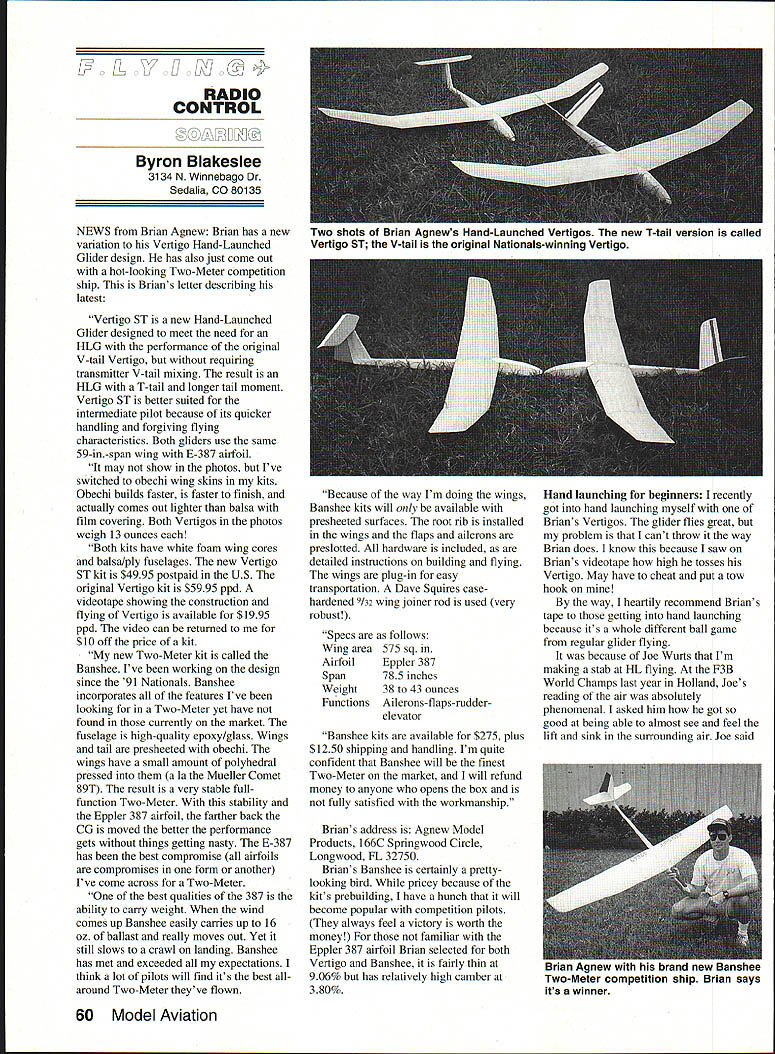
Brian has a new variation to his Vertigo hand-launched glider design and a new Two-Meter competition ship. Below is Brian's letter describing his latest offerings.
"Vertigo ST is a new hand-launched glider designed to meet the need for an HLG with the performance of the original V-tail Vertigo, but without requiring transmitter V-tail mixing. The result is an HLG with a T-tail and longer tail moment. Vertigo ST is better suited for the intermediate pilot because of its quicker handling and forgiving flying characteristics. Both gliders use the same 59-inch span wing with Eppler 387 airfoil.
"It may not show in the photos, but I've switched to obeche wing skins in my kits. Obeche builds faster, is faster to finish, and actually comes out lighter than balsa with film covering. Both Vertigos in the photos weigh 13 ounces each!
"Both kits have white foam wing cores and balsa/ply fuselages. The new Vertigo ST kit is $49.95 postpaid in the U.S. The original Vertigo kit is $59.95 postpaid. A videotape showing the construction and flying of Vertigo is available for $19.95 postpaid. The video can be returned to me for $10 off the price of a kit.
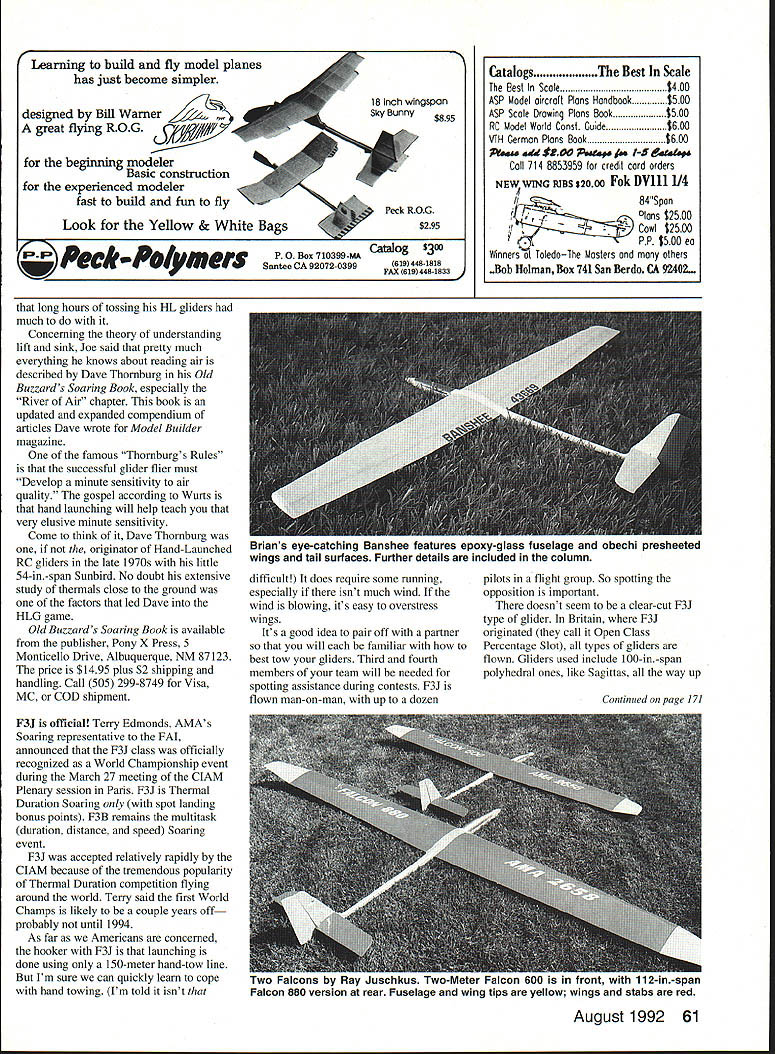
"My new Two-Meter kit is called the Banshee. I've been working on the design since the 1991 Nationals. Banshee incorporates all of the features I've been looking for in a Two-Meter, yet have not found in those currently on the market. The fuselage is high-quality epoxy/glass. Wings and tail are presheeted with obeche. The wings have a small amount of polyhedral pressed into them (a la the Mueller Comet 89T). The result is a very stable full-function Two-Meter. With this stability and the Eppler 387 airfoil, the farther back the CG is moved the better the performance gets without things getting nasty. The E-387 has been the best compromise (if an airfoil is a compromise in one form or another) I've come across for a Two-Meter.
"One of the best qualities of the 387 is its ability to carry weight. When the wind comes up Banshee easily carries up to 16 ounces of ballast and really moves out. Yet it still slows to a crawl on landing. Banshee has met and exceeded all my expectations. I think a lot of pilots will find it the best all-around Two-Meter they've flown.
"Because of the way I'm doing the wings, Banshee kits will only be available with presheeted surfaces. The root rib is installed in the wings and the flaps and ailerons are preslotted. All hardware is included, as are detailed instructions on building and flying. The wings are plug-in for easy transportation. A Dave Squires case-hardened 1/32-inch wing joiner rod is used (very robust!).
"Specs are as follows:
- Wing area: 575 sq. in.
- Airfoil: Eppler 387
- Span: 78.5 inches
- Weight: 38 to 43 ounces
- Functions: Ailerons, flaps, rudder, elevator
"Banshee kits are available for $275, plus $12.50 shipping and handling. I'm quite confident that Banshee will be the finest Two-Meter on the market, and I will refund money to anyone who opens the box and is not fully satisfied with the workmanship."
Brian's address: Agnew Model Products, 166C Springwood Circle, Longwood, FL 32750.
Editor's notes on Brian's designs
Brian's Banshee is certainly a pretty-looking bird. While pricey because of the kit's prebuilding, I have a hunch it will become popular with competition pilots. For those not familiar with the Eppler 387 airfoil Brian selected for both Vertigo and Banshee, it is fairly thin at 9.06% but has relatively high camber at 3.80%.
Hand launching for beginners
I recently got into hand launching myself with one of Brian's Vertigos. The glider flies great, but my problem is that I can't throw it the way Brian does. I know this because I saw on Brian's videotape how high he tosses his Vertigo. Maybe I have to cheat and put a tow hook on mine!
I heartily recommend Brian's tape to those getting into hand launching, because it's a whole different ball game from regular glider flying.
It was because of Joe Wurts that I'm making a stab at HL flying. At the F3B World Champs last year in Holland, Joe's reading of the air was absolutely phenomenal. I asked him how he got so good at being able to almost see and feel the lift and sink in the surrounding air. Joe said, "Develop minute sensitivity to the air." He added that long hours of tossing his HL gliders had much to do with it.
Concerning the theory of understanding lift and sink, Joe said that pretty much everything he knows about reading air is described by Dave Thornburg in his Old Buzzard's Soaring Book, especially the "River of Air" chapter. This book is an updated and expanded compendium of articles Dave wrote for Model Builder magazine.
One of the famous "Thornburg's Rules" is that the successful glider flier must "Develop a minute sensitivity to air quality." The gospel according to Wurts is that hand launching will help teach you that very elusive minute sensitivity.
Come to think of it, Dave Thornburg was one, if not the, originator of hand-launched RC gliders in the late 1970s with his little 54-inch span Sunbird. No doubt his extensive study of thermals close to the ground was one of the factors that led Dave into the HLG game.
Books and resources
Old Buzzard's Soaring Book is available from the publisher:
- Pony X Press, 5 Monticello Drive, Albuquerque, NM 87123.
- Price: $14.95 plus S&H.
- Call (505) 299-8749 for Visa, MC, or COD shipping.
F3J is official!
Terry Edmonds, AMA's soaring representative to the FAI, announced that the F3J class was officially recognized as a World Championship event during the March 27 meeting of the CIAM Plenary session in Paris. F3J is Thermal Duration Soaring (with spot-landing bonus points). F3B remains the multitask (duration, distance, and speed) soaring event.
F3J was accepted relatively rapidly by CIAM because of the tremendous popularity of thermal-duration competition flying around the world. Terry said the first World Championships are likely a couple of years off — probably not until 1994.
For Americans, the hot news with F3J is that launching is done using only a 150-meter hand-tow line. I'm sure we can quickly learn to cope with hand towing. (I'm told it isn't that difficult!) It does require some running, especially if there isn't much wind. If the wind is blowing, it's easy to overstress wings.
It's a good idea to pair off with a partner so that you will each be familiar with how to best tow your gliders. Third and fourth members of your team will be needed for spotting assistance during contests. F3J is flown man-on-man, with up to a dozen pilots in a flight group. So spotting the opposition is important.
There doesn't seem to be a clear-cut F3J type of glider. In Britain, where F3J originated (they call it Open Class Percentage Slot), all types of gliders are flown. Gliders used include 100-inch span polyhedral ships, like Sagittas, all the way up to 160-inch span super ships that can be ranged all over the area and still be seen. However, the Brits do not use the spot-landing bonus that F3J will have, so the big ships will be at a disadvantage in making landing points.
Choosing the optimum glider depends a lot on the weather. Calm, light conditions will favor floaters; heavier, faster ships will do better in windy weather with rapidly moving thermals. If I had to predict the popular all-around F3J glider, it would likely have these characteristics:
- Wingspan: 3.0 to 3.5 meters
- Controls: ailerons and flaps
- Radio: computer radio controlled
- Construction: built light (about 10 oz./sq. ft. minimum wing loading)
- Ballast capability: able to carry ballast to bring wing loading up to about 16 oz./sq. ft.
In other words, think of a bigger F3B ship. I'll have more on hand-towing technique and equipment in upcoming columns.
Transcribed from original scans by AI. Minor OCR errors may remain.

