
RADIO CONTROL: SOARING
Byron Blakeslee 3134 N. Winnebago Dr., Sedalia, CO 80135
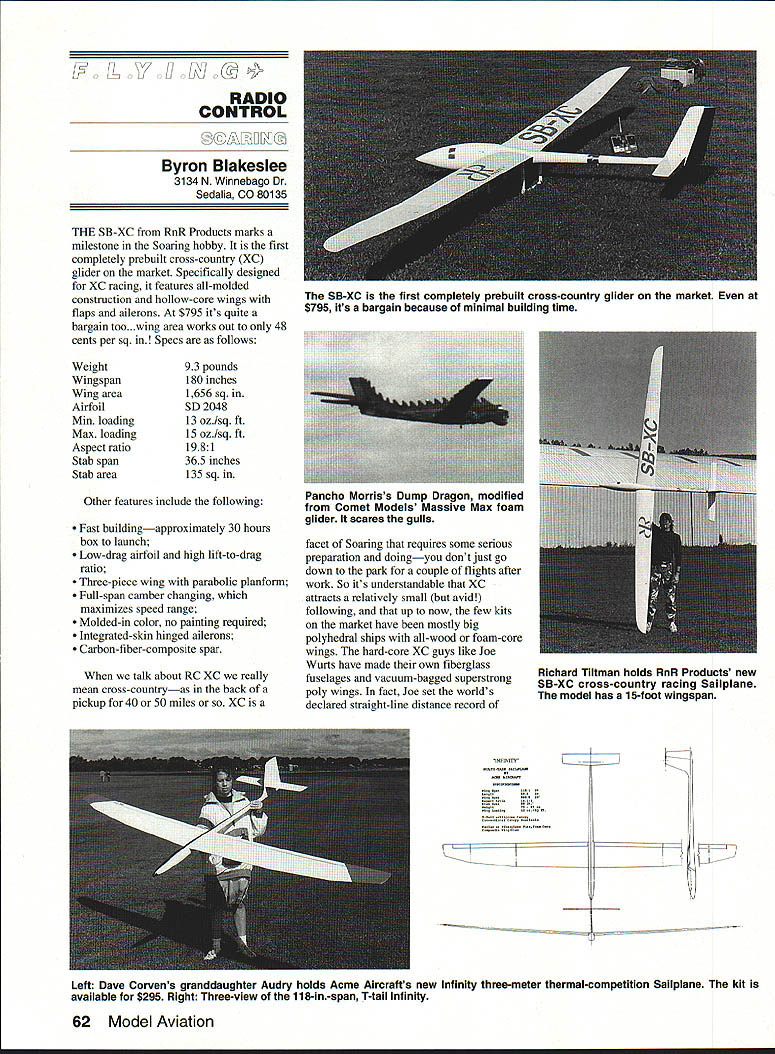
THE SB-XC
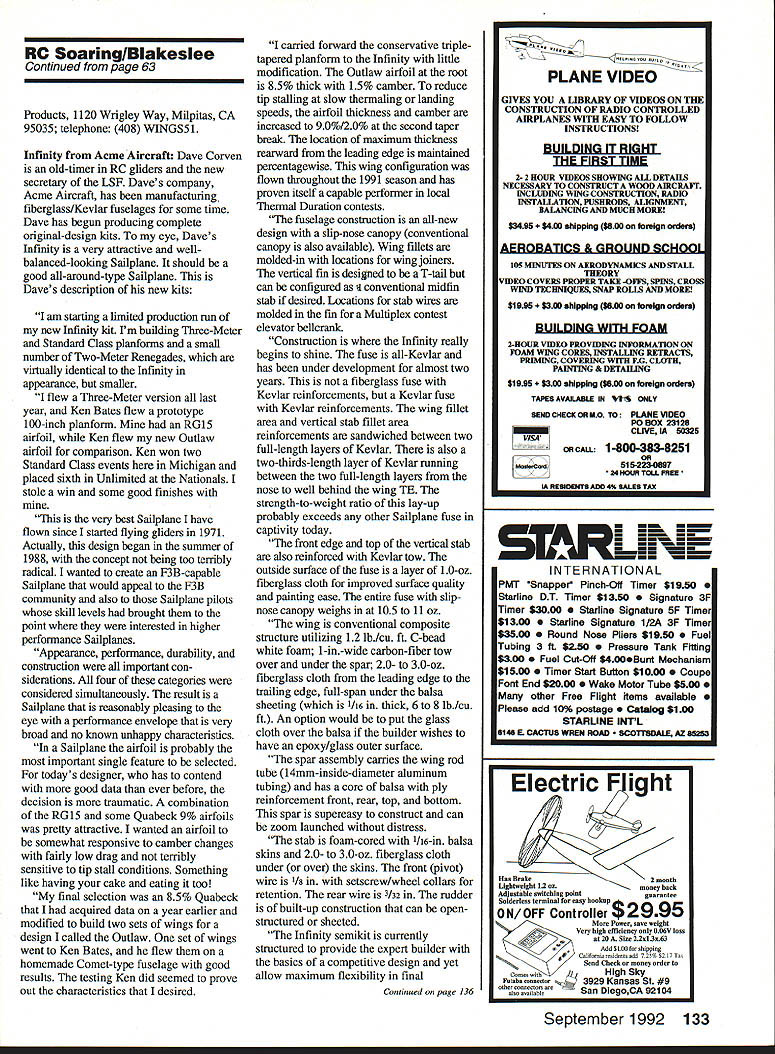
RnR Products marks a milestone in the soaring hobby with the SB-XC — the first completely prebuilt cross-country (XC) glider on the market. Specifically designed for XC racing, it features all-molded construction, hollow-core wings, flaps and ailerons. Price: $795. Wing area works out to about 48 cents per sq. in.
#### Specs
- Weight: 9.3 pounds
- Wingspan: 180 inches
- Wing area: 1,656 sq. in.
- Airfoil: SD 2048
- Min. loading: 13 oz./sq. ft.
- Max. loading: 15 oz./sq. ft.
- Aspect ratio: 19.8:1
- Stabilizer span: 36.5 inches
- Stabilizer area: 135 sq. in.
#### Features
- Fast building — approximately 30 hours from box to launch
- Low-drag airfoil and high lift-to-drag ratio
- Three-piece wing with parabolic planform
- Full-span camber changing to maximize speed range
- Molded-in color — no painting required
- Integrated-skin hinged ailerons
- Carbon-fiber-composite spar
XC (cross-country) soaring requires serious preparation and commitment — you don't just go to the park for a couple of flights after work. Because of that, XC attracts a relatively small but avid following. Until now, most available kits were large polyhedral ships with all-wood or foam-core wings. Hard-core XC pilots (for example Joe Wurts) have produced their own fiberglass fuselages and vacuum-bagged poly wings; Joe set the world declared straight-line distance record of 2,264 kilometers (almost 142 miles) with Wiley's Revenge in 1988.
Flite Lite Composites' Eagle XC emphasizes size, speed, stability and strength. Large size helps visibility and flight efficiency; speed is essential for XC racing; stability helps keep the glider under control when it's far away; and strength reduces losses from exceeding red-line speeds or other stresses.
RnR Products principals Rich Spicer and Richard Tiltman (the two Rs) are known for Synergy III, Synergy 91, Thermal/F3B designs, Nova and Slope Racer. The SB-XC is a modern, all-molded sailplane with ailerons, sufficient polyhedral for inherent stability, and fully adjustable wing camber (positive and negative) — an advantage when coping with varying lift and sink conditions. The SB-XC looks to be a hot ticket at XC contests.
Ordering / Information: RnR Products, 1120 Wrigley Way, Milpitas, CA 95035. Telephone: (408) [number not legible on scan].
INFINITY (Acme Aircraft)
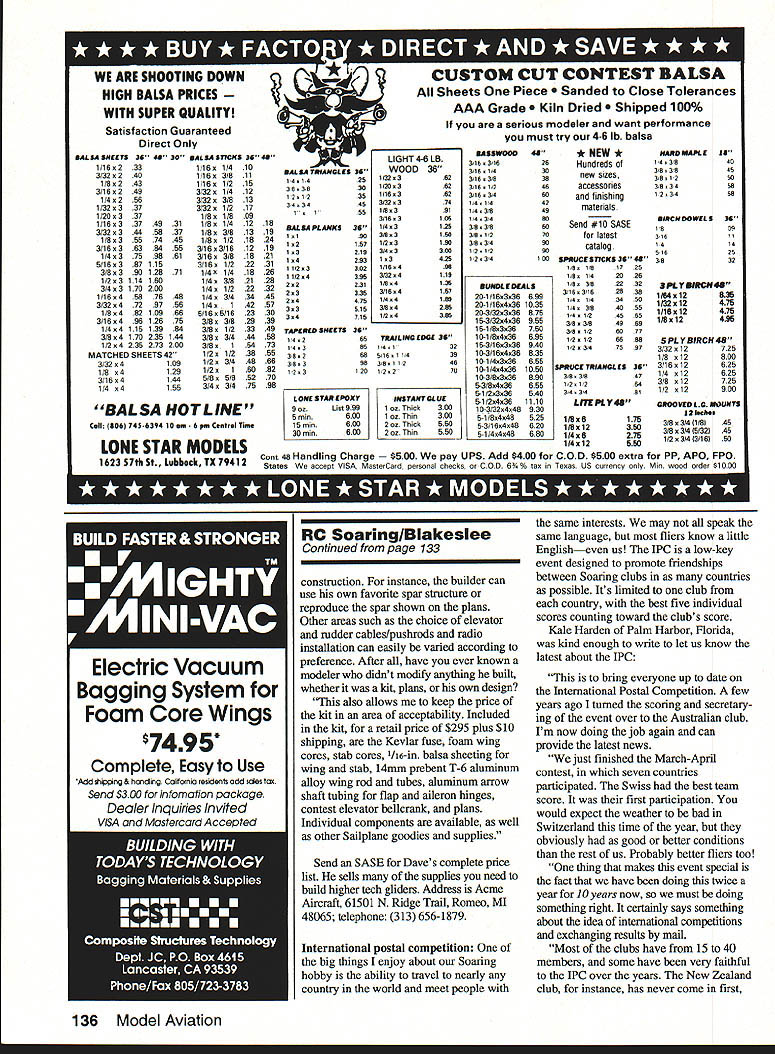
Dave Corven of Acme Aircraft (longtime RC glider pilot and LSF secretary) has begun producing complete original-design kits, the Infinity. Available planforms include Three-Meter and Standard Class, plus a limited number of Two-Meter Renegades (smaller versions of the Infinity).
Overview and Performance
Dave flew a Three-Meter version throughout the previous season; Ken Bates flew a 100-inch prototype. Dave's uses an RG15 airfoil, while Ken tested a new Outlaw airfoil. Ken won two Standard Class events in Michigan and placed sixth in Unlimited at the Nationals; Dave also achieved wins and good finishes.
The Infinity was conceived in 1988 as an F3B-capable sailplane appealing to high-performance pilots. The design emphasizes appearance, performance, durability and construction. The result is a visually pleasing sailplane with a broad performance envelope and no known unhappy characteristics.
Airfoil and Planform
The chosen airfoil family combines RG15 and Quabeck 9% characteristics. The final selection is an 8.5% Quabeck-derived airfoil (the Outlaw) with modifications. The planform is a conservative triple taper carried forward to the Infinity with little change.
- Root section: Outlaw airfoil at 8.5% thickness with 1.5% camber
- Tip section (second taper break): thickness and camber increased to 9.0% / 2.0% to reduce tip stalling at slow thermalling and landing speeds
- The location of maximum thickness is maintained percentage-wise along the span
This wing configuration was tested throughout the season and proved capable in local Thermal Duration contests.
Fuselage and Tail
The fuselage is an all-new design with a slip-nose canopy (a conventional canopy is also available). Wing fillets are molded in with locations for wing joiners. The vertical fin is designed for a T-tail but can be configured as a conventional mid-fin tailplane. Locations for stab wires are molded into the fin for a Multiplex-style elevator bellcrank.
Construction and Materials
Construction is a strong selling point of the Infinity semikit.
- Fuselage: all-Kevlar construction (not fiberglass with Kevlar reinforcements). Fillet and fin reinforcements are sandwiched between two full-length Kevlar layers. A two-thirds-length Kevlar layer runs between the full-length layers from the nose to well behind the wing trailing edge. The front edge and top of the vertical fin are also Kevlar reinforced. The outside surface has a 1.0-oz. fiberglass cloth layer for improved finish and painting ease. The complete fuselage with slip-nose canopy weighs about 10.5–11 oz.
- Wing: conventional composite with 1.2 lb/cu.ft. C-bead white foam cores; an inch-wide carbon-fiber tow over and under the spar; 2.0–3.0 oz. fiberglass cloth from leading edge to trailing edge, full-span under 1/16 in. balsa sheeting (to 6 or 8 lb/cu.ft.). Optionally, the builder can apply glass cloth over the balsa for an epoxy/glass outer surface.
- Spar assembly: carries a 14 mm inside-diameter aluminum wing rod tube; spar core of balsa with plywood reinforcement front, rear, top and bottom. The spar is straightforward to construct and suitable for boom launching.
- Stabilizer: foam-cored with 1/16 in. balsa skins and 2.0–3.0 oz. fiberglass cloth under the skins. Pivot wire front is 1/8 in. with setscrew/wheel collars for retention; rear wire is 3/32 in. Rudder is built-up construction and may be open-structured or sheeted.
Semikit Philosophy and Flexibility
The Infinity semikit provides the expert builder with competitive basics while allowing flexibility in final construction. Builders may use their preferred spar design or reproduce the plans' spar. Choices such as elevator and rudder cables/pushrods and radio installation can be varied according to preference.
Kit Contents and Price
Retail price: $295 plus $10 shipping. The semikit includes:
- Kevlar fuselage
- Foam wing cores
- Stabilizer cores
- 1/16 in. balsa sheeting for wing and stab
- 14 mm prebent T-6 aluminum alloy wing rod and tubes
- Aluminum arrow-shaft tubing for flap and aileron hinges
- Contest elevator bellcrank
- Plans
Individual components and other sailplane supplies are available. Send an SASE for a complete price list.
Ordering / Information: Acme Aircraft, 61501 N. Ridge Trail, Romeo, MI 48065. Telephone: (313) 656-1879.
INTERNATIONAL POSTAL COMPETITION (IPC)
One of the strengths of the soaring hobby is meeting fliers worldwide. The International Postal Competition (IPC) is a low-key event promoting friendships between soaring clubs in many countries. It is limited to one club per country; the best five individual scores count toward the club total.
Kale Harden (Palm Harbor, FL) provided the latest IPC news and is currently handling scoring and secretary duties.
Format and History
- The IPC has been held twice a year for 10 years, usually as a spring and fall event. This scheduling accommodates Northern and Southern Hemisphere seasons.
- Initially the contest followed F3B-style six-minute Precision Duration only. For a time two tasks were flown (alternating F3B Speed and F3B Distance alongside Duration), but the IPC now flies six-minute Duration only, five rounds per contest.
- The event began with the Pelicans (Tampa–St. Pete) and the Brisbane club. Interest spread quickly and teams from many countries joined. Over the years, correspondents from 14 countries have taken part; as many as eight countries have participated in a single contest.
Participation and Notable Competitors
Most participating clubs have 15–40 members. Some clubs have competed faithfully for many years (e.g., the New Zealand club and the Pelicans). Notable past IPC competitors include:
- Walt Good, Brian Agnew, Leon Kincaid and John Gussauhians (U.S.)
- Garry Jordan (Australia)
- Brian Sharp (Scotland)
- Rudiger Kraus and Reinhard Werner (Germany)
- Sean Walbank (England)
- John Lightfoot (South Africa)
Recent Contest and Results
In the most recent March–April contest, seven countries participated. The Swiss team (Modellfluggruppe of Switzerland) had the best team score in their first participation; weather and pilot skill influenced results across teams.
Final standings:
- Modellfluggruppe (Switzerland) — 21,003 points
- Pelican S.A. (U.S.A.) — 19,955 points
- Brisbane M.C.S. (Australia) — 18,476 points
- Scottish Aeromodelers (Scotland) — 18,114 points
- Southern Soaring Club (South Africa) — 16,955 points
- Wellington M.A.C. (New Zealand) — 16,935 points
- Santiago Soaring Club (Chile) — 11,394 points
Canada and Ireland indicated they might participate in the fall contest; if they do, participation could reach a new record of 10 teams.
For clubs in other countries interested in participating in the IPC, contact Kale Harden: 3184 Brunswick Circle, Palm Harbor, FL 34684, U.S.A.
Transcribed from original scans by AI. Minor OCR errors may remain.

