
Radio Control: Soaring
Byron Blakeslee 3134 N. Winnebago Dr. Sedalia, CO 80135
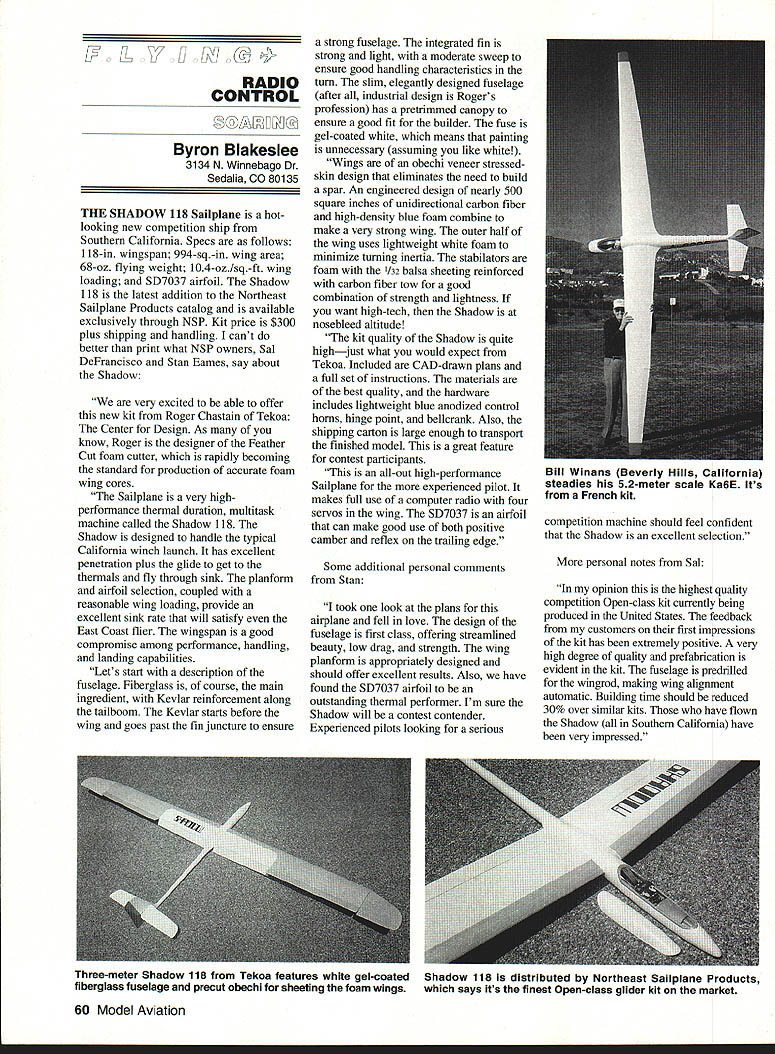
THE SHADOW 118 Sailplane — hot-looking new competition ship
Specs:
- Wingspan: 118 in.
- Wing area: 994 sq. in.
- Flying weight: 68 oz.
- Wing loading: 10.4 oz./sq. ft.
- Airfoil: SD7037
- Kit price: $300 plus shipping and handling
- Available exclusively through Northeast Sailplane Products (NSP)
NSP owners Sal DeFrancisco and Stan Eames report:
"We are very excited to be able to offer this new kit from Roger Chastain of Tekoa, The Center for Design. As many of you know, Roger is the designer of the Feather‑Cut foam cutter, which is rapidly becoming the standard for production of accurate foam wing cores.
"The Sailplane is a very high‑performance thermal/duration, multitask machine called the Shadow 118. The Shadow is designed to handle the typical California winch launch. It has excellent penetration plus the glide to get to the thermals and fly through sink. The planform and airfoil selection, coupled with a reasonable wing loading, provide an excellent sink rate that will satisfy even the East Coast flier. The wingspan is a good compromise among performance, handling, and landing capabilities.
"Let's start with a description of the fuselage. Fiberglass is, of course, the main ingredient, with Kevlar reinforcement along the tailboom. The Kevlar starts before the wing and goes past the fin juncture to ensure a strong fuselage. The integrated fin is strong and light, with a moderate sweep to ensure good handling characteristics in the turn. The slim, elegantly designed fuselage (after all, industrial design is Roger's profession) has a pretrimmed canopy to ensure a good fit for the builder. The fuse is gel‑coated white, which means that painting is unnecessary (assuming you like white!).
"Wings are of an obeche veneer stressed‑skin design that eliminates the need to build a spar. An engineered design of nearly 500 sq. in. of unidirectional carbon fiber and high‑density blue foam combine to make a very strong wing. The outer half of the wing uses lightweight white foam to minimize turning inertia. The stabilators are foam with 1/32 in. balsa sheeting reinforced with carbon fiber tow for a good combination of strength and lightness. If you want high‑tech, then the Shadow is an advanced, high‑performance kit—quality of the Shadow is quite high—just what you would expect from Tekoa. Included are CAD‑drawn plans and a full set of instructions. The materials are of the best quality, and the hardware includes lightweight blue anodized control horns, hinge points, and bellcrank. Also, the shipping carton is large enough to transport the finished model. This is a great feature for contest participants.
"This is an all‑out high‑performance sailplane for the more experienced pilot. It makes full use of a computer radio with four servos in the wing. The SD7037 is an airfoil that can make good use of both positive camber and reflex on the trailing edge."
Additional comments from Stan Eames:
- He fell in love with the plans and praises the fuselage design for streamlined beauty, low drag, and strength.
- He finds the wing planform appropriate and expects excellent results.
- He rates the SD7037 airfoil as an outstanding thermal performer and expects the Shadow to be a contest contender.
Personal notes from Sal DeFrancisco:
- He considers this the highest quality competition Open‑class kit currently being produced in the United States.
- Customer feedback on first impressions has been extremely positive; a high degree of quality and prefabrication is evident.
- The fuselage is predrilled for the wing rod, making wing alignment automatic and reducing building time by an estimated 30% over similar kits.
- Many pilots in Southern California who have flown the Shadow have been very impressed.
NSP contact:
- Address: 16 Kirby Lane, Williston, VT 05495
- Phone: (802) 658‑9482 (Monday–Saturday, 9 a.m.–7 p.m. EST)
Features summary
- White gel‑coated fiberglass fuselage with Kevlar tailboom reinforcement
- Obeche veneer stressed‑skin wings with unidirectional carbon reinforcement
- Foam outer wing panels to reduce turning inertia
- Foam stabilators with balsa sheeting and carbon reinforcement
- CAD plans, full instructions, high‑quality hardware
---
Flight Lite Composites sold
Mark Allen reports that as of July 1 Ron Vann is taking over Flight Lite Composites (FLC). Ron, a well‑known Northern California slope‑racing enthusiast, is moving the shop and gearing up for increased kit production.
Notes:
- Demand for the Falcon, Eagle, and Swift lines has been tremendous, causing delivery delays.
- Ron's new manufacturing facility should reduce the wait list for kits to about zero.
- Mark Allen will remain FLC's chief designer while pursuing other projects.
New mailing address:
- Flight Lite Composites, P.O. Box 311, Windsor, CA 95492
---
Scale news
Robin Lehman, East Coast aero‑towing enthusiast, reports on recent scale activity and new models.
Bill Winans and Ka6E:
- Bill owns a 1/3‑scale Ka6E built to 1:2.9 scale with a glass fuselage and foam‑core wings.
- Dimensions: span 5.2 m (approx. 17 ft), length 2.3 m (approx. 7.5 ft), weight about 24 lb.
- The kit is from French manufacturer Dominique Disciullo; Bill found it advertised in a French model magazine.
- Dan Troxell has two of them; Robin is acquiring one.
- Bill also has a 1/4‑scale Ka6E from a Multiplex kit. Both models have very thick, scale wing sections that make them excellent floaters and, if desired, highly aerobatic.
Aero‑towing activity:
- Bill has been active in aero‑towing; Dan Troxell towed one of Bill's smaller gliders during a spring visit.
- Bob Smith Jr. and Sr. are building a 1/3‑scale L‑5 tow plane as a tug for Robin's big Grob. They expect to fly the combination in the summer.
Background on the full‑size Ka6E:
- The Ka6 was designed by Rudolf Kaiser (hence "Ka") and produced by Schleicher in Poppenhausen, Germany.
- The original Ka6 dates from 1956 and was successful in Standard Class competitions.
- The Ka6E, which first flew in 1965, incorporated many changes and improvements. Some Ka6Es are still airworthy, but the wood/glue construction requires careful inspection.
---
The Saturn 3.0 revisited
Background:
- The Saturn 3.0 is manufactured by David Layne and Peter Urwyler of Modesto, California.
- The kit offers a three‑meter ship with an all‑flying T‑tail and plug‑on wings with ailerons and flaps. Wings and stabilizer are vacuum‑bagged fiberglass over blue foam.
- The kit comes with much of the fuselage construction already completed. Price was about $500.
First impressions on receipt and construction:
- The kit arrives in a big box; the workmanship and materials appear industrial‑strength and well suited for contest use.
- A three‑foot‑long, 5/8‑in. T‑6061 aluminum tube is used as the wing joiner. The tube passes through the fuselage and mates with PVC sleeves in the wing panels; the long joiner provides excellent rigidity. Wing rear alignment wire and predrilled locations simplify assembly.
- The all‑flying stabilator arrives finished and screws onto a molded fiberglass rocker assembly installed in the top of the fin. The rudder is finished and supplied in the builder's choice of white, red, blue, or black (wing and stab bottoms are also color‑choice). The rudder is taped to the left side of the fin.
Builder tasks:
- Cut off ailerons and flaps and install them.
- Cut out holes for four servos in the wings (locations are premarked) and install servos.
- Fill small voids in the fiberglass and Kevlar fuselage, paint as desired, and install rudder and elevator servos and linkages.
Recommended modification:
- The kit supplies tubular "floating" pushrods that run unsupported from the servos to the bellcrank. To avoid rattling and possible damage on rough landings, the author installed .052‑in. wire pushrods inside plastic tubing, securing the tubing to the fuselage sides with CA glue. Longer lengths of wire were required and sourced locally. The stab drive system became dead‑solid with this arrangement, which is important for pitch trim.
Flying impressions:
- Finished and balanced weight: 81 oz. (spec listed 78 oz.). Wing loading remained just under 12 oz./sq. ft., suitable for this ship.
- A steel joiner tube can be substituted for the aluminum tube to add ballast easily.
- The Saturn flew out of the box with the stab incidence set per instructions. On a strong‑thermal day in May the Saturn climbed exceptionally well; it repeatedly climbed out of sight in only a few turns in strong lift.
- Handling: solid in pitch despite a small‑looking stabilator, fairly sensitive in roll due to minimal dihedral, and it signals lift well by wing waggle and tail lift.
- It is not a miracle worker—it won't stay up without lift—but it is an excellent all‑around thermal ship suitable for AMA and F3J contests: strong enough for vigorous launches, capable of flying well out, good handling, and accurate spot landings.
Airfoil note:
- Layne/Urwyler chose the Quabeck 2.5/9.0 airfoil (2.5% camber, 9.0% thickness). This section provides reasonable lift without excessive drag and is thin enough to give the glider good cruising speed for escaping sink and finding lift.
Recommendation and contacts:
- The Saturn 3.0 is highly recommended for those who want a competitive sailplane that can be assembled and flown quickly (allowing for a couple of hundred extra dollars in cost).
- Layne/Urwyler contact: 1808 Applegate Dr., Modesto, CA 95350. Phone: (209) 529‑8457.
- Saturns are also available from NSP.
---
Weston Aerodesign Co. catalog
Frank Weston has released a new 27‑page catalog. Weston Aerodesign (WACO) began a few years ago with the Magic and has expanded into a full supplier for composite gliders and supplies.
Catalog highlights:
- Nearly one‑stop shopping for cloth, resin, tools, vacuum pumps, radios, etc.
- Expanded glider line includes hand‑launched ships and several electrics—nine different designs in the new catalog.
To order a catalog:
- Send $1 to WACO, 944 Placid Ct., Arnold, MD 21012
- Phone: (410) 974‑0958
---
Transcribed from original scans by AI. Minor OCR errors may remain.

