
Radio Control: Soaring
Byron Blakeslee 3134 N. Winnebago Dr., Sedalia, CO 80135
Flying the Klingberg Wing 100
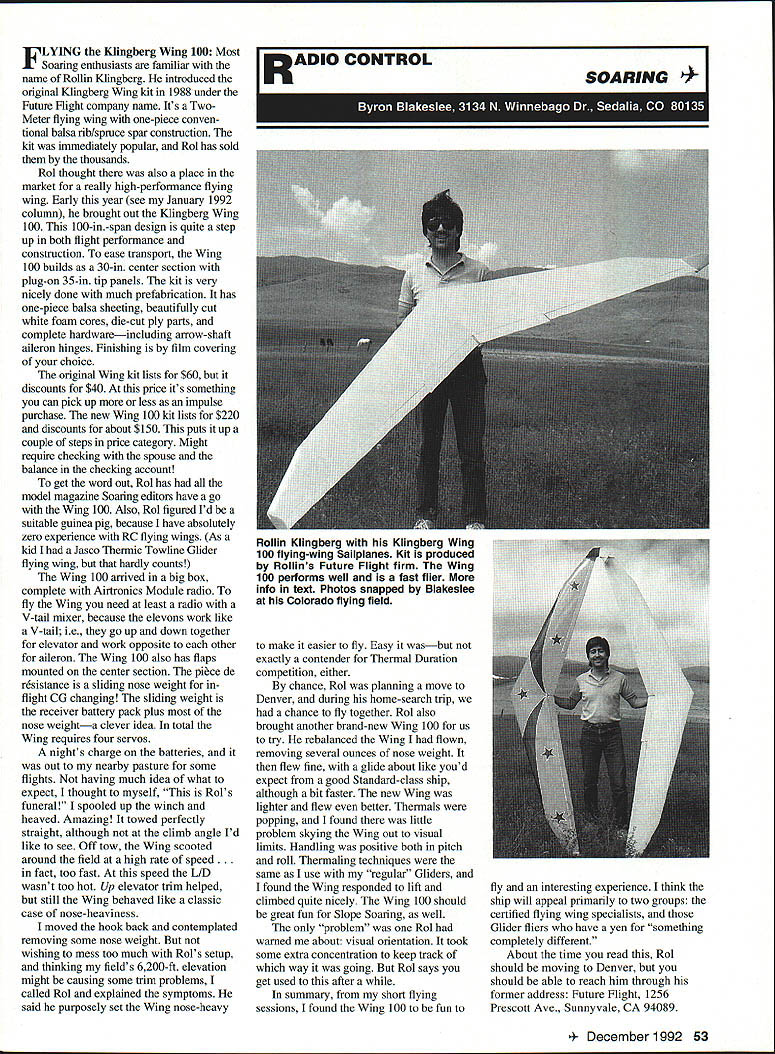
Most soaring enthusiasts know Rollin Klingberg. He introduced the original Klingberg Wing kit in 1988 under the Future Flight name — a popular Two-Meter flying wing with one-piece conventional balsa rib/spruce spar construction. Early this year he brought out the Klingberg Wing 100, a 100-in. span design that is a step up in both flight performance and construction.
Highlights of the kit and construction:
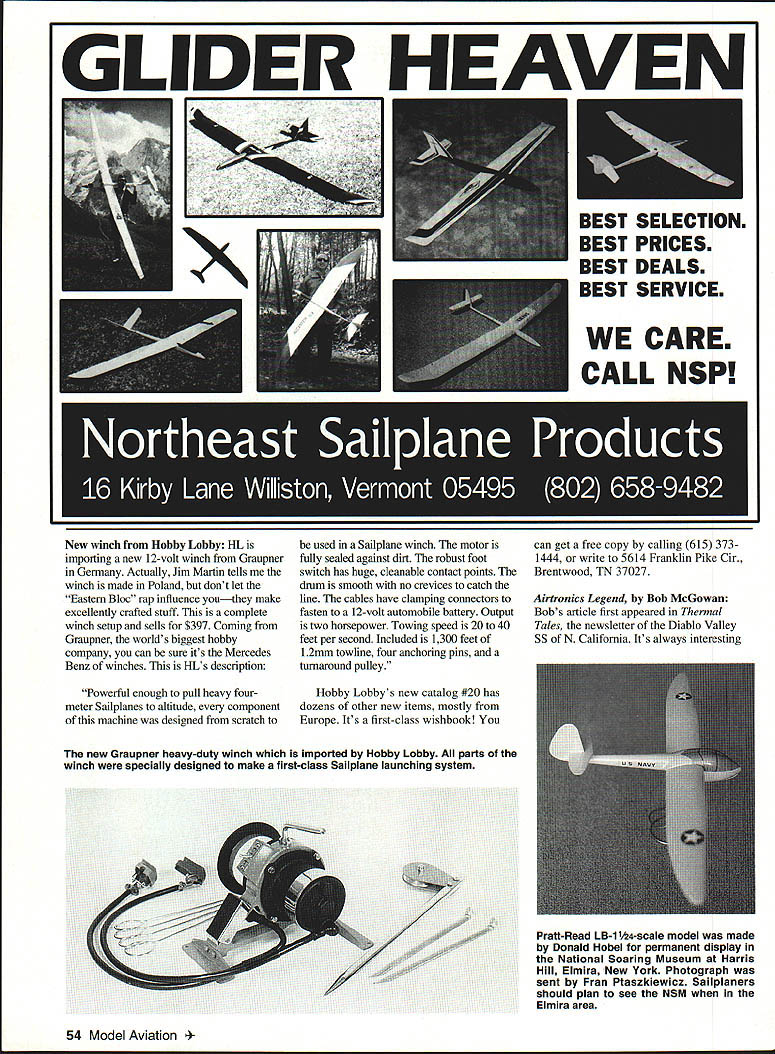
- Builds as a 30-in. center section with plug-on 35-in. tip panels for easier transport.
- Good prefabrication: one-piece balsa sheeting, well-cut white foam cores, die-cut ply parts, complete hardware (including arrow-shaft aileron hinges).
- Finished by film covering of your choice.
Pricing:
- Original Wing kit: list $60, discount about $40.
- Wing 100 kit: list $220, typical discount about $150.
Equipment and setup:
- The Wing 100 requires at least a radio with a V-tail mixer because the elevons act like a V-tail (up/down together for elevator, opposite for aileron).
- The center section has flaps.
- The sliding nose weight (the receiver battery pack plus most nose weight) allows in-flight CG changes — a clever idea.
- Four servos are required.
Flight impressions:
- On first flights at a high-elevation field (6,200 ft), the Wing towed straight but felt nose-heavy and fast off tow; glide (L/D) was not optimal until pitch trim was adjusted.
- Roll intentionally ships them slightly nose-heavy to make them easier to fly. After removing several ounces of nose weight and trying a lighter new Wing 100, performance improved markedly.
- With proper balance, the Wing 100 glides like a good Standard-class ship (a bit faster) and thermals well. It handles positively in pitch and roll, responds to lift, and climbs nicely. It should be great for slope soaring, too.
- The main challenge is visual orientation — it takes concentration to keep track of heading until you get used to it.
Summary:
- The Wing 100 is fun and interesting to fly. It will appeal to dedicated flying-wing specialists and glider fliers wanting something different.
Contact for Rollin Klingberg (Future Flight): Future Flight, 1256 Prescott Ave., Sunnyvale, CA 94089.
Klingberg Wing 100 flying-wing. Kit produced by Rollin's Future Flight firm. Wing 100 performs well; a fast flier. Photos taken at Blakeslee, Colorado flying field.
Over to Bob: Airtronics Legend (the "Little Legend")
"The latest addition to my arsenal of contest ships is the Airtronics Legend. It was dubbed the Little Legend at the 1991 Fall Soaring Festival because I cut the wingspan down to 100 in. (from stock 113 in.). I'll give a little review of the kit and offer insight into modifications I chose to make.
Why 100 in.?
- A 100-in. ship is a good compromise: increased maneuverability (loops and rolls), easier landings in imperfect winds, and still competitive in contests.
- High launches are crucial in competition. Given typical winch power, line stretch, and common line lengths (~200 m), planes over 100 in. can lose potential launch height. A 100-in. ship helps get a towering zoom launch and immediate confidence.
Kit and construction
- Airtronics kits are high quality: good wood, complete hardware, and a detailed instruction manual.
- To reduce span to 100 in., I compressed rib spacing in the aileron panels (each shortened by 6 in.), left the center section standard, made the small tip panels 1/2 in. shorter, added a 2-in. block at the tip, and compressed tip-panel ribs to create greater taper and a rounder tip. The change is mostly aesthetic.
- The wing is conventional built-up construction with a carbon-fiber-reinforced spar. It's a competitive option for those who prefer built-up wings over foam-core.
Important building notes and mods
- Ensure the shear web runs between spars across the whole aileron panel; add it if you have an early kit to prevent flutter.
- Check center section spar height before laminating carbon-fiber caps; I had to sand my spar slightly to match rib height.
- My structural insurance mods:
- Wrapped the wing rod joiner boxes with Kevlar thread.
- Added an 8-in. spruce subspar against the balsa trailing edge at the center to strengthen corners where flap cutouts meet the solid trailing edge.
Cautions and mistakes
- Be careful making structural mods; adding strength can add weight, and removing structure to save weight can cause failures.
- I shortened the 1/4-in. steel wing rods to save a bit of weight and paid the price when a wing panel blew off during a zoom launch at an important contest. Don’t skimp on critical components.
Tail and fuselage mods
- I reduced the elevator/stab size and lopped 1 in. off the top of the vertical fin to match the smaller wing.
- To save weight, I substituted balsa for much of the spruce in the rear end while keeping the Kevlar-wrapped joiner boxes and the center subspar for strength.
- I substituted a flex cable for the stock pushrod/bellcrank elevator drive (works well for me). Be cautious: lighter rear-end saves ounces but requires careful design to avoid in-flight failures.
- I changed the wing hold-down from bolt-on to rubberband-on so things can move a bit in hard landings rather than break.
- I used a flex cable for rudder control and left the elevator drive area under the wing open for easy ballasting.
Flying impressions
- The Legend makes smooth, effortless thermal turns with minimal input, similar to a polyhedral ship.
- Large flaps allow you to slow virtually to a stop before final touchdown for consistent spot landings.
- My wing loading is very light at 10 oz./sq. ft. — great for dawn calm-air flying and slow spot landings. In wind, I add ballast to reach 12 oz./sq. ft., where the plane still performs excellently: better glide ratio and still good minimum sink.
- The wide center-panel chord kites well on the towline, and very high launches are achievable even downwind.
Summary
- The Legend's performance is competitive for thermal/spot-landing contests, and its gentle handling makes it a fine recommendation as a first aileron plane."
F31 Aero-Tow Soaring
F31 is a provisional FAI Soaring event developed in France over the past decade. It is for scale (or scale-like) gliders with a minimum 3.5 m wingspan and uses only aero-towing for launches.
Rules summary (from Guy Revel, Silent Flight magazine):
- Each round comprises one speed flight and two duration flights (similar to F3B format).
- Launch altitude: 200 meters.
- Duration task: 8-minute precision task with landing within a 40 x 20-meter rectangle (extra 20-point bonus).
- Speed task: four laps between two vertical planes 250 meters apart (total 1 km).
- Launch altitude is measured by an altimeter on the tow plane with a telemetry link to a ground receiver; a contest official monitors the readout and calls release.
Tow operations and contest organization:
- Power pilots enjoy towing; a well-run contest may have six tow planes and about 50 contestants.
- Typical climb to 200 m takes about 1 minute; tow plane turnaround allows a roughly 3-minute launch cycle.
- Typical speed task time around 45 sec.; record ~29 sec. (≈77 mph).
Silent Flight magazine
Silent Flight (British) is now bimonthly (six issues per year). The June/July issue was the first in the new schedule. New subscription rate: $35/year (about $5.83 per copy). U.S. subscription agent:
- Wise Owl Worldwide Publications, 4314 W. 238th St., Torrance, CA 90505.
Wise Owl also handles other model magazines (RCM&E, Aeromodeller, Radio Modeller, Radio Control Scale Aircraft).
New F3J rules
F3J is the FAI provisional event for man-on-man thermal duration with hand-tow launching. Summary of rule changes (from Dave Jones, Silent Flight):
- Competitors get two launch attempts; the second launch may be made at any time. This was a compromise between keeping the second launch within one minute and allowing unlimited attempts.
- Tactical implications:
- In good weather, everyone will usually launch immediately and fly out the time.
- In poor weather, competitors can launch, assess conditions, and relaunch later if desired, making relaunch strategy and landing accuracy more important.
- The possibility of multiple relaunches favors smaller, more maneuverable models (around 3.5 m wingspan) that are easier to land quickly for a relaunch.
- F3J is expected to gain official FAI class status on January 1, 1993, provided two more competitions are run with five different nations competing. World Championship status had not yet been granted; earliest likely World Champs date is 1996.
Transcribed from original scans by AI. Minor OCR errors may remain.

