
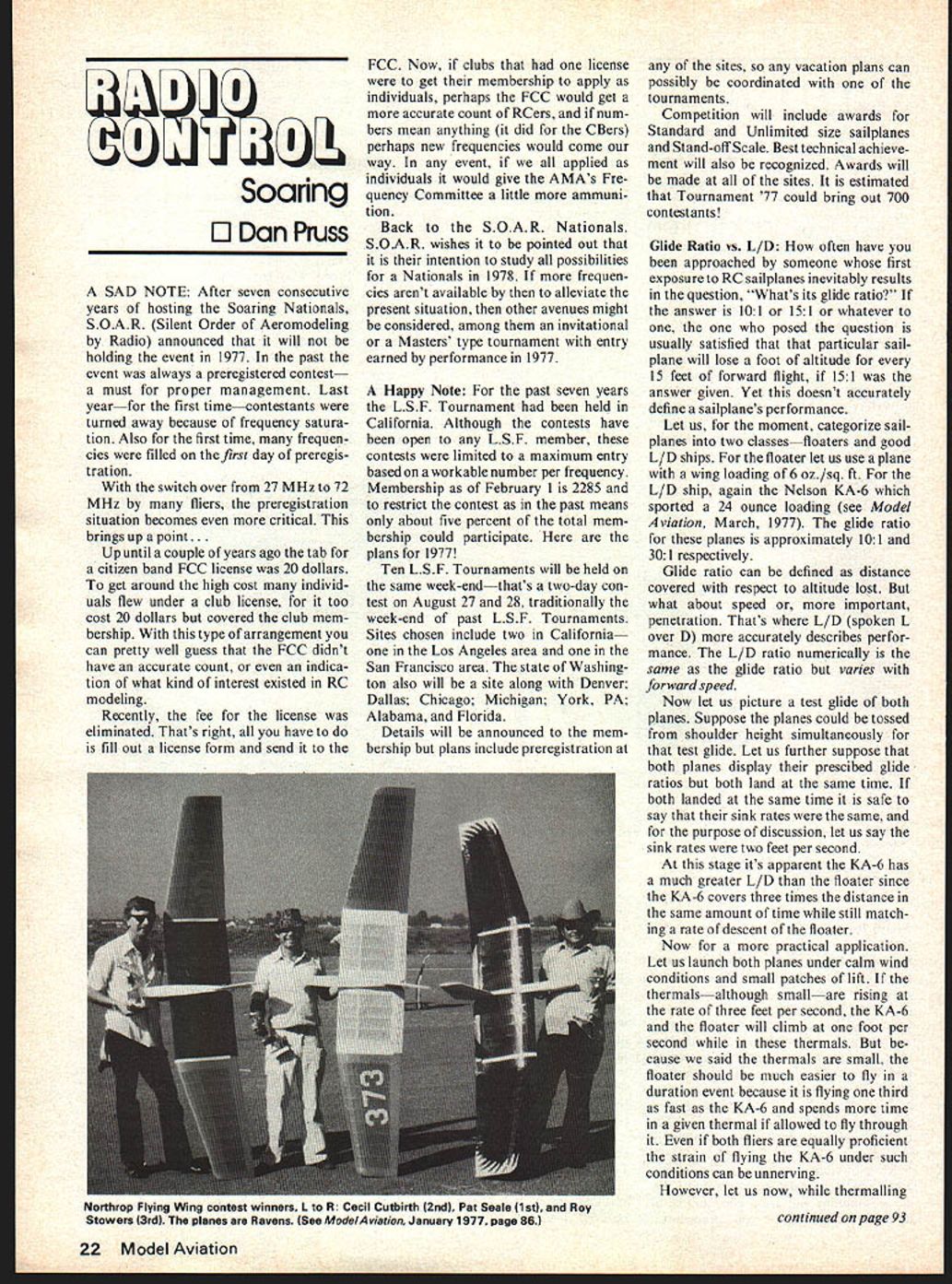
Radio Control: Soaring
Dan Pruss
A SAD NOTE: After seven consecutive years of hosting the Soaring Nationals, S.O.A.R. (Silent Order of Aeromodeling by Radio) announced that it will not be holding the event in 1977. In the past the event was always a preregistered contest—a must for proper management. Last year—for the first time—contestants were turned away because of frequency saturation. Also for the first time, many frequencies were filled on the first day of preregistration.
With the switch over from 27 MHz to 72 MHz by many fliers, the preregistration situation becomes even more critical. This brings up a point.
Up until a couple of years ago the tab for a citizen band FCC license was 20 dollars. To get around the high cost many individuals flew under a club license, for it too cost 20 dollars but covered the club membership. With this type of arrangement you can pretty well guess that the FCC didn't have an accurate count, or even an indication of what kind of interest existed in RC modeling.
Recently, the fee for the license was eliminated. That's right, all you have to do is fill out a license form and send it to the FCC. Now, if clubs that had one license were to get their membership to apply as individuals, perhaps the FCC would get a more accurate count of RCers, and if numbers mean anything (it did for the CBers) perhaps new frequencies would come our way. In any event, if we all applied as individuals it would give the AMA's Frequency Committee a little more ammunition.
Back to the S.O.A.R. Nationals. S.O.A.R. wishes it to be pointed out that it is their intention to study all possibilities for a Nationals in 1978. If more frequencies aren't available by then to alleviate the present situation, then other avenues might be considered, among them an invitational or a Masters' type tournament with entry earned by performance in 1977.
A Happy Note: For the past seven years the L.S.F. Tournament had been held in California. Although the contests have been open to any L.S.F. member, these contests were limited to a maximum entry based on a workable number per frequency. Membership as of February 1 is 2285 and to restrict the contest as in the past means only about five percent of the total membership could participate. Here are the plans for 1977:
Ten L.S.F. Tournaments will be held on the same week-end—that's a two-day contest on August 27 and 28, traditionally the week-end of past L.S.F. Tournaments. Sites chosen include two in California—one in the Los Angeles area and one in the San Francisco area. The state of Washington also will be a site along with Denver; Dallas; Chicago; Michigan; York, PA; Alabama, and Florida.
Details will be announced to the membership but plans include preregistration at any of the sites, so any vacation plans can possibly be coordinated with one of the tournaments.
Competition will include awards for Standard and Unlimited size sailplanes and Stand-off Scale. Best technical achievement will also be recognized. Awards will be made at all of the sites. It is estimated that Tournament '77 could bring out 700 contestants!
Glide Ratio vs. L/D: How often have you been approached by someone whose first exposure to RC sailplanes inevitably results in the question, "What's its glide ratio?" If the answer is 10:1 or 15:1 or whatever to one, the one who posed the question is usually satisfied that that particular sailplane will lose a foot of altitude for every 15 feet of forward flight, if 15:1 was the answer given. Yet this doesn't accurately define a sailplane's performance.
Let us, for the moment, categorize sailplanes into two classes—floaters and good L/D ships. For the floater let us use a plane with a wing loading of 6 oz./sq. ft. For the L/D ship, again the Nelson KA-6 which sported a 24 ounce loading (see Model Aviation, March, 1977). The glide ratio for these planes is approximately 10:1 and 30:1 respectively.
Glide ratio can be defined as distance covered with respect to altitude lost. But what about speed or, more important, penetration. That's where L/D (spoken L over D) more accurately describes performance. The L/D ratio numerically is the same as the glide ratio but varies with forward speed.
Now let us picture a test glide of both planes. Suppose the planes could be tossed from shoulder height simultaneously for that test glide. Let us further suppose that both planes display their prescribed glide ratios but both land at the same time. If both landed at the same time it is safe to say that their sink rates were the same, and for the purpose of discussion, let us say the sink rates were two feet per second.
At this stage it's apparent the KA-6 has a much greater L/D than the floater since the KA-6 covers three times the distance in the same amount of time while still matching a rate of descent of the floater.
Now for a more practical application. Let us launch both planes under calm wind conditions and small patches of lift. If the thermals—although small—are rising at the rate of three feet per second, the KA-6 and the floater will climb at one foot per second while in these thermals. But because we said the thermals are small, the floater should be much easier to fly in a duration event because it is flying one-third as fast as the KA-6 and spends more time in a given thermal if allowed to fly through it. Even if both fliers are equally proficient the strain of flying the KA-6 under such conditions can be unnerving.
However, let us now, while thermalling both ships suddenly encounter a 10-mph wind. To the old salts the effects on thermals by the wind is old stuff, but to the newcomers to the sport here is what sometimes causes that new pride and joy to land in undesirable places. If you're a mid-westerner it's usually in tall corn. Come to think of it it's always in tall corn.
Picture a thermal as a rising bubble of air that resembles an invisible hot air balloon. As this thermal breaks from the ground its direction or movement of flight is at the whims of the wind—exactly as is the track of a hot-air balloon. Now visualize your plane circling within that thermal and staying confined within that bubble. As the thermal rises it also drifts downwind at the speed of the wind—in this case at 10 mph. As you are lazily winding your way upward—and downward—there comes a point where a decision has to be made as to when to head back—and heading back is now into the wind. Now if both the KA-6 and the floater were enjoying the same thermal, and both fliers were of equal skill, both planes would be at the same altitude but the KA-6 would be flying at three times the airspeed.
It is rather obvious which has the advantage in getting back to the launch site but let's run through some figures. It is also obvious that if the floater flies at 10 mph in order to achieve a L/D of 10:1 then by flying faster—that is decreasing the angle of attack—the airspeed will increase but the glide ratio will decrease. The rate of sink will also increase. Let's say the glide ratio drops to 7:1 and the L/D is now 7:1 at 13 mph.
Now back to the thermal. Let's further say that both planes had launches to a normal height, hooked into the same thermal and are now five minutes into the flight. Altitude is now 700 feet after five minutes of launch release and with the 10-mph wind, both planes are 4500 ft. downwind. The KA-6 with its higher L/D should make it back to the launch point still 550 feet above the ground. Meanwhile the floater, in hopes to get back, has to increase its speed. Its original flying speed of 10 mph is matched by the wind and therefore will make zero mph over the ground. If the before mentioned increase in speed to 13 mph is the best the plane can combine at the L/D of 7:1, then the plane's speed over the ground is 19 ft./sec. minus the wind's 15 ft./sec. or 4 ft./sec. This would take the floater over 18 minutes to get back to the field—if it didn't run out of airspace. But alas, with the above figures the floater does run out after covering approximately 2800 ft. and it's the tall corn for a landing.
Next month we'll discuss ballasting and how to improve the performance of some usually lighter wing-loaded planes.
Dan Pruss, Rt. 2, Box 490, Plainfield, IL 60544.
Transcribed from original scans by AI. Minor OCR errors may remain.

