

THE PREDATOR — Dave Hill
The really nice thing about writing this soaring column is the chance to meet glider fliers from all over. A reader I've been corresponding with for some time is Adrian Kininaka of Mililani (Oahu), Hawaii. Adrian tipped me off to the Predator Open-class ship designed and built by his friend Dave Hill.
Dave has been developing the glider for several years and has made a number for his Mid‑Pacific Soaring Society clubmates. He recently moved into a new shop and is ready to go into production. Dave's day job is Dave Hill Custom Hawaii, building custom sailboards and surfboards — a natural pairing with model gliders.
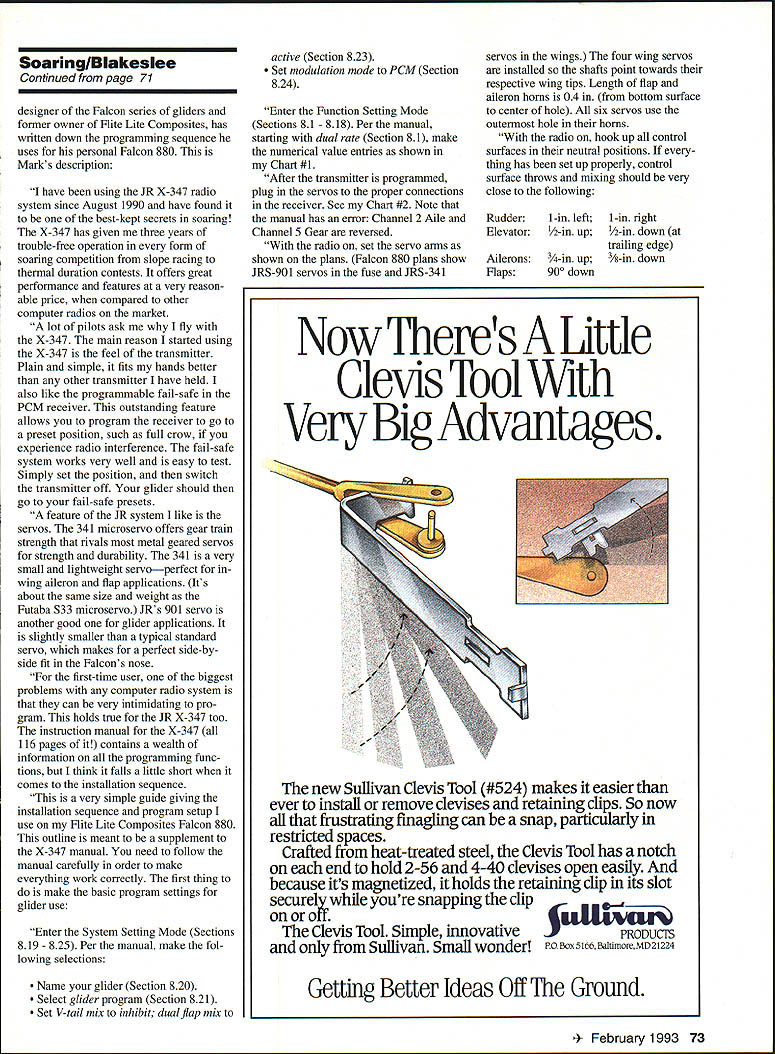
General description: the Predator is a modern 120-inch-span sailplane that looks something like an F3B ship but is intended for thermal competition, slope flying, and all‑around sport flying. Specs and notes:
- Span: 120 inches
- Wing area: 973 sq. in.
- Length: 54 inches
- Weight: 85 ounces (prototype)
- Wing loading: 12.5 oz./sq. ft.
- Airfoil (prototype): RG12a; molded version expected to use RG15
- Base price: $650 plus shipping
Design notes:
- The RG12a was selected early because the RG15 looked too symmetrical for all‑around use; RG12a was expected to give better minimum sink and thermal performance. Later, Dave shifted to using the RG15 for the molded version and expects even better high‑speed behavior while retaining good climb.
- Camber change is important with the RG foils to make them perform optimally.
- In marginal lift the Predator won't climb as well as an SD7037 or E205, but in Hawaii's typically windy, medium‑to‑strong lift it has performed very well.
- Ballasted to about 96 ounces, the Predator penetrates strongly — in 20‑knot winds it feels as if there were no wind at all. Pitch and roll are well balanced; the ship flies fast and may take some adjustment for pilots used to slower ships.
Offerings and finish:
- Predators are offered finished — no cutting and hinging required by the buyer.
- All surfaces are gel‑coated; multiple color options and custom graphics are available.
- Customers receive an order card showing views of all surfaces to indicate color and radio/servo choices.
- Options: two‑aileron/two‑flap servos or two‑aileron/one‑flap servo installation.
Contact:
- Dave Hill Custom Hawaii, 91‑229 Wahine 'Oma'o Way, Ewa Beach, HI 96706; tel. (808) 681‑0051.
Libelle H‑301B (four‑meter) — Dave Hill
Dave is also offering a four‑meter Libelle H‑301B as a kit after molding a fuse for himself. The Libelle is a favorite scale model for him, and demand from club members and visiting pilots prompted kit availability.
Construction and notes:
- Fuse, rudder, and canopy: molded white gelcoat
- Wings and stab: foam cores with obeche sheeting
- Leading edges sanded; ailerons and flaps cut and capped
- The Libelle's moments and aspect ratio are conservative, making it an excellent scale model without enlarging tips or stab
Specs:
- Span: 158 inches
- Area: 1,025 sq. in.
- Length: 63.5 inches
- Weight: 136 ounces
- Airfoil: HQ 3.0/13 → 3.0/12
- Price: $400 plus shipping
Dave says the Libelle often gets higher on launch than the Predator — and it's scale.
JR X‑347 / Falcon 880 Project — Mark Allen
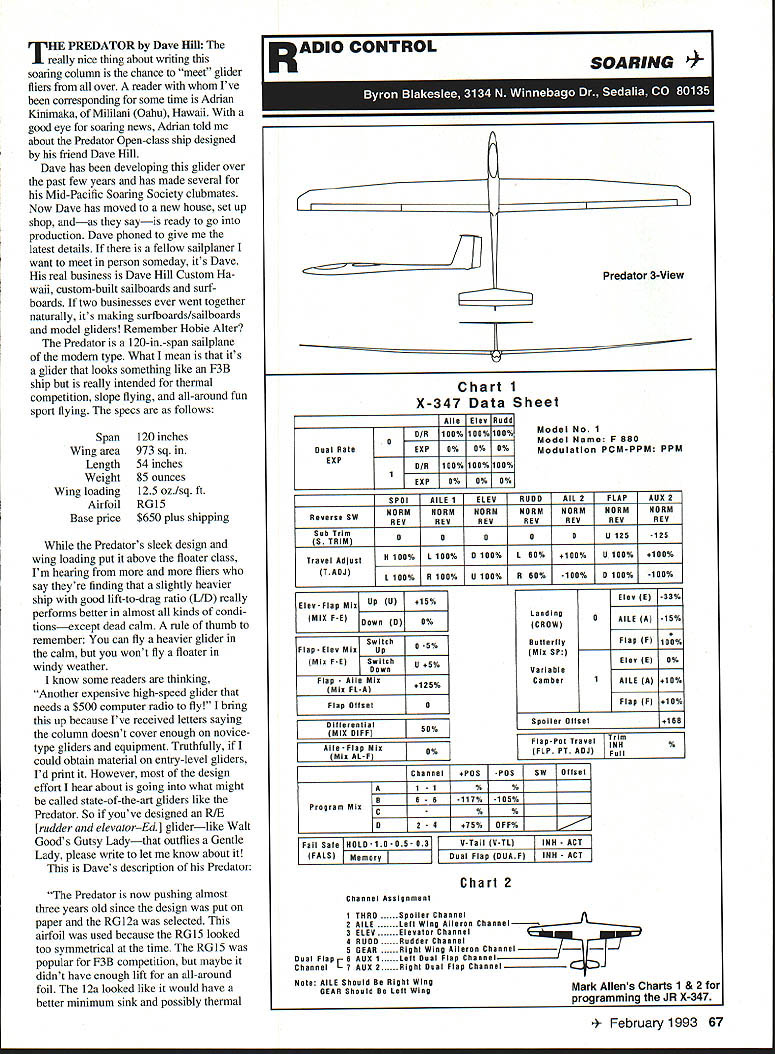
Mark Allen (designer of the Falcon series and former owner of Flite Lite Composites) describes his programming and installation sequence for using the JR X‑347 radio on a Falcon 880. The outline below is a supplement to the X‑347 manual and reflects Mark's personal setup.
Initial system settings (follow the X‑347 manual sections referenced):
- Enter System Setting Mode (Sections 8.19–8.25):
- Name your glider (Section 8.20).
- Select glider program (Section 8.21).
- Set V‑tail mix to inhibit; dual flap mix to active (Section 8.23).
- Set modulation mode to PCM (Section 8.24).
- Enter Function Setting Mode (Sections 8.1–8.18):
- Start with dual rate (Section 8.1) and make numerical entries as needed (Mark used specific values — see his charts if available).
Installation and servo hookup:
- After programming, plug servos into the receiver according to Mark's layout (note: the manual has an error — Channel 2 Aile and Channel 5 Gear are reversed).
- The Falcon 880 uses JR S‑901 servos in the fuse and JRS‑341 microservos in the wings per the plans.
- Wing servos are installed so their shafts point toward the respective wing tips.
- Flap and aileron horn length: 0.4 in. (from bottom surface to center of hole).
- All six servos use the outermost hole in their horns.
- With the radio on, set servo arms and hook up control surfaces in neutral. Control throws and mixing should be close to:
- Rudder: 1 in. left / 1 in. right
- Elevator: 1/2 in. up / 1/2 in. down (measured at trailing edge)
- Ailerons: 3/8 in. up / 7/8 in. down
- Flaps: 90° down
Mixing:
- Rudder mixed with aileron: 3/4 in. left and right
- Camber mixed with elevator: flaps 3/4 in. and ailerons 1/8 in. down
Landing mode (set by Butterfly/Crow mixing switch):
- Pos. 0 (Landing): Flap 90° down; aileron 1/8 in. up; elevator 3/8 in. down
- Pos. 1 (Launch/Thermal): Flap 1/4 in. down; aileron 1/8 in. down; elevator neutral
Usage notes:
- The Butterfly/Crow switch determines what the throttle stick does. Mark uses Pos. 1 for launching (full stick for launch, half stick for thermal centering) and Pos. 0 for landing. With the throttle stick full up in either position, the wing trailing edge and elevator should be neutral.
- The Aileron‑to‑Rudder switch should usually be on, except for high‑speed turns. Elevator‑to‑flap mixing is a matter of personal preference — experiment to find what suits you.
- The X‑347 manual is comprehensive but can be intimidating; test settings at the field and refine until the ship is "dialed in."
Additional notes:
- Hobby Dynamics offers a $30 modification that replaces the Flap‑Elevator switch with a three‑position Mode switch (Launch / Neutral / Thermal), similar to the Flight Mode switch on the Airtronics Vision. Some airplane/helicopter software is lost in the modification; for glider‑only use this is not an issue.
Reference: Tom Long wrote an extensive article on programming the modified X‑347 in RC Soaring Digest (September 1992). RCSD subscription: $19/year. RCSD, P.O. Box 2108, Wylie, TX 75098‑2108; tel. (214) 442‑3910 (Jerry or Judy Slates).
Falcon 880 with SD7037 Airfoil — Field Impressions
Mark built a Falcon 880 from a Flite Lite presheeted wing kit using the SD7037 airfoil and used the JR X‑347 on it. The SD7037 section is currently popular and is 9.20% thick with 3.02% camber and a slight undercamber on the bottom.
Comparative notes:
- The original Falcon 880 uses an S3021 at the root (9.47% thick, 2.96% camber) transitioning to S3014 at the tip (9.46% thick, 2.57% camber). Both are flat‑bottom sections.
- Mark's Falcon weighed 59 oz. (wing loading 9.6 oz./sq. ft.). My Falcon weighs 60 oz.; I generally fly with +4 oz ballast except in dead calm.
- Mark's Falcon launched well; the wings felt stiff and it performed respectable zooms for a light ship. CG and trim were near right, the dive test was straight, and the best L/D cruise speed seemed similar to the standard Falcon. Handling was comfortable and it climbed impressively in lift.
- My impression after ~30 flights: the SD7037 works well in small, light patches of lift but a lightly loaded 7037 tends to be lively in breeze. Ballast would smooth this and improve penetration.
- Mark agreed: SD7037 is good for light conditions; the regular Falcon section may be better in stronger breeze.
1992 F3B Team Selection Finals (Carson, CA — Sept 5–7)
The finals were hosted by the Soaring Union of Los Angeles. To qualify, pilots had to pass flight standards or place high in qualification contests. Competitors organized into five teams by region:
- Team 1: So. California No. 1
- Team 2: Arizona
- Team 3: Illinois
- Team 4: Colorado
- Team 5: So. California No. 2
Order of finish (place — pilot — glider — score — team):
- Joe Wurts — F3B Eagle — 14,742 — 1
- Larry Jolly — Ellipse — 14,569 — 1
- Randy Spencer — F3B Eagle — 14,431 — 1
- Daryl Perkins — F3B Eagle — 14,261 — 1
- Steve Lewis — Comeagle — 14,144 — 1
- Don Edberg — Comet 89T — 14,000 — 1
- Skip Miller — Ellipse — 13,868 — 4
- Seth Dawson — Omega — 13,609 — 2
- Steve Condon — Synergy — 13,358 — 5
- Rich Burnoski — Comet 89T — 13,332 — 3
- John Wyss — Reaction — 13,320 — 2
- Don Sciegiel — Omega — 13,016 — 2
- Jack Sasson — Reaction — 12,912 — 4
- Gavin Botha — Synergy — 12,784 — 3
- Mike Reagan — F3B Eagle — 12,724 — 5
- Phil Renaud — Omega — 12,638 — 2
- Jim McCarthy — Comet 89T — 12,428 — 3
- Lenny Keer — Comet 89T — 12,359 — 3
- Manny Tau — Modi 900 — 11,702 — 5
- Dennis Phelan — Comet 89T — 11,654 — 3
- Phil Gilbert — Comet 89T — 11,289 — 2
- Buzz Averill — Comet 89T — 749 — 2
Notes:
- The top six finishers were all on Team 1 (So. California No. 1). This was significant because duration and distance tasks are flown man‑on‑man — flight groups are arranged to contain pilots from different teams to avoid collusion.
U.S. Team for 1993 & Joe Wurts
- Joe Wurts, winner of the 1991 F3B World Championship, is automatically eligible for the 1993 champs as defending champion and may enter as an individual. Joe has chosen to step down from the official four‑man U.S. team so a full American team can be selected.
- The 1993 U.S. team will therefore consist of Larry Jolly, Randy Spencer, and Daryl Perkins. Joe Wurts will fly in the event but his score will not count toward the Team Championship awards.
- Skip Miller has been asked to serve as Team Manager.
- Background: The 1991 team was Wurts, Perkins, and Jolly, with Spencer as Team Manager. Miller won the first F3B World Championship in 1977 and placed ninth in 1979.
1993 Segelflug Bildkalender
The Segelflug Bildkalender (soaring wall calendar) for 1993 is available. The weak U.S. dollar has increased cost, but the full‑color sailplane photographs make excellent contest awards.
- Price: $18.50
- UPS shipping inside the U.S.: $5.00 (outside the U.S.: $7.50)
- Order to: Hortenflug, 4420 Daventry Ct., Charlotte, NC 28226
(For club contest prizes, the author mounts the 12 photos on 20 x 14‑inch mats and lets top pilots choose.)
Transcribed from original scans by AI. Minor OCR errors may remain.

