
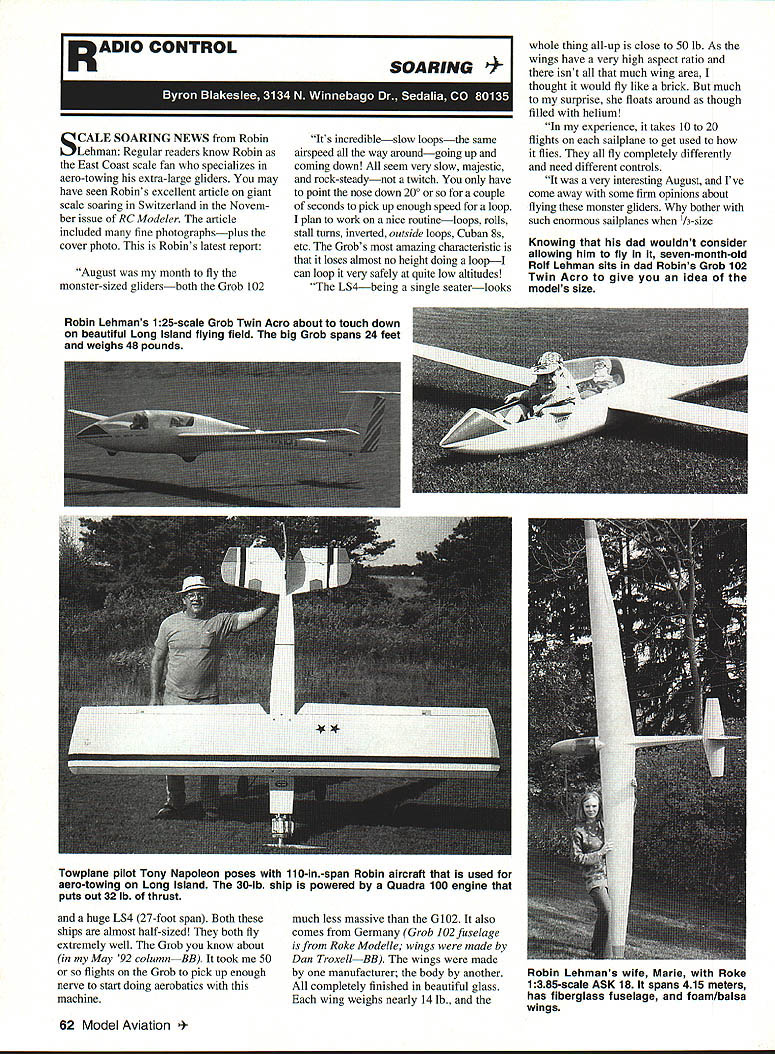
Radio Control: Soaring
Byron Blakeslee, 3134 N. Winnebago Dr., Sedalia, CO 80135
SCALE SOARING NEWS from Robin Lehman
Regular readers know Robin as the East Coast scale fan who specializes in aero-towing his extra-large gliders. You may have seen Robin's excellent article on giant scale soaring in Switzerland in the November issue of RC Modeler. The article included many fine photographs—plus the cover photo. This is Robin's latest report:
"It's incredible—slow loops—the same airspeed all the way around—going up and coming down! All seem very slow, majestic, and rock-steady—not a twitch. You only have to point the nose down 20° or so for a couple of seconds to pick up enough speed for a loop. I plan to work on a nice routine—loops, rolls, stall turns, inverted, outside loops, Cuban 8s, etc. The Grob's most amazing characteristic is that it loses almost no height doing a loop—I can loop it very safely at quite low altitudes!
"The LS4—being a single seater—looks much less massive than the G102. It also comes from Germany (Grob 102 fuselage is from Roke Modelle; wings were made by Dan Troxell—BB). The wings were made by one manufacturer; the body by another. All completely finished in beautiful glass. Each wing weighs nearly 14 lb., and the whole thing all-up is close to 50 lb. As the wings have a very high aspect ratio and there isn't all that much wing area, I thought it would fly like a brick. But much to my surprise, she floats around as though filled with helium!
"In my experience, it takes 10 to 20 flights on each sailplane to get used to how it flies. They all fly completely differently and need different controls.
"It was a very interesting August, and I've come away with some firm opinions about flying monster gliders. Why bother with such enormous sailplanes when 1/3-size gliders are much more transportable and much easier to aero-tow? The answer comes when you see these huge gliders fly. They move with not a single twitch. They carve absolutely rock-steady, smooth grooves in the sky. Obviously, the smaller you go, the more difficult it is to fly without twitching the wings.
"A new-found friend, John F. Clarke, made a video he is calling How to Air-Tow. It shows both smaller and larger gliders and tow planes. We spent a day and a half videotaping this project. You will be able to see firsthand the monster Grob and LS4, your 4.15-meter Roke ASK 18 (Robin talked me out of my ASK 18! —BB), and a couple of other smaller gliders.
"Last but not least, I am now in my Rochester, New York, mode. I live there most of the year and on Long Island sporadically on some weekends and mainly in the summer. We fly the monster gliders on Long Island because that's the only place where we have a large tow plane. In Rochester, it's quarter-size and smaller air-towing, and mostly slope soaring. We have three hills within a half hour's drive of where I live, and recently discovered some nice hills on Lake Ontario. One of the Rochester clubs does a lot of winch and competition flying. I occasionally go there and fly my smaller gliders, but frankly I really prefer slope soaring and air-towing."
John F. Clarke's video of Robin's air-towing sounds exciting—I love to see the Grob and LS4 in the air! John's ad in RC Soaring Digest says his tapes are $15, including shipping and handling. The address is 911 Covert Ave., New Hyde Park, NY 11040.
Auto-Vac System from Aerospace Composite Products
In the early days of vacuum-bagging, it was difficult to find a source for supplies, equipment, and information. Fortunately, things are much easier today. Aerospace Composite Products recently introduced a high-quality "pro" vacuum pump system. Now Aerospace Composite Products has teamed with Greco Technologies (the Modi folks) to produce an up-to-date video on how to make vacuum-bagged wings.
But first, ACP's release on the Auto-Vac:
"ACP has developed a fully automatic vacuum-bagging system that eliminates the need for constant monitoring during the bagging process. The Auto-Vac system is unique in that it is completely self-monitoring, eliminating the need to run the pump continuously. The switch senses the vacuum in the system and activates the pump only when the vacuum falls below a preset point.
"Since the pump runs only on demand, the user no longer needs to be concerned with its running continuously for 24 hours or more. The switch is fully adjustable from two to 24 inches of mercury vacuum. The reservoir prevents frequent cycling of the vacuum pump, even when there's a leak in the system.
"The Auto-Vac kit comes completely assembled, mounted on a wood base, and ready to use. Included in the kit are the E-Z Vac II electric pump, adjustable vacuum switch, vacuum gauge, large-capacity reservoir, check valve, neoprene tubing, E-Z Vac connector, two Quick-Lok seals, nine feet of 18-in.-wide bagging tube, nine feet of 15-in.-wide breather cloth, and a complete set of vacuum-bagging instructions.
"The Auto-Vac kit is available through your local hobby store or directly from Aerospace Composite Products, at $198 complete plus $7 for shipping and handling. For more information, contact ACP by calling (714) 250-1107, fax (714) 250-0307, or write to P.O. Box 16621, Irvine, CA 92714."
This is ACP's description of the Introduction to Vacuum-Bagging video produced by Greco Technologies:
"This easy-to-use reference video was designed to be an introduction into the exciting techniques of vacuum-bagging wings. The video was created on the premise that the modeler does not want to spend his time researching how to vacuum-bag.
"The video features George Spitzer, an avid RC pilot for eight years. He has been building and designing his own composite aircraft for the past four years. Spitzer gives the modeler the benefit of his experience on bagging and gives helpful suggestions and tips. Each step is explained in plain English.
"The video comes with an accompanying booklet. It is a review of the techniques in vacuum-bagging and in some cases, an expansion. Having both the visual picture from the video and the written instructions make the techniques simple for the modeler to follow."
I've seen the video and recommend it highly to anyone just starting in bagging. It includes helpful hints that will be of interest to more experienced baggers as well. If you are only considering bagging, this is a quick way to decide if and how you should proceed. The video and booklet cost $25 plus $4 shipping and handling. Write to ACP's address given above.
North American Scale Soaring Association
North American Scale Soaring Association (NASSA) is a brand-new organization being formed to promote scale glider flying in the U.S. and Canada. Will Byers, author of Model Aviation's "Slope Soaring" column, sent the full story printed below.
You may recall that Will and his Tri-Cities Soarers club have been putting on the Scale Soar Fun-Fly in Richland, Washington, for several years (now alternating with Torrey Pines in southern California—Richland in even years, Torrey Pines in odd years).
The Scale fun-fly concept has proven extremely popular. Well over 100 pilots show up, each one usually bringing several gliders. Gliders range from small Power Scale ships to 1/4- and 1/5-scale sailplanes. Last year, there wasn't much wind at Eagle Butte, so the guys resorted to winch launching!
Some of the pilots who so much enjoy the scale fun-flys decided it would be a good idea to form a permanent organization to coordinate them, as well as to promote other scale events. Because so many Canadians come down for the fun-flys, NASSA is a joint U.S./Canadian effort.
This is what Will sent about NASSA:
"The association is being founded to promote scale gliding in the U.S. and Canada. The group will be made up of members who have a like interest in scale and who will help promote scale flying events. This will include many scale flying formats: slope, thermal, duration, cross-country, aero-tow, and winch.
"NASSA will publish a newsletter and compile information for members to draw on. The idea is to help enthusiasts find information and to promote scale soaring fly-ins. We intend to have an annual National Scale Rally based on NASSA-established rules (which I prefer to call guidelines).
"We (the NASSA core membership) have decided to host an introductory event for 1993. The event will be held during the weekend of July 10–11. We encourage all scale enthusiasts to participate; however, this event will emphasize the late-June/early-July type of soaring maneuvers, as well as the usual slope soaring and fun-fly maneuvers.
"We're tentatively planning the thermal event to use a format that has been developed by Mr. Martin Simons' club in Australia. Gliders are divided into Vintage and Modern classes. Vintage is any glider that first flew prior to November 1957. The Thermal duration event will be for a total of 40 minutes. The 40 minutes of airtime usually involves multiple launches; however, if the pilot can stay aloft for 40 minutes on one flight, that's okay too. Landing is on a scale-type runway.
"Models are judged for accuracy of scale and detail by standoff-scale format. Judges must stand outside a 25-foot-diameter circle. For the initial event, we're thinking the scale bonus shouldn't be greater than 10% of the flight score. At some future point, there may well be a special event dedicated to precision scale. At any rate, the idea behind judging is just to promote the accuracy of scale.
"What do you think of all this? How should we proceed in making the scale movement grow? Tom Kikuchi is certainly helping enthusiastically by getting JR to contribute four X-347 radios to the effort.
"For those who are interested in joining NASSA, the cost is $10. The money will be applied to the expense associated with publishing the newsletter in RCSD and advertising/mailings. None of it will go toward enriching the organizers! Where and how the association's funds will be spent will be decided by some type of board. (Directors of course need to be chosen.) Many of these types of decisions still need to be worked out, and they will be.
"But first, NASSA needs members and people willing to become involved in the workings of such an association. If modelers want to join right away, they can send $10 and my address: NASSA, Rt. 4, Box 9544, W. Richland, WA 99352. Or send an SASE for an application form."
Self-launching sailplanes?
I added the question mark because many folks aren't sure engines belong in sailplanes! Full-size sailplanes are experiencing similar emotional conflicts. Currently, more full-size gliders are being produced with engines than without. The problem is figuring out how to handle motorized gliders in soaring contests designed for towed-up sailplanes.
But back to models. The question is, what's the best way to develop a contest class for electric-motor-powered gliders that are designed principally for soaring? We are almost certainly not talking about limited motor-run events because they will always encourage powerful propulsion systems for maximum climbing ability—even if the climb is limited to a modest number of Ni-Cd battery cells.
Let's hear from a flier who has some experience on the subject. This is a letter from old pal Dave Manley of Shawnee, Kansas:
"After attending our club's Electric fly, I walked away from 22 years of soaring pursuit into a total fascination with self-launching sailplanes. The Mid America Soaring Association (MASA) members hold both pure and self-launching sailplane contests monthly. Initially, only two or three MASA members dabbled in self-launching craft. Now nearly half fly Electrics.
"The electric contingent basically regard electric motors as just another way to launch. Some fly the self-launchers as 'pure' sailplanes, using the power plant only to launch. Once the power is off, the sailplane is flown as though motorless. The motor is only used again to initiate another ground launch.
"Two members are constructing an altitude-sighting device so they can create a 500-foot (or whatever) starting 'gate' similar to those used in full-size sailplane contests.
"The instrument allows the crew on the ground to see when a sailplane crosses an imaginary line and whether that craft is higher than allowed for a 'legal' contest start.
"Using this method makes possible the mixing of self-launching craft with the 'pure' in the same event. The planes launch (by winch, high-start, or on-board motor) and then fly through the gate. Once through, they begin the thermal search.
"The gate concept originated when a couple of us were discussing the shortcomings of current AMA electric rules. The limited motor runs encourage extremely light (and sometimes frail) craft driven to altitude by extremely expensive motors. The unlimited category necessitates (by some competitors' definitions) over-propping and more powerful battery packs than recommended by the motor manufacturers. We want a soaring event, not a fly-on race to altitude!
"Lastly, our primary interest is soaring, not the launching method—although we have a club member who says a sailplane must be motorless. Another member insists a pure sailplane can be self-launched—as all other soaring creatures are. Best of all, those of us who fly self-launching gliders are not at all evangelical—a trait deeply appreciated by the other members."
Thanks for the letter, Dave. Because this is really a whole new soaring ballgame, it should help stir up some controversy. Please let us know how the starting gate idea works. I'm eager to hear from other readers with thoughts about self-launch soaring, pro or con.
Suntiger sunglasses
A few years back we heard a lot about Suntiger orange-tinted flying glasses, and then the dealer went out of business. In a recent copy of Soaring, the magazine of the Soaring Society of America (full-size soaring), I noticed an ad for Suntigers. They are available from Res Co Supply, 2042 Terrace Drive, Long Beach, CA 90806. The price is $64.50, plus $4 shipping and handling. Frames are matte black carbon fiber with stainless-steel temples. A hard case is included. The glasses are 100% effective against UVA and UVB.
Orange-tinted glasses make a blue sky appear gray. This increases the contrast between the sky and your glider, and you can see it farther away. I got my orange-tinted prescription glasses from LensCrafters. They use Brain Power dye, which I think is similar to the dye used for Suntigers.
What radio should I buy?
If you are asking yourself this question, help is at hand. Don Edberg, editor of the soaring column in RC Modeler magazine, has put together a handy comparison chart for the seven computer-type radios available in the U.S. Included are the Ace Micropro, Airtronics Infinity 600, Airtronics Vision 8SP, Control Systems Labs Vision Upgrade, Futaba Super 7, Futaba 9VAP, and JR X-347 (upgraded). Don also gives you a one-page summary of his thoughts on each radio. Your choice, of course, depends on your personal situation, but Don helpfully provides his own opinion of the pros and cons of each rig.
Don did not include what I consider the plus ultra of computer radios, the made-in-Germany Multiplex 3030. This is a fairly rare set here because of its price (around $1,000), but is very popular in Europe. Multiplex radios and kits are available from Beemer R/C West in Arizona (phone (602) 837-0311). The JR-made Graupner MC-18 radio is also popular in Europe, but is not available here.
Don has also written a one-page "Servo Conversion Chart." This is something every sailplaner needs because no matter which brand of radio we use, we always seem to be mixing Airtronics, Futaba, and JR servos. Don shows you how to modify servo plugs so they work with your radio.
The "Sailplane Radio Comparison Chart" is $2; the "Servo Conversion Chart" is $1. Send your three bucks to Dynamic Modeling, 4922 Rochelle Ave., Irvine, CA 92714. Phone is (714) 552-1912.
Transcribed from original scans by AI. Minor OCR errors may remain.

