
Radio Control: Soaring
Byron Blakeslee 3134 N. Winnebago Dr., Sedalia, CO 80135
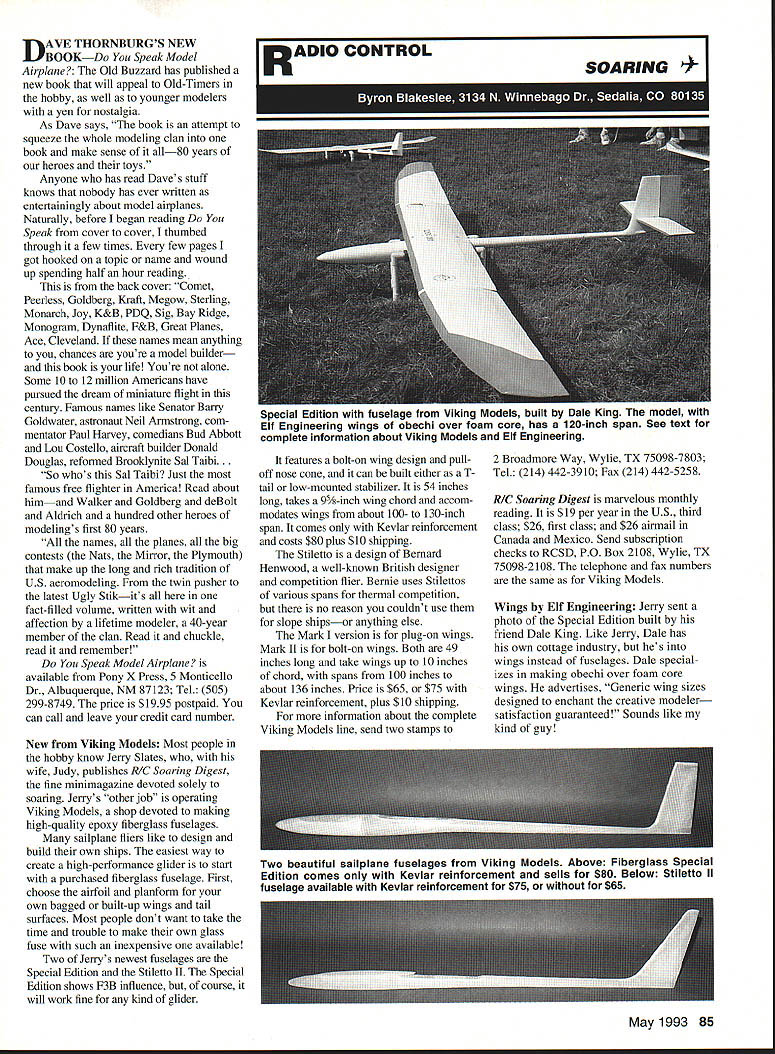
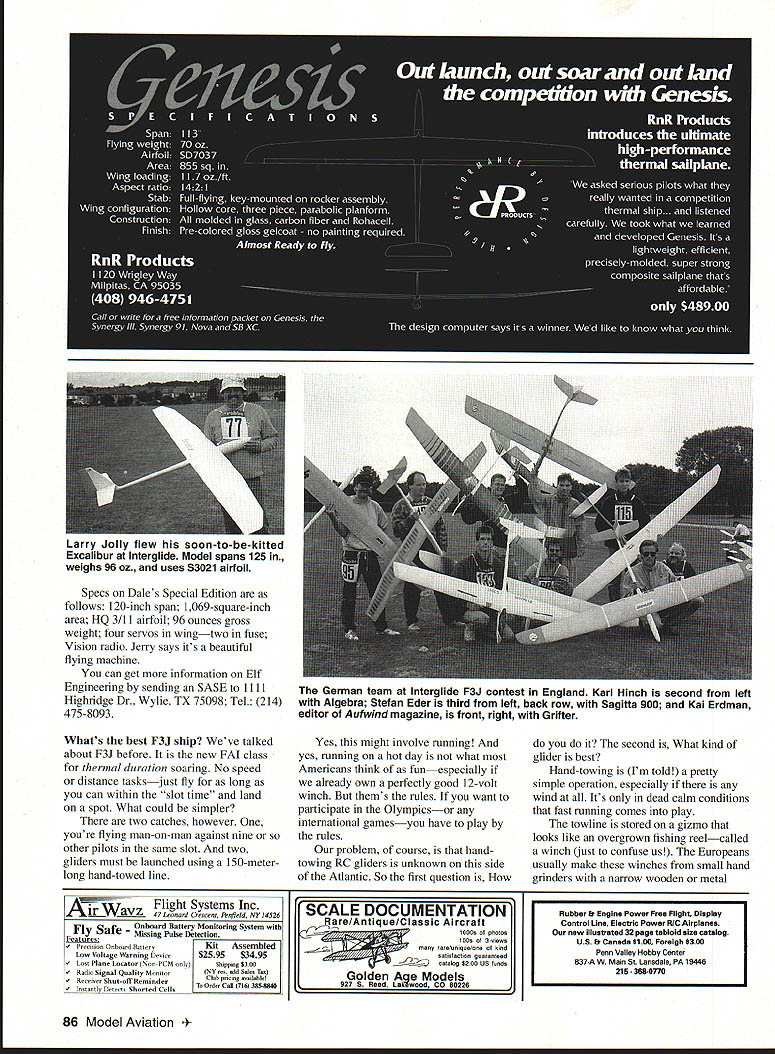
Viking Models fuselages (New Viking Models / Special Edition / Stiletto II)
Viking Models, operated by Jerry Slater, produces high-quality epoxy/fiberglass fuselages that make it easier for sailplane fliers to create high-performance gliders by adding their own wings and tail surfaces.
Special Edition
- Bolt-on wing design and pull-off nose cone.
- Can be built with either a high- or low-mounted stabilizer.
- 54 inches long; accepts a 9½-inch wing chord.
- Accommodates wing spans about 100–130 inches.
- Kevlar reinforced.
- Price: $80 plus $10 shipping.
Stiletto II (design by Bernard Henwood)
- Mark I: plug-on wings; Mark II: bolt-on wings.
- 49 inches long; accepts wings up to 10 inches chord.
- Span range about 100–136 inches.
- Price: $65 (or $75 with Kevlar reinforcement); add $10 shipping.
For more information about the complete Viking Models line, send two stamps to 2 Broadmore Way, Wylie, TX 75098-7803; Tel: (214) 442-3910; Fax: (214) 442-5258.
R/C Soaring Digest (subscription)
R/C Soaring Digest is a monthly magazine devoted to soaring.
- $19 per year in the U.S., third class.
- $26 per year first class in the U.S.
- $26 per year airmail to Canada and Mexico.
Send subscription checks to RCSD, P.O. Box 2108, Wylie, TX 75098-2108. The telephone and fax numbers are the same as for Viking Models.
Wings by Elf Engineering
Jerry sent a photo of the Special Edition built by his friend Dale King. Dale specializes in making obeche-over-foam-core wings. He advertises: "Generic wing sizes designed to enchant the creative modeler—satisfaction guaranteed!"
F3J (FAI thermal-duration class)
What is F3J?
- F3J is an FAI class for thermal-duration soaring with no speed or distance tasks: fly for as long as you can within the "slot time" and land on a spot.
- Gliders for F3J must be launched using a 150-meter hand-towed line (hand-tow), which may require running.
Hand-towing technique
- Hand-towing is relatively simple, especially with any wind. Dead calm conditions require fast running.
- The towline is stored on a device resembling an oversized fishing reel—commonly called a winch. Europeans often make these from a small hand grinder with a narrow drum replacing the grinding wheel; commercial winches are also available.
- The winch gearing makes it easy to wind up the line quickly after a launch.
- Line: 100- to 150-pound-test monofilament with a flag or small chute on the end.
- Another technique for no-wind days: fix the end of the line to a spike and tow with a pulley hooked on the line. Line length is lost, but the pulley gives a 2:1 mechanical advantage for greater speed.
Which glider is best?
- There is no single best F3J glider. Conditions dictate the required type—"horses for courses."
- Pilots typically need a variety of planes and must know their gliders well.
- In F3J contests, the last two flyoff slots are 15 minutes in duration; long flights and smart decisions are required.
Expert opinions
#### Bernard Henwood (British Radio Modeller Soaring column editor)
- In the UK, Henwood believes gliders under three meters span are too small for F3J/Open contests. Bigger models tend to fly better in the UK's changeable conditions.
- Typical contest day: flying starts around 9:30 a.m. and may finish as late as 6 p.m. Thermals often peak mid-afternoon; mornings and evenings can be very light.
- When lift is unpredictable, a model around 144 inches span has advantages: lower sink rate, greater ability to cover ground, and better climb in very light lift.
- On strong thermal days, smaller models have faster tow times and can be more maneuverable in small thermals near the ground; ailerons can reduce differences between big and small models.
- In light-breeze conditions, big rudder/elevator (no aileron) models can be landed very accurately; ailerons can sometimes be a disadvantage in these conditions because they may disturb the wing near minimum sink.
- Henwood often set up his transmitter with rudder and elevator on the right stick and aileron on the left, coupling aileron with rudder only when required.
- Very large models (~5 meters span) occasionally appear but Henwood feels they are too big—more building time, more risk in tight flying, and may inhibit pilot aggressiveness.
- Henwood modified a Stiletto II bolt-on-wing fuselage with two aluminum tubes from the radio bay into the tailboom to carry ballast close to the CG and strengthen the wing seat area. His wing is basically three-piece with plug-on tips to experiment with different spans and tip shapes—current tips allow spans from 142 to 167 inches and increase area by about one square foot.
- He plans to experiment with asymmetric tip combinations to study response but notes asymmetric towing could be “just too exciting.”
#### Stefan Eder (Germany)
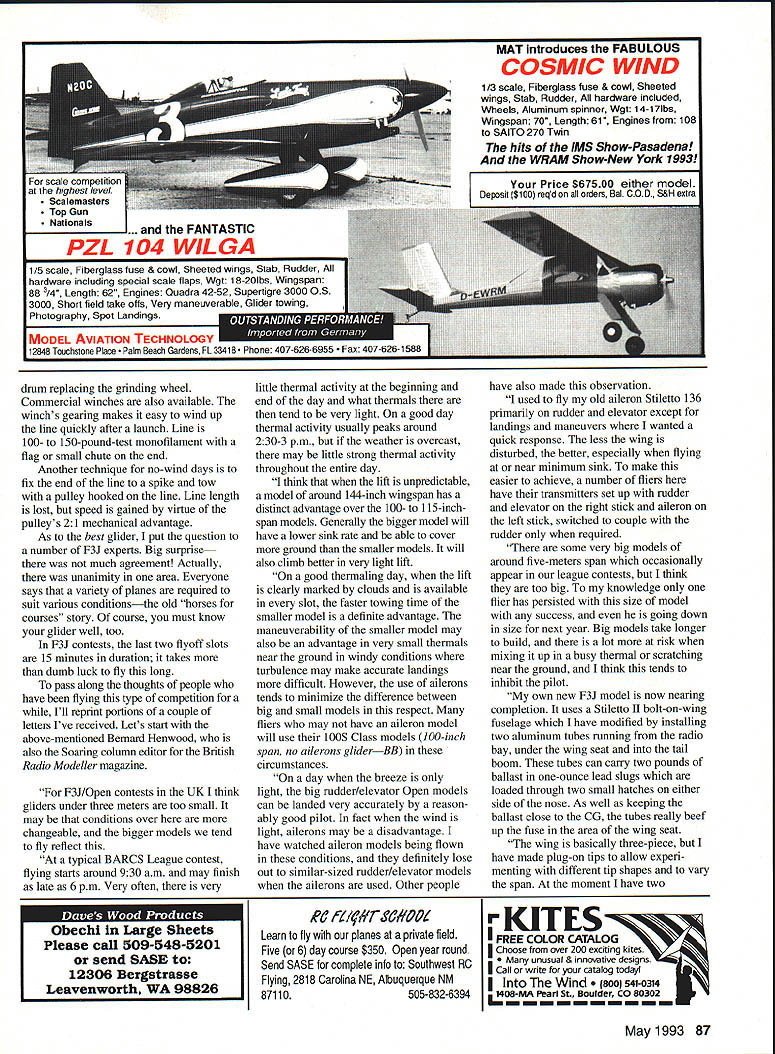
- Stefan, third in the 1992 F3J Europa Cup, also emphasizes that there is no one best design; successful competitors generally need at least two models.
- For light conditions: a floater such as the British Algebra or a Sagitta 900 (or similar) is recommended.
- For windy weather: an F3B design or other higher wing-loading model is better.
- A good all-around F3J design: about 3-percent camber airfoil, ~3.5-meter span (~138 inches), relatively light with the option for ballast for windy conditions. Flaps can help with crowd-mode landings.
- Stefan used a Sagitta 900 (Airtronics kit) and a Synergy 91 (RinR Products) in the 1992 Cup; he also tried his F3B design Patch 5 but had radio trouble with it. For F3J he uses a 3-channel radio with aileron to achieve lower wing loading and more efficiency. He planned to use a Magic Mk III from Weston Aerodels for the next season.
Conclusion from European results
- The 1992 Europa Cup winner flew an Algebra 1000 rudder/elevator kit—showing pilot skill often outweighs equipment sophistication: "the pilot counts for at least three-quarters of the fight."
White Company parachutes
Jim White is noted for high-quality parachutes and now offers anti-tangle netting in the canopy top to prevent the lines that hold the tow ring from tangling. He also offers a detachable hand loop for high-starts so the launcher can slip his wrist through and still have both hands free.
Chute sizes and uses:
- Mini-Chute: 62 square inches — for hand-towing (F3J) and short high-starts.
- Competition-Chute: 82 square inches — for F3B competition and retriever winch operation.
- Standard-Chute: 126 square inches — for normal winch and high-start use.
Features:
- Marine-quality nylon, eight panels.
- Eight continuous nylon shroud lines from top loop over the canopy to the towline loop, all without knots.
- Color options: solid red, orange, or yellow; or mixed eight-panel combinations (red, white, orange, yellow, and other colors) for easy winch identification.
- Price: $15 postpaid (check or money order); add $1 for anti-tangle netting.
Available from The White Company, 122 Spring View Pl., Sequim, WA 98382-2893; Tel.: (206) 683-2893.
Klingberg Wing 100 — lower price
Rol Klingberg reports the list price of the KW 100 has been lowered from $219.95 to $154.95, resulting in a replacement price in the $100 range. The price drop is mainly due to replacing pre-spliced balsa sheeting with standard three-inch-wide sheeting; the builder does a bit more work but saves over $50. Rol's move to Colorado has been put on indefinite hold; his address remains Future Flight, 1256 Prescott Ave., Sunnyvale, CA 94089; Tel.: (408) 735-8260.
Scale Model Research's new catalog
Bob Banka (Scale Model Research) continues to add subjects to his list.
- The new catalog contains 161 sailplanes and 29 powered sailplanes.
- SMR's Foto Paks (6–24 color photographs) serve as scale and color-scheme documentation and cost about $10–$20.
- The 1993 SMR catalog is a scale modeler's sourcebook: it lists about 4,000 Foto Paks and three-views, and includes articles on preparing scale documentation, shooting photos, and manufacturing scale kits and accessories.
Catalog price: $5 postpaid. Send check to Scale Model Research, 2334 Ticonderoga Way, Costa Mesa, CA 92626; Tel.: (714) 979-8058.
Dave Thornburg's new book — Speak Model Airplane
Dave Thornburg has published Speak Model Airplane, a nostalgic, fact-filled volume covering about 80 years of model aviation history. It profiles companies and personalities—Comet, Peerless, Goldberg, Sig, Great Planes, and many others—and famous modelers and public figures who flew models. The book is written with wit and affection by a 40-year hobbyist and is recommended for both older modelers and newer enthusiasts.
Available from Pony X Press, 5 Monticello Dr., Albuquerque, NM 87123; Tel.: 505-299-8749. Price: $19.95 postpaid.
Lost Hills / Haught (Contest report — excerpts)
Launches in the flyoff produced several notable performances.
- One competitor turned in a 202 for fourth place. When asked if he was happy with his placing, he replied, "No. I'm a pretty competitive person, and I like to win." He vowed to return with revised tow hooks and still-air models.
- Matt Gewain towed toward the most favorable area of the field, made an outstanding launch, and his Pacer glided to a deserved team spot.
- Randy Weiler flew a version of the Wishbone/R1-14 series and rode an extremely flat, slow glide (possibly the flattest and slowest of the flyoff models) to make the team easily.
- First-time team member Tom Coussens, aided by Lee Hines and Jim Parker who checked temperatures and removed obstructions, saw his Sonrise surpass the others for first place. Tom was elated after a long two years of effort and a 1990 final-round disaster that had cost him a team spot.
The year's F1A team—three members from California who can practice together—should be among the best the U.S.A. has produced.
F1C (Power)
- Twenty-eight power fliers began the Finals, which proved to be of very high quality.
- The first round four-minute max was met by 26 of 28 competitors. Most dropped flights were caused by pilot error in tricky air conditions.
- After seven rounds there were still 14 clean scores; after nine rounds there were 11, and that same group held form through the last five rounds to qualify for a mass flyoff the next morning.
Notable flyoff stories:
- Doug Joyce and his canard models qualified—could this be their breakthrough?
- Gil Morris flew the only flapper observed and narrowly made one round by less than a second.
- Charlie Caton, well-known in AMA circles and relatively new to F1C, qualified despite a "string of minor disasters."
- Doug Galbreath survived a midair in an early round that broke a wing tip; he switched to a V-Max until repairs could be made, then switched back.
- The final flyoff field included former team members and top fliers such as Mike Achterberg, Bob Guitt, Ken Happerstet, Ed Keck, Ken Phair, and Roger Simpson.
Speculation was that it would take at least a nine-minute round to cut the field to three. An extended flyoff risked carrying into thermal-flying weather, where drift, haze, timing, and binocular quality could influence results. With no F1B flyoff and only one round of F1A flyoff, the schedule allowed the F1C flyoff to be completed in the least-active conditions possible.
All 11 competitors made the five-minute first round. Doug, Achterberg, and Caton dropped out on the seven-minute second round by a total of 21 seconds. The nine-minute round followed, heightening tension. As the eight remaining fliers took pole positions, near-total silence fell over the line. Doug Galbreath continued his aggressive style, being one of the first away. He clocked a 4:58, then waited for the others to catch him. Ken Oliver went soon after, but
Transcribed from original scans by AI. Minor OCR errors may remain.

