
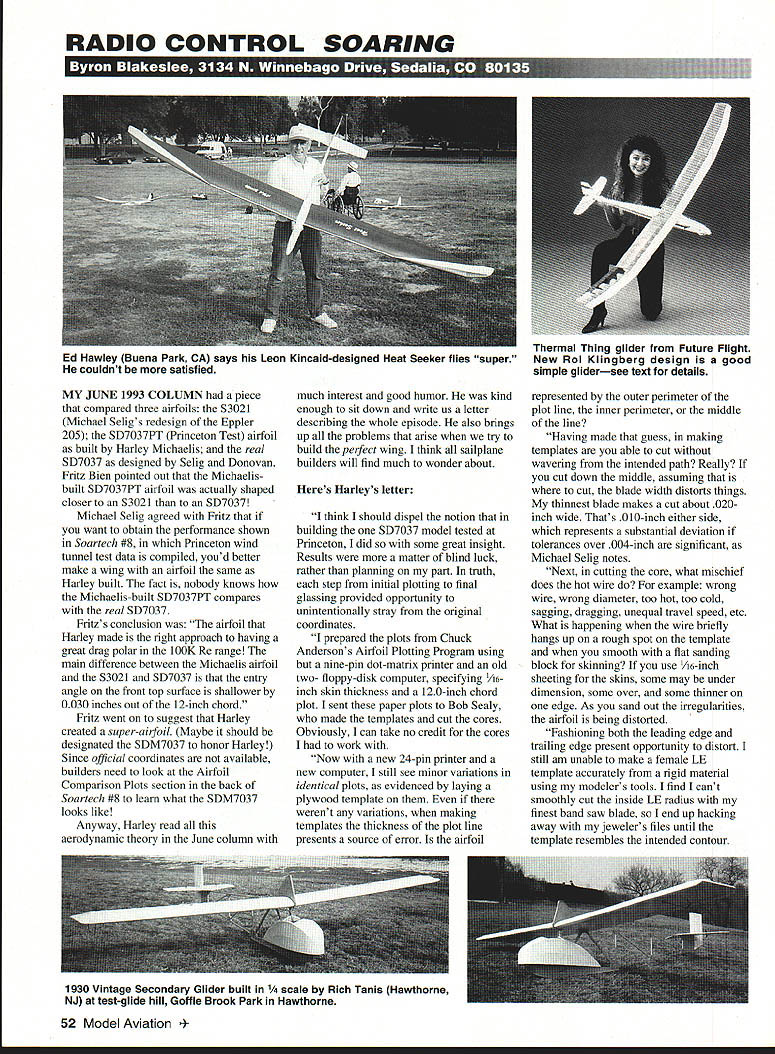
RADIO CONTROL SOARING
Byron Blakeslee, 3134 N. Winnebago Drive, Sedalia, CO 80135
My June 1993 column had a piece that compared three airfoils: the S3021 (Michael Selig’s redesign of the Eppler 205); the SD7037PT (Princeton Test) airfoil as built by Harley Michaelis; and the real SD7037 as designed by Selig and Donovan. Fritz Bien pointed out that the Michaelis-built SD7037PT airfoil was actually shaped closer to an S3021 than an SD7037!
Michael Selig agreed with Fritz that if you want to obtain the performance shown in Soartech #8, in which Princeton wind-tunnel test data is compiled, you’d better make a wing with an airfoil the same as Harley built. The fact is, nobody knows how the Michaelis-built SD7037PT compares with the real SD7037.
Fritz’s conclusion was: “The airfoil that Harley made is the right approach to having a great drag polar in the 100K Re range! The main difference between the Michaelis airfoil and the S3021 and SD7037 is that the entry angle on the front top surface is shallower by .030 inches out of the 12-inch chord.” Fritz went on to suggest that Harley created a super-airfoil. (Maybe it should be designated the SDM7037 to honor Harley!) Since official coordinates are not available, builders need to look at the Airfoil Comparison Plots section in the back of Soartech #8 to learn what the SDM7037 looks like.
Anyway, Harley read all this aerodynamic theory in the June column with much interest and good humor. He was kind enough to sit down and write us a letter describing the whole episode. He also brings up all the problems that arise when we try to build the perfect wing. I think all sailplane builders will find much to wonder about.
Here's Harley's letter:
I think I should dispel the notion that in building the one SD7037 model tested at Princeton, I did so with some great insight. Results were more a matter of blind luck, rather than planning on my part. In truth, each step from initial plotting to final glassing provided opportunity to unintentionally stray from the original coordinates.
I prepared the plots from Chuck Anderson’s Airfoil Plotting Program using an old nine-pin dot-matrix printer and an old two-floppy-disk computer, specifying 1/16-inch skin thickness and a 12.0-inch chord plot. I sent these paper plots to Bob Sealy, who made the templates and cut the cores. Obviously, I can take no credit for the cores. I had to work with them.
Now with a new 24-pin printer and a new computer, I still see minor variations in identical plots, as evidenced by laying a plywood template on them. Even if there weren’t any variations, when making templates the thickness of the plot line presents a source of error. Is the airfoil represented by the outer perimeter of the plot line, the inner perimeter, or the middle of the line?
Having made that guess, in making templates are you able to cut without wavering from the intended path? Really! If you cut down the middle, assuming that is where to cut, the blade width distorts things. My thinnest blade makes a cut of about .020-inch wide. That’s .010-inch either side, which represents a substantial deviation. Tolerances over .004-inch are significant, as Michael Selig notes.
Next, in cutting the core, what mischief does the hot wire do? For example: wrong wire, wrong diameter, too hot, too cold, sagging, dragging, unequal travel speed, etc. What is happening on the wire briefly hangs up on the template and you get a rough spot. When smoothing, you use a flat sanding block for skinning. I use 1/16-inch sheeting for the skins; some may be under dimension, some may be over, and some thinner on the edge. As you sand out irregularities, the airfoil is being distorted.
Fashioning both the leading edge and trailing edge presents an opportunity to distort. I am still unable to make a female leading-edge template accurately from a rigid material using my modeler’s tools. I find I can’t smoothly cut the inside leading-edge radius with my finest band saw blade, so I end up hacking away with my jeweler’s files until the template resembles the intended contour.
Although friend Harry Smith cuts great cores, inevitably leading-edge shaping time reveals that the structure does not lend itself to being shaped like the template. It’s either too thick or too thin at times; I’ve seen discrepancies up to 1/16-inch, which can be far off. So I resort to eyeball engineering, the modeler’s friend TLAR [That Looks About Right] system. Building a multiple-tapered wing surely has template increments and sanding blocks, but I have no tools to accurately shape rounded radii descending dimensions.
Much has been said about keeping the trailing edge thin; since it is impractical to feather to zero, some distortion is inevitable. Most wings I have seen on display show disproportionate trailing-edge thickening, which represents the builder’s limitation in feathering out to a desired thinness while maintaining some strength.
In making the SD7037 model for the wind tunnel, I didn't need to be concerned about practicality at the field. So I extended the fiberglass cloth layers together for a paper-thin surface. This likely impacted the numbers favorably, but is impractical in the real world.
In practice, I always make the plot overlength—say 10/16 inches if the actual chord is to be 10 inches. Then when I build the wing to the 10-inch chord, it is about 1/4-inch thick at the TE with a 0.007-inch carbon fiber laminate between the 1/16-inch skins. This is clearly a TE distortion, but a realistic trade-off. In bagging glass cloth directly over a core, the TE is thinner and looks great, but is subject to easy chipping.
With others raving about my PT SD7037 (9.2% thick with 3.02% camber), I thought I should build a wing with it for my Jouster design. To give the airfoil the best chance, I took particular care in building the wing. Compared to the unheralded S2091 (improved Aquila airfoil, 10.1% thick with 3.91% camber) and the SD7032 (9.95% thick with 3.66% camber), I was not impressed.
The ship did not get as high on tow, had to be kept boring in at higher speed to handle well, had far less favorable stall characteristics, and did not stay up as well in marginal lift. It seemed to cruise faster, which could be advantageous in wind, but it came in hotter on landing.
My conclusion was that I preferred the other two airfoils mentioned. Did I get a wing with the SD7037 comparable to the Princeton model? How would I know? How would any builder know?
Sometimes I think the popularity of an airfoil is the product of:
- some skilled flier happens to win the NATS with it,
- some prominent kit maker arbitrarily decides to use it based on (1), or
- everybody is using it, so it must be good.
We are fortunate to have many fine airfoil choices from the efforts of Michael Selig, John Donovan, David Fraser, and all the builders who provided the models for the Princeton tests. However, with all the talk about airfoils, I think we should remember that such things as sound, basic airframe design, well-made and well-aligned surfaces, proper and matching washout, correct CG, etc., and plenty of practice are vital to success. Even if there were an airfoil of unquestioned superiority for a given application, the expected results would not be achieved without practice and confident piloting.
I have one more anecdote about the SD7037 story. When I tested the Jouster and the other wings, I also found that small differences in span, area and aspect ratio made noticeable performance differences that could exceed the differences among airfoils. In short, the whole airplane counts—balancing wing, tail, fuselage, and pilot skill. If anything, the Princeton tests are a reminder that wind-tunnel numbers are useful guides, not gospel. They help us see trends and identify promising airfoils, but real-world flying depends on how the airfoil is implemented and how the model is built and flown.
Whereas acceptable tolerances are expressed in thousandths of an inch, with the typical tools, techniques, and materials used by the bulk of builders, we are lucky to build in hundredths. I question that it is possible to build a wing and intentionally match a set of coordinates. If you think you could, how could you prove it anyway?
Many thanks, Harley, for your thoughtful comments. Most of us have an intuitive feeling that it's practically impossible to build a wing with a perfect airfoil, but probably not many have stopped to consider all the ways to go wrong.
From personal experience, I can offer another way. Last year my friend Kal Kanyo and I bagged a glass-over-white-foam wing that was supposed to have a HQ 2.5/9.0 airfoil. We bit too much vacuum and kind of squeezed it a little. The airfoil probably came out at about 2.25/8.5, and it still flew fine!
I'll bet many of you were as surprised as I was to learn that Harley is not overly fond of his airfoil, the SD7037. This brings up another important aspect of flying RC gliders. Each flier needs to select a sailplane/airfoil combination with which he is comfortable. Some people prefer lighter and slower models; some like heavier and faster.
If you are a newcomer to the hobby, you need to experiment with a series of kits, which of course can take years. The normal progression is to start with trainer-type designs, which are the lighter/slower-flying gliders. These designs will use higher-lift airfoils that are fairly thick, with higher camber (e.g., the SD7032) and have wing loadings of around 10 ounces per square foot (or less).
After a while you may feel the need for more speed. Then you can look at some of the heavier/faster designs that use lower-lift airfoils like the HQ 2.0/8.0 or RG15, which are thinner and less cambered. Wing loadings will be over 12 ounces per square foot. Heavier designs will ordinarily have stronger airframes and will be capable of dealing with a wider variety of flying conditions—like windy weather.
But as Harley hinted, the name of the game is finding a setup that suits your own flying style and local conditions. This, I find, is a large part of the enjoyment of RC soaring.
Vintage M&M Secondary Glider
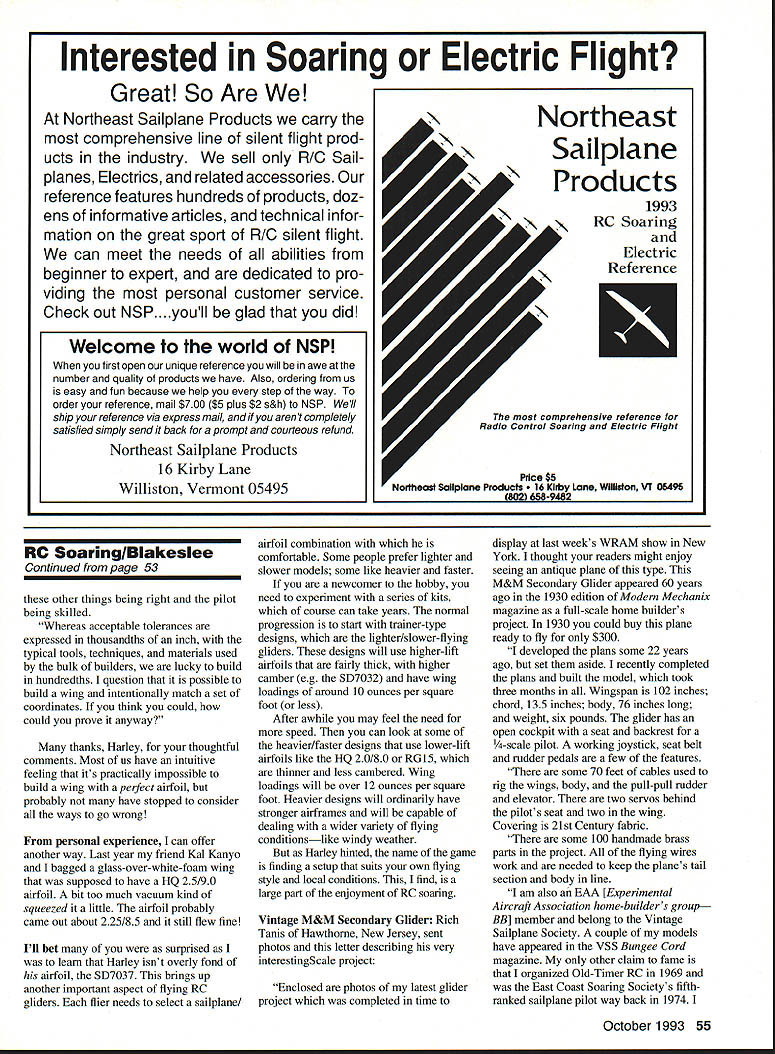
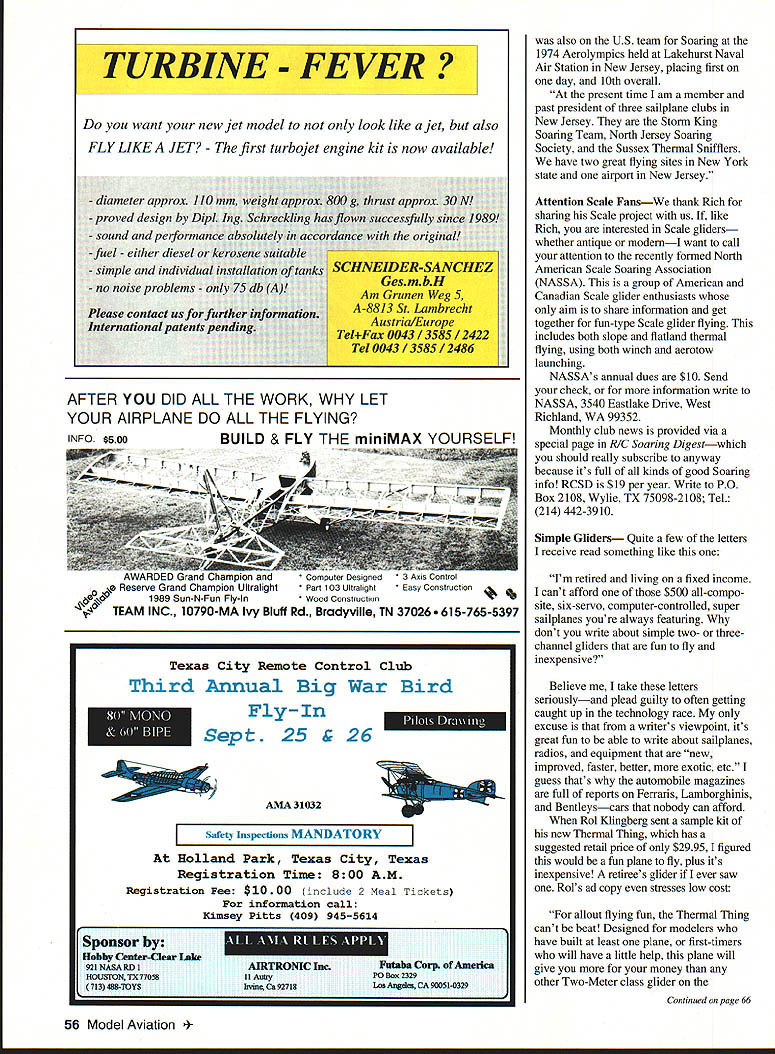
Rich Tanis of Hawthorne, New Jersey, sent photos and this letter describing his very interesting scale project.
"Enclosed are photos of my latest glider project which was completed in time to display at last week's WRAM show in New York. I thought your readers might enjoy seeing an antique plane of this type." This M&M Secondary Glider appeared 60 years ago in the 1930 edition of Modern Mechanix magazine as a full-scale home builder's project. In 1930 you could buy this plane ready to fly for only $30.
"I developed the plans some 22 years ago, but set them aside. I recently completed the plans and built the model, which took three months in all. Wingspan is 102 inches; chord, 13.5 inches; body, 7.5 inches long, and weight, six pounds. The glider has an open cockpit with a seat and backrest for a 1/4-scale pilot. A working joystick, seat belt and rudder pedals are a few of the features.
"There are some 70 feet of cables used to rig the wings, body, and the full-pull rudder and elevator. There are two servos behind the pilot's seat and two in the wing. Covering is 1.5 oz Century fabric.
"There are some 100 handmade brass parts in the project. All of the flying wires work and are needed to keep the plane's tail section and body in line.
"I am also an EAA home-builder's group (BBJ) member and belong to the Vintage Sailplane Society. A couple of my models have appeared in the VSS Bungee Cord magazine. My only other claim to fame is that I organized Old-Timer RC in 1969 and was the East Coast Soaring Society's fifth-ranked sailplane pilot way back in 1974. I was also on the U.S. team for Soaring at the 1974 Aerolympics held at Lakehurst Naval Air Station in New Jersey, placing first on one day, and 10th overall.
"At the present time I am a member and past president of three sailplane clubs in New Jersey. They are the Storm King Soaring Team, North Jersey Soaring Society, and the Sussex Thermal Sniffers. We have two great flying sites in New York state and one airport in New Jersey."
Attention Scale Fans—We thank Rich for sharing his scale project with us. If, like Rich, you are interested in scale gliders—whether antique or modern—I want to call your attention to the recently formed North American Scale Soaring Association (NASSA). This is a group of American and Canadian scale glider enthusiasts whose only aim is to share information and get together for fun-type scale glider flying. This includes both slope and flatland thermal flying, using both winch and aerotow launching.
NASSA's annual dues are $10. Send your check, or for more information write to:
- NASSA, 3540 Eastlake Drive, West Richland, WA 99352
Monthly club news is provided via a special page in R/C Soaring Digest—which you should really subscribe to anyway because it's full of all kinds of good soaring info! RCSD is $19 per year. Write to:
- R/C Soaring Digest, P.O. Box 2108, Wylie, TX 75098-2108; Tel.: (214) 442-3910
Simple Gliders
Quite a few of the letters I receive read something like this:
"I'm retired and living on a fixed income. I can't afford one of those $500 all-composite, six-servo, computer-controlled, super-sailplanes you're always featuring. Why don't you write about simple two- or three-channel gliders that are fun to fly and inexpensive?"
Believe me, I take these letters seriously—and plead guilty to often getting caught up in the technology race. My only excuse is that from a writer's viewpoint, it's great fun to be able to write about sailplanes, radios, and equipment that are "new, improved, faster, better, more exotic, etc." I guess that's why the automobile magazines are full of reports on Ferraris, Lamborghinis, and Bentleys—cars that nobody can afford.
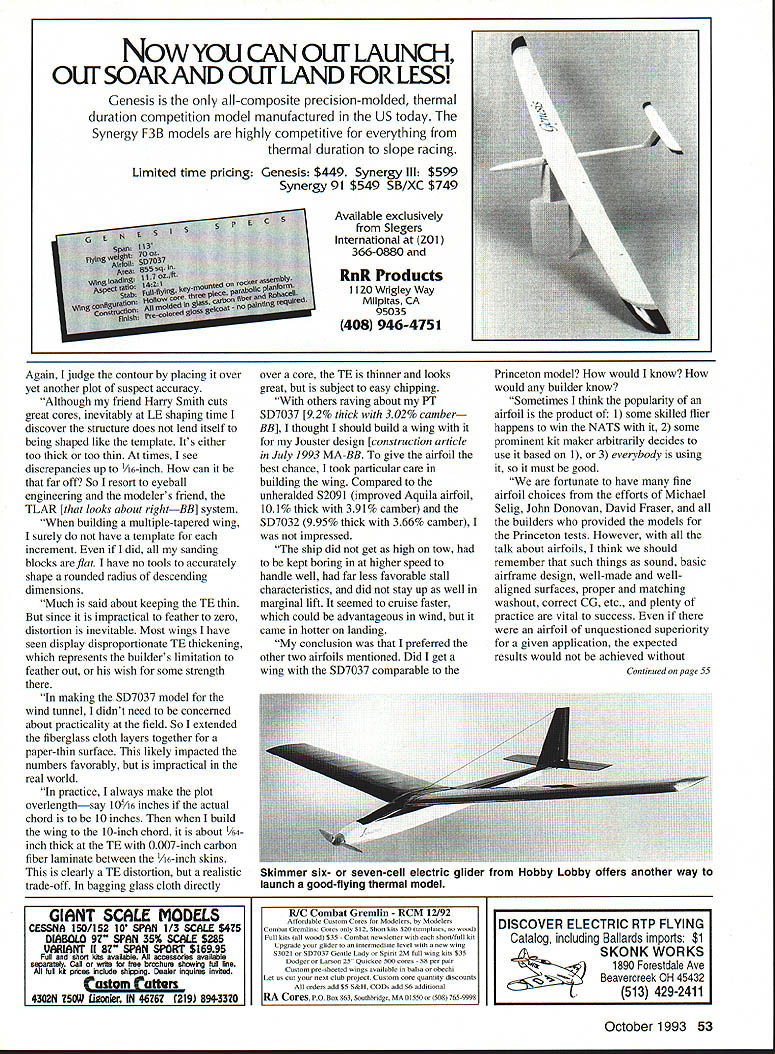
When Rod Klingberg sent a sample kit of his new Thermal Thing, which has a suggested retail price of only $29.95, I figured this would be a fun plane to fly, plus it's inexpensive! A retrofit glider if I ever saw one. Rod's ad copy even stresses low cost:
"For all-out flying fun, the Thermal Thing can't be beat! Designed for fliers who want at least one plane, or first-timers who will have a little help, this plane will give you more for your money than any other Two-Meter class glider on the market."
The Thermal Thing can be built with either a 71- or 77-inch wingspan, a 430-square-inch wing area, and minimum weight of 16 ounces. It'll even take an .049 engine if you want to go that route.
Thermal Thing kits should be available in local hobby shops, or you can order directly from Future Flight:
- Future Flight, 1256 Prescott Ave., Sunnyvale, CA 94089
Rod has a limited-time special mail order price—$15, plus $5 shipping and handling. Can't beat that!
Other simple gliders would include just about all the Two-Meter kits that are put out as trainers. Carl Goldberg sells a lot of Gentle Lady kits because they are inexpensive and they fly quite well.
For a little more money, I like the Airtronics Oly 650 because it's an excellent kit to build, it's very sturdy (bounces better), and it's a fine flier. The Ace Easy Eagle (designed by Harley Michaelis) and the Great Planes Spirit (designed by Paul Carlson) are also nice, simple gliders.
If you want to go to a larger 100-inch-span model, the Airtronics Oly II is the all-time favorite trainer. It can be flown with only rudder and elevator, although the addition of spoilers is a good idea. The Great Planes Spirit 100 also seems like a smart choice because it includes material to build either a slower S3010 or faster S7037 airfoil wing. You can even put ailerons and flaps on it. But that's getting away from the simple sailplane premise!
Simple Electric Gliders
Simple electric gliders are not that much different from the pure trainer-type gliders mentioned above. Actually, electrics are a very good way to learn to fly gliders, or to just have fun dinking around.
Six- or seven-cell electrics have a lot going for them because of the popularity of RC cars, motors, batteries, and chargers, which are quite inexpensive. You can launch a two-meter-size electric in a relatively small area; there is no high-start or winch line to stretch out.
There is really no need to run the motor longer than to get the plane up higher than about 75 to 100 feet. This gives you practice in finding and using lower-level lift, which is exactly what Joe Wurts recommends doing with a hand-launched glider—only starting a little higher than you otherwise would.
If there's no lift, just restart the motor. Depending on your motor-battery-prop combination, you could get up to 10 throws out of a charge.
Also, if you stop and think about it, electrics are perfect for slope soaring. The extra weight is usually an advantage on the slope. When the breeze stops, you just switch on the motor! Think how envious your flying buddies will be as they trek to the bottom of the slope to retrieve their gliders.
Simple electric kits include:
- Airtronics Eclipse Deluxe
- Graupner UHU
- Astro Flight Challenger
- Davey Systems Lucifer
- Great Planes Spectra
and similar Two-Meter electric kits. They all use six- or seven-cell battery packs and inexpensive motors. A lot of fun for your buck!
New Skimmer Electric Sailplane
The latest addition to the above list of fun electrics is the Skimmer from Hobby Lobby International (HLI). This is a rudder-elevator-motor control, 70-inch-span, all-wood kit selling for $48.
Jim Martin at HLI is very excited about this new design and says, "It performs like a $300 custom electric sailplane." He says the Skimmer will climb to peak height two or three times on one charge. Then with power off and the prop folded, Jim guarantees you will catch thermals.
Specifications:
- Selig 3021 airfoil
- 532-square-inch wing area
- total weight: 44 ounces
- wing loading: 12 ounces per square foot
- battery compartment on the bottom under the wing for easy battery changes
Recommended drive system:
- Graupner Speed 600 motor with six cells and a 7 x 3 prop, or seven cells and an 8 x 4½ prop
- Speed 600 motor with folding propeller: $33
- On/off motor controller with Battery Eliminator Circuit (BEC) is required; a Hitec 1003 costs less than $30 and works fine.
A video is available on the Skimmer for $9, and you get $6 back when you return it. Hobby Lobby also has an excellent free 124-page catalog. To order, request a catalog, or for further information write to:
- Hobby Lobby, 5614 Franklin Pike Circle, Brentwood, TN 37027; Tel.: (615) 373-1444
RC Soaring/Blakeslee
Transcribed from original scans by AI. Minor OCR errors may remain.

