

Radio Control: Soaring
Dan Pruss
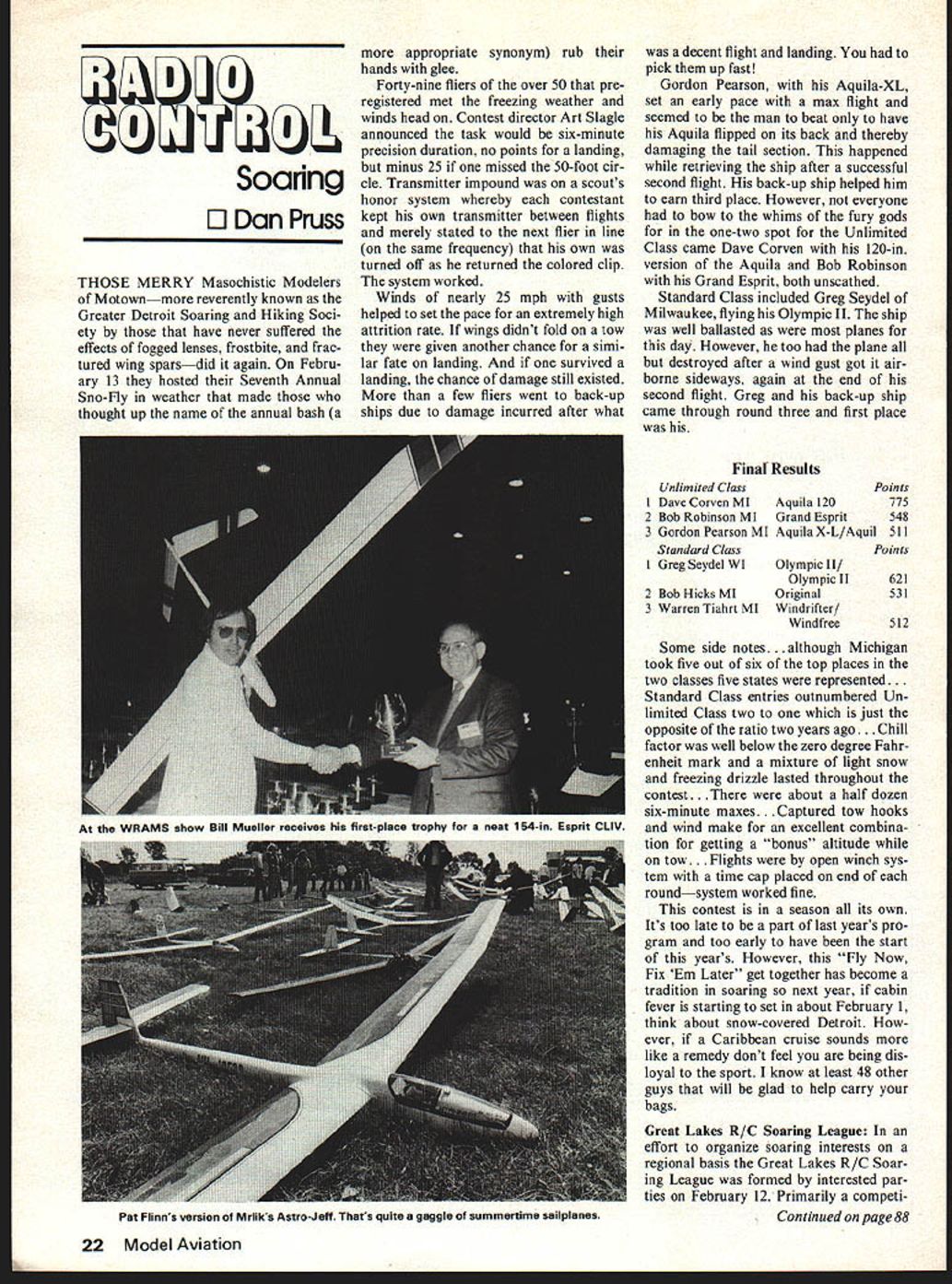
THOSE MERRY Masochistic Modelers of Motown—more reverently known as the Greater Detroit Soaring and Hiking Society by those that have never suffered the effects of fogged lenses, frostbite, and fractured wing spars—did it again. On February 13 they hosted their Seventh Annual Sno-Fly in weather that made those who thought up the name of the annual bash (a more appropriate synonym) rub their hands with glee.
Forty-nine fliers of the over 50 that pre-registered met the freezing weather and winds head on. Contest director Art Slagle announced the task would be six-minute precision duration, no points for a landing, but minus 25 if one missed the 50-foot circle. Transmitter impound was on a scout's honor system whereby each contestant kept his own transmitter between flights and merely stated to the next flier in line (on the same frequency) that his own was turned off as he returned the colored clip. The system worked.
Winds of nearly 25 mph with gusts helped to set the pace for an extremely high attrition rate. If wings didn't fold on a tow they were given another chance for a similar fate on landing. And if one survived a landing, the chance of damage still existed. More than a few fliers went to back-up ships due to damage incurred after what was a decent flight and landing. You had to pick them up fast!
Gordon Pearson, with his Aquila-XL, set an early pace with a max flight and seemed to be the man to beat only to have his Aquila flipped on its back and thereby damaging the tail section. This happened while retrieving the ship after a successful second flight. His back-up ship helped him to earn third place. However, not everyone had to bow to the whims of the fury gods; in the one-two spot for the Unlimited Class came Dave Corven with his 120-in. version of the Aquila and Bob Robinson with his Grand Esprit, both unscathed.
Standard Class included Greg Seydel of Milwaukee, flying his Olympic II. The ship was well ballasted as were most planes for this day. However, he too had the plane all but destroyed after a wind gust got it airborne sideways, again at the end of his second flight. Greg and his back-up ship came through round three and first place was his.
Final Results
Unlimited Class
- Dave Corven MI — Aquila 120 — 775 points
- Bob Robinson MI — Grand Esprit — 548 points
- Gordon Pearson MI — Aquila X-L/Aquila XL — 511 points
Standard Class
- Greg Seydel WI — Olympic II — 621 points
- Bob Hicks MI — Original — 531 points
- Warren Tiahrt MI — Windrifter/Windfree — 512 points
Some side notes... although Michigan took five out of six of the top places in the two classes, five states were represented. Standard Class entries outnumbered Unlimited Class two to one which is just the opposite of the ratio two years ago. Chill factor was well below the zero degree Fahrenheit mark and a mixture of light snow and freezing drizzle lasted throughout the contest... There were about a half dozen six-minute maxes. Captured tow hooks and wind make for an excellent combination for getting a "bonus" altitude while on tow. Flights were by open winch system with a time cap placed on the end of each round—system worked fine.
This contest is in a season all its own. It's too late to be a part of last year's program and too early to have been the start of this year's. However, this "Fly Now, Fix 'Em Later" get-together has become a tradition in soaring so next year, if cabin fever is starting to set in about February 1, think about snow-covered Detroit. However, if a Caribbean cruise sounds more like a remedy don't feel you are being disloyal to the sport. I know at least 48 other guys that will be glad to help carry your bags.
Great Lakes R/C Soaring League: In an effort to organize soaring interests on a regional basis the Great Lakes R/C Soaring League was formed by interested parties on February 12. Primarily a competition-oriented organization, its main purpose is to hold sanctioned contests and have member clubs effort select regional champions in the following categories:
- Open Class B combined
- Open Class C
- Junior/Senior combined Class A/B/C combined
- Junior/Senior/Open combined Sport Scale
The league is comprised of AMA chartered clubs devoted primarily to R/C soaring from the following states regarded as parts of the region: Illinois, Indiana, Michigan, Ohio, Wisconsin. The following clubs make up the league: GDS & HS — Detroit, MI; LOFT — Fort Wayne, IND; MOSS — Columbus, OH; MRCS — Ann Arbor, MI; SOAR — Chicago, IL. It was pointed out during the meeting that with a regional concept a workable solution could develop whereby a Masters or National type of competition could be held if enough other regions held their own selection program.
At least two other regions already have similar organizations. The SC2 (Soaring Clubs of Southern California) and the Tri-State Soaring Society of western Pennsylvania, eastern Ohio, and West Virginia. Whether other regions develop, those mentioned are serving a need within their respective areas.
Those soaring clubs interested and located within the Great Lakes region can obtain more information by contacting: Warren Tiahrt, 1086 Ashley Dr., Troy, MI 48098.
New Winch Drum
D. C. Werbeck sends information that winch drums are available for the long-shaft Ford starters which have become the unofficial accepted standard for winches. The color slides he sent can't be printed here but they indicate the drums are completely machined and superbly crafted. Price is around $50 and further information can be obtained from: Mr. Paul Emerling, Emerling Engineering, Nederland, CO 80466.
Is your workshop in your basement? And is your ceiling unfinished? Good. You have an excellent storage area between the floor joists overhead for your models if you haven't found that out already. However, if you have some old worn-out high-starts of the 5/16 in. bungee cord variety, you can make that area work even better.
Obtain some screw eyes that are large enough through which the bungee can be run. Screw the screw eyes on the bottom edge of the floor joists every 24 inches maintaining a parallel pattern across the joists. Knot one end of the bungee and thread the unknotted end through one row of screw eyes across the joists. Stretch the bungee about 25% for the span covered and while stretched cut the bungee at the last screw eye. Knot that end. Repeat for the lengths through the other eyes.
The bungee under tension is rigid enough to support wings and fuselages, rolled plans and other light loads. This system is not recommended for sheet balsa or spar material where a flat surface would serve better and help prevent warps. The one distinct advantage to the bungee supports is you can pull down one section between the floor joists to get to whatever, without disturbing what is in the adjacent bays.
Cramped for space? Especially wall space? Have you ever wanted to get those plans of your latest world beater off the bench and out from under the wood shavings onto a wall for better reference only to realize you don't have the wall space.
From Jim McIntyre (world's greatest winch master) comes a clever idea. Get an inexpensive window shade five to six feet long. The cheaper ones don't have black-out capabilities and cost about three to six dollars. These types can usually be found in variety stores.
Mount the shade over your bench— You now have an excellent display of the plans and when you want to get them out of the way, just tug on the shade and, voila, the plans and shade disappear faster than a timer when it's your turn to fly.
Have any ideas or club happenings that you think are unique that you would care to share with others? Send them to this column and we'll pass them on. Sketches and pictures help.
Dan Pruss, Box 490, Plainfield, IL 60544.
Transcribed from original scans by AI. Minor OCR errors may remain.

