
RADIO CONTROL SOARING
Byron Blakeslee 3134 N. Winnebago Drive, Sedalia, CO 80135
THE SUPER V FROM MARK LEVOE
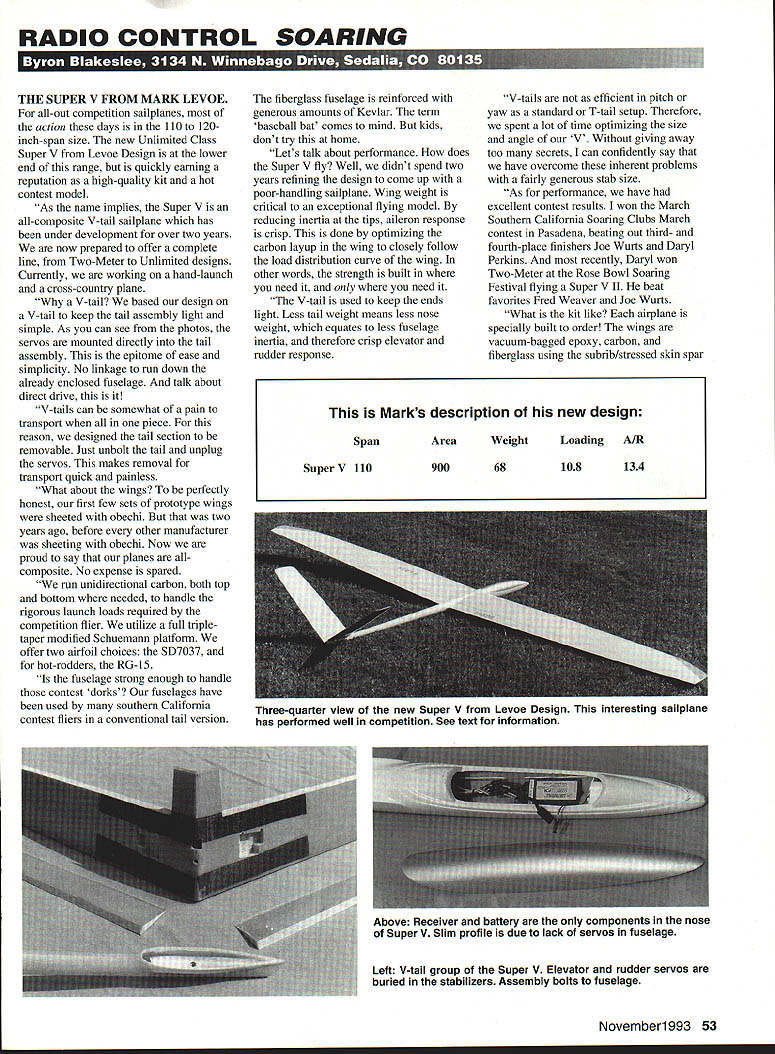
For all-out competition sailplanes, most of the action these days is in the 110- to 120-inch-span size. The new Unlimited Class Super V from Levoe Design is at the lower end of this range, but is quickly earning a reputation as a high-quality kit and a hot contest model.
As the name implies, the Super V is an all-composite V-tail sailplane which has been under development for over two years. We are now prepared to offer a complete line, from Two-Meter to Unlimited designs. Currently, we are working on a hand-launch and a cross-country plane.
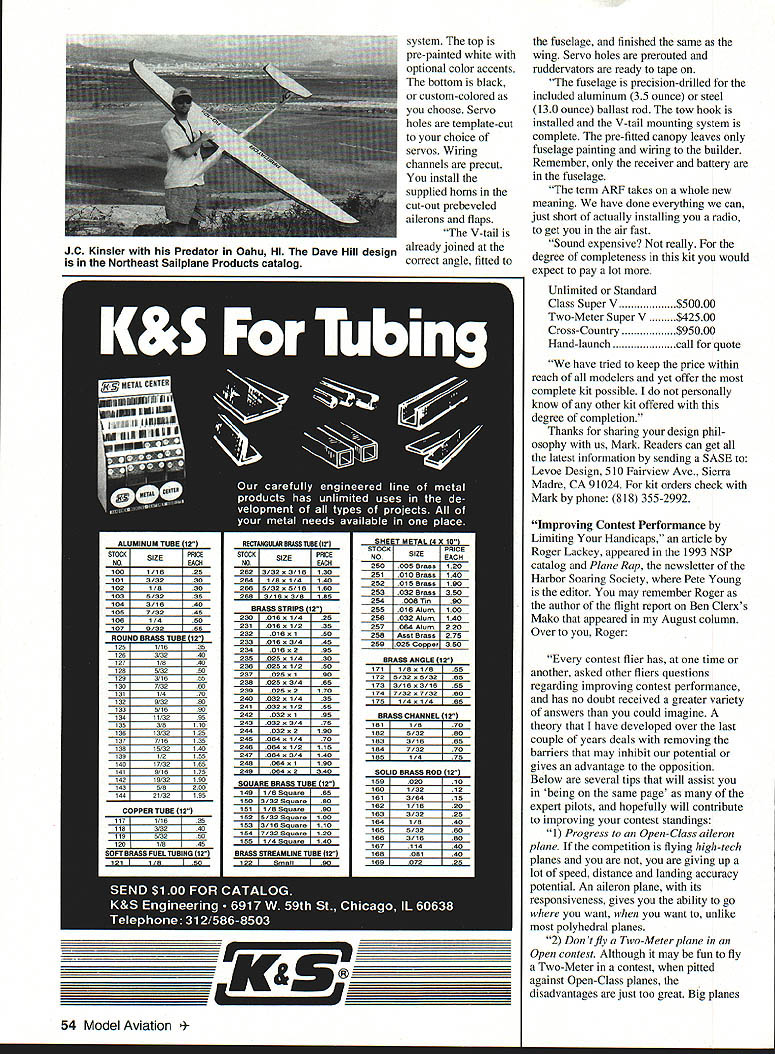
"Why a V-tail? We based our design on a V-tail to keep the tail assembly light and simple. As you can see from the photos, the servos are mounted directly into the tail assembly. This is the epitome of ease and simplicity. No linkage to run down the already enclosed fuselage. And talk about direct drive—this is it!
"V-tails can be somewhat of a pain to transport when all in one piece. For this reason, we designed the tail section to be removable. Just unbolt the tail and unplug the servos. This makes removal for transport quick and painless.
"What about the wings? To be perfectly honest, our first few sets of prototype wings were sheeted with obeche. But that was two years ago, before every other manufacturer was sheeting with obeche. Now we are proud to say that our planes are all-composite. No expense is spared.
"We run unidirectional carbon, both top and bottom where needed, to handle the rigorous launch loads required by the competition flier. We utilize a full triple-taper modified Schuemann platform. We offer two airfoil choices: the SD7037, and for hot-rodders, the RG-15.
"Is the fuselage strong enough to handle those contest 'dorks'? Our fuselages have been used by many southern California contest fliers in a conventional tail version. The fiberglass fuselage is reinforced with generous amounts of Kevlar. The term 'baseball bat' comes to mind. But kids, don't try this at home.
"Let's talk about performance. How does the Super V fly? Well, we didn't spend two years refining the design to come up with a poor-handling sailplane. Wing weight is critical to an exceptional flying model. By reducing inertia at the tips, aileron response is crisp. This is done by optimizing the carbon layup in the wing to closely follow the load distribution curve of the wing. In other words, the strength is built in where you need it, and only where you need it.
"The V-tail is used to keep the ends light. Less tail weight means less nose weight, which equates to less fuselage inertia and therefore crisp elevator and rudder response.
"V-tails are not as efficient in pitch or yaw as a standard or T-tail setup. Therefore, we spent a lot of time optimizing the size and angle of our 'V'. Without giving away too many secrets, I can confidently say that we have overcome these inherent problems with a fairly generous stab size.
"As for performance, we have had excellent contest results. I won the Southern California Soaring Club's March contest in Pasadena, beating out third- and fourth-place finishers Joe Wurts and Daryl Perkins. And most recently, Daryl won Two-Meter at the Rose Bowl Soaring Festival flying a Super V II. He beat favorites Fred Weaver and Joe Wurts.
"What is the kit like? Each airplane is specially built to order! The wings are vacuum-bagged epoxy, carbon, and fiberglass using the subrib/stressed skin spar.
This is Mark's description of his new design:
- Span: 110
- Area: 900
- Weight: 68
- Loading: 10.8
- A/R: 13.4
The top is pre-painted white with optional color accents. The bottom is black, or custom-colored as you choose. Servo holes are template-cut to your choice of servos. Wiring channels are precut. You install the supplied horns in the cut-out prebeveled ailerons and flaps.
The V-tail is already joined at the correct angle, fitted to the fuselage, and finished the same as the wing. Servo holes are prerouted and ruddervators are ready to tape on.
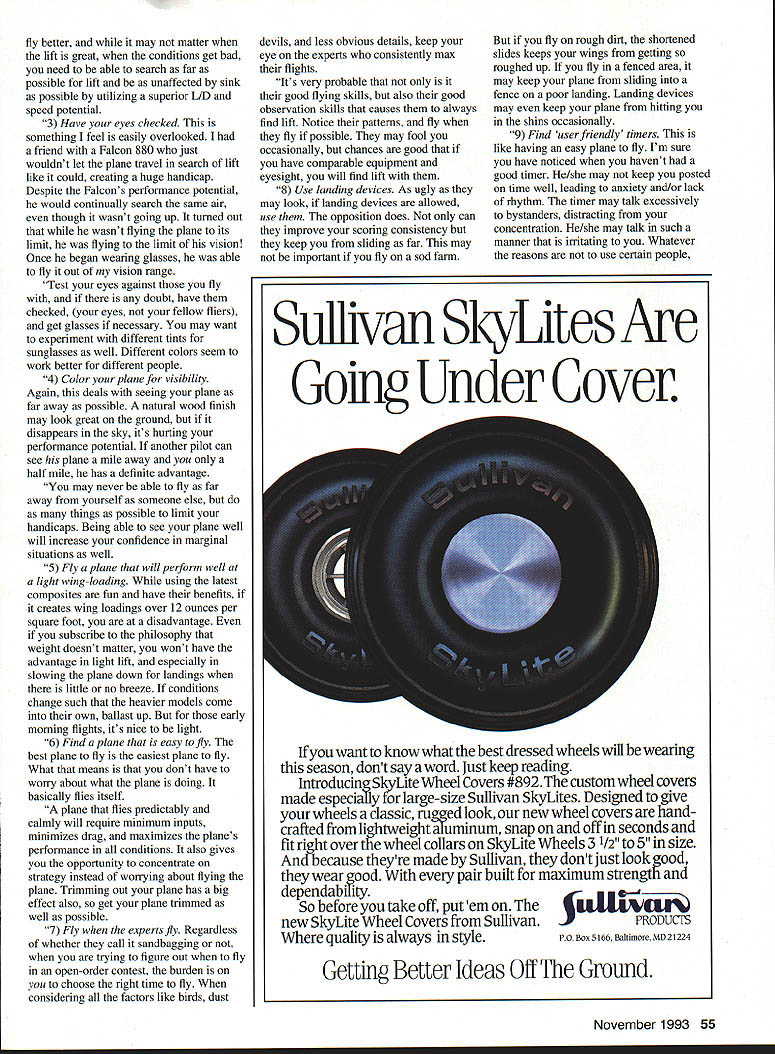
The fuselage is precision-drilled for the included aluminum (3.5 ounce) or steel (13.0 ounce) ballast rod. The tow hook is installed and the V-tail mounting system is complete. The pre-fitted canopy leaves only fuselage painting and wiring to the builder. Remember, only the receiver and battery are in the fuselage.
The term ARF takes on a whole new meaning. We have done everything we can, just short of actually installing your radio, to get you in the air fast.
Sound expensive? Not really. For the degree of completeness in this kit you would expect to pay a lot more.
- Unlimited or Standard Class Super V: $500.00
- Two-Meter Super V: $425.00
- Cross-Country: $950.00
- Hand-launch: call for quote
"We have tried to keep the price within reach of all modelers and yet offer the most complete kit possible. I do not personally know of any other kit offered with this degree of completion. Thanks for sharing your design philosophy with us, Mark. Readers can get all the latest information by sending a SASE to: Levoe Design, 510 Fairview Ave., Sierra Madre, CA 91024. For kit orders check with Mark by phone: (818) 355-2992."
Radio Control: Soaring
fly better, and while it may not matter when the lift is great, when the conditions get bad, you need to be able to search as far as possible for lift and be as unaffected by sink as possible by utilizing a superior L/D and speed potential.
"(3) Have your eyes checked. This is something I feel is easily overlooked. I had a friend with a Falcon 880 who just wouldn't let the plane travel in search of lift like it could, creating a huge handicap. Despite the Falcon's performance potential, he would continually search the same air, even though it wasn't going up. It turned out that while he wasn't flying the plane to its limit, he was flying to the limit of his vision! Once he began wearing glasses, he was able to fly it out of my vision range.
Test your eyes against those you fly with, and if there is any doubt, have them checked (your eyes, not your fellow fliers), and get glasses if necessary. You may want to experiment with different tints for sunglasses as well. Different colors seem to work better for different people.
"(4) Color your plane for visibility. Again, this deals with seeing your plane as far away as possible. A natural wood finish may look great on the ground, but if it disappears in the sky, it's hurting your performance potential. If another pilot can see his plane a mile away and you only a half mile, he has a definite advantage.
You may never be able to fly as far away from yourself as someone else, but do as many things as possible to limit your handicaps. Being able to see your plane well will increase your confidence in marginal situations as well.
"(5) Fly a plane that will perform well at a light wing loading. While using the latest composites are fun and have their benefits, if it creates wing loadings over 12 ounces per square foot, you are at a disadvantage. Even if you subscribe to the philosophy that weight doesn't matter, you won't have the advantage in light lift, and especially in slowing the plane down for landings when there is little or no breeze. If conditions change such that the heavier models come into their own, ballast up. But for those early morning flights, it's nice to be light.
"(6) Find a plane that is easy to fly. The best plane to fly is the easiest plane to fly. What that means is that you don't have to worry about what the plane is doing. It basically flies itself.
"A plane that flies predictably and calmly will require minimum inputs, minimizes drag, and maximizes the plane's performance in all conditions. It also gives you the opportunity to concentrate on strategy instead of worrying about flying the plane. Trimming out your plane has a big effect also, so get your plane trimmed as well as possible.
"(7) Fly when the experts fly. Regardless of whether they call it sandbagging or not, when you are trying to figure out when to fly in an open-order contest, the burden is on you to choose the right time to fly. When considering all the factors like birds, dust devils, and less obvious details, keep your eye on the experts who consistently max their flights.
"It's very probable that not only is it their good flying skills, but also their good observation skills that causes them to always find lift. Notice their patterns, and fly where they fly if possible. They may fool you occasionally, but chances are good that if you have comparable equipment and eyesight, you will find lift with them.
"(8) Use landing devices. As ugly as they may look, if landing devices are allowed, use them. The opposition does. Not only can they improve your scoring consistency but they keep you from sliding as far. This may not be important if you fly on a sod farm.
But if you fly on rough dirt, the shortened slides keeps your wings from getting so roughed up. If you fly in a fenced area, it may keep your plane from sliding into a fence on a poor landing. Landing devices may even keep your plane from hitting you in the shins occasionally.
"(9) Find 'user friendly' timers. This is like having an easy plane to fly. I'm sure you have noticed when you haven't had a good timer. He/she may not keep you posted on the time well, leading to anxiety and/or lack of rhythm. Their timer may talk excessively to bystanders, distracting from your concentration. He/she may talk in such a manner that is irritating to you. Whatever the reasons are not to use certain people, strive to find several that read lift well, keep you posted of your times, and have mannerisms that put you at ease and allow you to concentrate on flying.
"(10) Build a light, yet strong plane that will launch high. High launches feel great, look great, and give you a definite advantage. It may take a little bit of work and knowledge, but with the right amount of weight and structure in the right places, you can build a light-yet-strong plane.
"It is advisable to start with a kit or project that has the potential to be both light and strong. There are a lot of Open Class planes out there that meet these criteria, so stick around 10 ounces per square foot if possible. It seems like planes rarely come in at or less than their advertised weights.
"(11) Learn to use ballast. Finally, since several of my topics dealt with keeping the weight down, it is important that you learn to overcome any disadvantage created by light weight when the conditions change. Heavy planes at times have the advantage. If the wind picks up, there is still lift to be found. You should be able to match heavier aircraft's performance in these conditions. Learning how to ballast will put you in the same ballpark, so learn when and how much to ballast—and do it!
"In closing, I hope these tips are helpful to you. In my observation over the years I have been contest flying, they seem to be true more often than not. Anything you can do to give yourself an edge, or to neutralize the opposition—do it! While it almost always comes down to the pilot and not the plane, removing as many handicaps as possible will go a long way towards improving your ultimate contest performance."
Thanks, Roger, for sharing these thought-provoking ideas with us. I'm certain that reading and heeding Roger's advice will be helpful to all of us trying to improve our performance in the great game of RC soaring.
Shark's Teeth—Good or Bad?
Terry Edmonds, from Iowa City, Iowa, is a longtime soaring competitor, and is also the AMA's RC Soaring delegate to the CIAM. The CIAM is the aeromodelling branch of the FAI (the worldwide governing body for sport aviation). As such, Terry looks after our interests relating to F3B, F3J, and other international soaring classes. This is a letter Terry recently sent:
"At the risk of opening a Pandora's Box, I would like to raise the issue of shark's teeth commonly used on RC sailplanes. I submitted a rules proposal to ban their use in competition in the last cycle of AMA rules changes. The proposal was defeated. However, it did receive a majority vote in favor, but not a large enough majority to continue in the process.
"I frankly was surprised anyone would vote against a safety proposal, but then I also recognize everyone has a different view of the world. My first reaction to the negative vote was to drop the idea until the next rules cycle. However, my conscience got the better of me. What if someone got seriously injured because of these things in the meantime?
"Some years ago I witnessed an accident in a contest where a glider experienced some sort of radio interference and went into a vertical dive, striking an individual on top of his head. Fortunately the injury was minor. But what if the model had shark's teeth on it?
"If you have been around the soaring scene for any length of time, you likely have seen similar close calls. I heard where a model with shark's teeth hit a shade canopy and ripped it open. Admittedly, I have not heard of a documented case of a personal injury due to shark's teeth, but the potential is certainly there.
"What I am suggesting we do at this time is begin an objective open forum on the subject, and try to find an acceptable solution to the situation (or determine if it is not a threat at all). I will start the ball rolling by telling you the history of the issue and my personal views. This reminds me of a sign hanging in my barber's shop: 'Everyone is entitled to my opinion.'
"A couple of years ago, this same issue came up in the CIAM F3B subcommittee. In a fairly short time a ban on 'arresting devices' was installed in the FAI rules for F3B. Interestingly, there was very little opposition to the FAI proposal. My proposal for the AMA rules was to simply adopt the FAI wording for AMA competition.
"Perhaps that was a mistake, since Americans traditionally like to do their own thing. Maybe different verbiage would make the idea more palatable to those who currently oppose it.
"I have heard the argument that a ban on shark's teeth would not be effective because it would not necessarily prevent injury if a model strikes a person. That is like saying airbags should not be in automobiles because you still could get killed in a car crash. Using that logic, the minimum-nose-radius rule is not needed, either. What we are talking about here is eliminating additional unnecessary risks. It certainly does not mean all risks are prevented.
"Another argument against a ban is that shark's teeth are needed to slow a model on landing, and prevent it from hitting someone. I have a couple of responses to that.
"Generally speaking, a model sliding on the ground without shark's teeth is less dangerous than a model in flight with shark's teeth. Secondly, a model coming in hot and relying on shark's teeth to stop it is an indication of poor piloting skills.
"There is also the argument that not having shark's teeth encourages dock landings. I don't have a good rebuttal for that, except to say it is not a good enough reason to sacrifice safety. If we want to prevent dock landings then we should do it in another way.
"The situation appears to be taking a turn for the worse. A recently published sailplane design uses aluminum shark's teeth mounted in the nose of the model. The designer is not to blame for this. He has designed a model to be as competitive as he can within the rules. That is, in fact, what competition design is all about.
"The idea is quite innovative and could possibly be the next thing you have to have to be competitive. But can you imagine going to a large contest, with the sky filled with gliders, that all have aluminum shark's teeth in the noses? That is not the future I would like to see for the sport.
"For those of you out there who agree with my point of view, there is something we can do in the short term. Contests can have a local rule banning such devices. Keep in mind the AMA rules require any variation in rules be properly advertised in advance.
"Well, that is the way I see it. I am sure there are other sides to this issue I haven't thought of. I encourage you to make your ideas known."
Thanks for your thoughts, Terry. I think it is appropriate to use this column as a forum to discuss important issues that affect our sport. Therefore, I would like to invite readers to write me, and I'll print as many as space permits.
Radio Control: Soaring
coming out this year, but as Sal and Stan say, "It was worth the wait!" I strongly recommend that all sailplaneers get this catalog! It's a wish book come true. It's double the size of the previous issue—over 180 pages.
Gliders are divided by purpose and/or size: 18 hand-launch kits, 59 slope models, 24 Two-Meter, 13 Standard, 24 Open-Class, 4 cross-country, 9 Scale, and 30 Electrics. Also included are big sections on radios, accessories, and electric motors.
The big bonus is all the special articles. They range from thoughts on F3J by Dave Thornburg to construction methods, and soaring tips from the 1993 USA F3B team. This book has it all.
Send $7 (includes Priority Mail) to NSP, 16 Kirby Lane, Williston, Vermont 05495; Tel.: (802) 658-9482.
Transcribed from original scans by AI. Minor OCR errors may remain.

