
RADIO CONTROL SOARING
Brian Agnew, 5095 N. Hampton Dr., Fort Myers, FL 33919
The 1993 AMA Nationals were originally scheduled for midsummer in Lubbock, Texas, but conflict with the FAA forced AMA to find a new site. The event was moved to Vincennes, Indiana, the same site used in 1991. Scheduling placed the Nats just two weeks after the LSF (League of Silent Flight) National Championships, and combined with floods in the Midwest, attendance in the soaring events was sparse.
Two-Meter was the largest event, with 28 entries. Contest Director Gilbert Gaugher provided a relaxed atmosphere focused on friendly, spirited competition rather than the rushed intensity of larger meets.
Lincoln High School has hosted several soaring contests over the past two years. The site offers ample parking and room to set winches regardless of wind direction. Landings were on freshly mowed grass, and apart from the school, flying was virtually uninhibited in all directions. The weather was nearly flawless all week, except for drizzle Thursday morning and early afternoon; wind was rarely a factor.
Monday, July 19
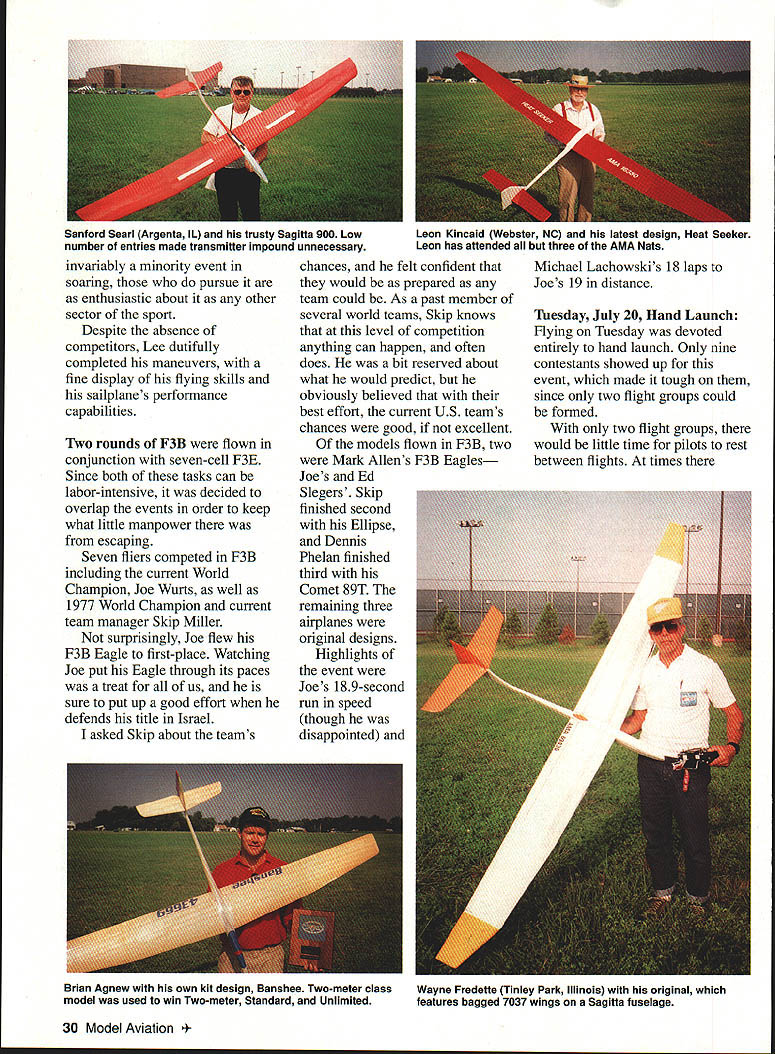
The first official day of soaring began with Scale, followed by F3B. Scale turnout was disappointing—Lee Montgomery and his SB-10 were the only entry. Typically the Nats draws six to ten Scale entries; while Scale is a minority event, those who pursue it are enthusiastic. Lee nonetheless completed the maneuvers in a fine display of flying skill and sailplane performance.
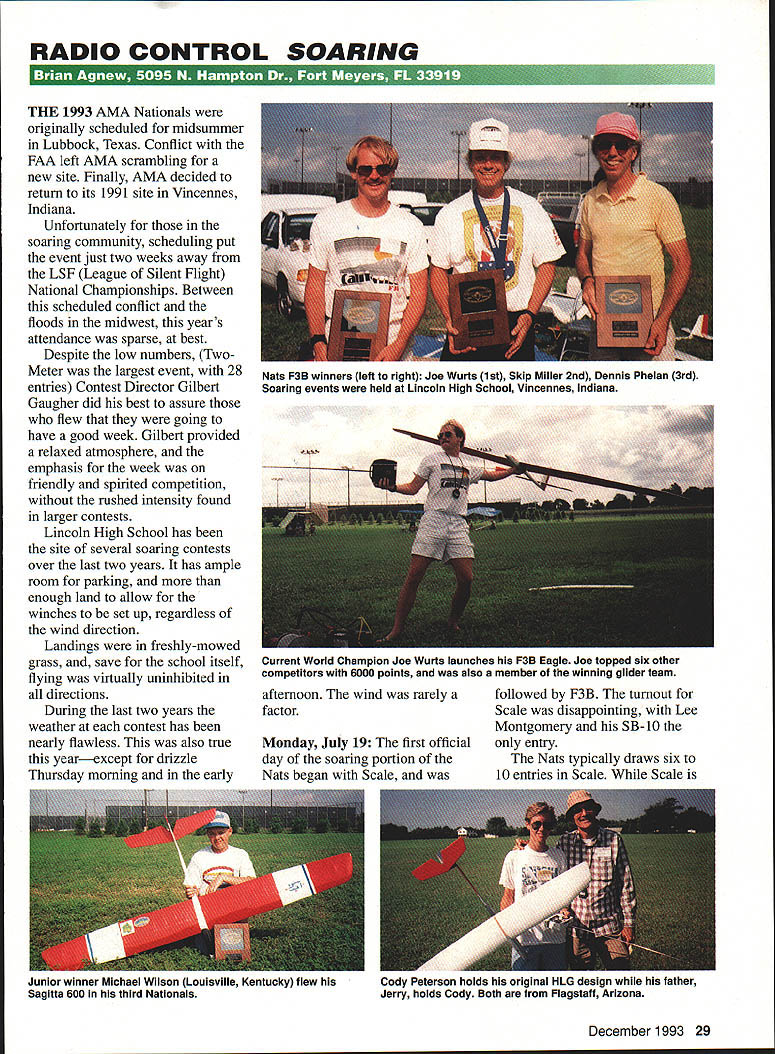
Two rounds of F3B were flown in conjunction with seven-cell F3E. Because both tasks can be labor-intensive, the events were overlapped to conserve manpower. Seven fliers competed in F3B, including current World Champion Joe Wurts and 1977 World Champion and current team manager Skip Miller. Joe flew his F3B Eagle to first place; Skip finished second and Dennis Phelan third.
Models flown in F3B included two of Mark Allen's F3B Eagles, Joe's Eagle, Ed Slegers' Ellipse, Dennis Phelan's Comet 89T, and three original-design airplanes. Highlights included Joe's 18.9-second speed run and Joe's 19 laps in distance, while Michael Lachowski recorded 18 laps. When asked about the team's chances, Skip felt confident the U.S. team was well prepared but cautioned that at the world level anything can happen.
Tuesday, July 20 — Hand Launch
Tuesday was devoted entirely to hand launch. Only nine contestants showed, so two flight groups were formed, leaving little rest time between flights. Six 10-minute rounds were flown, with one throw-out round allowed. The tasks were:
- Round One: Unlimited throws; achieve three two-minute maxes—best three flights scored.
- Round Two: Unlimited throws; achieve a five-minute maximum—lowest flight scored.
- Round Three: Unlimited throws; achieve three three-minute maxes—best three flights scored.
- Round Four: Unlimited throws; achieve five two-minute maxes—best five flights scored.
- Rounds Five and Six: Five throws; achieve three two-minute maxes—best three flights scored.
RC hand-launch competition is demanding and exciting. Pilots and helpers scramble for position on the field; fliers often throw into and fly in the same thermals, so midair potential is substantial.
From the start of the day it appeared Joe Wurts and I (Brian) were on a collision course for a flyoff—Joe had edged me out the previous year. In the third round I struggled while Skip Miller secured his maxes; that became my throw-out round and Joe went unbeaten.
The decisive task was Round Four: five throws for five two-minute maxes. Joe posted 9:47 (13 seconds shy of perfect), and I followed with 9:46. Joe then maxed his remaining rounds and finished with a perfect 5000. I was second with 4998; Skip Miller was third with 4751.
Joe flew a new Larry Jolly design called the Vagabond—conventional built-up construction using the Selig 3021 airfoil and a V-tail. The combination worked extremely well; Joe maxed every throw across all six rounds. It was unclear whether Larry intended to kit the Vagabond, but it would be a good candidate.
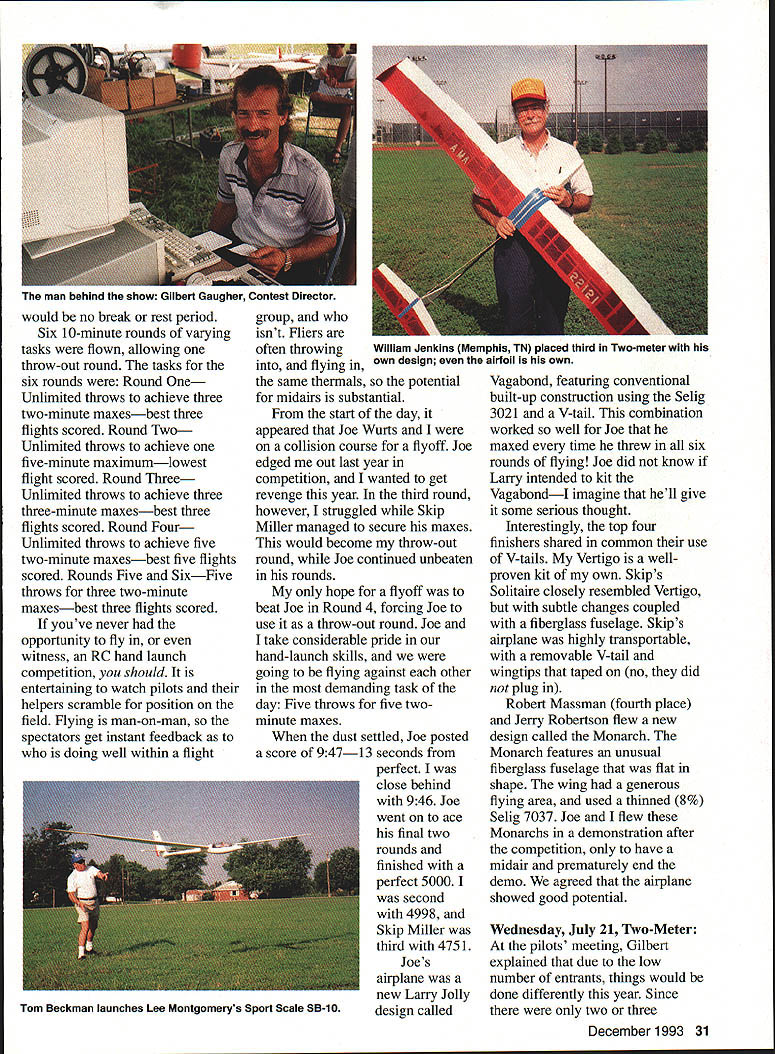
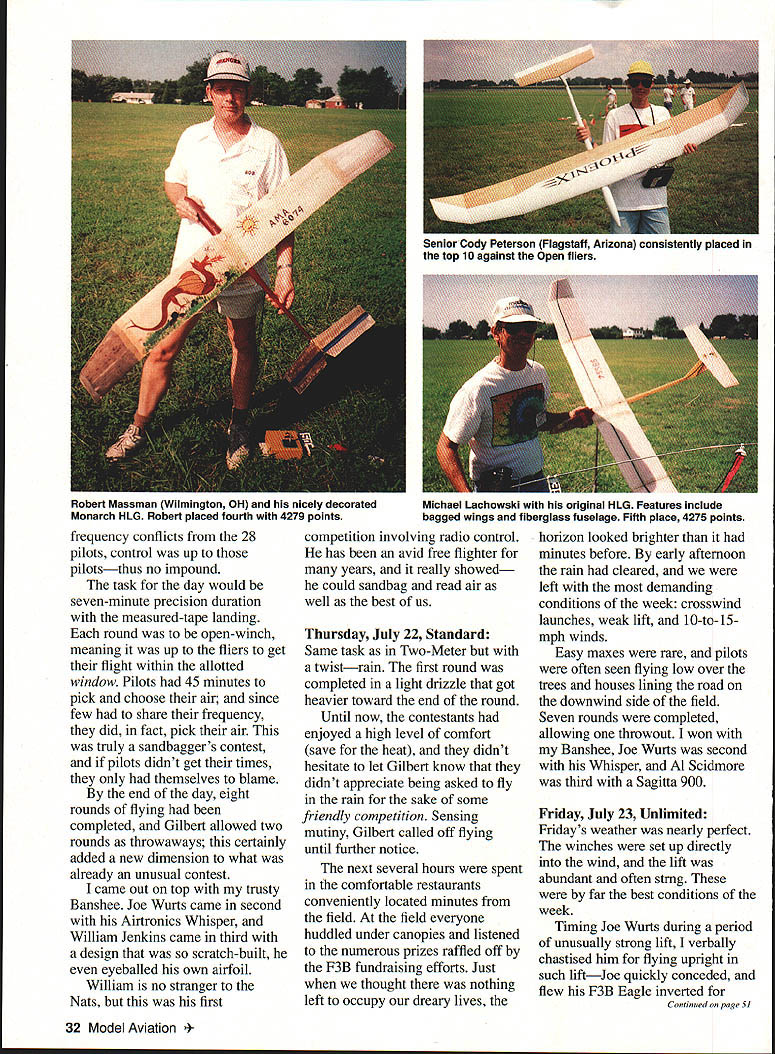
Notably, the top four finishers all used V-tails. My Vertigo is a proven kit. Skip's Solitaire resembled the Vertigo but had subtle changes and a fiberglass fuselage; it was very transportable with a removable V-tail and taped-on wingtips. Robert Massman (fourth) and Jerry Robertson flew a new design called the Monarch, featuring a flat-shaped fiberglass fuselage and a wing with generous area using a thinned (8%) Selig 7037. Joe and I flew Monarchs in a demonstration after the competition but had a midair that ended the demo; the design still showed good potential.
Wednesday, July 21 — Two-Meter
At the pilots' meeting Gilbert explained that due to the low number of entrants, control would be in the pilots' hands—there would be no impound. The day's task was seven-minute precision duration with a measured-tape landing. Each round was open winch: pilots had 45 minutes to pick their air. With few pilots sharing frequencies, many were able to choose ideal conditions, making this a sandbagger's contest.
Eight rounds were completed, with two rounds allowed as throwaways. I won flying my trusty Banshee. Joe Wurts was second with his Airtronics Whisper, and William Jenkins was third flying a largely scratch-built design (he even eyeballed his own airfoil). William, an experienced free-flighter but new to RC competition, demonstrated excellent sandbagging and air reading skills.
Thursday, July 22 — Standard
Standard used the same task as Two-Meter but rain intervened. The first round was completed in light drizzle that intensified near the end. Contestants were unhappy about being asked to fly in rain; Gilbert called off flying until further notice.
During the break many spent hours in nearby restaurants while others sheltered at the field under canopies and listened to F3B fundraising prize raffles. By early afternoon the rain cleared and the field faced the most demanding conditions of the week: crosswind launches, weak lift, and 10–15 mph winds. Easy maxes were rare; pilots often flew low over trees and houses lining the downwind side.
Seven rounds were completed with one throwout. I won again with my Banshee; Joe Wurts was second with his Whisper; Al Scidmore was third with a Sagitta 900.
Friday, July 23 — Unlimited
Friday's weather was nearly perfect. Winches were set directly into the wind and lift was abundant and often strong—by far the best conditions of the week. At one point Joe inverted his F3B Eagle in unusually strong lift and held it inverted for nearly five minutes.
Seven rounds were flown with one throw-out. I finished first in Unlimited with my Banshee; Skip Miller was second with his Airtronics Thermal Eagle; Joe was third flying the F3B Eagle.
With the Unlimited win I swept the three thermal events and received the Hi Johnson Memorial Award. I also received the Lee Renaud Memorial Award for best combined performance across classes. Teaming with Skip Miller and Joe Wurts, we won the Dan Pruss team award for best performance by a three-man team over the final three days. Team "Past, Present, and Future" scored five points—the sum of each team member's best performance (my first, plus Joe's second, plus Skip's second). We enjoyed arguing over who was Past, who was Present, and who was Future.
Younger fliers also impressed: Michael Wilson (Junior winner from Louisville, Kentucky) and Cody Peterson (Senior winner from Flagstaff, Arizona) flew well all week. Cody was often spotted coring thermals and salvaging flights from low approaches. Both are names to watch.
Despite the disappointing turnout, those who flew enjoyed the Nats. The competitive soaring community is relatively small; while some pilots would gladly attend two independent week‑long soaring championships, back-to-back scheduling (especially with only two weeks between contests) proved too much for many. Many in the community would like to see AMA and LSF coordinate scheduling to avoid conflicts.
Transcribed from original scans by AI. Minor OCR errors may remain.

