
RADIO CONTROL SOARING
Byron Blakeslee 3134 N. Winnebago Drive, Sedalia, CO 80135
1994 World Soaring Jamboree
Seven Northwestern clubs have joined together to announce the first World Soaring Jamboree. The nine-day event will be held in Richland, Washington from May 28 through Sunday, June 5.
The thermal, slope, and cross-country events will have divisions for novice, intermediate, and expert pilots. Contests will include Open and Two-Meter thermal duration, Hand Launch, F3J, and F3B. Slope racing will be for Limited, Unlimited, and Power Scale models. There will be fun-flying and cross-country racing for Scale and non-Scale models. North American Scale Soaring Association tasks can also be flown and recognized.
In addition to the soaring events, WSJ will feature a banquet dinner with a special guest speaker and a super evening social. Entrants will also have a chance to participate in technical seminars and vendor forums.
The WSJ promises soaring enthusiasts an opportunity to participate in RC soaring history. Expect more details as the event draws nearer. Pilots or observers interested in attending can obtain information from the WSJ committee. Send a large SASE to: World Soaring Jamboree, P.O. Box 4267, West Richland, WA 99352.
Sprite 2-Meter from Dodgson Designs
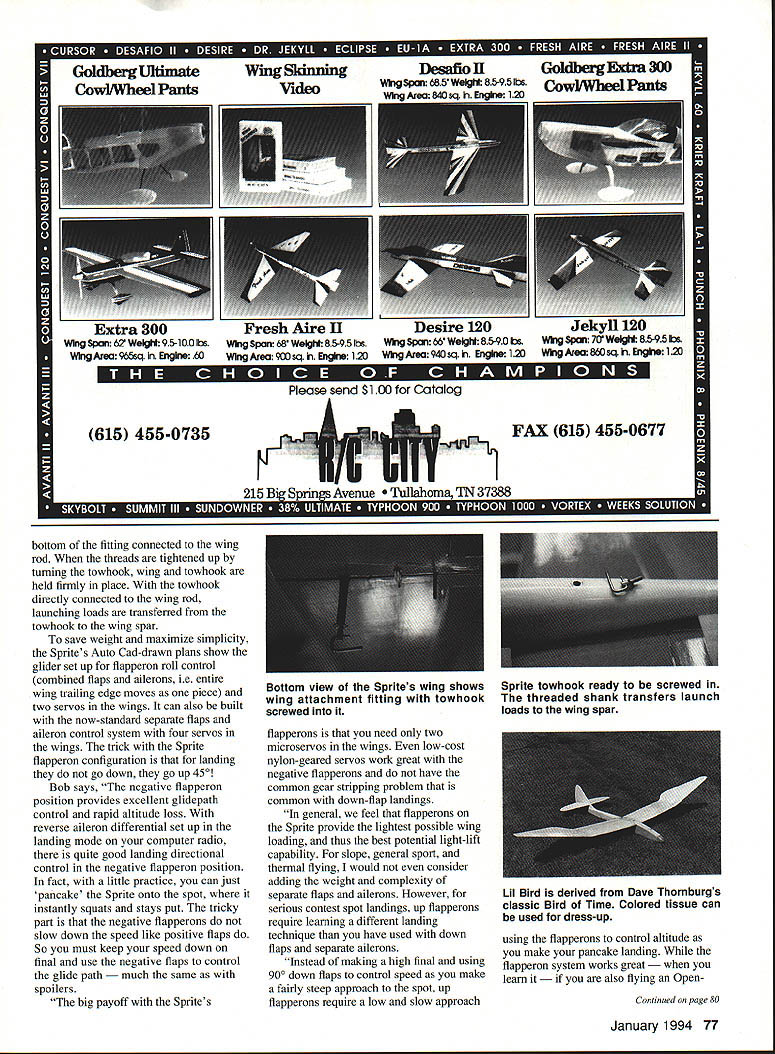
Bob Dodgson's latest kit is a nifty 2-meter model that follows the illustrious record of his K-Minnow (1980) and Pixy (1985) designs. We'll get to Sprite's new and interesting features, but first the specs:
- Wingspan: 78 inches
- Wing area: 585 sq. in.
- Airfoil: SD7037
- Weight: 37 ounces
- Wing loading: 9.0 oz./sq.ft.
- Aspect ratio: 10.4:1
- Wing construction: Obechi over white foam
- Stab & rudder: Built-up wood & film
- Controls: Flapperons, elevator, rudder
- Kit price: $155 plus $8 UPS shipping (add $10 for nose job)
Bob says some builders get their Sprites in the air within two weeks of receiving the kit. Some Sprites are as light as 34 ounces with a fully painted fuselage; this drops the wing loading to a ladylike 8.4 oz./sq.ft., which is important when working those small, light bubbles.
What is new and different about the Sprite is the MonoSeam fiberglass fuselage and the wing attachment system. Bob lays up the fuselage in one piece and then joins a top seam down the turtledeck to complete the tailboom section. The top of the nose section of the fuselage is not closed; it is open like Bob's taco-shell fuselages and must be finished with a balsa block, glass cloth, and polyester resin. If you want this part completed, add $10 for the nose job. The fin is built-up wood and glued into a slot in the tailboom.
The unique wing mounting system works this way:
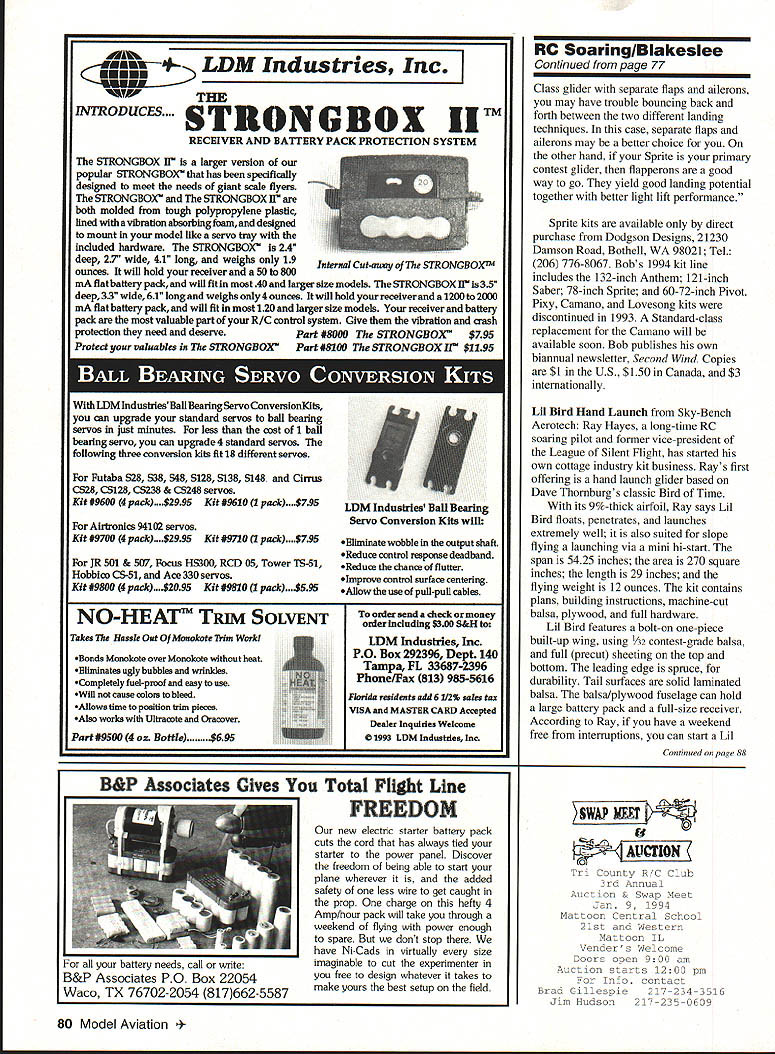
- The wings plug together in the center section via a 7-1/2" wing rod and a wing alignment pin. Before assembly, when the wing rod and pin are installed in one side, brass fittings that fit between the wings are slipped onto the rod and pin.
- The wing halves are then held tightly together with a rubber band on the bottom. The band is concealed inside the fuselage when the wings are in place. With the wing halves held tightly together, the two brass fittings, attached to the wing rod and alignment pin, project down from the wing bottom.
- To install the wings onto the fuselage, the projecting brass fittings slip into brass tubes mounted vertically along the centerline of the fuselage. The fitting that projects down from the wing rod has a threaded insert in the base.
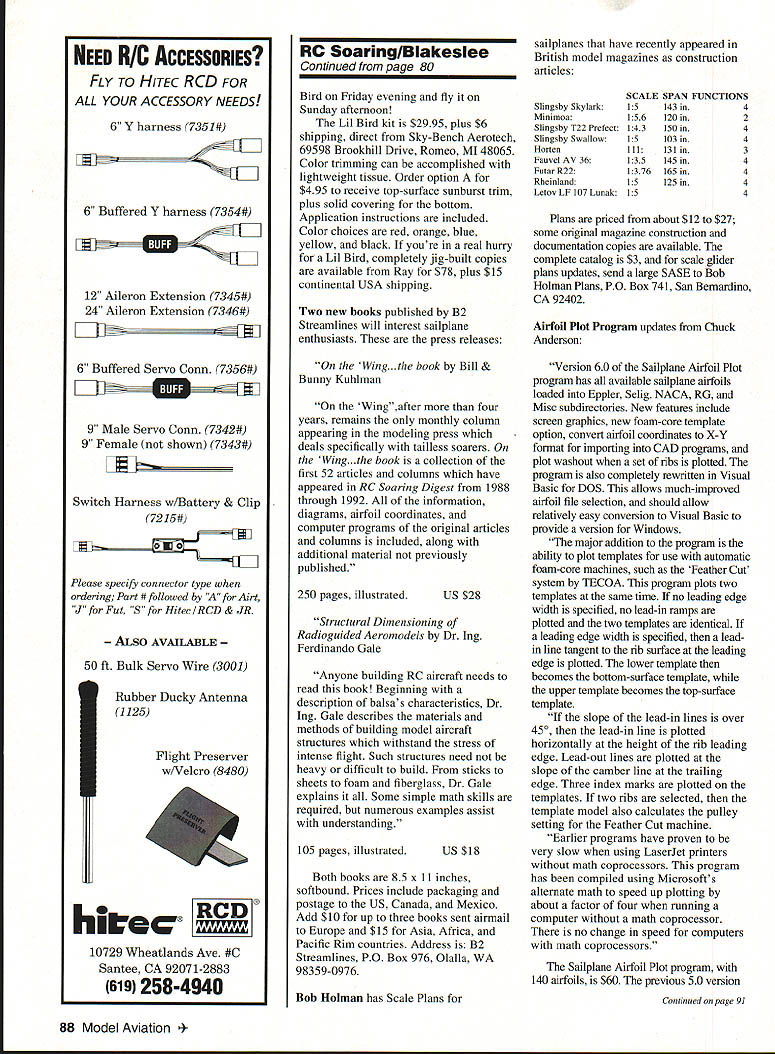
- The tow hook has a threaded shank that extends upward through the normal hole in the bottom of the fuselage and screws into the bottom fitting connected to the wing rod. Threads are tightened up, turning the tow hook; the wing tow hook is held firmly in place. The tow hook is directly connected to the wing rod; launching loads are transferred to the tow hook and wing spar, saving weight and maximizing simplicity.
Sprite's AutoCAD-drawn plans show the glider set up with flapperon roll control (combined flaps & ailerons), i.e., the entire wing trailing edge moves as one piece with two servos. Wings can also be built with the now-standard separate flap & aileron control system (four servos). One trick in the Sprite's flapperon configuration is landing. Bob says negative flapperon position provides excellent glidepath control and rapid altitude loss. A reverse aileron differential set up in landing mode on a computer radio gives quite good landing directional control. In the negative flapperon position, with little practice you can pancake the Sprite onto the spot; it instantly squats and stays put. The tricky part is negative flapperons slow down speed like positive flaps. So you must keep your speed down on final and use the negative flaps to control the glide path — much the same as with spoilers.
"The big payoff with the Sprite's flapperons is that you need only two microservos in the wings. Even low-cost nylon-geared servos work great with the negative flapperons and do not have the common gear-stripping problem that occurs with down-flap landings.
"In general, we feel that flapperons on the Sprite provide the lightest possible wing loading, and thus the best potential light-lift capability. For slope, general sport, and thermal flying, I would not even consider adding the weight and complexity of separate flaps and ailerons. However, for serious contest spot landings, up flapperons require learning a different landing technique than you have used with down flaps and separate ailerons.
"Instead of making a high final and using 90° down flaps to control speed as you make a fairly steep approach to the spot, up flapperons require a low and slow approach using the flapperons to control altitude as you make your pancake landing. While the flapperon system works great — when you learn it — if you are also flying an Open-Class glider with separate flaps and ailerons, you may have trouble bouncing back and forth between the two different landing techniques. In this case, separate flaps and ailerons may be a better choice for you. On the other hand, if your Sprite is your primary contest glider, then flapperons are a good way to go. They yield good landing potential together with better light-lift performance."
Sprite kits are available only by direct purchase from Dodgson Designs, 21230 Damson Road, Bothell, WA 98021; Tel.: (206) 776-8067. Bob's 1994 kit line includes the 132-inch Anthem; 121-inch Saber; 78-inch Sprite; and 60-/72-inch Pivot. Pixy, Camano, and Lovesong kits were discontinued in 1993. A Standard-class replacement for the Camano will be available soon. Bob publishes his own biannual newsletter, Second Wind. Copies are $1 in the U.S., $1.50 in Canada, and $3 internationally.
Li'l Bird Hand Launch from Sky-Bench Aerotech
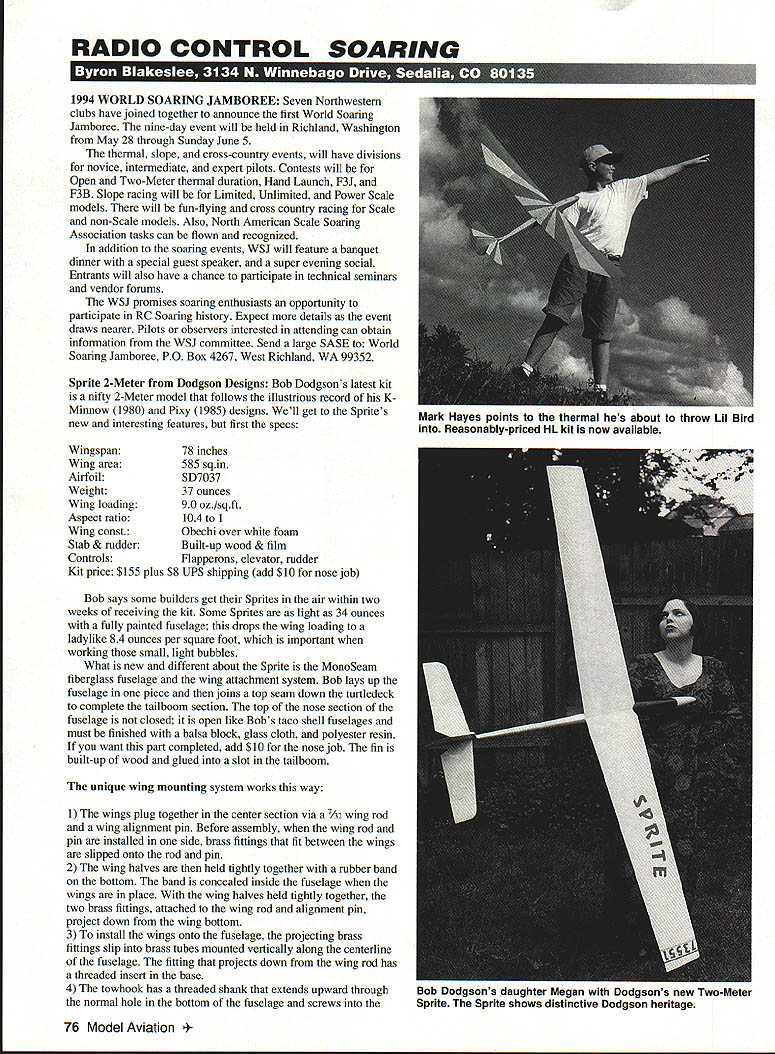
Ray Hayes, a long-time RC soaring pilot and former vice-president of the League of Silent Flight, has started his own cottage-industry kit business. Ray's first offering is a hand-launch glider based on Dave Thornburg's classic Bird of Time. With its 9%-thick airfoil, Ray says Li'l Bird floats, penetrates, and launches extremely well; it is also suited for slope flying and launching via a mini hi-start.
Specs:
- Span: 54.25 inches
- Area: 270 sq. in.
- Length: 29 inches
- Flying weight: 12 ounces
The kit contains plans, building instructions, machine-cut balsa, plywood, and full hardware. Li'l Bird features a bolt-on one-piece built-up wing, using 3/32 contest-grade balsa, and full sheeting on the top and bottom. The leading edge is spruce for durability. Tail surfaces are solid laminated balsa. The balsa/plywood fuselage can hold a large battery pack and a full-size receiver. According to Ray, if you have a weekend free from interruptions, you can start a Li'l Bird and finish it in a weekend.
Bird on Friday evening and fly it on Sunday afternoon!
The Li'l Bird kit is $29.95, plus $6 shipping, direct from Sky-Bench Aerotech, 69598 Brookhill Drive, Romeo, MI 48065. Color trimming can be accomplished with lightweight tissue. Order option A for $4.95 to receive top-surface sunburst trim, plus solid covering for the bottom. Application instructions are included. Color choices are red, orange, blue, yellow, and black. If you're in a real hurry for a Li'l Bird, completely jig-built copies are available from Ray for $78, plus $15 continental USA shipping.
New Books from B2 Streamlines
Two new books published by B2 Streamlines will interest sailplane enthusiasts:
- On the 'Wing — Bill & Bunny Kuhlman
- Collection of the first 52 articles and columns that appeared in RC Soaring Digest from 1988 through 1992; focuses on tailless soarers. Includes information, diagrams, airfoil coordinates, computer programs, and additional unpublished material.
- 250 pages, illustrated. US $28
- Structural Dimensioning of Radioguided Aeromodels — Dr. Ing. Ferdinando Gale
- Describes materials and methods of building model aircraft structures that withstand the stresses of intense flight. Covers sticks, sheets, foam, and fiberglass, with examples; some basic math required.
- 105 pages, illustrated. US $18
Both books are 8.5 x 11 inches, softbound. Prices include packaging and postage to the US, Canada, and Mexico. Add $10 for up to three books sent airmail to Europe and $15 for Asia, Africa, and Pacific Rim countries. Address: B2 Streamlines, P.O. Box 976, Olalla, WA 98359-0976.
Scale Plans from Bob Holman
Bob Holman has scale plans for sailplanes that appeared in British model magazines as construction articles:
- Slingsby Skylark: 1:5 — 143 in. — 4 functions
- Minimoa: 1:5.6 — 120 in. — 2 functions
- Slingsby T.22 Prefect: 1:4.3 — 150 in. — 4 functions
- Slingsby Swallow: 1:5 — 103 in. — 4 functions
- Horten IV: 1:11 — 145 in. — 3 functions
- Fauvel AV.36: 1:3.5 — 145 in. — 4 functions
- Futura R.22: 1:3.76 — 125 in. — 3 functions
- Rheinland: 1:5 — 175 in. — 4 functions
- Letov LF 107 Lunak: 1:5 — 120 in. — 4 functions
Plans are priced from about $12 to $27; some original magazine construction and documentation copies are available. The complete catalog is $3. For scale glider plans updates, send a large SASE to Bob Holman Plans, P.O. Box 741, San Bernardino, CA 92402.
Airfoil Plot Program Updates (Chuck Anderson)
Version 6.0 of the Sailplane Airfoil Plot program has all available sailplane airfoils loaded into Eppler, Selig, NACA, RG, and Misc subdirectories. New features include screen graphics, a new foam-core template option, conversion of airfoil coordinates to X-Y format for importing into CAD programs, and plotting washout when a set of ribs is plotted. The program is completely rewritten in Visual Basic for DOS, allowing much-improved airfoil file selection and easier conversion to Visual Basic for Windows.
The major addition is the ability to plot templates for use with automatic foam-core machines, such as the Feather Cut system by TECOA. This program plots two templates at the same time. If no leading edge width is specified, no lead-in ramps are plotted and the two templates are identical. If a leading edge width is specified, then a lead-in lane tangent to the rib surface at the leading edge is plotted. The lower template becomes the bottom-surface template, while the upper template becomes the top-surface template.
If the slope of the lead-in lines is over 45°, the lead-in line is plotted horizontally at the height of the rib leading edge. Lead-out lines are plotted at the slope of the camber line at the trailing edge. Three index marks are plotted on the templates. If two ribs are selected, the template model also calculates the pulley setting for the Feather Cut machine.
Earlier programs were very slow when using LaserJet printers without math coprocessors. This program has been compiled using Microsoft's C compiler with alternate math to speed up plotting by about a factor of four on computers without a math coprocessor. There is no change in speed for computers with math coprocessors.
The Sailplane Airfoil Plot program, with 140 airfoils, is $60. The previous 5.0 version (42 airfoils) is also available for $35. Chuck is near release of a new Model Design 4.0 program with 140 airfoils, which will be $75. Upgrades to Airfoil Plot 5.0 and Model Design 3.0 are $15, and earlier versions are $25. Contact Chuck at P.O. Box 305, Tullahoma, TN 37388; Tel.: (615) 455-6430.
The Landing Points Controversy
Beginning with the first soaring contests, there has been considerable debate over how much landings should count. Some say a spot landing bonus of 10 to 25 percent of the maximum flight score is about right. Others advocate no landing bonus at all, contending that RC soaring boils down to landing contests and that soaring competitions should be won in the air, not on the ground.
Advocates of a landing bonus maintain that landing a glider consistently well is an essential flying skill and should be rewarded. They also point out that if most of the top pilots get their flight times, landing points are another means of determining placings.
As I mentioned previously (re: Shark's Teeth), I think it's appropriate to use this column to air important soaring issues. Therefore, I am pleased to print the following letter from Ray Hayes, which he sent with his Li'l Bird information. I will be happy to print letters expressing other views:
"After 23 years of participating in all aspects of RC soaring, I still find it exciting, challenging, and highly pleasurable. During this time, I have competed in soaring contests on both coasts, and from Canada to Florida. My experiences range from starting a soaring club, being a contest director for many contests, to participating in F3B Finals and Dan Pruss's old Soar Nats.
"Lately, some competitors have been talking about de-emphasizing, or completely eliminating landing bonus points for duration tasks. I am opposed to this because I accept the challenge our present AMA landing rules give us. In my view, there is little challenge in landing a sailplane at a precise time without a relatively small target included.
"Recently, I participated in a contest that required landing only within the field boundaries. No landing tape and no landing points. All the unpracticed contestants thought they had a real chance to win. Did they? The only thing different was that they lost by fewer points.
"The point is: consistently good landing scores require a disciplined practice program. Landing points should not be diminished to accommodate those who do not want to practice. Anyone who objects to a landing equivalent to LSF Level 2 [within 1.5 meters of spot — BB] is missing the object of a contest, i.e., a total test of flying skills.
"I believe RC soaring is an art form proportional to our individual flying skill. Mastering the art of thermal flying without also mastering landings is inconceivable to me. So I say we shouldn't de-emphasize landings."
Jim White, 1929–1993
It was with much sadness that we learned of the passing of Jim White last August. The White Company, run by Jim and his wife Jane, made a full line of quality parachutes. The Whites moved from California to Washington state upon retirement several years ago. Jim was an avid contest-goer, mostly for the enjoyment of mixing with the guys. Jane will continue The White Company's production of parachutes; the address is 280 Spring View Place, Sequim, WA 98382.
SOAR Club Great Race (1994)
The Silent Order of Aeromodeling in Radio (SOAR) Club's Great Race is on for 1994! The cross-country race had to be cancelled last year because SOAR lost their old field. The Central Sod Farm in Naperville is the site this year, but I don't have the dates. Contact Ron Kraal at 210 S. Prairie, New Lenox, IL 60451 for more information.
Transcribed from original scans by AI. Minor OCR errors may remain.

