
Radio Control: Soaring
OPUS 750
Michael Selig
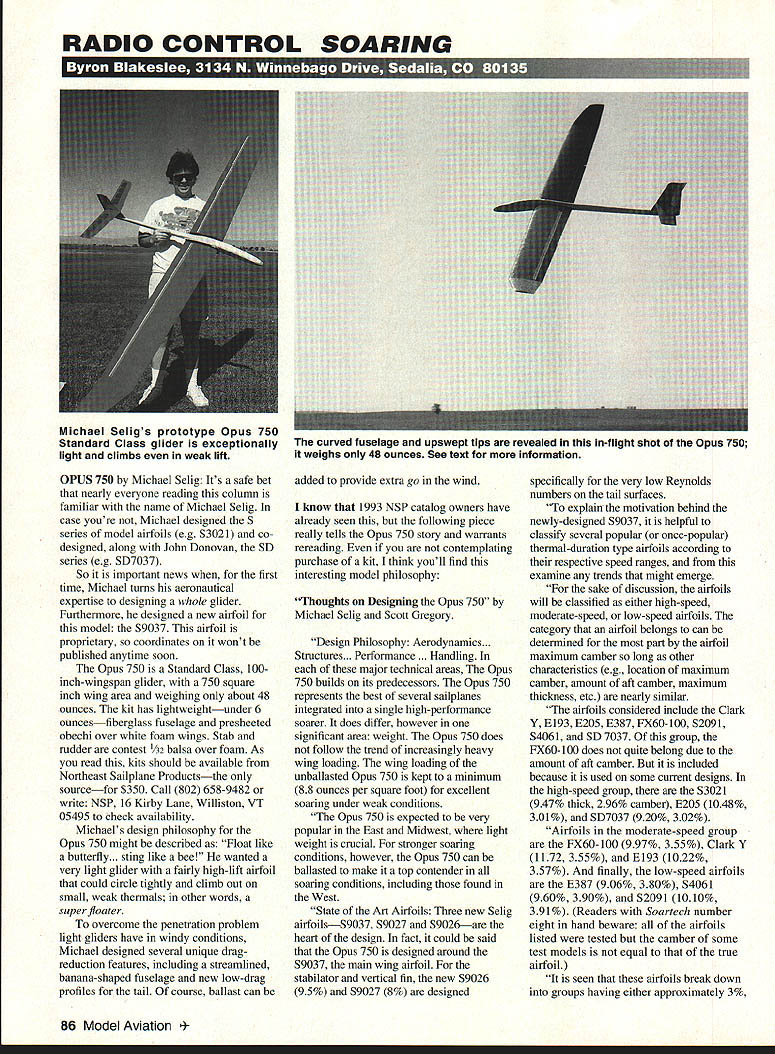
It's a safe bet nearly everyone reading this column is familiar with the name Michael Selig. In case you're not, Michael designed the S‑series model airfoils (e.g., S3021) and co‑designed, along with John Donovan, the SD series (e.g., SD7037). For the first time Michael has turned his aeronautical expertise to designing a complete glider and a new airfoil for it: the proprietary S9037 (coordinates not published).
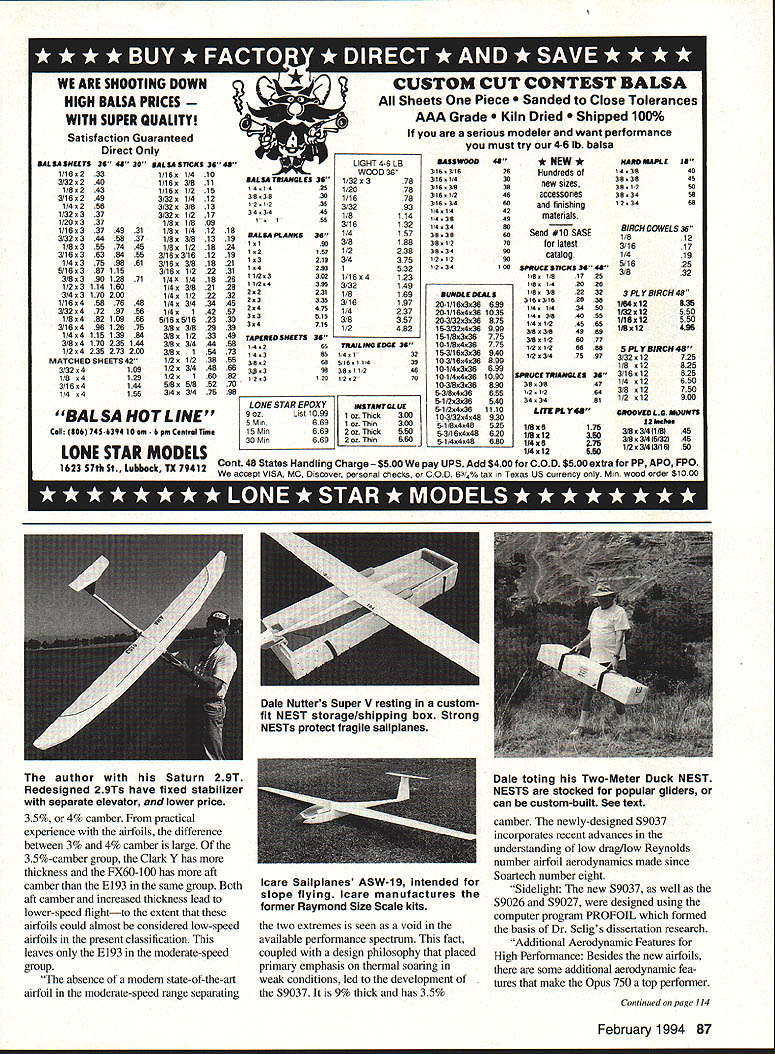
The Opus 750 is a Standard Class glider with a 100‑inch wingspan, 750 square‑inch wing area and an unballasted weight of about 48 ounces. The kit includes a lightweight (under 6 ounces) fiberglass fuselage, presheeted obechi over white foam wings, and a stabilizer and rudder of contest A2 balsa over foam. Kits are (or were) available from Northeast Sailplane Products for $350. Contact NSP: (802) 658‑9482 or NSP, 16 Kirby Lane, Williston, VT 05495 to check availability.
Michael's design philosophy for the Opus 750 might be summarized: "Float like a butterfly... sting like a bee." He wanted a very light glider with a fairly high‑lift airfoil that could circle tightly and climb out of small, weak thermals — a super floater. To help penetration in wind, he designed several drag‑reduction features, including a streamlined, banana‑shaped fuselage and low‑drag tail profiles. Ballast can be added for stronger conditions.
The following is Michael Selig's (with Scott Gregory) explanation of the design philosophy and technical details of the Opus 750.
Thoughts on Designing the Opus 750 — Michael Selig and Scott Gregory
Design Philosophy
- Focus areas: aerodynamics, structures, performance, handling.
- The Opus 750 integrates the best features of several sailplanes into a single high‑performance soarer.
- A key differentiator is weight: the unballasted wing loading is kept low (about 8.8 ounces per square foot) for excellent performance in weak lift. Ballast can be added for stronger conditions.
State‑of‑the‑Art Airfoils
- Three new Selig airfoils are central to the design: S9037 (main wing), S9027 and S9026 (stabilator and vertical fin).
- The S9026 (9.5%) and S9027 (8%) were designed specifically for very low Reynolds numbers and multiple laminar surfaces.
- The S9037 was created to fill a gap in the performance spectrum between existing moderate‑speed and low‑speed airfoils. It is 9% thick with 3.5% camber and incorporates advances in low‑drag/low‑Reynolds aerodynamics (work partly based on the PROFOIL program used in Dr. Selig's dissertation research).
Airfoil classification (typical characteristics)
- High‑speed group
- S3021 — ~9.47% thick, ~2.96% camber
- E205 — ~10.48% thick, ~3.01% camber
- SD7037 — ~9.20% thick, ~3.02% camber
- Moderate‑speed group
- FX60‑100 — ~9.97% thick, ~3.55% camber
- Clark Y — ~11.72% thick, ~3.55% camber
- E193 — ~10.22% thick, ~3.57% camber
- Low‑speed group
- E387 — ~9.06% thick, ~3.80% camber
- S4061 — ~9.60% thick, ~3.90% camber
- S2091 — ~10.10% thick, ~3.91% camber
Note: published airfoil data can vary (model differences, reporting variations), but the breakdown helps explain the motivation for S9037 as a modern moderate‑speed/high‑lift solution for model sailplanes.
Sidelight
- The S9037, S9026 and S9027 were designed using the PROFOIL computer program.
Additional Aerodynamic Features for High Performance
Fuselage
- Full‑scale sailplane research shows proper nose curvature reduces fuselage drag in both cruise and thermal modes. The Opus 750 uses substantial nose droop to alleviate flow separation at the leading‑edge wing root in thermal flight.
- Extensive juncture fillets around the wing/body intersection, a bowed tailboom, and a low fuselage cross‑section (servos mounted in line) all reduce fuselage drag.
- Practical benefit: nose droop helps prevent the flaps from contacting the ground on landing, protecting servo gears.
Tiplets and Wingtips
- Tiplets, derived from the Schuemann platform, improve handling and the behavior of the laminar separation bubble.
- At low Reynolds numbers, tiplet sweepback (leading edge sweepback with little/no trailing edge sweep) confines laminar separation to tip regions, preventing bubble migration inboard and reducing bubble size over the main panel.
- Low‑loss sharp‑edged wingtips increase effective span and improve launch and climb performance versus conventional rounded tips.
Stabilator
- The stabilator planform uses sweepback on both leading and trailing edges to move the mean aerodynamic center aft, increasing effective tail moment without lengthening the tailboom (and without adding weight or nose counterweight).
Wing Planform
- The main wing and tiplet panels use more gradual taper (broader chord toward the tip) relative to comparable RC sailplanes.
- Main wing panel (40‑inch span) tapers from 9 to 7.5 inches.
- Tiplet (8‑inch span, not including 1.75‑inch tips) tapers from 7.5 to 4.75 inches.
- Benefits:
- Increased wing area contributes to lighter wing loading for improved thermal performance.
- Reduced taper (higher chord near the outer wing) lowers profile drag and offsets increased induced drag from a modestly lower aspect ratio.
- Broader tips reduce tendency for tip stall.
- Overall, these choices aim to make the Opus 750 equal to or better than comparable sailplanes in the tradeoffs.
---
Saturn 2.9 (Layne/Urywler)
I built and flew a Saturn 2.9T and liked it very much. The 2.9T (113‑inch span for the 2.9T or 118‑inch span for the 3.0) is a slightly smaller, lower‑priced derivative of Layne/Urywler's original Saturn 3.0. Both are full‑house designs using six servos (ailerons, flaps, elevator, rudder).
- Saturn 3.0 (118‑inch span) kit: fiberglass fuselage, bagged glass/foam wings and stab, about 98% ARF, sells for $500. Airfoil: HQ 2.5/9 — an excellent thermal machine.
- Important joiner feature: 36‑inch length of 3/4‑inch seamless 6061‑T6 aluminum tube that extends well into each wing panel. On the 3.0 the joiner is straight with dihedral in the outer panels; on the 2.9T the joiner is bent in the middle to produce about 3° dihedral per side. This joiner takes bending loads, allowing lighter internal spar structure and strong assembled wings.
- Saturn 2.9T specifics: slimmer fuselage, obechi veneer skins on foam wing and stab cores, plastic tubes installed for the wing joiner in the cores. Airfoil: HQ 2.0/9 to 2.0/8. Flying weight ~70 ounces. Kits available standard (you apply skins) or pre‑sheathed.
- A 2.5T (99‑inch span) version is offered for Standard Class competitors.
- Recent changes lowered the price: standard kit $199, pre‑sheathed obechi version $299 (same for both sizes); add $15 shipping and handling.
- Major design change: switch from an all‑flying T‑tail to a bolt‑on stab with conventional elevator — improves pitch authority and reduces elevator servo throw, while increasing fin strength.
- Flight notes: excellent thermaling comparable to a Falcon 880; outstanding landing behavior thanks to large flaps.
Contact: Layne/Urywler — 1808 Applegate Drive, Modesto, CA 95350; Tel: (209) 529‑8457; Fax: (209) 549‑1642. Saturn 2.9T kits also available from Northeast Sailplane Products: (802) 658‑9482, and Slegers International: (201) 366‑0880.
---
ICARE Sailplanes (Canada)
Etienne Dorig (Quebec) has taken over the former Raymond Size line of scale sailplanes and is offering two small semi‑scale kits suited to slope flying (not intended for beginners).
- Salto H‑101
- Span: 53 inches; Weight: 26 ounces; Wing area: 210 sq in.
- Designed for slope flying in light to medium winds. Very aerobatic; with a thin Go 795 airfoil it can be flown fast.
- Ailerons actuated via cable pushrods; can be used as flaperons with two microservos.
- Fuselage: epoxy‑fiberglass with white gelcoat; canopy thermoformed PVC.
- ARF kit ($135 US): foam presheeted with obechi, leading edge, tip, wing joiner and root rib installed, wings sanded to shape, ailerons routed, aileron cable pushrod tube installed.
- Built‑up wing kit ($95): all ribs precut. V‑tail built from sheet balsa. Hardware, plans and instructions included.
- ASW‑19
- Span: 82 inches; Weight: 42 ounces; Wing area: 480 sq in.
- Semiscale Alexander Schleicher ASW‑19 (15 m prototype). E‑203 airfoil, high aspect ratio, covers ground well, aerobatic, good energy retention.
- Kit: epoxy‑fiberglass fuselage (optional white), foam presheeted obechi wings, ailerons prerouted, aileron push cable tubes installed. Leading edges and wing joiners installed by builder. Clear plastic canopy; FG molded canopy tray. Tail surfaces built‑up.
- Kit complete with wood, hardware, CAD plans, instructions. Price: $130 (regular fuselage) or $145 (white fuselage). Shipping extra.
For information, send $1 to Icare Sailplanes, 381 Joseph‑Huet, Boucherville, PQ, J4B 2C5, Canada; Tel: (514) 449‑9094.
---
NEST Model Boxes
Dale Nutter, a longtime glider flier, developed the NEST model box for safe storage, transport and shipping. Description:
- Constructed from white Pack‑Lite™ corrugated plastic — heat‑resistant and waterproof.
- Material used by the U.S. Postal Service for reusable shipping containers, tested to ASTM standards, with a compression strength of 3,700 pounds per square foot.
- Designed to be durable and protective for custom models.
Transcribed from original scans by AI. Minor OCR errors may remain.

