
Radio Control: Soaring
Byron Blakeslee 3134 N. Winnebago Drive, Sedalia, CO 80135
Change of Contributing Editor
Dan Pruss was Model Aviation's contributing editor for Soaring when the magazine was founded back in 1975. Those who knew Dan in the '70s and early '80s remember his many contributions to RC soaring. Dan CD'd the SOAR Nats and was Team Manager of the first three U.S. F3B Teams. Dan died of cancer in 1986, and I've been minding the column since then.
The job has been marvelously rewarding in many ways, especially in giving me the opportunity to make friends with so many great sailplaners here and around the world. I have enjoyed this immensely, but time marches on and I feel it's time to pass the baton. This will be my last column, but I love to build and fly gliders, so I'll contribute kit reviews and such to the column from time to time.
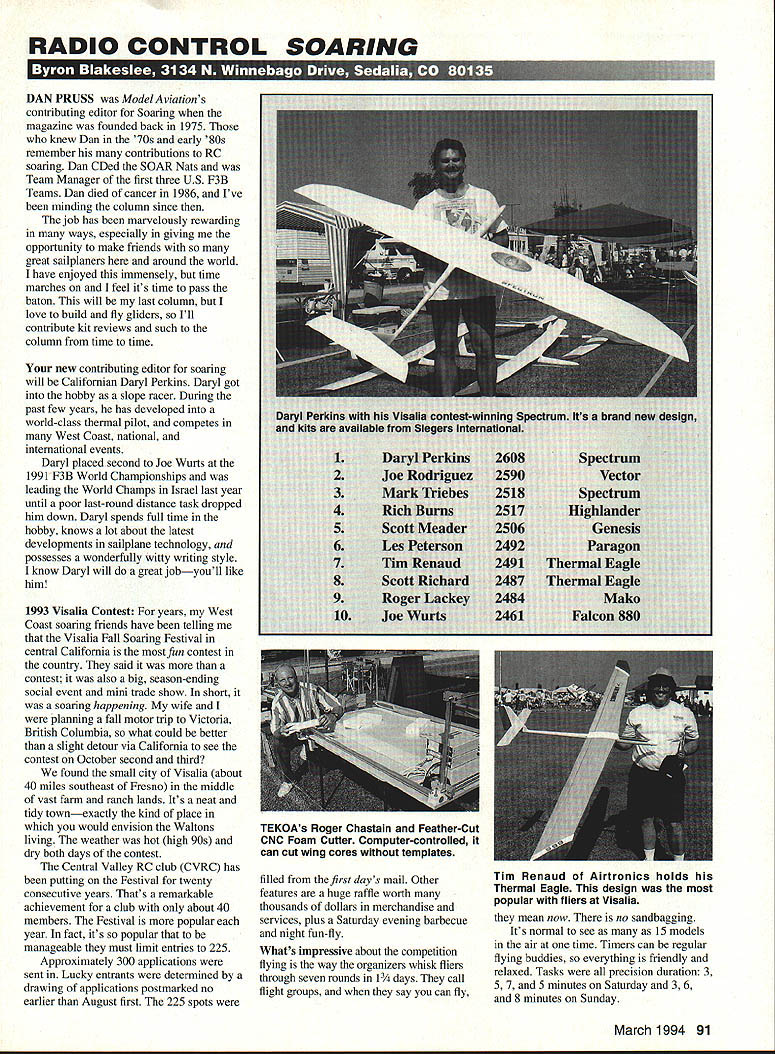
Your new contributing editor for Soaring will be Californian Daryl Perkins. Daryl got into the hobby as a slope racer. During the past few years he has developed into a world-class thermal pilot and competes in many West Coast, national, and international events.
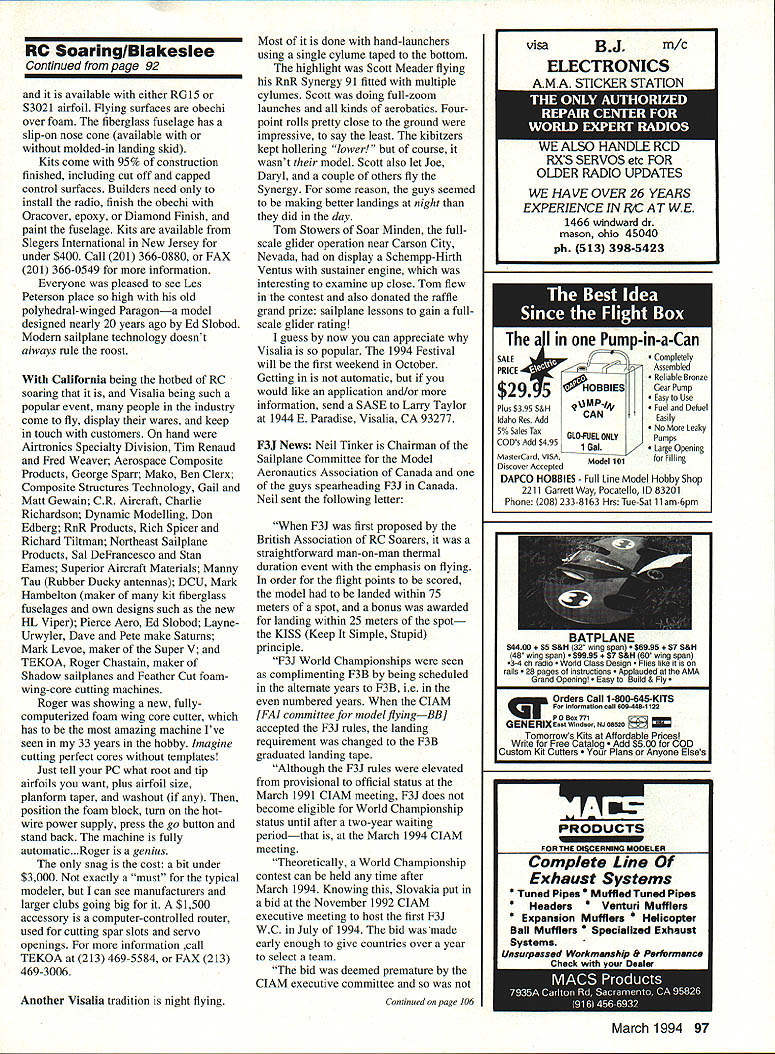
Daryl placed second to Joe Wurts at the 1991 F3B World Championships and was leading the World Champs in Israel last year until a poor last-round distance task dropped him down. Daryl spends full time in the hobby, knows a lot about the latest developments in sailplane technology, and possesses a wonderfully witty writing style. I know Daryl will do a great job—you'll like him!
1993 Visalia Contest
For years my West Coast soaring friends have been telling me that the Visalia Fall Soaring Festival in central California is the most fun contest in the country. They said it was more than a contest; it was also a big, season-ending social event and mini trade show. In short, it was a soaring happening. My wife and I were planning a fall motor trip to Victoria, British Columbia, so what could be better than a slight detour via California to see the contest on October 2 and 3?
We found the small city of Visalia (about 40 miles southeast of Fresno) in the middle of vast farm and ranch lands. It's a neat and tidy town—exactly the kind of place in which you would envision the Waltons living. The weather was hot (high 90s) and dry both days of the contest.
The Central Valley RC Club (CVRC) has been putting on the Festival for twenty consecutive years. That's a remarkable achievement for a club with only about 40 members. The Festival is more popular each year. In fact, it's so popular that they must limit entries to 225.
Approximately 300 applications were sent in. Lucky entrants were determined by a drawing of applications postmarked no earlier than August 1. The 225 spots were filled from the first day's mail. Other features are a huge raffle worth many thousands of dollars in merchandise and services, plus a Saturday evening barbecue and night fun-fly.
What's impressive about the competition flying is the way the organizers whisk fliers through seven rounds in 1-1/4 days. They call flight groups, and when they say you can fly, they mean now. There is no sandbagging.
It's normal to see as many as 15 models in the air at one time. Timers can be regular flying buddies, so everything is friendly and relaxed. Tasks were all precision duration: 3, 5, 7.5 minutes on Saturday and 3, 6, and 8 minutes on Sunday.
The CVRC club-owned field is used for the contest. It's an 11-acre rectangular plot surrounded by cotton fields a few miles north of Visalia. Winches, retrievers, and turnarounds are hard-mounted to pedestals, with the winch lines running north. There's no moving winch lines if the wind isn't right. Unfortunately, southerly breezes prevail at this time of the year.
Joe Wurts had warned me about this. He said that anyone flying at Visalia had better practice lots of downwind landings. I can see why shark's teeth are de rigueur. CVRC has the area from the winches to behind the landing circles planted in wiry Bermuda grass. Anything landing fast is in for a long slide.
Most competitors were well aware of this, and used a variety of arrestor devices. In addition to the usual nose gadgets, many models had about a two-inch-long skeg behind the tow hook—quite effective, and it helps keep flaps off the ground.
Hitting consistent spot landings is vital at Visalia. With so many top pilots on hand, a goodly number can be counted on to get their flight times, making landings the real separator. Even so, at times the sink cycles were severe enough that some of the big guns couldn't get their max. Some were even seen landing in the cotton.
Unusual and difficult landing-bonus schemes are traditional at Visalia. This time the setup was relatively generous: three concentric circles of 0.75, 1.5, and 3.0 meters radius. Landing inside the inner circle netted a 20% bonus on target flight points. The middle circle added 10%, and the outer circle 5%.
With the premium placed on accurate landings, the most popular models were the lightweight aileron/flap designs with 100- to 118-inch wingspans. They can use "crow" (flaps down—ailerons up) for slow, controlled landing approaches. A light model with full wing camber is a big advantage in downwind launches, too.
I'd guess that 90% of entries fit this category. A smattering of polyhedral models, plus smaller and larger aileron designs, filled out the rest. Airtronics' Thermal Eagle was the most popular kit design, with more than 30 flown. The RnR Genesis was second with about 20.
Following were Saturns, Falcons, Shadows, Super Vs, and Makos.
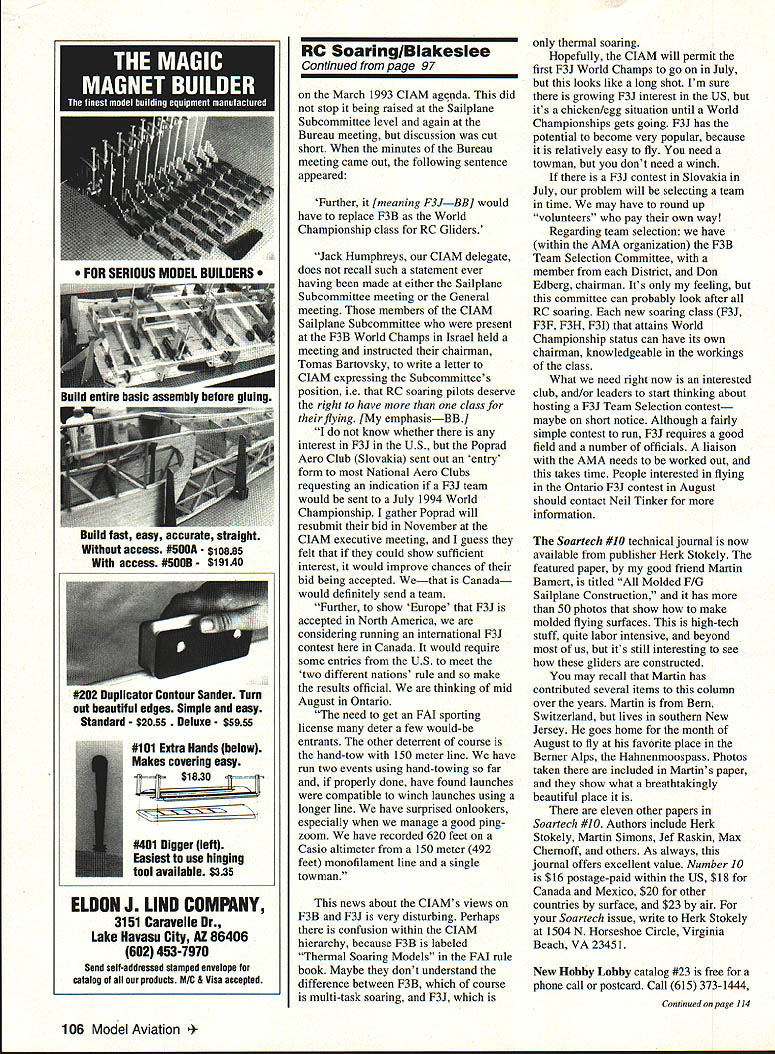
However, the contest winner was none of the above. It was a brand-new design called the Spectrum—flown by none other than your new Soaring contributing editor. Yes, Daryl Perkins flew 98% perfect, dropping only 56 points out of a possible 2,664.
The Spectrum is a very attractive-looking model, designed by Mark Triebs and Ron Vann. It's made to order for Visalia conditions: 108-inch span, 62 ounces, the T-tail has a fixed stab with separate elevator, and it is available with either RG15 or S3021 airfoil. Flying surfaces are balsa over foam. The fiberglass fuselage has a slip-on nose cone (available with or without molded-in landing skid). Kits come with 95% of construction finished, including cut-off and capped control surfaces. Builders need only to install the radio, finish the cowl with Oracover, epoxy, or Diamond Finish, and paint the fuselage. Kits are available from Slegers International in New Jersey for under $400. Call (201) 366-0880, or FAX (201) 366-0549 for more information.
Everyone was pleased to see Les Peterson place so high with his old polyhedral-winged Paragon — a model designed nearly 20 years ago by Ed Slobod. Modern sailplane technology doesn't always rule the roost.
With California being the hotbed of RC soaring that it is, and Visalia being such a popular event, many people in the industry come to fly, display their wares, and keep in touch with customers. On hand were representatives from:
- Airtronics Specialty Division — Tim Renaud and Fred Weaver
- Aerospace Composite Products — George Sparr
- Mako — Ben Clerx
- Composite Structures Technology — Gail and Matt Gewain
- C.R. Aircraft — Charlie Richardson
- Dynamic Modeling — Don Edberg
- Ron R Products — Rich Spicer and Richard Titman
- Northeast Sailplane Products — Sal DeFrancsco and Stan Eames
- Superior Aircraft Materials
- Manny Tau (Rubber Ducky antennas)
- DCU — Mark Hambleton (maker of many kit fiberglass fuselages and designs such as the HL Viper)
- Pierce Aero — Ed Slobod
- Layne-Uwyler — Dave and Pete (makers of Saturns)
- Mark Levoe (maker of the Super V)
- TEKOA — Roger Chastain (maker of Shadow sailplanes and Feather-Cut foam-wing-core cutting machines)
Roger was showing a new, fully computer-controlled foam wing-core cutter, which has to be the most amazing machine I've seen in my 33 years in the hobby. It will cut perfect cores without templates! Just tell your PC what root and tip airfoils you want, plus airfoil size, planform taper, and washout (if any). Then position the foam block on the machine, turn on the hot-wire power supply, press the go button and stand back. The machine is fully automatic... Roger is a genius.
The only snag is the cost, a bit under $3,000. Not exactly a "must" for the typical modeler, but I can see manufacturers and larger clubs going big for it. A $1,500 accessory is a computer-controlled router, used for cutting spar slots and servo openings. For more information, call TEKOA at (213) 469-5584, or FAX (213) 469-3006.
Another Visalia tradition is night flying.
Most of it is done with hand-launchers using a single cyalume taped to the bottom. The highlight was Scott Meader flying his RnR Synergy 91 fitted with multiple cyalumes. Scott was doing full-zoom launches and all kinds of aerobatics. Four-point rolls pretty close to the ground were impressive, to say the least. The kibitzers kept hollering "lower!", but of course it wasn't their model. Scott also let Joe, Daryl, and a couple of others fly the Synergy. For some reason, the guys seemed to be making better landings at night than they did in the day.
Tom Stowers of Soar Minden, the full-scale glider operation near Carson City, Nevada, had on display a Schempp-Hirth Ventus with sustainer engine, which was interesting to examine up close. Tom flew in the contest and also donated the raffle grand prize: sailplane lessons to gain a full-scale glider rating!
I guess by now you can appreciate why Visalia is so popular. The 1994 Festival will be the first weekend in October. Getting in is not automatic, but if you would like an application and/or more information, send a SASE to Larry Taylor at 1944 E. Paradise, Visalia, CA 93277.
F3J News
Neil Tinker is Chairman of the Sailplane Committee for the Model Aeronautics Association of Canada and one of the guys spearheading F3J in Canada. Neil sent the following letter:
"When F3J was first proposed by the British Association of RC Soarers, it was a straightforward man-on-man thermal duration event with the emphasis on flying. In order for the flight points to be scored, the model had to be landed within 75 meters of a spot, and a bonus was awarded for landing within 25 meters of the spot — the KISS (Keep It Simple, Stupid) principle.
"F3J World Championships were seen as complementing F3B by being scheduled in the alternate years to F3B, i.e., in the even-numbered years. When the CIAM (FAI committee for model flying) accepted the F3J rules, the landing requirement was changed to the F3B graduated landing tape.
"Although the F3J rules were elevated from provisional to official status at the March 1991 CIAM meeting, F3J does not become eligible for World Championship status until after a two-year waiting period — that is, at the March 1994 CIAM meeting.
"Theoretically, a World Championship contest can be held any time after March 1994. Knowing this, Slovakia put in a bid at the November 1992 CIAM executive meeting to host the first F3J World Championship in July of 1994. The bid was made early enough to give countries over a year to select a team.
"The bid was deemed premature by the CIAM executive committee and so was not on the March 1993 CIAM agenda. This did not stop it being raised at the Sailplane Subcommittee level and again at the Bureau meeting, but discussion was cut short. When the minutes of the Bureau meeting came out, the following sentence appeared:
"'Further, it [meaning F3J] would have to replace F3B as the World Championship class for RC Gliders.'
"Jack Humphreys, our CIAM delegate, does not recall such a statement ever having been made at either the Sailplane Subcommittee meeting or the General meeting. Those members of the CIAM Sailplane Subcommittee who were present at the F3B World Champs in Israel held a meeting and instructed their chairman, Tomas Bartosky, to write a letter to CIAM expressing the Subcommittee's position, i.e., that RC soaring pilots do deserve the right to have more than one class for their flying. [My emphasis — BB.]
"I do not know whether there is any interest in F3J in the U.S., but the Poprad Aero Club (Slovakia) sent out an 'entry' form to most National Aero Clubs requesting an indication if an F3J team would be sent to a July 1994 World Championship. I gather Poprad will resubmit their bid in November at the CIAM executive meeting, and I guess they felt that if they could show sufficient interest, it would improve chances of their bid being accepted. We — that is Canada — would definitely send a team.
"Further, to show 'Europe' that F3J is accepted in North America, we are considering running an international F3J contest here in Canada. It would require some entries from the U.S. to meet the two-nation rule and so make the results official. We are thinking of mid-August in Ontario. We will have two classes: F3J and F3B.
"The need to get a FAI sporting license may deter a few would-be entrants. The other deterrent of course is the hand-tow with 150 meter line. We have run two events using hand-towing so far and, if properly done, have found launches were comparable to winch launches using a longer line. We have surprised onlookers, especially when we manage a good pz-zoom. We have recorded 620 feet on a Casio altimeter from a 150 meter (492 feet) monofilament line and a single towman."
This news about the CIAM's views on F3B and F3J is very disturbing. Perhaps there is confusion within the CIAM hierarchy, because F3B is labeled "Thermal Soaring Models" in the FAI rule book. Maybe they don't understand the difference between F3B, which of course is multi-task soaring, and F3J, which is only thermal soaring.
Hopefully, the CIAM will permit the first F3J World Champs to go on in July, but this looks like a long shot. I'm sure there's a growing F3J interest in the U.S., but it's a chicken/egg situation until a World Championship gets going. F3J has the potential to become very popular, because it is relatively easy to fly. You need a towman, but you don't need a winch.
If there is an F3J contest in Slovakia in July, our problem will be selecting a team in time. We may have to round up "volunteers" — who pay their own way!
Regarding team selection: we have (within the AMA organization) the F3B Team Selection Committee, with a member from each District, and Don Edberg, chairman. It's only my feeling, but this committee can probably look after all RC soaring. Each new soaring class (F3J, F3F, F3H, F3I) that attains World Championship status can have its own chairman, knowledgeable in the workings of the class.
What we need right now is an interested club, and/or leaders to start thinking about hosting an F3J Team Selection contest—maybe on short notice. Although a fairly simple contest to run, F3J requires a good field and a number of officials. A liaison with the AMA needs to be worked out, and this takes time. People interested in flying in the Ontario F3J contest in August should contact Neil Tinker for more information.
Soartech #10
The Soartech #10 technical journal is now available from publisher Henk Stokely. The featured paper, by my good friend Martin Barnert, is titled "All Molded F/G Sailplane Construction," and it has more than 50 photos that show how to make molded flying surfaces. This is high-tech stuff, quite labor intensive, and beyond most of us, but it's still interesting to see how these gliders are constructed.
You may recall that Martin has contributed several items to this column over the years. Martin is from Bern, Switzerland, but lives in southern New Jersey. He goes home for the month of August to fly at his favorite place in the Berner Alps, the Hahnenmoospass. Photos and text of his trip are included in Martin's paper, and they show what a breathtakingly beautiful place it is.
There are eleven other papers in Soartech #10. Authors include Henk Stokely, Martin Simons, Jef Raskin, Max Chernoff, and others. As always, this journal offers excellent value. Number 10 is $16 postage-paid within the U.S., $18 for Canada and Mexico, $20 for other countries by surface, and $23 by air. For your Soartech issue, write to Henk Stokely at 1504 N. Horseshoe Circle, Virginia Beach, VA 23451.
Hobby Lobby Catalog and Czech Imports
New Hobby Lobby catalog #23 is free for a phone call or postcard. Call (615) 373-1444 or write to Hobby Lobby International at 5614 Franklin Pike Circle, Brentwood, TN 37027. HLI is now bringing in models from the Czech Republic, said to be German quality at lower prices. For example, a nice-looking Scale Discus kit, 114-inch span and ready-to-fly, is less than $400.
Another item from the Czech Republic that caught my eye is a 96-inch-span electric soarer called the Raptor. It can carry 12 to 16 cells, has a white gel-coat fiberglass fuselage, balsa or foam wings with E387 airfoil, and sells for $199. HLI also has an excellent selection of motors, controllers, props, and chargers. Sailplaners can think of electrics as self-launching gliders; they are also a natural for slope flying. If the wind stops, just turn on the motor.
Segelflug Calendar
The 1994 Segelflug Bildkalender from Germany features beautiful 11 x 19-inch color prints of full-scale sailplanes. I've loved this calendar for years. It makes a wonderful gift or contest award. The price is $18.50, plus $6 UPS shipping in the U.S., $8.50 elsewhere. Write to: Aeromuseum, 809 Dothan Ct., Raleigh, NC 27614; Tel.: (919) 676-8876.
It's tough to say "goodbye"—"see you later" sounds much better. Thank you for your support and your calls and letters over the years.
BB.
Transcribed from original scans by AI. Minor OCR errors may remain.

