


RADIO CONTROL SOARING
Daryl Perkins, 4234 Petaluma Blvd. North, Petaluma, CA 94952
Modelers are nuts. What is this neurosis we refer to as radio control soaring? We jeopardize relationships, jobs, and financial well-being for a few fleeting moments of glory. The feeling we get from watching a glider cruising with a tremendous amount of energy, watching a model streak across the field at a dangerously low level and tremendous speed, or squinting to see a model at cloudbase — whatever the attraction, we keep coming back.
After selling my car because my winch wouldn't fit in the trunk, I bought a truck, and I couldn't be happier!
I recently received a letter from a gentleman with the same RC soaring symptoms as myself. Joe Thomas of San Jose, California writes:
"Just for the heck of it, I have enclosed photos of the inside of my Toyota 4-Runner. The rack is made of PVC sprinkler pipe, Masonite, and foam-backed carpet. There are five sailplanes shown in one photograph, but I've had as many as nine stuffed in there, including a 1/4-scale Multiplex DG 600 and a 1/4-scale DG 300."
Actually, this is a great way to carry your models around. I hate it when models slide around in the back.
Epitome of scale soaring
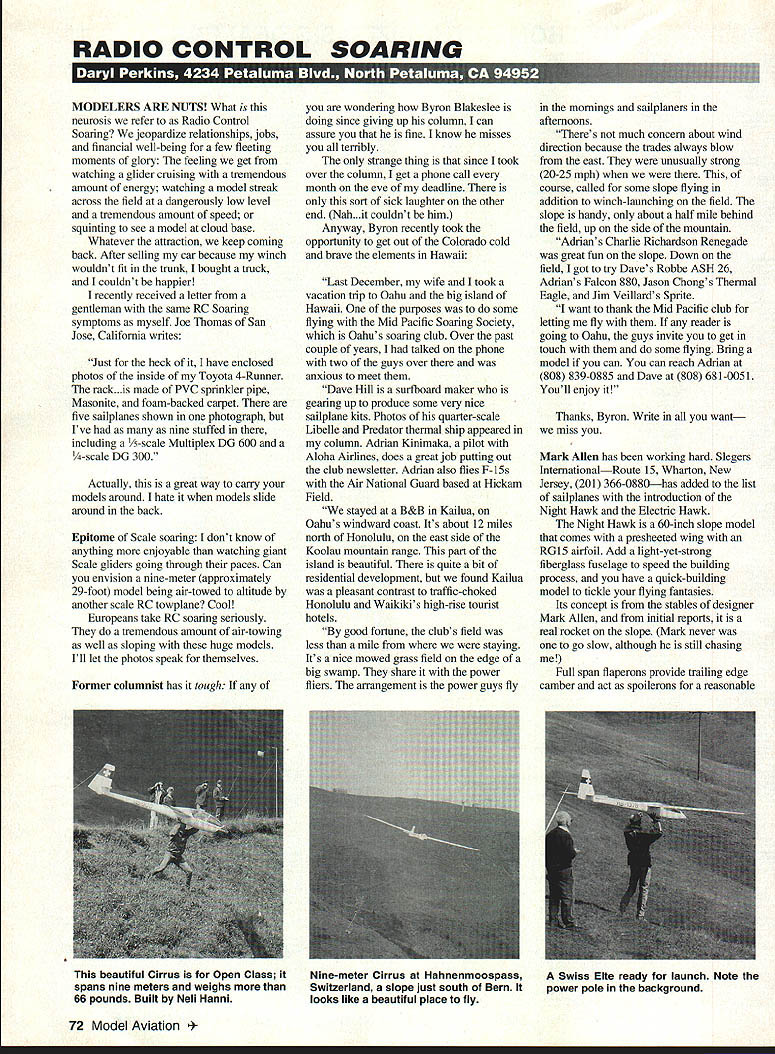
I don't know of anything more enjoyable than watching giant scale gliders go through their paces. Can you envision a nine-meter (approximately 29-foot) model being air-towed to altitude by another scale RC towplane? Cool!
Europeans take RC soaring seriously. They do a tremendous amount of air-towing as well as sloping with these huge models. I'll let the photos speak for themselves.
Former columnist has it tough
If any of you are wondering how Byron Blakeslee is doing since giving up his column, I can assure you that he is fine. I know he misses you all terribly. The only strange thing is that since I took over the column, I get a phone call every month on the eve of my deadline — there is only this sort of sick laughter on the other end. (Nah... it couldn't be him.)
Byron recently took the opportunity to get out of the Colorado cold and brave the elements in Hawaii.
Last December my wife and I took a vacation trip to Oahu and the Big Island of Hawaii. One of the purposes was to do some flying with the Mid Pacific Soaring Society, which is Oahu's soaring club. Over the past couple of years I had talked on the phone with two of the guys there and was anxious to meet them.
- Dave Hill is a surfboard maker who is gearing up to produce some very nice sailplane kits. Photos of his quarter-scale Libelle and Predator thermal ship appeared in my column.
- Adrian Kinimaka, a pilot with Aloha Airlines, does a great job putting out the club newsletter. Adrian also flies F-15s with the Air National Guard based at Hickam Field.
We stayed at a B&B in Kailua on Oahu's windward coast. It's about 12 miles north of Honolulu, on the east side of the Koolau mountain range. This part of the island is beautiful, with quite a bit of residential development; Kailua is a pleasant contrast to traffic-choked Honolulu and Waikiki's high-rise tourist hotels.
By good fortune, the club's field was less than a mile from where we were staying. It's a nicely mowed grass field on the edge of a big swamp. They share it with the power fliers: the power guys fly in the mornings and sailplaners in the afternoons.
"There's not much concern about wind direction because the trades always blow from the east. They were unusually strong (20–25 mph) when we were there. This, of course, called for some slope flying in addition to winch-launching on the field. The slope is handy, only about a half mile behind the field, up on the side of the mountain."
Adrian's Charlie Richardson Renegade was great fun on the slope. Down on the field, I got to try Dave's Robbe ASH 26, Adrian's Falcon 880, Jason Chong's Thermal Eagle, and Jim Veillard's Sprite.
I want to thank the Mid Pacific club for letting me fly with them. If any reader is going to Oahu, the guys invite you to get in touch and do some flying. Bring a model if you can. You can reach Adrian at (808) 839-0885 and Dave at (808) 681-0051. You'll enjoy it!
Thanks, Byron. Write in all you want — we miss you.
New kits from Slegers International
Mark Allen has been working hard. Slegers International — Route 15, Wharton, New Jersey — (201) 366-0880 — has added to the list of sailplanes with the introduction of the Night Hawk and the Electric Hawk.
- Night Hawk: a 60-inch slope model that comes presheeted with an RG15 airfoil. Add a light-yet-strong fiberglass fuselage to speed the building process, and you have a quick-building model to tickle your flying fantasies. Its concept is from designer Mark Allen, and initial reports say it is a real rocket on the slope. Full-span flaperons provide trailing-edge camber and act as spoilerons for a reasonable turn of speed.
- Electric Hawk: designed to fill the mid-range electric class. It has a 72-inch wingspan and utilizes the SD7037 airfoil. It uses seven to ten cells and, with its light wing loading, it streaks up where you can accomplish some real tree flying. The Electric Hawk is provided with a presheeted stab and wing and a light-but-strong fiberglass fuselage to speed the building process.
Both kits feature the complete accessories packages that are standard in Slegers International kits.
Slegers International has also taken over production of the Vertigo (both the V- and T-tail) and is adding a fiberglass fuselage as an option. The fiberglass fuselages are available for those who want to upgrade their current Vertigos. The Banshee is another model that Slegers International is going to kit for designer Brian Agnew.
Feel free to give Ed a call — he's a heck of a nice guy, and he loves to talk about our sport. He also has an extensive catalog and has just about everything in stock.
International Slope Race returns to Big Creek
The Big Creek Lumber Co., just north of Davenport, California, had been the ISR location for years. Before that, it was referred to as the RCM Trophy Race, sponsored by Radio Control Modeler magazine. South Bay Soaring Society were the driving force behind this awesome event. For us old-timers, the ISR was the slope race — no other event was more prestigious. All year was spent designing and building models for the 30–50 mph winds prevalent at this site during May.
The ISR died a few years ago, only to be resurrected by the California Slope Racers. The Torrey Pines Gulls hosted the 1993 ISR in San Diego, California. The 1994 ISR will return to Davenport, California, May 21–22. The Davenport site is a favorite among slope racers, known for its howling winds and phenomenal lift. Located on the untamed northern California coastline, you could not ask for a more scenic setting to perform such a wild sport.
May is known for predictably high winds along the coast. CSR has always sponsored two divisions of racing:
- Division 1 — for the "big guns" flying higher-performance racers.
- Division 2 — caters to the entry-level or less competitive pilots.
First-time slope pilots need not fear the slope. Despite high winds, the lift is smooth and uniform, and with a little ballast, almost any thermal ship will perform quite well. If you are a competent RC pilot, you have the necessary skills to begin slope racing.
For more information about the ISR, or to receive a registration package, contact:
- John Dvorak: (408) 259-4205
- Ray Kuntz: (310) 645-4269
I hope to see you at Davenport in May.
Other scale notes
- Cirrus Open Class: spans nine meters and is a hefty, impressive ship. The nine-meter Cirrus flown at Hahnenmoospass, Switzerland, looks like a beautiful machine for slope flying.
- ASW 20: gives the feel of full-scale soaring and can be flown in high winds and is capable of aerobatics. Epoxy/fiberglass fuselage plans and canopy options are available.
Thermals!
Transcribed from original scans by AI. Minor OCR errors may remain.

