
RADIO CONTROL Soaring
Daryl Perkins 4234 Petaluma Blvd., North Petaluma, CA 94952
Hi, guys! Sorry about last month — the magazine's computers and mine didn't interface, or something like that. (I don't do computers — just gliders.)
I have some sound advice for those of you who have notions about taking up roller skating: don't. It could seriously hamper your flying. What does roller skating have to do with flying, you ask? It's kind of a long story, but suffice it to say the doctors were able to conform the cast around my 9-ZAP, so I can still practice.
That's right, your favorite Soaring columnist broke his arm. (You can stop laughing now.) The hardest part isn't flying, but typing. Byron Blakeslee was kind enough to write most of the column for me, and he has done an informative, in-depth review on two popular transmitter trays. (I wonder if now would be a good time to convert to a suspended tray, what with the cast and all?)
Transmitter Trays
No European RC glider flier would be caught dead without his transmitter tray. European transmitters are designed to fit into a tray, or at least to use a neck strap attached to wire legs swinging out of the bottom of the transmitter.
I always wondered about this. In North America, most of us just hold the sides of the transmitter and work the sticks with our thumbs. What do the Europeans know that we don't? It would seem using a tray offers these advantages:
- Transmitter is more stable.
- Sticks can be held between thumb and forefinger.
- Sticks can be longer, making them less sensitive.
Is this a better way to fly? First, let's look at the 2% who don't hold their transmitters; they use simple neck straps. Transmitters made for the American market often have an eye on the front to hook onto neck straps. I've tried this. Besides literally being a pain in the neck, I haven't found this kind of support to be much help. It's mainly because the transmitter isn't stable when hung from a single point. Most people still hold the sides and use their thumbs. Sure, on long flights when the model is well trimmed and you're just letting it cruise, you can stick your hands in your pockets. This is the only real benefit I've found from neck straps.
I have been searching for something that really stabilized my transmitter and did not put a load on my neck. I recently came across two transmitter holders that appeared to offer the goods. I've tried them both and would like to pass along my impressions.
PNI Tray
- Price: $89.95 (plus $8 S&H)
- Available from: Pacific Northwest Industries, 9658 Ronald Drive, Blaine, WA 98230
- Tel: 206-332-8822
The PNI Tray is high-quality, all-aluminum construction and features padded straps that fit over your shoulders — no weight on your neck. The 3½-pound system is absolutely rigid and feels very solid and comfortable in place. It is fully adjustable and one-size-fits-most.
Features and notes:
- The tray adjusts to hold the transmitter's sides and bottom, with a shock cord hooking to the transmitter handle to hold it in place. Slip off the cord and the transmitter is quickly removed.
- The tray part can be separated from the shoulder unit by loosening a locking knob.
- PNI Tray features three-way adjustable palm rests and a place to rest your hands while operating the sticks.
- Thumb-and-forefinger rests provide a solid reference as hands and fingers move the sticks, allowing for more precise control inputs.
- Bill Law, PNI Tray's designer, cautions new users about overcontrolling — the tendency to move the sticks too much when the transmitter is held in a tray. Once you get used to the transmitter not moving around, control inputs become more precise.
- Launching is not a problem; having both hands free can be an advantage. Watch the antenna — rotate your body to keep it from waving around. If glare from the sun is a problem, you can quickly slip the transmitter out of the tray and hold it up to block the sun.
Kurt Rosner has used trays for years and reports that the PNI Tray is a big improvement over older neck-strap trays. He loves it.
Flying Buddy
- Price: $48 (plus $6 S&H)
- Available from: George Zatloka, 12212 NE 66th Street, Kirkland, WA 98033
- Tel: 206-827-1960
At first glance the Flying Buddy Transmitter Support looks like a conventional neck strap with two-point attachment. In reality it's quite different because of a clever design that provides more support and stability than a simple neck strap. It does not put any weight on your neck.
Key features:
- The secret is a fairly rigid plastic tube ergonomically shaped to fit over your shoulders and behind your neck. If necessary, you can bend the tube to suit your shape.
- Adjustable nylon straps connect from the plastic tube to the 3/16-inch-diameter wire frame that supports the transmitter.
- Four plastic clips ("snap locks") are adhered to the back of the transmitter with two-sided foam tape. The clips snap onto the frame to secure the transmitter.
- The Flying Buddy is light and comfortable to wear. It's not quite as stable a platform as the PNI Tray, but it is a less dramatic transition from hand-holding.
- Palm rests are not incorporated, but users could add wooden rests to the transmitter sides or fabricate metal straps to attach rests to the Flying Buddy frame. George may offer a Mark II with palm rests if there is demand.
A note on snap locks: the first time I pulled my Vision transmitter out of the frame, one of the lower snap locks came loose due to a circular recess in the transmitter case preventing full contact of the foam tape. A good cleaning of the transmitter case and new tape fixed the problem. The longer the foam tape is in place, the stronger the bond becomes. If applied properly, the snap locks release easily and I don't think there's danger of a transmitter coming adrift.
Conclusion
I think the Europeans are sold on trays because they permit more precise control inputs and probably improved flying. The downside is they can hamper movement and "body English" a bit. It boils down to personal preference and what you get accustomed to. I expect most Americans will continue to hand-hold because we're used to that method.
If you want to try flying with a more stable transmitter, start with a regular neck strap, bearing in mind it won't offer nearly the solidity of a tray. If the strap feels okay (aside from neck strain), then consider something better — like one of the trays reviewed here.
Thanks for the write-up, Byron. I know the Europeans wouldn't be caught dead without their trays. Maybe they know something we don't.
Competition Composites — Molded Pre-preg Carbon Fiber Sailplane
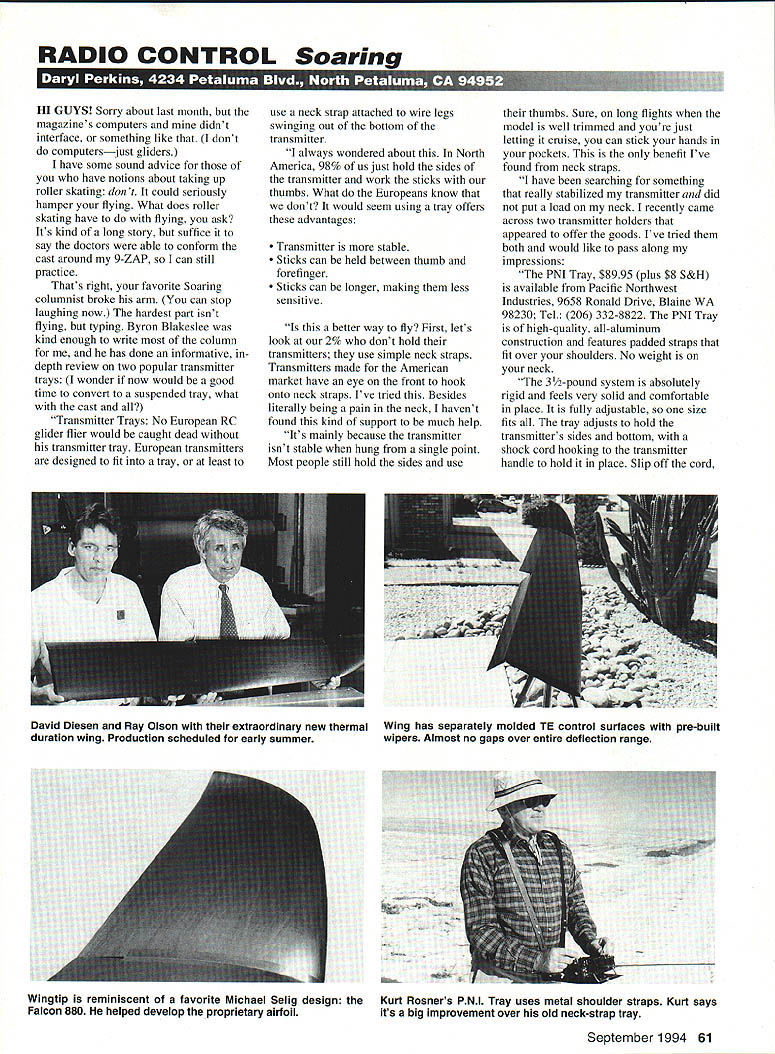
At a recent contest in Arizona, I ran into an old friend, Ray Olson. For years Ray has been interested in making available a state-of-the-art, high-performance thermal model. He has dedicated the last three years to the design and development of his newest offering. Along with David Diesen, he has come up with some incredible stuff.
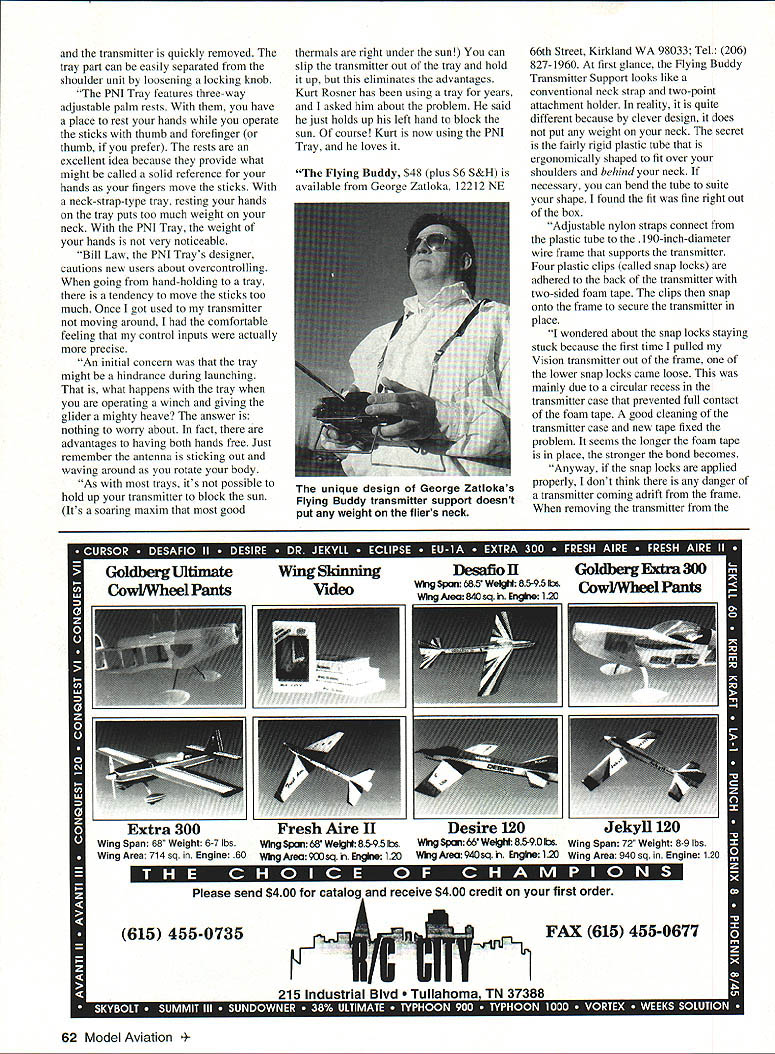
They have developed a procedure to mold sailplanes out of pre-preg carbon fiber. The results are revolutionary. These wings are practically bulletproof: no seam on the leading edge, no Rohacell inner skins — just solid carbon fiber skins. (They wouldn't let me look inside the wings, as they are trying to obtain a patent on the process.)
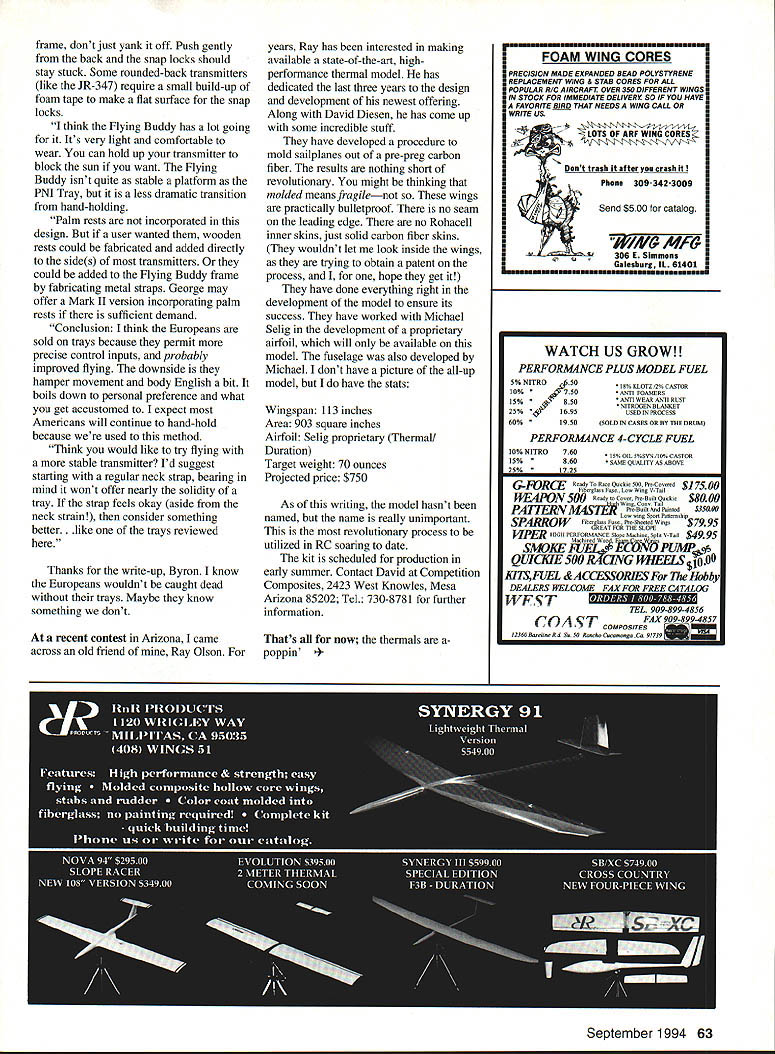
They have worked with Michael Selig to develop a proprietary airfoil and fuselage design. The airfoil will be proprietary to this model.
Model stats:
- Wingspan: 113 inches
- Area: 903 square inches
- Airfoil: Selig proprietary (Thermal/Duration)
- Target weight: 70 ounces
- Projected price: $750
- Kit production scheduled for early summer
Contact for information: David, Competition Composites, 2423 West Knowles, Mesa, AZ 85202. Tel: 730-8781.
That's all for now; the thermals are a-poppin'.
Transcribed from original scans by AI. Minor OCR errors may remain.

