
RADIO CONTROL SOARING
Daryl Perkins, 940 Baird Rd., Santa Rosa, CA 95409
Just being invited to the Masters of Soaring contest is truly an honor. When you arrive, you notice that you are in the company of some of the greatest contest fliers around.
On the first day, I was speaking with one of the newer winning names on the contest circuit, Roger Lackey, who said he felt as if he was at his first day of school. Little did we know he was about to teach some of the old masters a few lessons with a third-place finish.
How do you get invited to the Masters? This is what makes it so prestigious: LSF Level V's are eligible, as are Level IV's who have acquired their Level V wins.
This is great, but what if you are an LSF Level 0—such as myself? You win a major contest (a major contest is defined as a two-day contest). Hey, even Joe Wurts is only a Level II, but somehow I think he's qualified to attend.
This year the contest returned to the field of its origin in Covina, California, and it was hosted by the Silent Wings Soaring Association (SWSA). I always like to see contests there (because I used to fly there all the time). SWSA did a great job running this contest; we pumped through 16 rounds and were done by 1 p.m. Sunday afternoon.
For those who believe that a soaring contest can't happen in California because the sky is always going up, let me remind you: with that big California lift comes tremendous California sink. This sink caught quite a few top fliers unaware, and they were unable to make their times.
I remember one flight in particular: it was the last flight on Saturday, and the task was a simple three minutes. No-brainer, right? Wrong! I was at fifty feet with a minute-and-a-half remaining. I was fortunate enough to find a small bubble and work it just long enough to get a halfway decent final approach. Others weren't so fortunate. It was our own fault, however; we went the wrong way.
Top Five Fliers
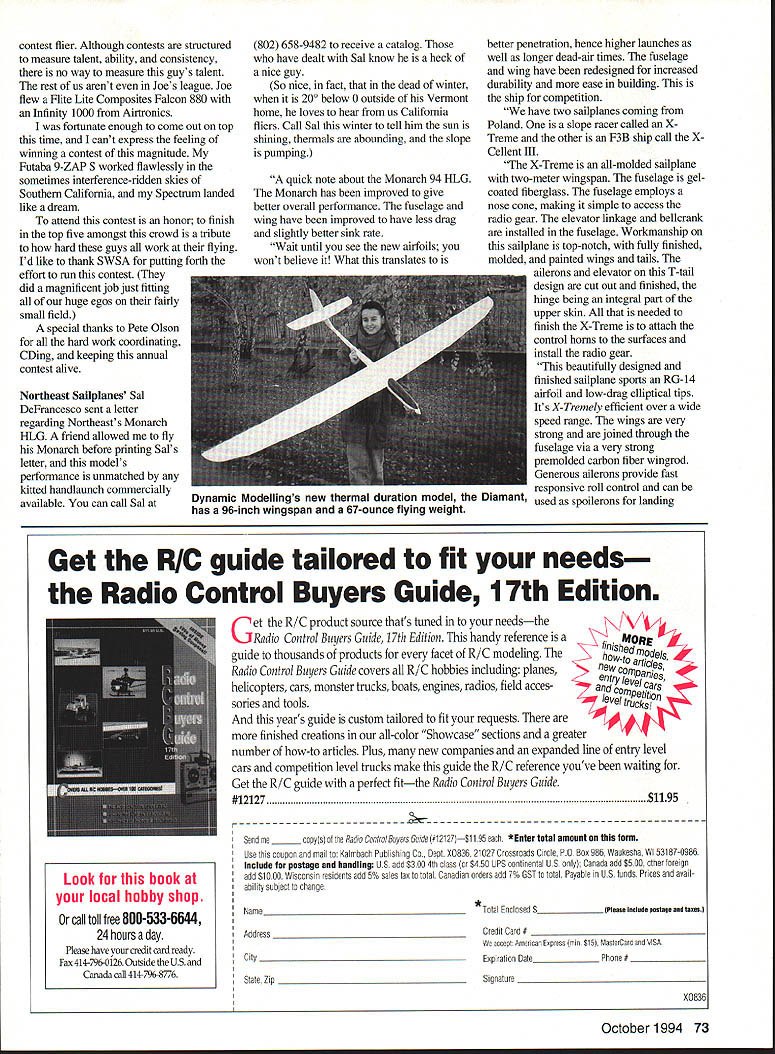
- 5th — Mike Aguirre
Mike was a rookie, but he showed many of us the poise necessary to do well. His model was a Ben Clerx-designed Mako driven by an Airtronics Vision transmitter.
- 4th — Randy Spencer
Randy is always a top competitor and tough to beat. I have had the honor to be on a US team with him. Randy's model was a Flite Lite Composites 70-ounce, 107-inch span X-Cellent III. It features an F3B V-tail, RG-15 airfoil, and Thermal Eagle setup. Randy used an Airtronics Infinity 1000.
- 3rd — Roger Lackey
Roger is one of the best spot landers I have ever seen. He works with Ben Clerx producing Makos, and he flies the trendy V-tail version. His Mako is also driven by an Airtronics Vision.
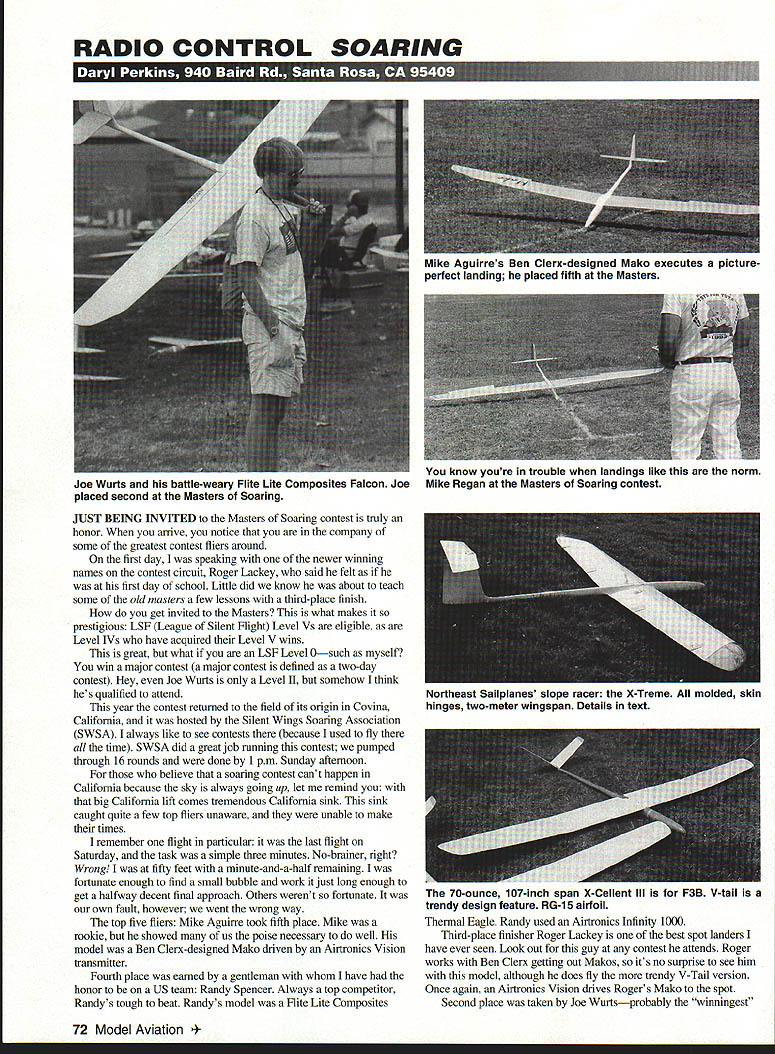
- 2nd — Joe Wurts
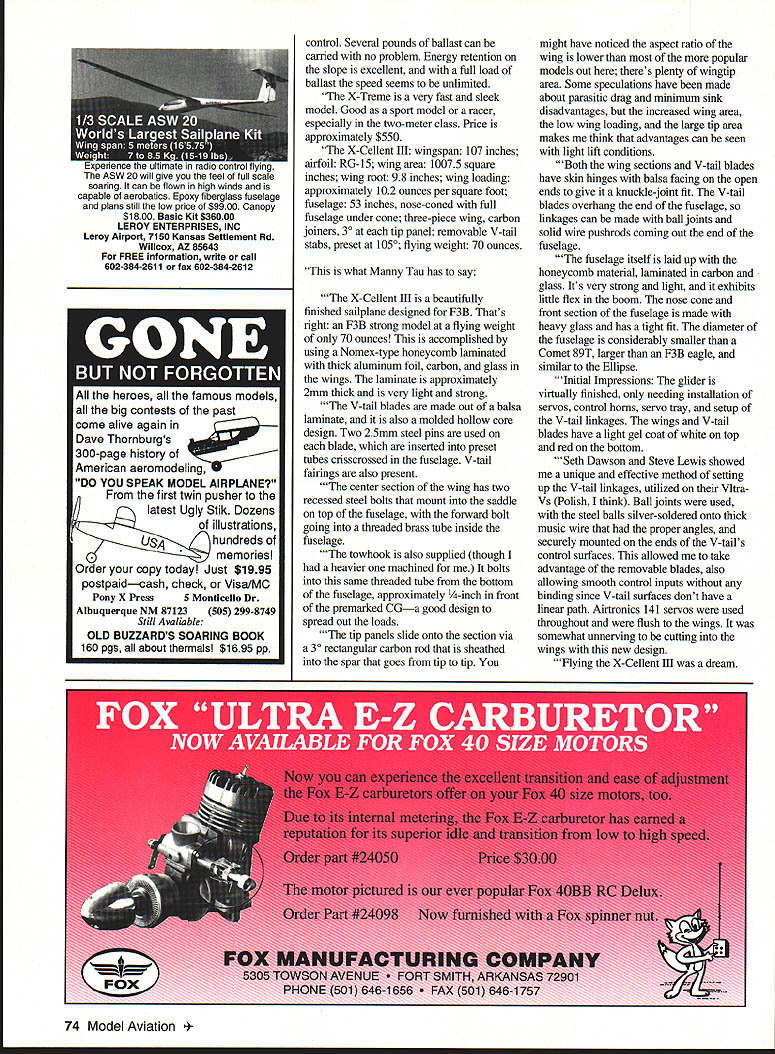
Probably the winningest contest flier, Joe flew a Flite Lite Composites Falcon. When landings like his are the norm, you know you're in trouble.
- 1st — Daryl Perkins (author)
I was fortunate enough to come out on top this time. I can't express the feeling of winning a contest of this magnitude. My Futaba 9ZAP-S worked flawlessly in sometimes interference-ridden skies of Southern California. The Spectrum systems landed like a dream.
I was honored to finish in the top five amongst such a crowd of talented fliers. As a tribute to the hard work these guys put into their flying, I'd like to thank SWSA for putting forth the effort to run the contest; they did a magnificent job of fitting huge egos into a fairly small field. Special thanks to Pete Olson for his hard work coordinating and CDing, keeping the annual contest alive.
NORTHEAST SAILPLANES
Northeast Sailplanes' Sal DeFrancesco sent a letter regarding Northeast's Monarch HLG. A friend allowed me to fly a Monarch before printing Sal's letter. The model's performance is unmatched. Kitted and handlaunch commercially available; you can call Sal at 802-658-9482 to receive a catalog. Having dealt with Sal, I know what a heck of a nice guy he is. So nice, in fact, that in dead winter (200 below zero outside his Vermont home) he loves to hear us California fliers call him and tell him the sun is shining, thermals abounding and the slope is pumping.
A quick note about the Monarch 94 HLG: the Monarch has improved to give better overall performance. The fuselage and wing have less drag and a slightly better sink rate. Wait until you see the new airfoils—you won't believe the improved penetration, hence higher launches as well as longer dead-air times. The fuselage and wing have been redesigned for increased durability and ease of building for ship competition.
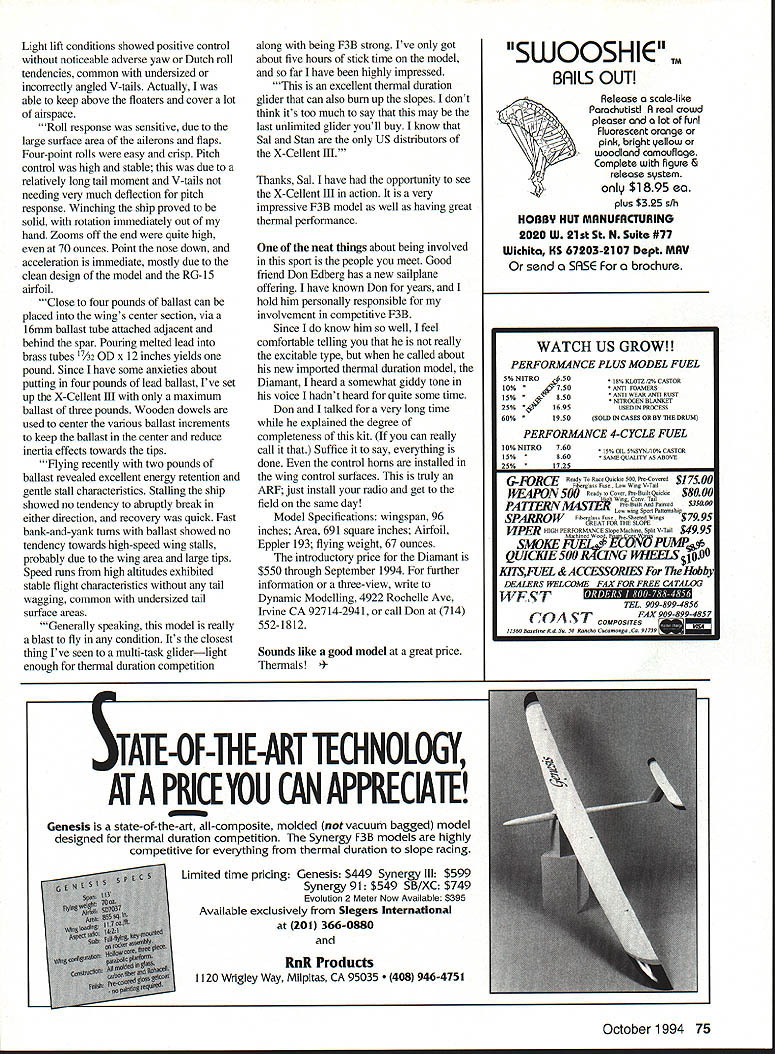
Northeast will have two sailplanes coming: a Poland slope racer called the X-Treme and an F3B ship called the X-Cellent III.
X-Treme (two-meter slope racer)
- All-molded sailplane with a two-meter wingspan.
- Gel-coated fiberglass fuselage with a removable nose cone for simple access to radio gear.
- Elevator linkage and bellcrank installed in the fuselage.
- Fully finished, molded, and painted wings and tails; workmanship is top-notch.
- Moldings and wing skins in the T-tail design are cut out and finished, the hinge being an integral part of the upper skin.
- Requires only attaching control horns and installing radio gear to finish.
- RG-14 airfoil with low-drag elliptical tips; very efficient over a wide speed range.
- Wings are very strong and join through the fuselage via a strong premolded carbon-fiber wingrod.
- Generous ailerons provide fast, responsive roll control and can be used as spoilers for landing.
- Can carry several pounds of ballast with no problem; energy retention on the slope is excellent.
- Good as a sport model or a racer, especially in the two-meter class.
- Approximate price: $550.
"This is the ship for competition."
X-Cellent III (F3B sailplane)
Specifications (quoted):
- Wingspan: 107 inches
- Airfoil: RG-15
- Wing area: 1007.5 square inches
- Wing root: 9.8 inches
- Wing loading: approximately 10.2 ounces per square foot
- Fuselage: 53 inches, nose-coned with full fuselage under center
- Three-piece wing, carbon joiners, 3" at each tip panel
- Removable V-tail stabs, preset at 105°
- Flying weight: 70 ounces
What Manny Tau has to say: The X-Cellent III is a beautifully finished sailplane designed for F3B. That's right: an F3B-strong model at a flying weight of only 70 ounces. This is accomplished by using a Nomex-type honeycomb laminate with thick aluminum foil, carbon, and glass in the wings. The laminate is approximately 2 mm thick and is very light and strong.
The V-tail blades are made out of a balsa laminate and are a molded hollow core design. Two 2.5 mm steel pins are used on each blade, which are inserted into preset tubes crossed in the fuselage. V-tail fairings are also present.
The center section of the wing has two recessed steel bolts that mount into the saddle on top of the fuselage, with the forward bolt going into a threaded brass tube inside the fuselage.
The tow hook is also supplied (though I had a heavier one machined for me). It bolts into this same threaded tube from the bottom of the fuselage, approximately 1/4-inch in front of the premarked CG — a good design to spread out the loads.
The tip panels slide onto the section via a 3" rectangular carbon rod that is sheathed into the spar that goes from tip to tip. You might have noticed the aspect ratio of the wing is lower than most of the more popular models out here; there's plenty of wingtip area. Some have speculated about parasitic drag and minimum sink disadvantages, but the increased wing area, the low wing loading, and the large tip area suggest advantages in light lift conditions.
Both the wing sections and V-tail blades have skin hinges with a balsa face on the open side and a beveled joint. The V-tail blades hinge at the end of the fuselage, so linkages can be made with ball joints and solid wire pushrods coming out the end of the fuselage.
The fuselage itself is laid up with the honeycomb material, laminated in carbon and glass. It's very strong and light, exhibiting little flex in the boom. The nose cone and front section of the fuselage are made with heavy glass and have a tight fit. The diameter of the fuselage is considerably smaller than a Comet 897, larger than an F3B Eagle, and similar to the Ellipse.
Initial impressions: The glider is virtually finished, only needing installation of servos, control horns, servo tray, and setup of the V-tail linkages. The wings and V-tail blades have a light gel coat of white on top and red on the bottom.
Seth Dawson and Steve Lewis showed me a unique and effective method of setting up the V-tail linkages used on their V-tail ships. Ball joints were used, with the steel balls silver-soldered onto the thick music wire that had the proper angles, and securely mounted on the ends of the V-tail's control surfaces. This allowed me to take advantage of the removable blades and allowed smooth control inputs without any binding since V-tail surfaces don't have a linear path. Airtronics 14L servos were used throughout and were flush to the wings. It was somewhat unnerving to be cutting into the wings with this new design.
Flying the X-Cellent III was a dream. Light lift conditions showed positive control without noticeable adverse yaw or Dutch roll tendencies, common with undersized or incorrectly angled V-tails. I was able to keep above the floaters and cover a lot of airspace.
Roll response was sensitive, due to the large surface area of the ailerons and flaps. Four-point rolls were easy and crisp. Pitch control was high and stable; this was due to a relatively long tail moment and V-tails not needing very much deflection for pitch response. Winging the ship proved to be solid, with rotation immediately out of my hand. Zooms off the end were quite high, even at 70 ounces. Point the nose down, and acceleration is immediate, mostly due to the clean design of the model and the RG-15 airfoil.
Ballast notes:
- Close to four pounds of ballast can be placed into the wing's center section via a 16 mm ballast tube attached adjacent and behind the spar.
- Pouring melted lead into brass tubes 1/32" OD × 12 inches yields one pound.
- Due to personal anxieties about four pounds of lead ballast, I set up the X-Cellent III with a maximum ballast of three pounds.
- Wooden dowels are used to center the various ballast increments to keep the ballast in the center and reduce inertia effects toward the tips.
Flying recently with two pounds of ballast revealed excellent energy retention and gentle stall characteristics. Stalling the ship showed no tendency to abruptly break in either direction, and recovery was quick. Fast bank-and-yank turns with ballast showed no tendency towards high-speed wing stalls, probably due to the wing area and large tips. Speed runs from high altitudes exhibited stable flight characteristics without any tail wagging, common with undersized tail surface area.
Generally speaking, this model is really a blast to fly in any condition. It's the closest thing I've seen to a multi-task glider—light enough for thermal duration competition yet F3B-strong. I've only got about five hours of stick time on the model, and so far I have been highly impressed.
"This is an excellent thermal duration glider that can also burn up the slopes. I don't think it's too much to say that this may be the last unlimited glider you'll buy. I know that Stan and Stan are the only US distributors of the X-Cellent III."
Thanks, Sal. I have had the opportunity to see the X-Cellent III in action. It is a very impressive F3B model as well as having great thermal performance.
DIAMANT (Dynamic Modelling)
One of the neat things about being involved in this sport is the people you meet. Good friend Don Edberg has a new sailplane offering. I have known Don for years, and I hold him personally responsible for my involvement in competitive F3B.
Since I do know him so well, I feel comfortable telling you that he is not really the excitable type, but when he called about his new imported thermal duration model, the Diamant, I heard a somewhat giddy tone in his voice. I hadn't heard that for quite some time. Don and I talked for a very long time while he explained the degree of completeness of this kit (if you can really call it that). Suffice it to say, everything is done. Even the control horns are installed in the wing control surfaces. This is truly an ARF; just install your radio and get to the field on the same day!
Model specifications:
- Wingspan: 96 inches
- Area: 691 square inches
- Airfoil: Eppler 193
- Flying weight: 67 ounces
The introductory price for the Diamant is $550 through September 1994. For further information or a three-view, write to Dynamic Modelling, 4922 Rochelle Ave., Irvine, CA 92714-2941, or call Don at (714) 552-1812.
Sounds like a good model at a great price. Thermals!
Transcribed from original scans by AI. Minor OCR errors may remain.

