
Radio Control: Soaring
Dan Pruss
Sailplane Distance Record Tentatively Broken. In an attempt to break Jerry Krainock's existing distance record of 27.20 miles, Jack Hiner of Downer's Grove, Ill., flew 32 miles for the straight-line record try.
A year ago, over the three-day Memorial Day week-end, Jack set a S.O.A.R. club record for a thermal-duration flight of 3 hrs., 7 mins., 52 secs.! It was this flight that urged Jack to plan for the distance record because weather conditions couldn't be more ideal. It should be noted that Springtime in the midwest produces evenings with the temperatures in the forties followed by daytime temperatures in the seventies. The freshly plowed fields that blanket this area become a cauldron of thermal activity and if the soaring axiom — for every thermal there is a "downer" — is true, these "downers" probably exist somewhere near the Missouri border! So — with these weather conditions as part of the master plan, Jack made preparations during the past year.
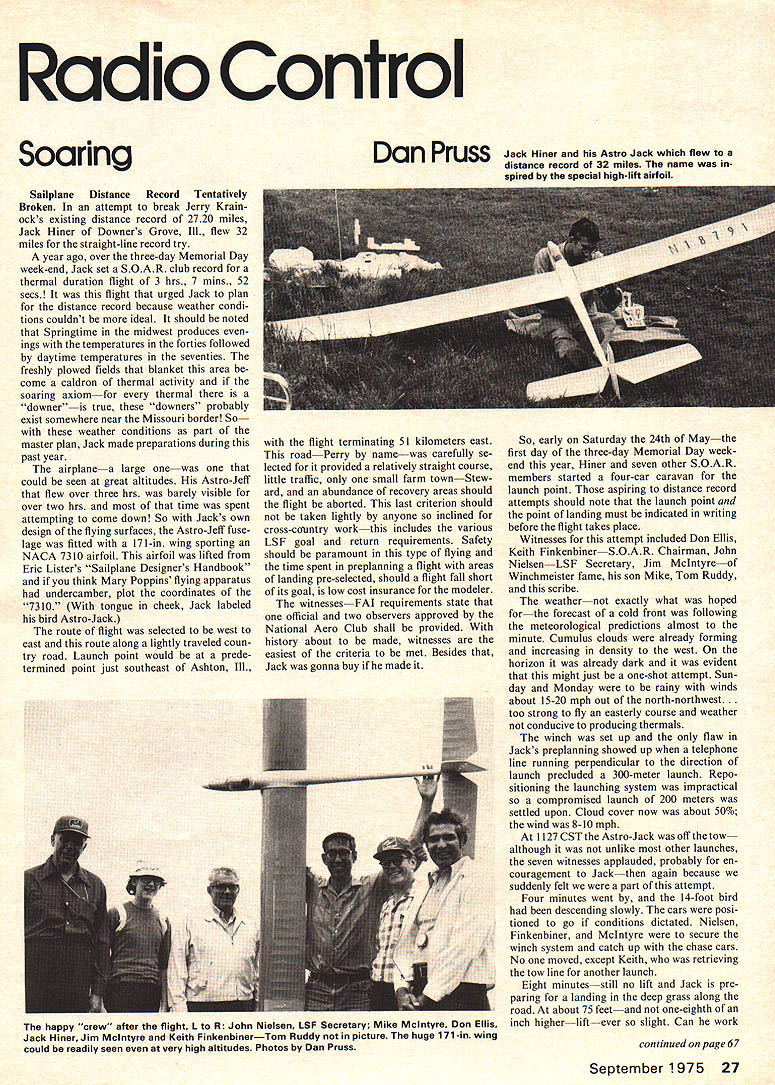
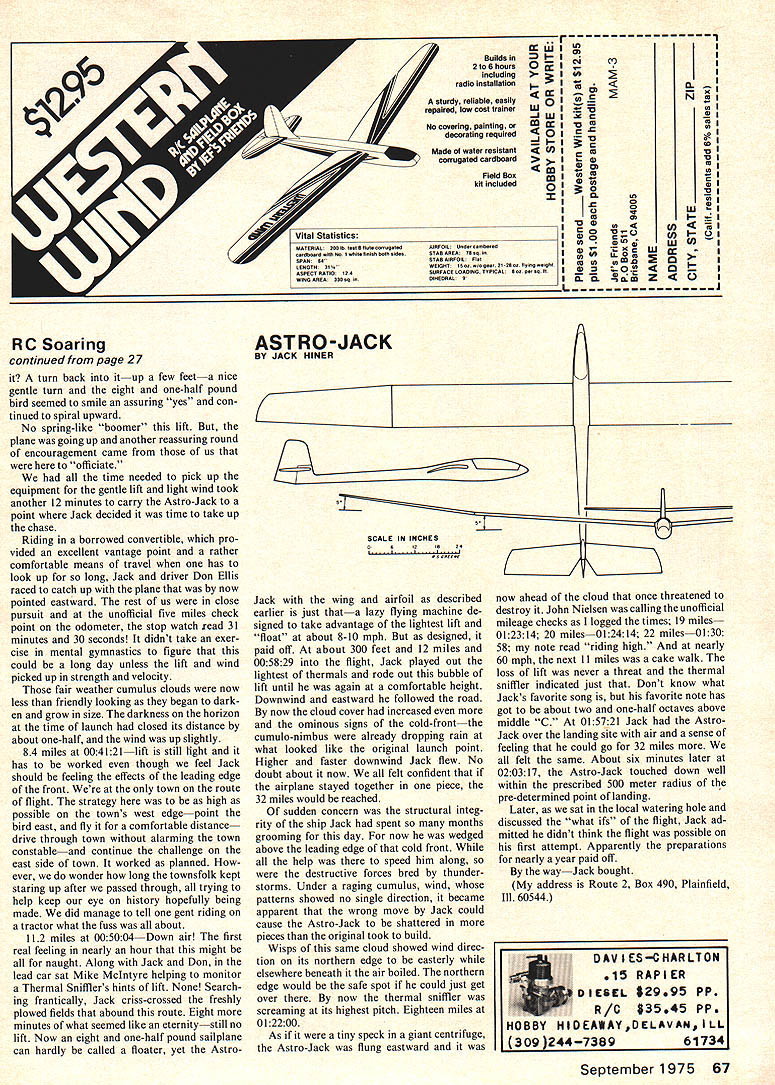
The airplane — a large one — was one that could be seen at great altitudes. His Astro-Jeff that flew over three hrs. was barely visible for two hrs. and most of that time was spent attempting to come down! So with Jack's own design of the flying surfaces, the Astro-Jeff fuselage was fitted with a 171-in. wing sporting an NACA 7310 airfoil. This airfoil was lifted from Eric Lister's "Sailplane Designer's Handbook" and if you think Mary Poppins' flying apparatus had undercamber, plot the coordinates of the "7310." (With tongue in cheek, Jack labeled his bird Astro-Jack.)
The route of flight was selected to be west to east and this route along a lightly traveled country road. Launch point would be at a predetermined point just southeast of Ashton, Ill., with the flight terminating 51 kilometers east. This road — Perry by name — was carefully selected to provide a relatively straight course, little traffic, only one small farm town — Steward — and an abundance of recovery areas should the flight be aborted. This last criterion should not be taken lightly by anyone so inclined for cross-country work — this includes the various LSF goal-and-return requirements. Safety should be paramount in this type of flying and the time spent in preplanning a flight with areas of landing pre-selected, should a flight fall short of its goal, is low-cost insurance for the modeler.
The witnesses — FAI requirements state that one official and two observers approved by the National Aero Club shall be provided. Witnesses are the easiest of the criteria to be met. Besides that, Jack was gonna have a good time if he made it.
So, early on Saturday the 24th of May — the first day of the three-day Memorial Day weekend this year, Hiner and seven other members of S.O.A.R. started a four-car caravan for the launch point. Those aspiring to distance-record attempts should note that the launch point and the point of landing must be indicated in writing before the flight takes place.
Witnesses for this attempt included Don Ellis, Keith Finkenbiner — S.O.A.R. Chairman, John Nielsen — LSF Secretary, Jim McIntyre of Winchmeister fame, his son Mike, Tom Ruddy, and this scribe.
The weather — not exactly what was hoped for — the forecast for a cold front was following the meteorological predictions almost to the minute. Cumulus clouds were already forming and increasing in density to the west. On the horizon it was already dark and it was evident that this might just be a one-shot attempt. Sunday and Monday were to be rainy with winds about 15-20 mph out of the north-northwest — too strong to fly an easterly course and weather not conducive to producing thermals.
The winch was set up and the only flaw in Jack's preplanning showed up when a telephone line running perpendicular to the direction of launch precluded a 300-meter launch. Repositioning the launching system was impractical so a compromised 200 meters was settled upon. Cloud cover was about 50%; the wind was 8-10 mph.
At 11:27 CST the Astro-Jack was off the tow — although it was not unlike most other launches, the seven witnesses applauded, probably for encouragement to Jack — then again because we suddenly felt we were a part of this attempt. Four minutes went by and the 14-foot bird had been descending slowly. The cars were positioned to go if conditions dictated. Nielsen, Finkenbiner, and McIntyre were to secure the winch system and catch up with the chase cars. No one moved, except Keith, who was retrieving the tow line for another launch.
Eight minutes — still no lift and Jack is preparing for a landing in the deep grass along the road. At about 75 feet — and not one-eighth of an inch higher — lift — ever so slight. Can be. it? A turn back into it—up a few feet—a nice gentle turn and the eight and one-half pound bird seemed to smile an assuring "yes" and continued to spiral upward.
No spring-like "boomer" this lift. But, the plane was going up and another reassuring round of encouragement came from those of us that were here to "officiate."
We had all the time needed to pick up the equipment for the gentle lift and light wind took another 12 minutes to carry the Astro-Jack to a point where Jack decided it was time to take up the chase.
Riding in a borrowed convertible, which provided an excellent vantage point and a rather comfortable means of travel when one has to look up for so long, Jack and driver Don Ellis raced to catch up with the plane that was by now pointed eastward. The rest of us were in close pursuit and at the unofficial five miles check point on the odometer, the stop watch read 31 minutes and 30 seconds! It didn't take an exercise in mental gymnastics to figure that this could be a long day unless the lift and wind picked up in strength and velocity.
Those fair weather cumulus clouds were now less than friendly looking as they began to darken and grow in size. The darkness on the horizon at the time of launch had closed its distance by about one-half, and the wind was up slightly.
8.4 miles at 00:41:21—lift still high and it was to be worked even though we feel Jack should be feeling the effects of the leading edge of the front. We're at the only town on the route of flight. The strategy here was to be as high as possible on the town's west edge—point the bird east, and fly it for a comfortable distance—drive through town without alarming the town constable—and continue the challenge on the east side of town. It worked as planned. However, we do wonder how long the townfolks kept staring up after we passed through, all trying to help keep our eye on history hopefully being made. We did manage to tell one gent riding on a tractor what the fuss was all about.
11.2 miles at 00:50:04—Down air! The first real feeling in nearly an hour that this might be all for naught. Along with Jack and Don, in the lead car sat Mike McIntyre helping to monitor a thermal sniffler's hints of lift. None! Searching frantically, Jack criss-crossed the freshly plowed fields that abounded this route. Eight more minutes of what seemed like an eternity—still no lift. Now an eight and one-half pound sailplane can hardly be called a floater, yet the Astro-Jack with the wing and airfoil as described earlier is just that—a lazy flying machine designed to take advantage of the lightest lift and "float" at about 8-10 mph. But as designed, it paid off. At about 300 feet and 12 miles and 00:58:29 into the flight, Jack played out the lightest of thermals and rode out this bubble of lift until he was again at a comfortable height. Downwind and eastward he followed the road. By now the cloud cover had increased even more and the ominous signs of the cold-front—the cumulo-nimbus were already dropping rain at what looked like the original launch point. Higher and faster downwind Jack flew. No doubt about it now. We all felt confident that the airplane stayed together in one piece, the 32 miles would be reached.
Of sudden concern was the structural integrity of the ship Jack had spent so many months grooming for this day. For now he was wedged above the leading edge of that cold front. While all the help we had there to speed him along, so were the destructive forces bred by thunderstorms. Under a raging cumulus, wind, whose patterns showed no single direction, it became apparent that the wrong move by Jack could cause the Astro-Jack to be shattered into more pieces than the original took to build.
Wisps of this same cloud showed wind direction on its northern edge to be easterly while elsewhere beneath it the air boiled. The northern edge would be the safe spot if he could just get over there. By now the thermal sniffers were screaming at its highest point. Eighteen miles at 01:22:00.
As if it were a tiny speck in a giant centrifuge, the Astro-Jack was flung eastward and it was now ahead of the cloud that once threatened to destroy it. John Nielsen was calling the unofficial mileage checks as I logged the times: 19 miles—01:23:14; 20 miles—01:24:14; 22 miles—01:30:58; my note read "riding high." And at nearly 60 mph, the next 11 miles was a cake walk. The loss of lift was never a threat and the thermal splitter indicated just that. Don't know what Jack's favorite song is, but his favorite note has got to be about two and one-half octaves above middle "C". At 01:57:21 Jack had the Astro-Jack over the landing site with air and a sense of feeling that he could go for 32 miles more. We all felt the same. About six minutes later at 02:03:17, the Astro-Jack touched down well within the prescribed 300 meter radius of the pre-determined point of landing.
Later, as we sat in the local watering hole and discussed the "what ifs" of the flight, Jack admitted he didn't think the flight was possible on his first attempt. Apparently the preparations for nearly a year paid off.
By the way—Jack's bought.
(My address is Route 2, Box 490, Plainfield, Ill. 60544.)
Transcribed from original scans by AI. Minor OCR errors may remain.

