
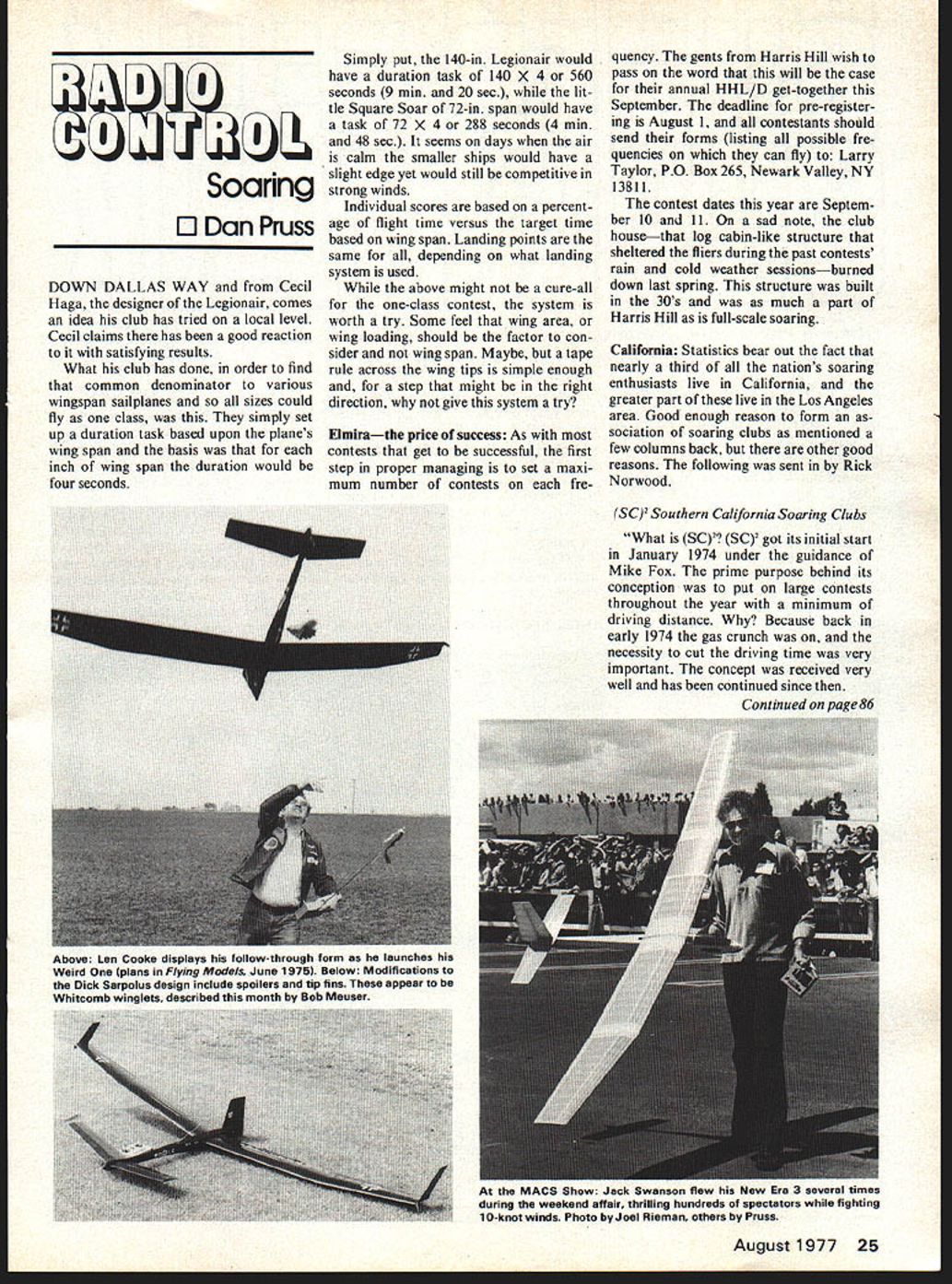

Radio Control: Soaring
Dan Pruss
DOWN DALLAS WAY and from Cecil Haga, the designer of the Legionair, comes an idea his club has tried on a local level. Cecil claims there has been a good reaction to it with satisfying results.
What his club has done, in order to find that common denominator to various wingspan sailplanes and so all sizes could fly as one class, was this. They simply set up a duration task based upon the plane's wing span and the basis was that for each inch of wing span the duration would be four seconds.
Simply put, the 140-in. Legionair would have a duration task of 140 X 4 or 560 seconds (9 min. and 20 sec.), while the little Square Soar of 72-in. span would have a task of 72 X 4 or 288 seconds (4 min. and 48 sec.). It seems on days when the air is calm the smaller ships would have a slight edge yet would still be competitive in strong winds.
Individual scores are based on a percentage of flight time versus the target time based on wing span. Landing points are the same for all, depending on what landing system is used.
While the above might not be a cure-all for the one-class contest, the system is worth a try. Some feel that wing area, or wing loading, should be the factor to consider and not wing span. Maybe, but a tape rule across the wing tips is simple enough and, for a step that might be in the right direction, why not give this system a try?
Elmira—the price of success:
As with most contests that get to be successful, the first step in proper managing is to set a maximum number of contests on each frequency. The gents from Harris Hill wish to pass on the word that this will be the case for their annual HHL/D get-together this September. The deadline for pre-registering is August 1, and all contestants should send their forms (listing all possible frequencies on which they can fly) to: Larry Taylor, P.O. Box 265, Newark Valley, NY 13811.
The contest dates this year are September 10 and 11. On a sad note, the club house—that log cabin-like structure that sheltered the fliers during the past contests' rain and cold weather sessions—burned down last spring. This structure was built in the '30s and was as much a part of Harris Hill as is full-scale soaring.
California:
Statistics bear out the fact that nearly a third of all the nation's soaring enthusiasts live in California, and the greater part of these live in the Los Angeles area. Good enough reason to form an association of soaring clubs as mentioned a few columns back, but there are other good reasons. The following was sent in by Rick Norwood.
(SC)2 Southern California Soaring Clubs
"What is (SC)2? (SC)2 got its initial start in January 1974 under the guidance of Mike Fox. The prime purpose behind its conception was to put on large contests throughout the year with a minimum of driving distance. Why? Because back in early 1974 the gas crunch was on, and the necessity to cut the driving time was very important. The concept was received very well and has been continued since then." Who is (SC)2? (SC)2 is made up of nine soaring clubs: San Fernando Valley Silent Flyers (SFVSF), Soaring Union of Los Angeles (SULA), Pacific Soaring Association (PSA), Pasadena Soaring Society (PSS), Harbor Soaring Society (HSS), Torrey Pines Gulls (TPG), Silent Wing Soaring Association (SWSA), Model Aviation Radio Kontrol Society (MARKS). (Note: only eight are listed here—DJP.)
How does (SC)2 work? Clubs who belong to (SC)2 who desire to hold a contest are assigned a month to hold their contest. Usually, there are seven contests throughout the year. There is a standardized entry fee of $3.50 per contestant, $2.50 of which goes to the club hosting the contest, $1 to the (SC)2 organization. The $1 is used for operating expenses, raffle prizes and year-end awards.
How is the year-end champion determined? Each contest has a raw score of 3000 points. Then the entire contest is normalized to 1000 points. A cumulative total of the normalized scores is used for year-end championship points. A contestant's best five out of the seven contests are counted.
What does the championship prove? The most obvious is that the person who wins the championship has flown the most consistently throughout the year. In 1976 the top three finishers flew the same plane all year. (Flying the same plane, and getting to know it, has been the key to other championship performances, witness Mrlik, Heithecker, Edberg, Rick Pearson, Mark Smith and current world champion Skip Miller—DJP.) They flew unmodified manufactured kits.
The above can act as a basis for the forming of other soaring groups. It should further remind those that think of the contest circuit only as a cross-country trek, that it can be more local if more local clubs would organize into groups. And if you are a newcomer to soaring and to this column, and if you think contests are only for those who have many thermals under their belts, may it be re-emphasized, the current World Champion, Skip Miller, started RC Soaring just a little over a year ago (kinda makes us all want to take up bowling).
Bumblebees cannot fly:
Some years ago a group of aerodynamicists got together and "proved" that the bee could not fly because of its wing loading and a few other factors. But, it was explained, the bee didn't know that and the little hummer went out and flew anyway.
A few issues back this column reported the speed record for sailplanes as 188 mph. This was set by Werner Sitar of Austria. Many of us raised our eyebrows and, if one column ever got a reader reaction, it was that one. Among those that screamed foul There were two readers that sent lengthy reports (one eight pages long) that said "the bumblebee cannot fly." Anyway, as incredible as it may seem, the record stands. And for what it is worth, the Austrian representative at the World Championship in South Africa, Karl Wasner, was a witness to the flight. Although not acting as an official, he gave a lengthy description to this scribe of the record-breaking flight, the attempts before, and the electronic timers used in the runs.
With respect to those who spent the time and much effort in offering their criticism, may you be reminded that this column does serve as a sounding board for your ideas and opinions. However, the in-depth study of any records, and the dispute of same, should be directed to AMA HQ, which is the U.S. aeromodeling representative to the FAI, for transmission—which many did in the case of the Sitar record.
Dan Pruss, Rt. 2, Box 490, Plainfield, IL 60544.
Transcribed from original scans by AI. Minor OCR errors may remain.

