

RADIO CONTROL: Soaring
Daryl Perkins 940 Baird Rd., Santa Rosa, CA 95409
Introduction
In the middle of last winter, when I was whining about the freezing temperatures, the rain, and the lack of opportunity to fly since I had moved to Northern California, I got somewhat motivated to build a project model: the Maverick. Remember? Well, I haven't forgotten the project; it's just that it's been summer, and I can't build in the summer!
Anyway, I thought it only fair to give you a little head start if you're planning on building a model along with me.
A sailplane designer needs to determine exactly where the model should excel. Based on my F3B and Thermal Duration experience, I thought I had a pretty good handle on the required performance parameters for the project: the Maverick was designed for launch altitude and distance performance, realizing that the rest would take care of itself.
The Wing Planform
There are many considerations when trying to optimize a wing for specific tasks. Take the launch, for example. What makes a sailplane launch well—wing area? wingspan? It's a combination. But there is another problem: there isn't unlimited power to launch a model. As a matter of fact, our F3B winches have been restricted to less power than the average club-contest winch. So how do we figure out what is optimum? We work the numbers backwards.
I know from experience that F3B winches have trouble pulling a model much heavier than eight pounds, which is about as heavy as I would want to fly the Speed task. I would like to fly Speed no heavier than 20 ounces per square foot in extreme conditions, and nominally at about 18 ounces per square foot. This dictates the area of the new wing. Eight pounds at 20 ounces per square foot calculates out to a 6.4 square-foot wing, or 921.6 square inches. So, we definitely don't want a much bigger model than this.
What do we do for wingspan? I am going to use a term that might be new to some of you—a term that aeronautical engineer Joe Wurts used to harp on to me about: spanwise loading. Joe used to tell me that a sailplane's span loading is as important (or more important) than its wing loading. I fully believe him.
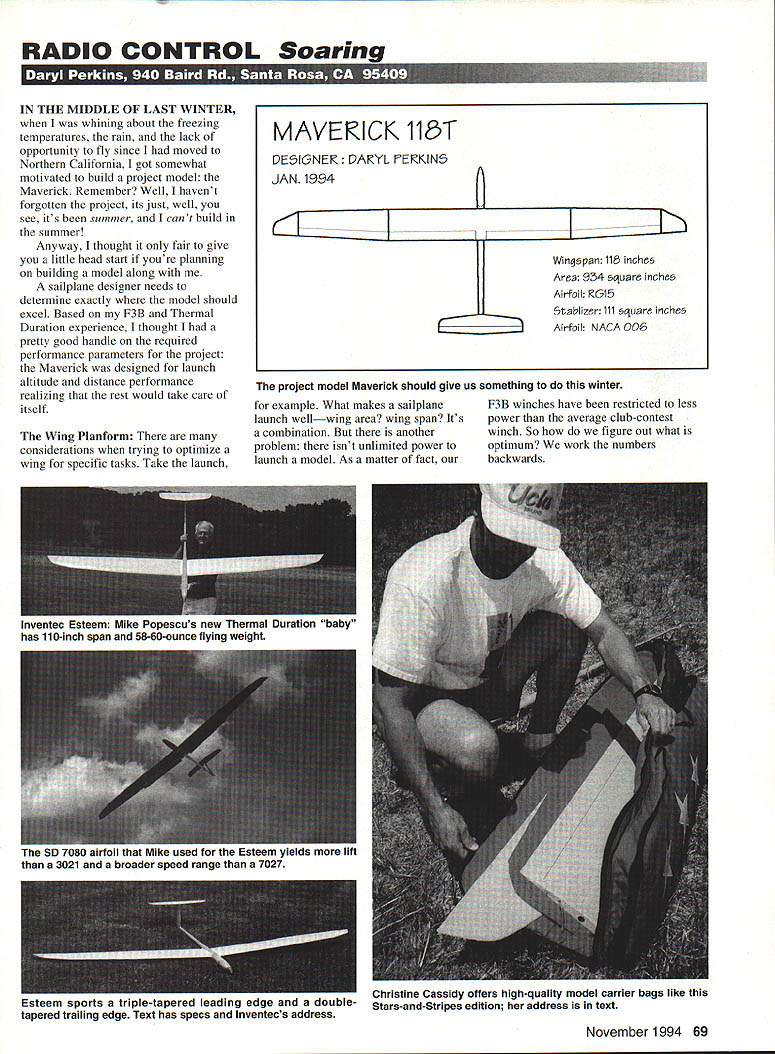
I decided to get the Maverick's span loading down for launch, yet keep the wing loading up for performance. I bumped up the span of the model from what I had been used to flying and decided not to increase the area. The span of the Maverick was 118 inches. (To see how the wing lays out, refer to the drawing.)
A constant-chord center panel has a 52-inch span and a nine-inch chord. I decided to go with a constant-chord center in case I built molds and wanted to experiment with different spans on the model, i.e., 110 inches for calm conditions and 122 inches for windy weather. The tip was also the main motivating factor behind the three-piece wing. The tip panels taper from nine inches to 6-1/2 inches over the next 26 inches of span, tapering to the trendy seven-inch, Schuemann-style tips. The trailing edge is not straight. I have always felt that too much taper at the leading edge diminished airfoil efficiency, hindering performance during a high CL (coefficient of lift) as in a launch or hard turns in Speed.
This calculates to 934 square inches of wing—a little bigger than I had wanted, but I can live with the extra 13 square inches.
Maverick 118T
Designer and Date
- Designer: Daryl Perkins
- Date: Jan. 1994
Specifications
- Wingspan: 118 inches
- Area: 934 square inches
- Airfoil: RG15
- Stabilizer area: 111 square inches
- Stabilizer airfoil: NACA 006
The project model Maverick should give us something to do this winter.
Construction Notes and Background
Maverick has taken unexpected turns since last winter. I used to build an all-molded F3B Eagle for Mark Allen of Allen Development and have been flying that plane the last couple of years and was going to use it as a backup. However, Mark sold the all-molded F3B Eagle molds to Steve Lewis of SMAL Enterprises. Since I no longer have access to the Eagle molds, some plugs were CNC-machined. If you're interested in the Eagle, contact Steve at (408) 554-8539.
This model is not the Airtronics Thermal Eagle; it is a high-performance, all-hollow construction F3B Thermal Duration model.
The airfoil is the RG15, because I had committed to molds without building a prototype, and I knew the RG15 wouldn't suffer in any of the required tasks.
I am still in the process of building bagged prototypes, and I will take you through the building process. Go ahead and order the foam for your new world-beater and select your favorite airfoil. The dimensions on the Maverick are also pretty close to the optimum Thermal Duration sailplane.
Working the numbers backwards, a competitive TD sailplane needs to finish at about 65 ounces in order to be competitive in the landing circle. The wing loading should be about 10 to 11 ounces per square foot. This yields a design of 6.4 to 6.5 square feet of wing, or approximately 934 square inches.
We'll get to control surfaces next time. I haven't finished my first molded one yet, but I plan to fly it in the US Team Finals. I'll let you know how it turns out.
The Bag Lady
Whenever I go over to my friend Phil Lontz's house, I say, "Where's the Bag Lady?" referring to his girlfriend. Believe it or not, he doesn't get angry; his girlfriend, Christine Cassidy, manufactures the highest-quality airplane carrier bags I have seen.
Christine used to design outdoor adventure equipment and utilizes the same technology in her custom line of wing bags. A state-of-the-art Cordura nylon shell is used, and her bags are fully lined with silky-smooth nylon taffeta. (I always liked the word taffeta. It just sounds plush.)
My gliders develop more damage due to hangar rash than from actual use. The Bag Lady's products can seriously reduce this damage. Each bag is custom-made to your specs and models; no two are the same. Even if you have a one-of-a-kind, scratch-built model, just get the dimensions to her, and she'll build you a bag. They don't call her the "Bag Lady" for nothing!
Contact:
- Christine Cassidy, The Bag Lady
- 1501 San Anselmo Ave., San Anselmo, CA 94960
- Tel.: (415) 457-1550
The Esteem
It seems that if you want to sell a RC sailplane, you simply have to follow suit. The model needs to be the "right" size or utilize the "correct" airfoil. But every once in a while, a designer comes along who is not afraid to step outside the norm. Mike Popescu of Inventec Corporation is one such designer.
When Mike told me of his new Thermal Duration sailplane, I thought it was going to be just another 7037 contest clone. Then he sent me the specs. He is using a fairly old airfoil, the SD 7080—one of those great airfoils that has been around for quite some time, but never caught on. (Why? I don't know. Maybe because one of your favorite contest fliers never won a contest with it, which is how it seems we select our airfoils nowadays.)
The 7080's polars look fantastic. It seems to produce more lift than a 3021, yet have a broader speed range than a 7037. All in all, it's a good airfoil.
Mike has also done some rather proprietary things with transitioning airfoils toward the tip. I probably shouldn't go into them, but I will say that I really like the direction he has gone.
He is going to send me his model so I can take it for a test ride; for some reason, he seems reluctant to let me fly it. (You break 20 or 30 models in your career, and you develop a reputation for being hard on sailplanes. Go figure!)
If you're interested in trying something a little bit different, contact Inventec Corporation:
- 808 David Dr., Trevose, PA 19053
- Tel.: (215) 357-5844
It should be a heck of a contest model.
Esteem Specifications
- Wingspan: 110 inches
- Area: 960 square inches
- Flying weight: 58–60 ounces
- Wing loading: 9.5–10 ounces per square foot
Closing
Until next time, gotta fly!
Transcribed from original scans by AI. Minor OCR errors may remain.

