
RADIO CONTROL SOARING
Mike Garton 506 NE 6th St., Ankeny IA 50021 E-mail: mike@iastate.edu
Mantis — design and construction
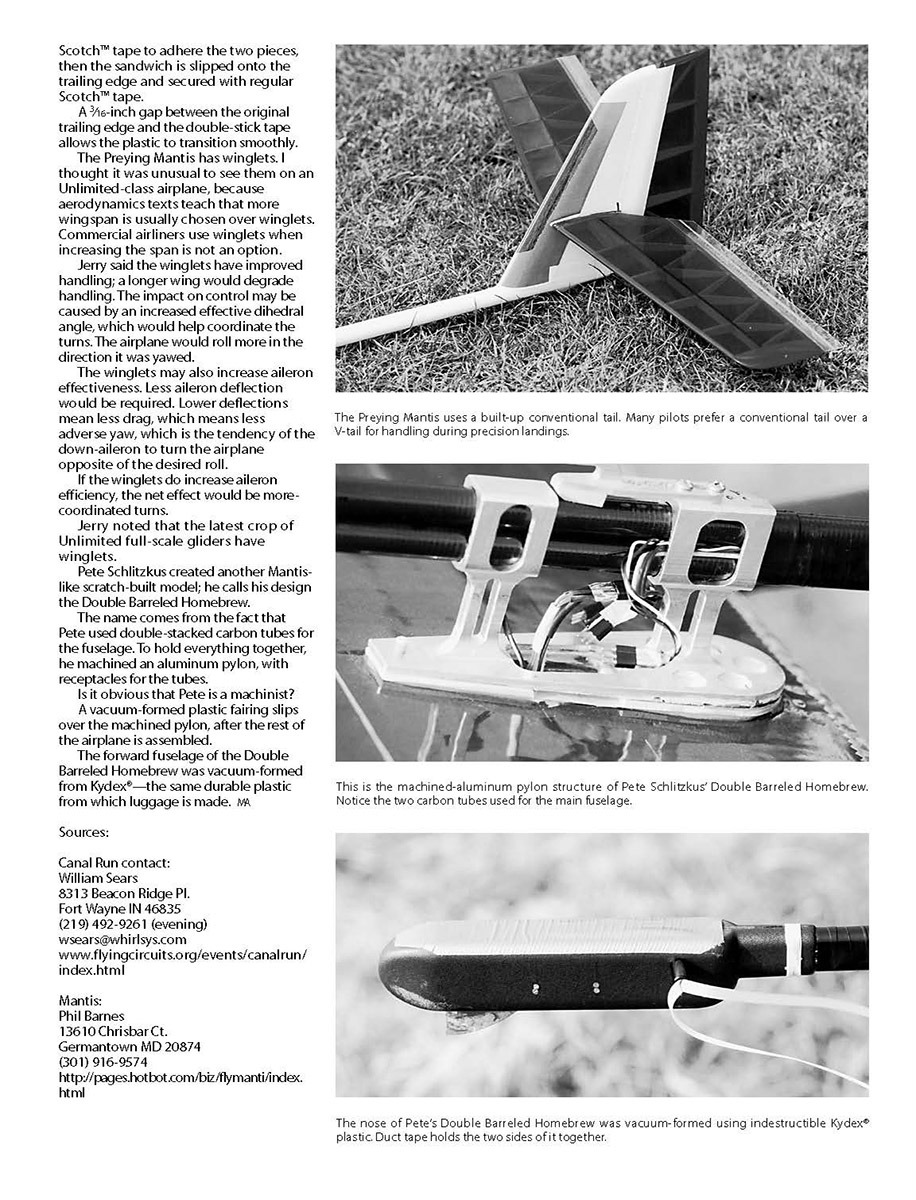
The Mantis, designed by Tom Kiesling of Johnstown, Pennsylvania, first flew in 1997. Since then Tom has refined the design and won many contests; he was the Eastern Soaring League Expert Champion three years in a row.
- Configuration: pod-and-boom fuselage, pylon-mounted wing, V-tail
- Wingspan: 122 inches (three-piece bolt-on wing)
- Airfoil: SD7037 (original Mantis)
- Construction: vacuum-bagged carbon-and-fiberglass wings with a molded fuselage
- Weight: approximately 57 ounces
Strengths: excellent light-air floating ability and forgiving landing characteristics. With flaps down the Mantis can slow to a crawl; the large V-tail provides solid handling on landing. Pilots often do not flare for contest landings — they fly to the 100-point end of the landing tape and push the nose down. The high strength-to-weight ratio tolerates rough touchdowns. If a wingtip is hit on landing, the wing can pivot around a single bolt to reduce damage; sandpaper glued to the wing-to-pylon interface provides friction to prevent in-flight pivoting.
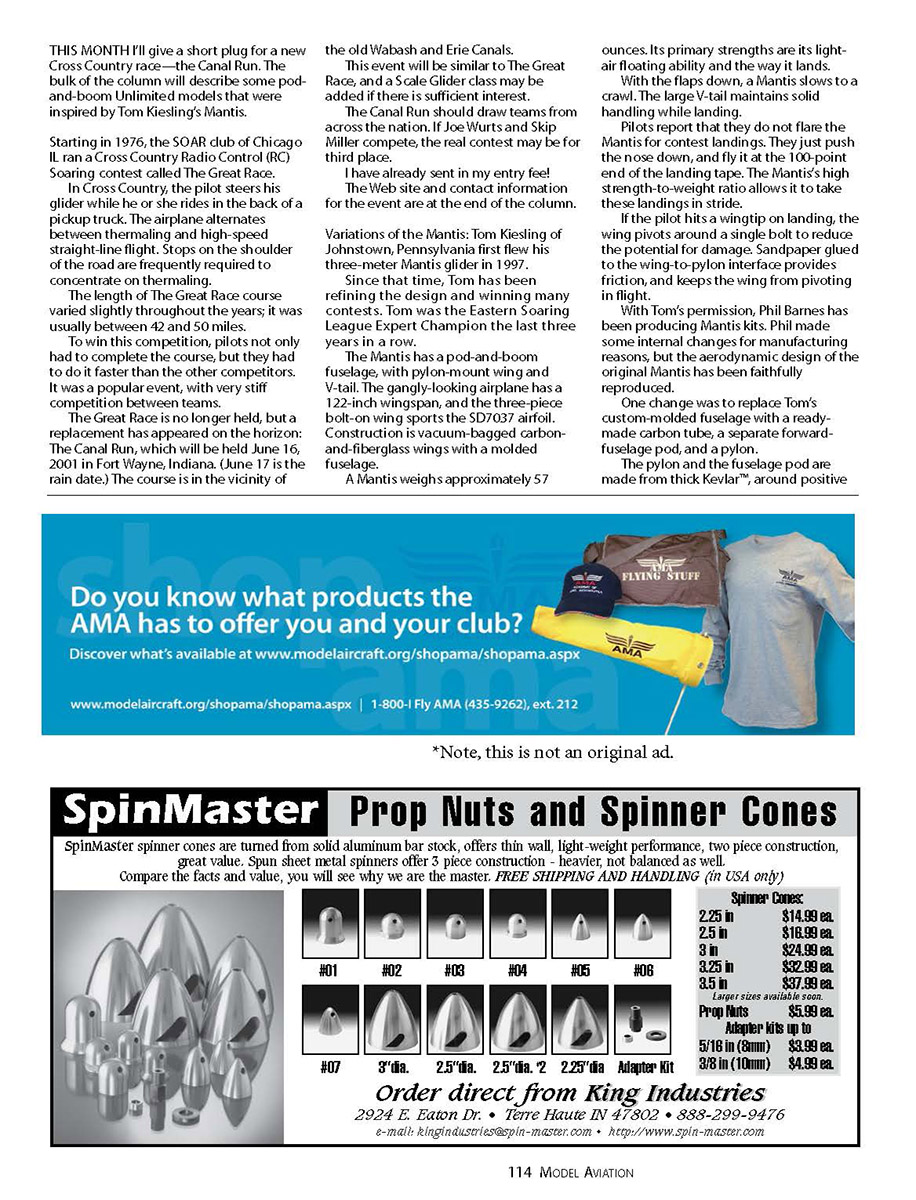
With Tom's permission, Phil Barnes has produced Mantis kits. Phil made some internal changes for manufacturing reasons but preserved the aerodynamic design. One change was replacing Tom's custom-molded fuselage with a ready-made carbon tube, a separate forward fuselage pod, and a pylon. The pylon and fuselage pod are made from thick Kevlar™ around positive molds. The parts are partially cured, slit along one side, then pulled off the forms; the kitbuilder rejoins the slit and reinforces it during assembly. This unconventional method works well for small composite parts. The Mantis also includes built-in ballast receptacles in the pylon.
Super Mantis (a.k.a. "Superman")
Tom developed a variant called the Super Mantis in 1999.
- Wing: stretched to 3.4 meters
- Airfoil: MH32 (faster than the SD7037)
- Handling: provides more penetration and range than the original Mantis
- Design tweak: slight polyhedral added to the wingtips to help coordinate turns while thermaling
Preying Mantis (Jerry Robertson)
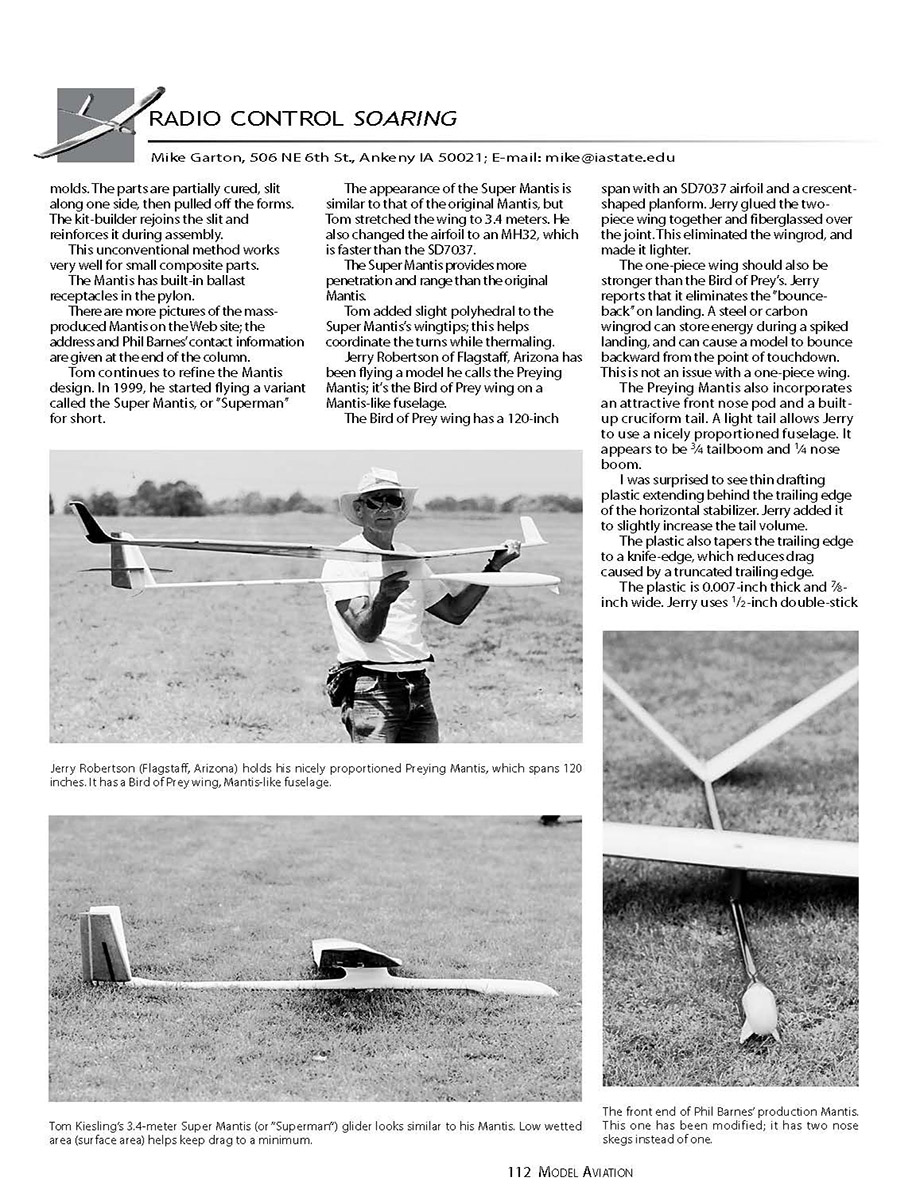
Jerry Robertson of Flagstaff, Arizona built a Preying Mantis: a Bird of Prey wing on a Mantis-like fuselage.
- Wing: Bird of Prey wing, 120-inch span, SD7037 airfoil, crescent-shaped planform
- Construction: Jerry glued the two-piece wing together and fiberglassed over the joint, eliminating the wingrod and reducing weight
- Advantage: a one-piece wing is stronger and eliminates "bounce-back" on landing (a steel or carbon wingrod can store energy during a spiked landing and cause a backward bounce)
- Fuselage/tail: attractive front nose pod and a built-up cruciform tail; light tail allowed a nicely proportioned fuselage (approximately 3/4 tailboom and 1/4 nose boom)
Tail modification: Jerry added thin drafting plastic extending behind the trailing edge of the horizontal stabilizer to slightly increase tail volume and taper the trailing edge to a knife-edge, reducing drag from a truncated edge.
- Plastic: 0.007-inch thick, 7/8-inch wide
- Attachment: Jerry adheres two pieces with 1/2-inch double-stick Scotch™ tape to make a sandwich, slips it onto the trailing edge, and secures with regular Scotch™ tape. A 3/16-inch gap between the original trailing edge and the double-stick tape allows the plastic to transition smoothly.
Winglets: the Preying Mantis has winglets. While more span is often preferred for performance, Jerry found the winglets improved handling; a longer wing would have degraded handling. Possible reasons:
- Increased effective dihedral helps coordinate turns (the airplane rolls more in the direction it is yawed).
- Increased aileron effectiveness: less aileron deflection needed, therefore less drag and less adverse yaw.
Jerry noted that the latest full-scale Unlimited gliders also have winglets.
Double Barrelled Homebrew (Pete Schlitzkus)
Pete Schlitzkus created a Mantis-like scratch-built model called the Double Barrelled Homebrew.
- Fuselage: double-stacked carbon tubes (hence the name) held by an aluminum pylon machined with receptacles for the tubes
- Fairing: a vacuum-formed plastic fairing slips over the machined pylon after assembly
- Forward fuselage: vacuum-formed from Kydex® (the durable plastic used for luggage)
Is it obvious that Pete is a machinist? The machined pylon and fit demonstrate that background.
Construction notes and molding method
- Vacuum-bagged carbon-and-fiberglass wings are used on production Mantis designs.
- For the Kevlar™ pylon and fuselage pod: parts are partially cured on positive molds, slit along one side, then pulled off the forms. The kitbuilder rejoins the slit and reinforces it during assembly. This technique is unconventional but effective for small composite parts.
Events and contest note
The Canal Run event will be similar to The Great Race; a Scale Glider class may be added if there is sufficient interest. The Canal Run should draw teams from across the nation. If pilots such as Joe Wurts and Skip Miller compete, the real contest may be for third place. The author has already sent in an entry fee.
Sources / Contacts
- Canal Run contact:
William Sears 8313 Beacon Ridge Pl. Fort Wayne, IN 46835 (219) 492-9261 (evening) wsears@whirlsys.com www.flyingcircuits.org/events/canalrun/index.html
- Mantis / Phil Barnes:
Phil Barnes 13610 Chrisbar Ct. Germantown, MD 20874 (301) 916-9574 http://pages.hotbot.com/biz/flymanti/index.html
Transcribed from original scans by AI. Minor OCR errors may remain.

