
RADIO CONTROL SOARING
Mike Garton 506 NE 6th St., Ankeny IA 50021 E-mail: mike@iastate.edu
Introduction
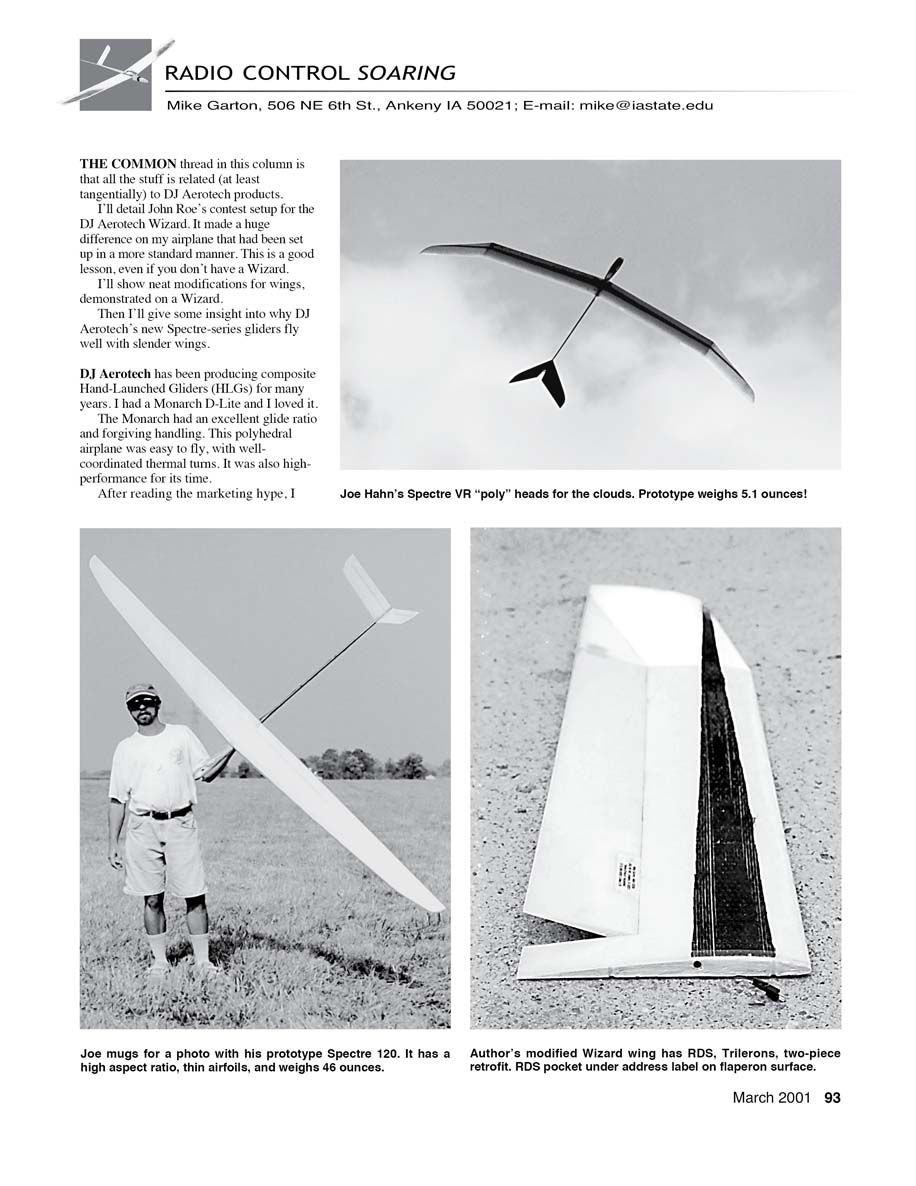
The common thread in this column is that all the material relates (at least tangentially) to DJ Aerotech products. I’ll detail John Roe’s contest setup for the DJ Aerotech Wizard, describe neat wing modifications demonstrated on a Wizard, and give insight into why DJ Aerotech’s new Spectre-series gliders fly well with slender wings.
DJ Aerotech has produced composite hand-launched gliders (HLGs) for many years. I owned a Monarch D-Lite and liked it a lot — an easy-to-fly polyhedral airplane with good glide ratio and forgiving handling. After reading the marketing hype I bought a Wizard, which was billed as higher performance.
First impressions of the Wizard
- The root airfoil thickness measures roughly 6.5% with very little camber.
- With the stock recommended CG and control throws, the Wizard felt fast but had a higher-than-average sink rate.
- It showed no tip-stall tendency, but it lost energy quickly in turns compared to other HLGs.
- The airplane has a narrow "drag bucket": the thin airfoil produces low drag only over a small preferred range of angle of attack; outside that range drag increases rapidly.
The Wizard turned out to be excellent practice for angle-of-attack control. Flying it improved my skills with all my gliders.
John Roe’s contest setup (paraphrased)
After many frustrating sessions, I emailed John Roe (he flew a Wizard in the 1999 International Hand Launch Glider Festival). He assumes an experienced pilot and uses an aggressive setup:
- CG: about 3/16 inch behind the aft limit marked on the plans. This removes tail downforce, slightly lowers effective wing loading and sink rate, and makes the model less stable in pitch so it reacts more to lift.
- Launch preset: John uses an up-elevator preset (enough up to pitch the model up quickly). He activates and holds this preset before launch with a spring-loaded toggle on the Airtronics Stylus (operated by the index finger).
- Launch sequence:
- Hold up-elevator preset, make a long underhand throw in the chosen direction.
- The airplane climbs nearly vertical after leaving the hand; release the preset near the top of the climb.
- The model slowly noses over into a near-vertical down line; as it gains speed it tucks (nose-down).
- John eases off some up-elevator and applies down trim so the model flies slightly nose-down and accelerates.
- Apply a little right aileron to counter spiral tendency, then release the preset.
- The plane is now fast and slightly nose-down; with the rearward CG it climbs aggressively when launched and attains more energy and altitude than a conservative launch.
- Control setup:
- Aileron differential: roughly 3/4 inch up, 1/4 inch down.
- Rudder-to-aileron mix: a large amount of rudder mixed into the ailerons.
- V-tail reverse differential: maximum allowed by the Stylus (20%) so the V-tail produces more down-rudder than up-rudder for rudder inputs.
John’s setup made my Wizard fly much better, though I still prefer other models. DJ Aerotech discontinued the Wizard, but many are still around — worth trying these tricks if you find one.
Broaden the drag bucket and reduce parasitic drag
The main problem with the Wizard was energy loss in turns. The solution is to broaden the drag bucket and minimize parasitic drag. Effective modifications I used:
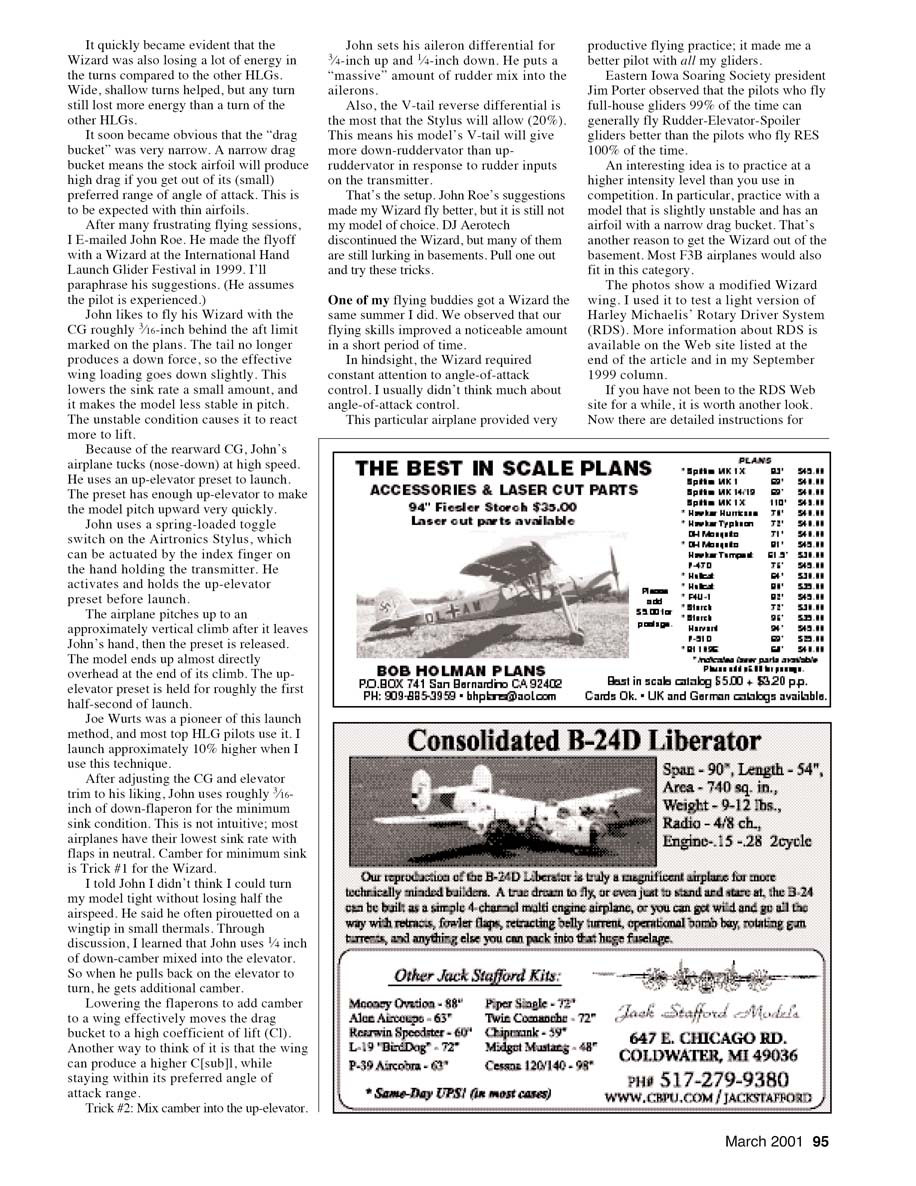
- Retrofit a two-piece wing for easier transport and precise washout tailoring.
- RDS (Rotary Driver System): install Reduced-Drag Sealing on the flaperon hinge line to smooth the hinge gap and reduce turbulence.
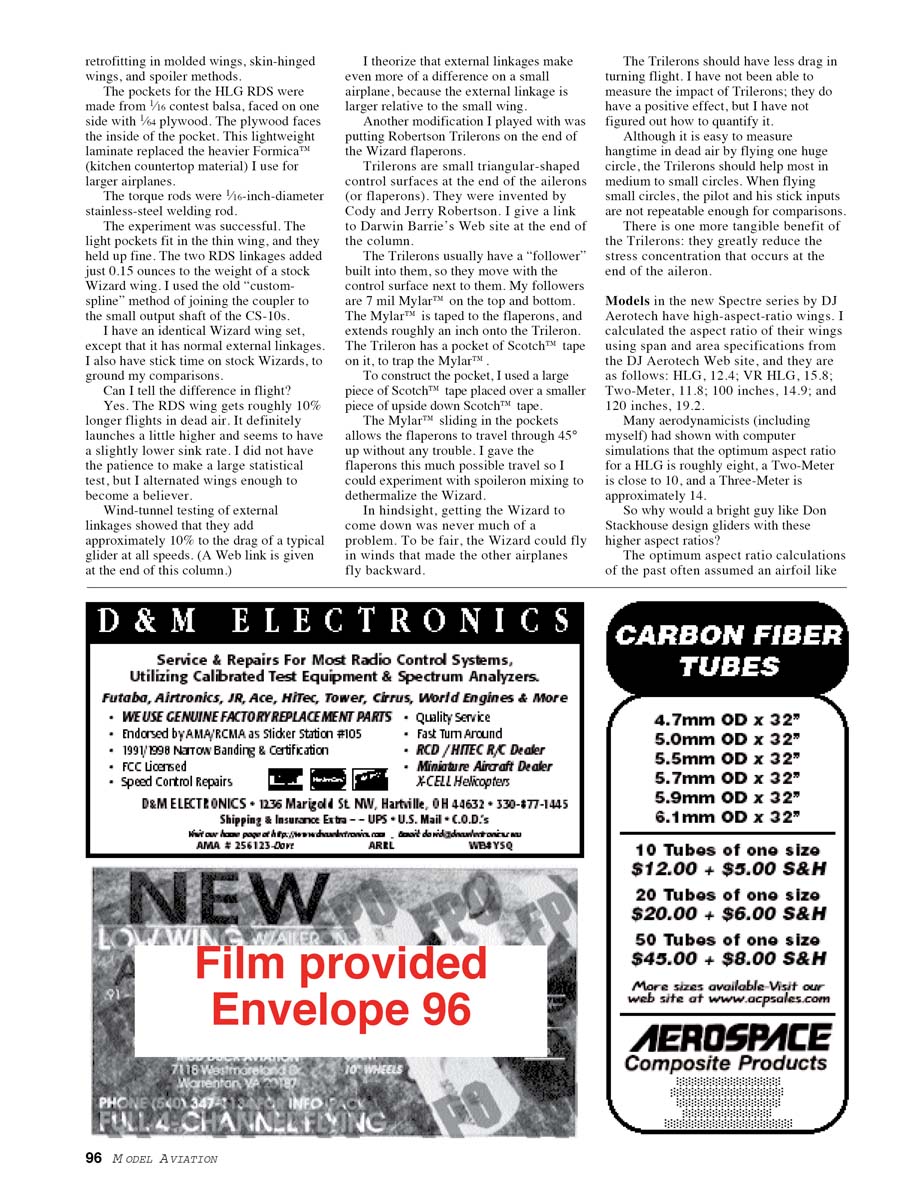
- Trilerons: small triangular tip surfaces that move with the flaperons to maintain tip control and prevent tip stall; they should reduce drag in turning flight and reduce stress concentrations at the aileron tips.
- Internal torque-rod bearing at the flaperon root to eliminate linkage wobble and keep control surfaces running true.
- Reduce external linkages where possible (they add drag).
These changes, combined with the rearward CG and launch preset technique, noticeably improved climb and glide performance.
Rotary Driver System (RDS) experiment
I installed a light version of Harley Michaelis’s RDS in a Wizard wing to test its effect.
Construction details:
- Pockets: made from 1/16 contest balsa faced on the inside with 1/64 plywood (the plywood faces the interior). This lightweight laminate replaced heavier Formica used on larger airplanes.
- Torque rods: 1/16-inch-diameter stainless-steel welding rod.
- Couplers: used a custom-spline method joining the coupler to the small output shaft of CS-10s.
Results:
- The two RDS linkages added about 0.15 ounces to a stock Wizard wing.
- The light pockets fit thin wings and held up well.
- Flight differences: the RDS wing produced roughly 10% longer flights in dead air, launched a bit higher, and seemed to have a slightly lower sink rate. I alternated wings enough to believe the improvement, though I did not run a large statistical test.
Wind-tunnel testing cited online shows external linkages can add about 10% to the drag of a typical glider at all speeds; their relative effect is probably greater on small airplanes.
Trilerons
Trilerons are triangular control surfaces mounted at the outboard ends of ailerons or flaperons (invented by Cody and Jerry Robertson). My implementation:
- Followers: 7-mil Mylar on top and bottom, taped to the flaperon and extending roughly an inch onto the trileron.
- Trileron pocket: a piece of Scotch tape over an upside-down piece of Scotch tape to create a pocket that traps the Mylar and allows sliding.
- This arrangement allows flaperons to travel through about 45° up without interference, enabling experiments with spoileron mixing to dethermalize the Wizard.
Benefits:
- Should have less drag in turning flight (hard to quantify in small circle tests because of pilot variability).
- Reduce stress concentration at the aileron end.
Spectre series — why slender wings work
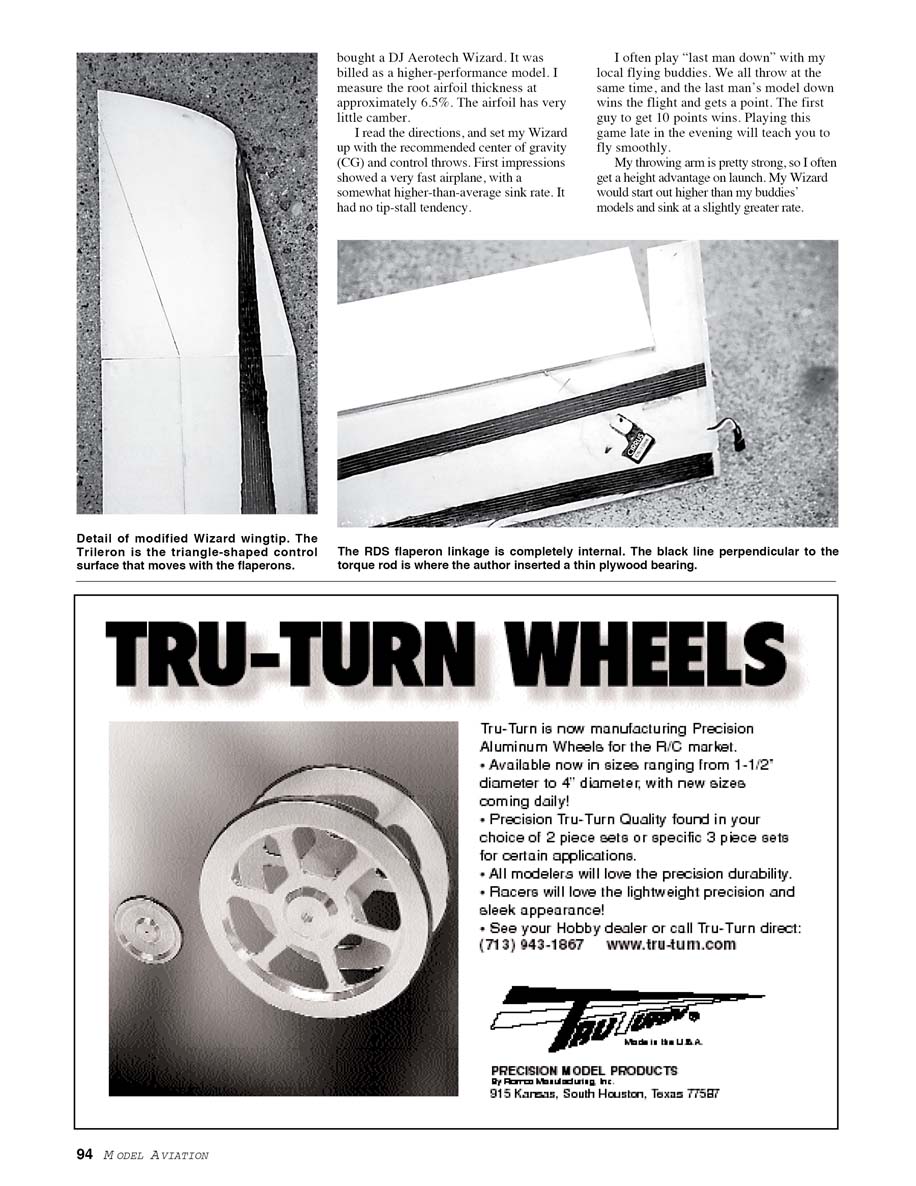
DJ Aerotech’s Spectre series uses high-aspect-ratio wings. I calculated aspect ratios from DJ Aerotech span and area specs:
- HLG: 12.4
- VR HLG: 15.8
- Two-Meter: 11.8
- 100-inch: 14.9
- 120-inch: 19.2
Past aerodynamic simulations suggested optimum aspect ratios around:
- HLG ~ 8
- Two-Meter ~ 10
- Three-Meter ~ 14
Why the Spectres have higher aspect ratios? Two key points:
- Older optimum calculations usually assumed thicker airfoils (for example SD7037 at 9.2% thickness). Thick airfoils develop a lot of drag at Reynolds numbers below ~60k, so they don't work well on small chords or light gliders.
- Little wind-tunnel data exists for 5%–7% thickness airfoils at low Reynolds numbers (below ~40k) because the flow is hard to measure and repeatable results are difficult. With modern engineering and experimentation, designers like Don Stackhouse have developed thin, low-camber airfoils that perform well at the small chord and low Reynolds-number conditions of HLGs.
Implications:
- Thinner, low-camber airfoils tolerate higher aspect ratios because they keep drag low at small chord Reynolds numbers.
- The Spectre series uses low-camber airfoils and moderate wing loading to maintain penetration and low sink rates via low span loading.
- High aspect ratio helps keep energy in turns.
- A little camber mixed into the elevator (camber-mix) can be beneficial for these models.
The Two-Meter Spectre (AR 11.8) likely needs extra wing area to carry heavy winch lines at contests, whereas unlimited-class gliders tolerate more line weight.
In my experience, Spectres combine high performance with friendly handling — similar to the old Monarch. I understand why DJ Aerotech focused on these designs.
Practical training suggestion
Flying a model that is slightly unstable and uses an airfoil with a narrow drag bucket (like the Wizard) at a higher practice intensity can improve piloting skills. Many F3B airplanes also fit this category and provide productive practice.
Photos and additional resources
- Photos accompanying the original article showed a modified Wizard wing used to test the light RDS.
- For RDS retrofit instructions and methods for molded wings, skin-hinged wings, and spoiler methods, see the RDS website (link below).
Sources
- DJ Aerotech
719 Fisk St. Piqua OH 45356 (937) 773-6772 www.bright.net/~djwerks/
- Rotary Driver System (RDS) information:
- Drag of external linkages information:
http://beadcel1.ea.bs.dlr.de/Airfoils/linkage.htm
- Robertson Trileron information:
www.users.qwest.net/~slickraft/trilext.htm
MA
Transcribed from original scans by AI. Minor OCR errors may remain.

