
RADIO CONTROL SOARING
Mike Garton 506 NE 6th St., Ankeny IA 50021 E-mail: mike@iastate.edu
This month's Soaring column covers three topics. I review the International Hand Launch Glider Festival 2000 video, describe a high-tech scratch-built hand-launched glider (HLG) by Matt Gewain, and explain the good and bad of switch-jacks — clever devices that serve as both a power switch and a charging jack for the flight pack.
International Hand Launch Glider Festival 2000 (video)
The International Hand Launch Glider Festival is held each June in San Diego, CA, hosted by the Torrey Pines Gulls club. Last year Paul Naton of Radio Carbon Art filmed the event and produced the video International Handlaunch 2000.
Paul is the creator of the classic Endless Lift and Endless Lift 2 tapes. His Radio Carbon Art videos are a level above the home-brew types: they are digitally edited and include sound tracks. Paul has a website and accepts phone or secure web orders. The production and distribution are very professional.
If you fly HLG, this video is a "must buy." It highlights the largest and most competitive HLG contest in the world so you can see the action without attending. Joe Wurts discusses his new HLG designs, and the video shows sidearm launches, midairs, and rounds filmed with microphones on pilots and helpers so you hear what they're doing. I give this video five stars for quality, content, and value. The source is listed at the end of the column.
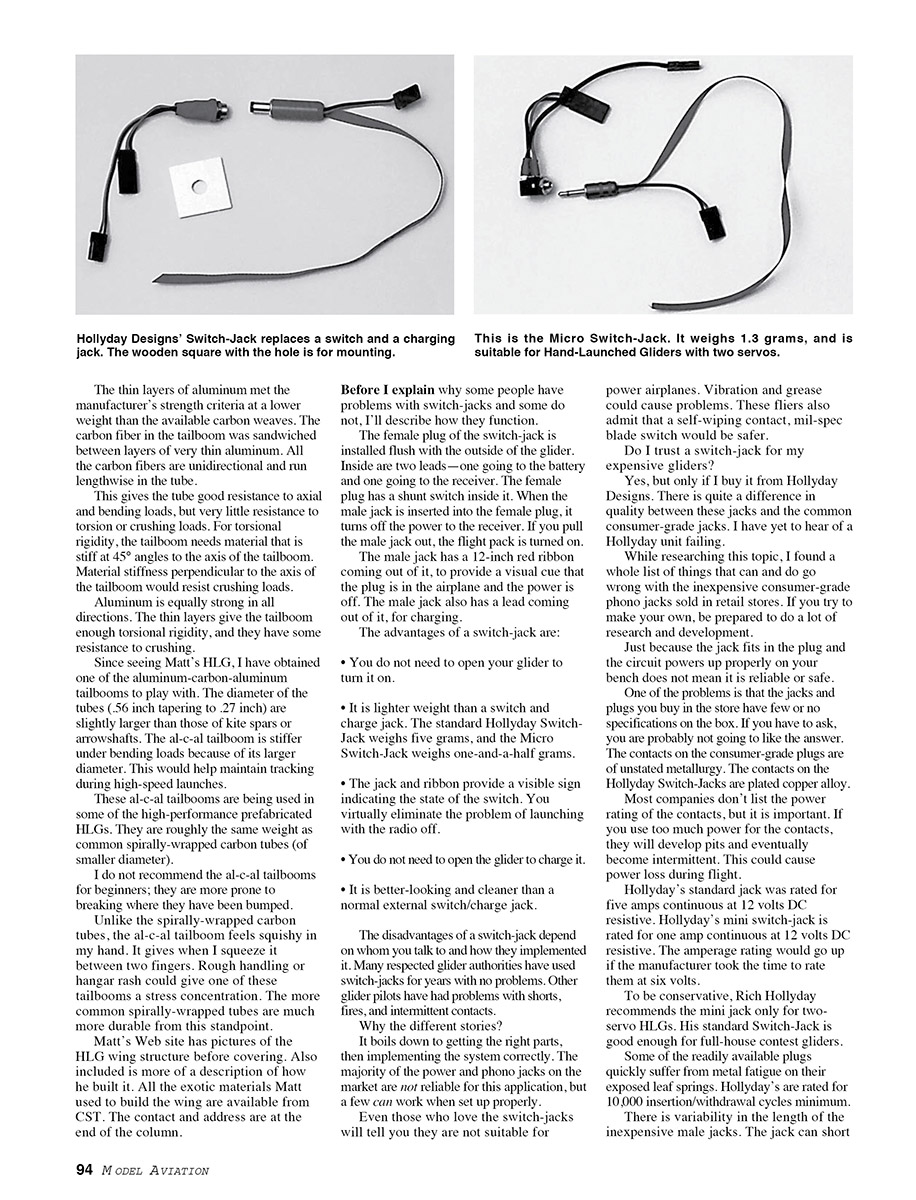
Matt Gewain's high-tech scratch-built HLG
A couple of photos show Matt Gewain's scratch-built HLG. Matt owns Composite Structures Technology (CST) in Tehachapi, California, and his model illustrates the high-tech materials he sells.
The first striking feature was how the model glows blaze orange in flight. The built-up wing structure was covered with light polyester tissue, then Matt mixed fluorescent orange pigment into dope and brushed it on. The covering was heat-shrunk after doping. When the sun shone through the wing, it glowed — much more striking than an opaque surface.
Closer inspection shows a very high-tech structure with a lot of carbon. The model is strong and weighs eight ounces ready-to-fly. Construction details include:
- Ribs: balsa capped with 0.007-inch carbon.
- Leading edge, trailing edge, and wingtips: .050-inch-diameter carbon rods.
- A small piece of 1/16-inch balsa added on top of the carbon leading edge to increase radius without the weight of more carbon.
- Wing spar: 0.25-inch inside-diameter carbon tube.
- Fuselage: a homemade molded Kevlar™ pod.
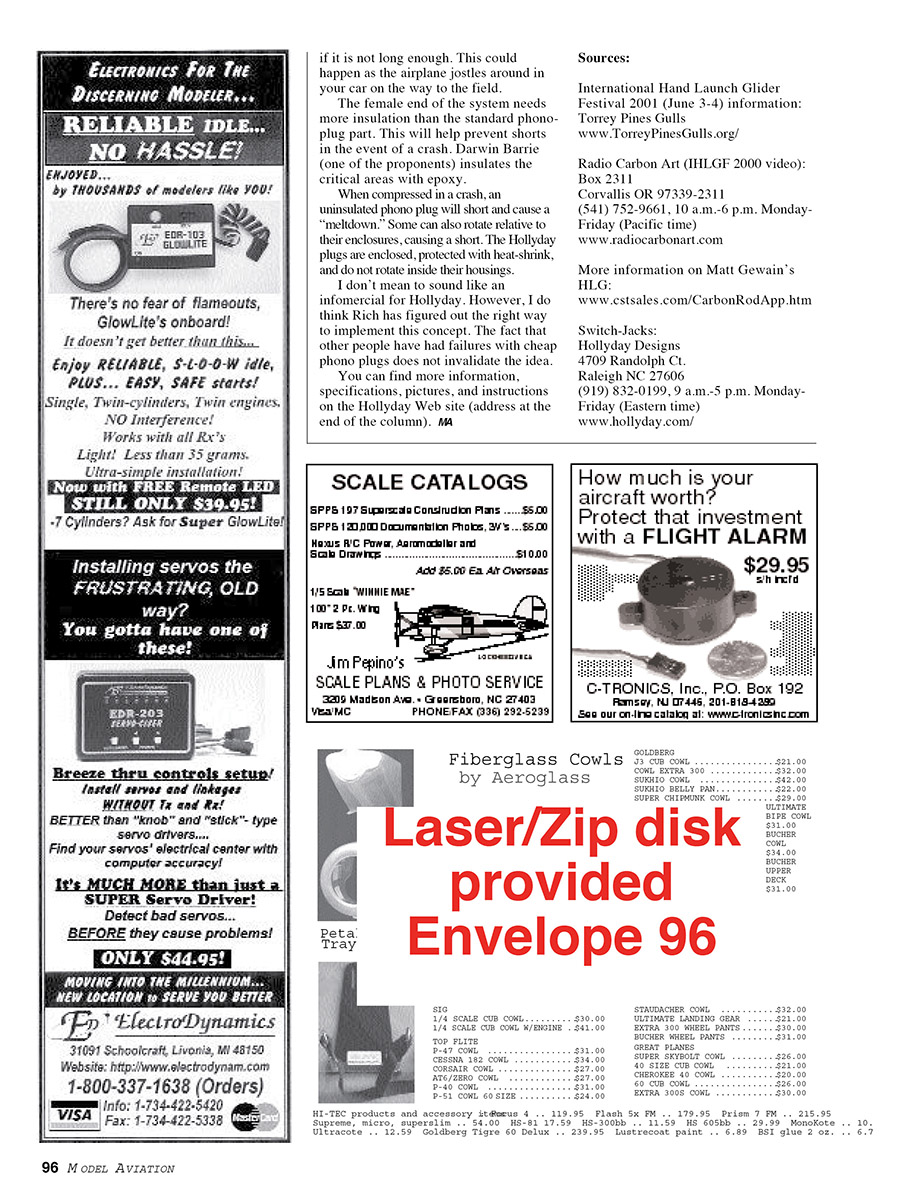
- Tailboom: an aluminum–carbon–aluminum (al-c-al) composite tube with a shiny metallic appearance.
Why aluminum in the tailboom? The thin aluminum layers met the manufacturer's strength criteria at lower weight than available carbon weaves. The carbon fibers in the tailboom are unidirectional and run lengthwise, giving good resistance to axial and bending loads but little torsional or crushing resistance. Torsional rigidity requires material stiff at 45° angles to the axis; crushing resistance requires stiffness perpendicular to the axis. Aluminum is equally strong in all directions; the thin layers provide torsional rigidity and some crushing resistance.
Since seeing Matt's HLG, I obtained an al-c-al tailboom to try. The tubes (.56 inch diameter tapering to .27 inch) are slightly larger than kite spars or arrowshafts. The al-c-al tailboom is stiffer under bending loads because of the larger diameter, which helps maintain tracking during high-speed launches. These al-c-al tubes are used in some higher-performance prefabricated HLGs and are roughly the same weight as common spirally-wrapped carbon tubes of smaller diameter.
I do not recommend al-c-al tailbooms for beginners; they're more prone to breaking where bumped. Unlike spirally-wrapped carbon tubes, al-c-al tailbooms feel "squishy" when squeezed and can develop stress concentrations from rough handling or hangar rash. Spirally-wrapped tubes are generally more durable in that respect.
Matt's website has pictures of the wing structure before covering and a description of how he built it. The exotic materials used are available from CST (contact at the end of the column).
Switch-Jacks — how they work
A switch-jack combines a power switch and charge jack into one unit. The female plug is installed flush with the outside of the glider. Inside are two leads — one to the battery and one to the receiver — and a shunt switch. When you insert the male jack into the female plug, it turns off power to the receiver (flight pack off). Pulling the male jack out turns the flight pack on.
The male jack has a 12-inch red ribbon to provide a visual cue that the plug is in the airplane and the power is off. The male jack also has a lead for charging.
Advantages of a switch-jack:
- You do not need to open your glider to turn it on.
- Lighter weight than a separate switch and charge jack (Hollyday's standard Switch-Jack weighs ~5 grams; the Micro Switch-Jack about 1.5 grams).
- The jack and ribbon provide a visible sign of switch state, virtually eliminating the problem of launching with the radio off.
- You do not need to open the glider to charge the battery.
- Cleaner and neater-looking than a normal external switch/charge jack.
Disadvantages and reliability issues
Reports of switch-jack reliability vary. Many respected glider pilots have used switch-jacks for years with no problems; others have experienced shorts, fires, and intermittent contacts. Why the different stories? It comes down to choosing the right parts and implementing them correctly. The majority of power and phono jacks on the market are not reliable for this application, but a few can work when set up properly.
Specific concerns:
- Vibration and grease can cause trouble in a power airplane; many fliers prefer a self-wiping contact, mil-spec blade switch for safety.
- Consumer-grade phono jacks often lack specifications (metallurgy, contact ratings) and can be unreliable. Contacts can pit under too much current and become intermittent.
- Hollyday Switch-Jacks use plated copper-alloy contacts and higher-quality construction. Hollyday's standard jack is rated for 5 amps continuous at 12 V DC resistive; the mini switch-jack is rated for 1 amp continuous at 12 V DC resistive. Rich Hollyday recommends the mini jack only for two-servo HLGs; the standard Switch-Jack is suitable for full-house contest gliders.
- Some low-cost plugs suffer metal fatigue on exposed leaf springs; Hollyday units are rated for a minimum of 10,000 insertion/withdrawal cycles.
- Variability in the length of inexpensive male jacks can cause shorts if the jack isn't long enough; jostling in a car can create a short.
- The female end needs more insulation than standard phono-plug parts to prevent shorts in a crash. Some proponents (e.g., Darwin Barrie) insulate critical areas with epoxy.
- Uninsulated phono plugs can short when compressed in a crash, causing a "meltdown"; some can rotate in their enclosures and short. Hollyday plugs are enclosed, protected with heat-shrink, and do not rotate inside their housings.
Do I trust a switch-jack for expensive gliders? Yes — but only if I buy it from Hollyday Designs. There is a noticeable difference in quality between these jacks and common consumer-grade jacks. I have yet to hear of a Hollyday unit failing. The fact that cheap phono plugs have failed does not invalidate the concept; it means you must use the right parts and proper installation.
You can find more information, specifications, pictures, and instructions on the Hollyday website (address at the end of the column).
Sources
- International Hand Launch Glider Festival 2001 (June 3–4) information: Torrey Pines Gulls — www.TorreyPinesGulls.org
- Radio Carbon Art (IHLGF 2000 video): Box 2311, Corvallis OR 97339-2311; (541) 752-9661, 10 a.m.–6 p.m. Monday–Friday (Pacific time); www.radiocarbonart.com
- More information on Matt Gewain's HLG: www.cstsales.com/CarbonRodApp.htm
- Switch-Jacks: Hollyday Designs, 4709 Randolph Ct., Raleigh NC 27606; (919) 832-0199, 9 a.m.–5 p.m. Monday–Friday (Eastern time); www.hollyday.com
Transcribed from original scans by AI. Minor OCR errors may remain.

