
RADIO CONTROL SOARING
Mike Garton 2733 NE 95th Ave., Ankeny IA 50021 E-mail: mike@iastate.edu
A follow-up on dihedral
A follow-up on Dihedral: The column I wrote about dihedral in the September issue generated a bunch of E-mail. This month I will follow up on that topic: I'll clarify some things, re-emphasize others, discuss using a gyro to augment spiral stability, and give a source for wing rods with larger bend angles.
I need to clarify "equivalent dihedral angle" (EDA). The EDA of a flat-wing glider is the angle between one side of the wing and the horizon. I was inconsistent in describing dihedral in the September column. The conclusions of that column are valid, but the numbers in the examples change a bit. If I had kept my angles consistent, it would have made my point more dramatic.
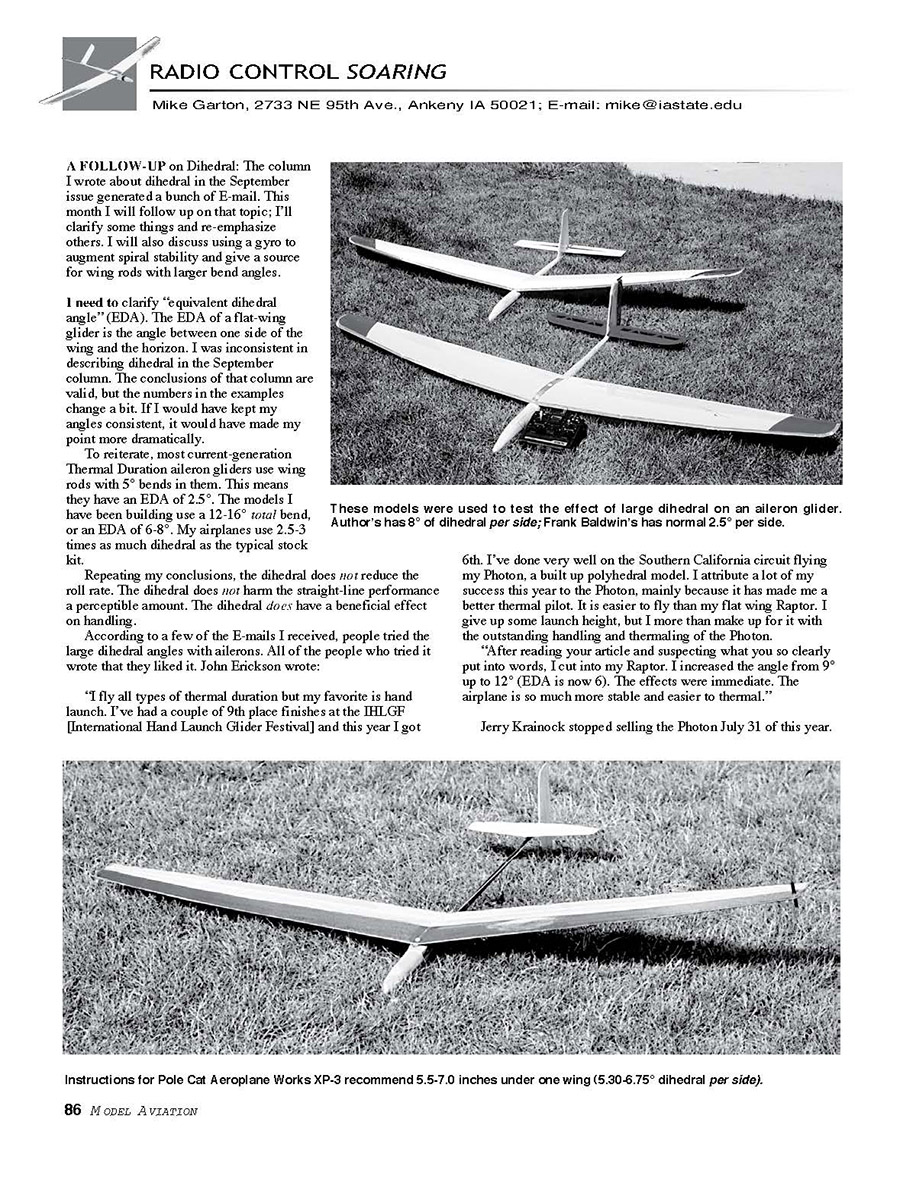
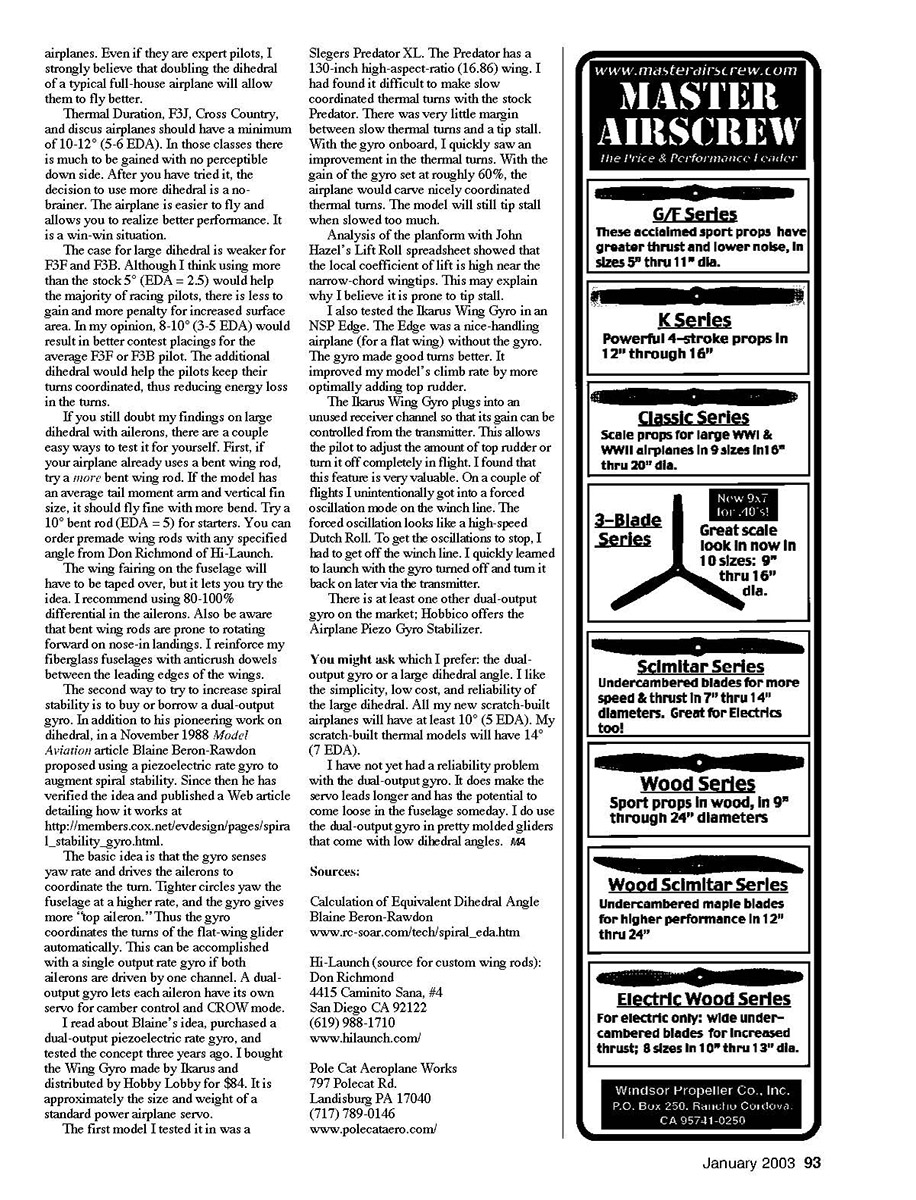
To reiterate, most current-generation Thermal Duration aileron gliders use wing rods with 5° bends in them. This means they have an EDA of 2.5°. The models I have been building use a 12–16° total bend, or an EDA of 6–8°. My airplanes use 2.5–3 times as much dihedral as the typical stock kit.
Repeating my conclusions: the dihedral does not reduce the roll rate. The dihedral does not harm straight-line performance a perceptible amount. The dihedral does have a beneficial effect on handling.
Reader feedback and tests
Several readers tried larger dihedral angles with ailerons and reported positive results.
- John Erickson wrote:
"I fly all types of thermal duration but my favorite is hand launch. I've had a couple of 9th place finishes at the IHLGF [International Hand Launch Glider Festival] and this year I got 6th. I've done very well on the Southern California circuit flying my Photon, a built-up polyhedral model. I attribute a lot of my success this year to the Photon, mainly because it has made me a better thermal pilot. It is easier to fly than my flat-wing Raptor. I give up some launch height, but I more than make up for it with the outstanding handling and thermaling of the Photon. "After reading your article and suspecting what you so clearly put into words, I cut into my Raptor. I increased the angle from 9° up to 12° (EDA is now 6). The effects were immediate. The airplane is so much more stable and easier to thermal."
- Jerry Krainock stopped selling the Photon July 31 of this year.
- Reader Jim Halbert built wings with different dihedral angles and conducted his own comparative experiment:
"I made up several wings to test the SA7035–SA7038 with and without 16 degrees (EDA = 8) dihedral. Very interesting. Your V16 works very well. I could see no difference in glide time over a poly wing and landing with the V sure was a lot easier."
I want to re-emphasize that large dihedral angles do not make landing more difficult. Available roll rate is the key to reacting to gusts. I have flown four different designs with 12–16° total bend (6–8° EDA). They are no more difficult to land in windy conditions than any other aileron airplanes; I actually found them easier to land in the wind than flat-wing models. Keep an open mind and try it. I am not a beginning pilot looking for a crutch to avoid learning something difficult.
Many experienced pilots argue that they use top rudder (also called cross-controlling) to coordinate thermal turns. I can do that too. Yes, it works—when I can see the airplane well. I also find that the pilot who does not have to worry about cross-controlling has more brainpower left to concentrate on centering the circles in the core of the thermal. Imagine only having to move your transmitter sticks once every two circles instead of two to three times per circle.
My 38-ounce Two Meter has thermaled up through most of the molded three-meter airplanes that it has encountered in the same thermal. When the thermal is far away, it is like taking candy from a baby.
Many pilots learn to fly with a polyhedral glider. Later they usually try a flat-wing aileron glider. Without exception they find that the flat-wing glider is more difficult to thermal and requires more concentration to fly. I propose that pilots try adding ailerons with the polyhedral (or large dihedral). They could consider it an aileron trainer.
I would bet my computer radio that most pilots who try high dihedral with ailerons will stop building low-dihedral aileron airplanes. Even if they are expert pilots, I strongly believe that doubling the dihedral of a typical full-house airplane will allow them to fly better.
Recommendations by class
- Thermal Duration, F3J, Cross Country, and discus airplanes:
- Minimum 10–12° total bend (5–6° EDA). There is much to be gained with no perceptible downside. After you have tried it, using more dihedral becomes an obvious choice—the airplane is easier to fly and allows better performance.
- F3F and F3B:
- The case for large dihedral is weaker. While more than the stock 5° (EDA = 2.5°) would help many racing pilots, there is less to gain and more penalty from increased surface area. In my opinion, 8–10° total bend (3–5° EDA) would result in better contest placings for the average F3F or F3B pilot. The additional dihedral helps keep turns coordinated, reducing energy loss in the turns.
How to test increased spiral stability yourself
If you still doubt the findings on large dihedral with ailerons, try one of these easy tests:
- Modify the wing rod:
- If your airplane already uses a bent wing rod, try a rod with a larger bend. If the model has an average tail moment arm and vertical fin size, it should fly fine with more bend. Try a 10° bent wing rod (EDA = 5°) for starters.
- You can order premade wing rods with any specified angle from Don Richmond of Hi-Launch.
- The wing fairing on the fuselage will have to be taped over, but this lets you try the idea. I recommend using 80–100% differential in the ailerons.
- Be aware that bent wing rods are prone to rotating forward on nose-in landings. I reinforce my fiberglass fuselages with anticrush dowels between the leading edges of the wings.
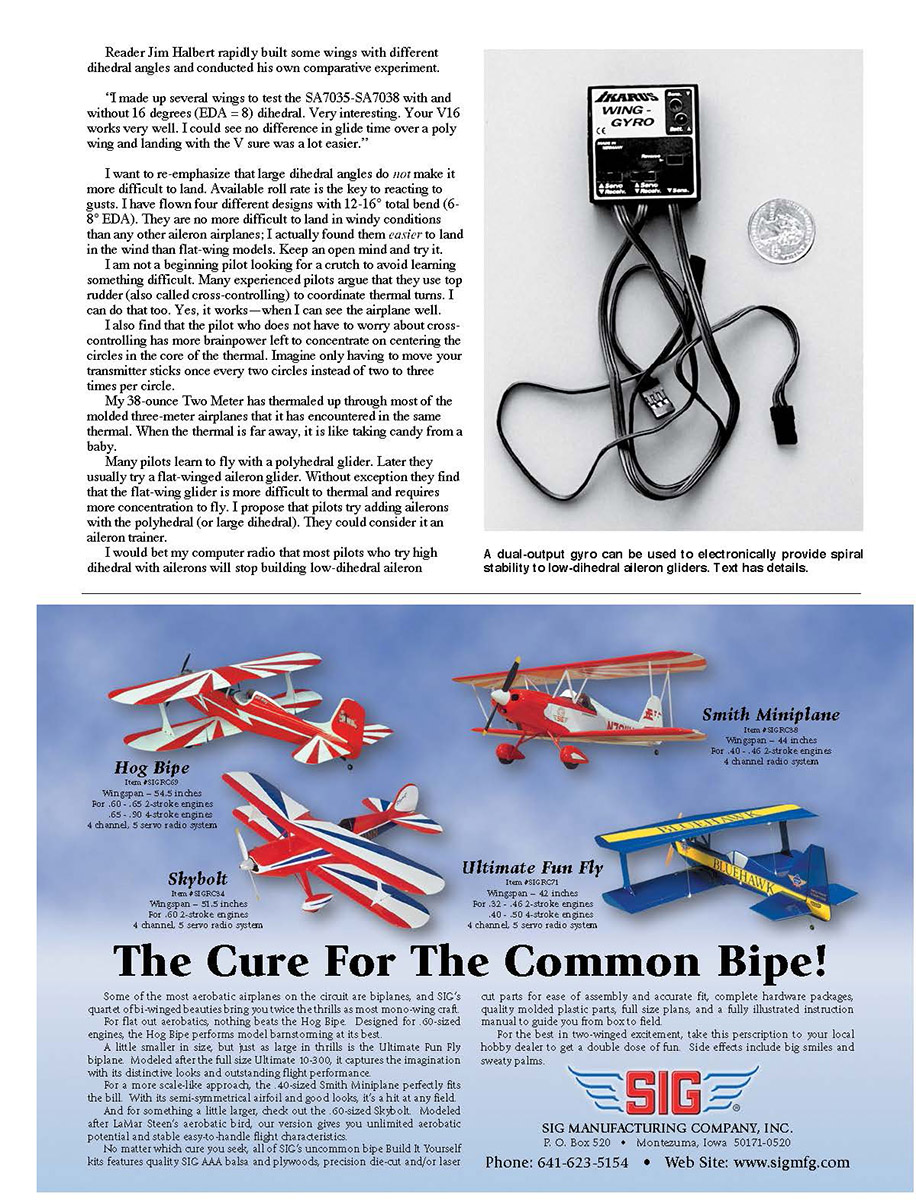
- Use a dual-output gyro:
- Buy or borrow a dual-output gyro to increase spiral stability. Blaine Beron-Rawdon proposed using a piezoelectric rate gyro to augment spiral stability (Model Aviation, Nov 1988) and later published a Web article describing how it works: http://members.cox.net/eveldesign/pages/spiral_stability_gyro.html.
- The gyro senses yaw rate and drives the ailerons to coordinate the turn: tighter circles yaw the fuselage faster, and the gyro adds more top aileron. This coordinates flat-wing gliders automatically.
- A single-output rate gyro can work if both ailerons are driven by one channel; a dual-output gyro lets each aileron have its own servo for camber control and CROW mode.
- The Ikarus Wing Gyro (distributed by Hobby Lobby) is one example of a dual-output piezoelectric rate gyro. It plugs into an unused receiver channel so its gain can be adjusted from the transmitter, allowing the pilot to vary or turn off the gyro in flight.
My tests with a gyro
I read Blaine's idea, bought a dual-output piezoelectric rate gyro, and tested it three years ago. I purchased the Ikarus Wing Gyro (about the size and weight of a standard power airplane servo) and installed it in a Slegers Predator XL and an NSP Edge.
- Predator XL:
- The Predator has a 130-inch high-aspect-ratio (16.86) wing. It was difficult to make slow coordinated thermal turns with the stock setup—very little margin between slow thermaling and a tip stall. With the gyro onboard and gain around 60%, the airplane carved nicely coordinated thermal turns. The model will still tip stall when slowed too much. Analysis with John Hazel's Lift Roll spreadsheet showed a high local coefficient of lift near the narrow-chord wingtips, which may explain the tip-stall tendency.
- NSP Edge:
- The Edge was a nice-handling flat wing without the gyro; adding the gyro made good turns better and improved climb rate by more optimally adding top rudder.
I found the transmitter-adjustable gain very valuable. On a couple of flights I unintentionally encountered a forced-oscillation mode on the winch line (a high-speed Dutch roll). Turning the gyro off for launch and enabling it later via the transmitter avoided that problem.
There is at least one other dual-output gyro on the market: Hobbico's Airplane Piezo Gyro Stabilizer.
Which I prefer
I prefer the simplicity, low cost, and reliability of large dihedral. All my new scratch-built airplanes will have at least 10° total bend (5° EDA). My scratch-built thermal models will have 14° total bend (7° EDA).
I have not yet had a reliability problem with the dual-output gyro. It does lengthen servo leads and has the potential to come loose in the fuselage someday. I use the dual-output gyro in some pretty molded gliders that come with low dihedral angles.
Sources
- Calculation of Equivalent Dihedral Angle
Blaine Beron-Rawdon www.rc-soar.com/tech/spiral_eda.htm
- Blaine Beron-Rawdon, spiral stability gyro article:
http://members.cox.net/eveldesign/pages/spiral_stability_gyro.html
- Hi-Launch (source for custom wing rods):
Don Richmond 4415 Caminito Sona, #4 San Diego, CA 92122 (619) 988-1710 www.hilaunch.com
- Pole Cat Aeroplane Works:
797 Polecat Rd. Landisburg, PA 17040 (717) 789-0146 www.polecataero.com
Transcribed from original scans by AI. Minor OCR errors may remain.

