
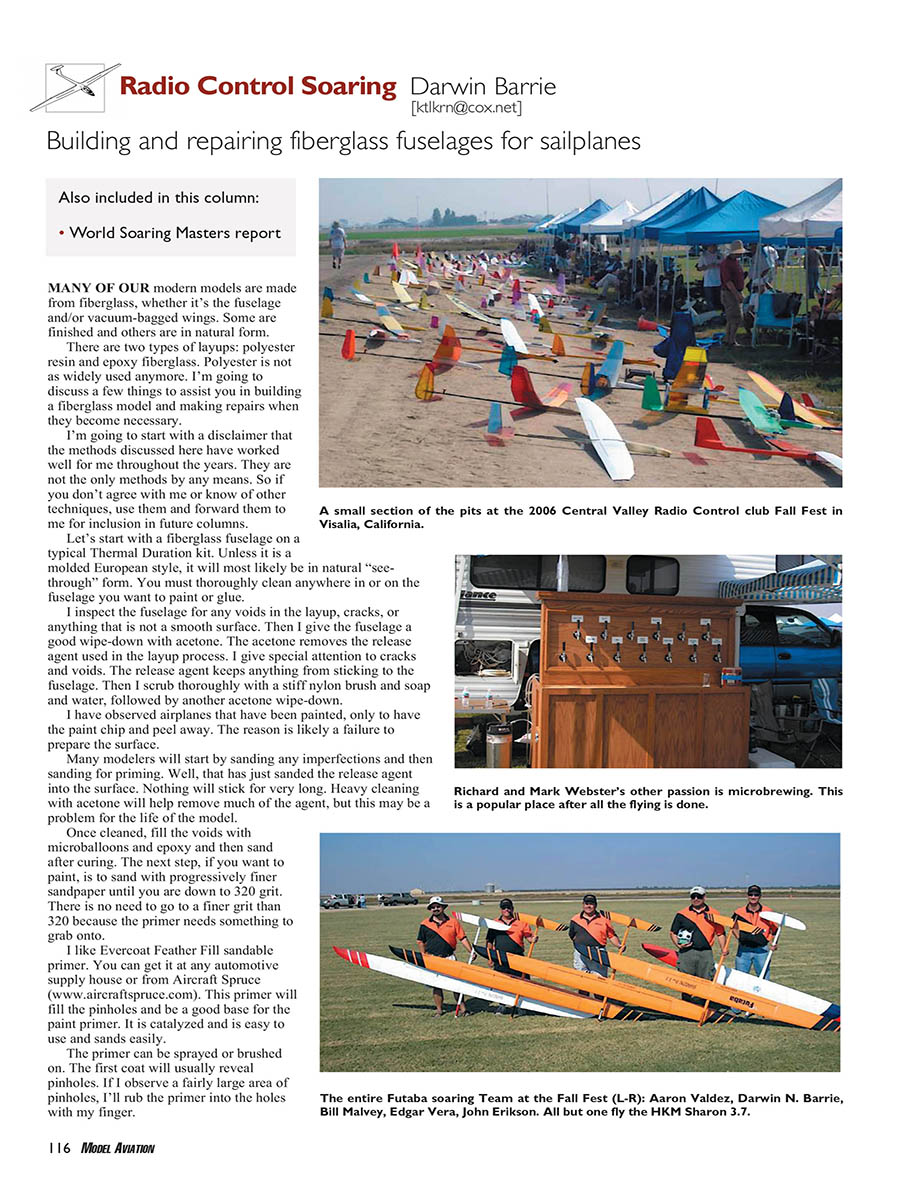
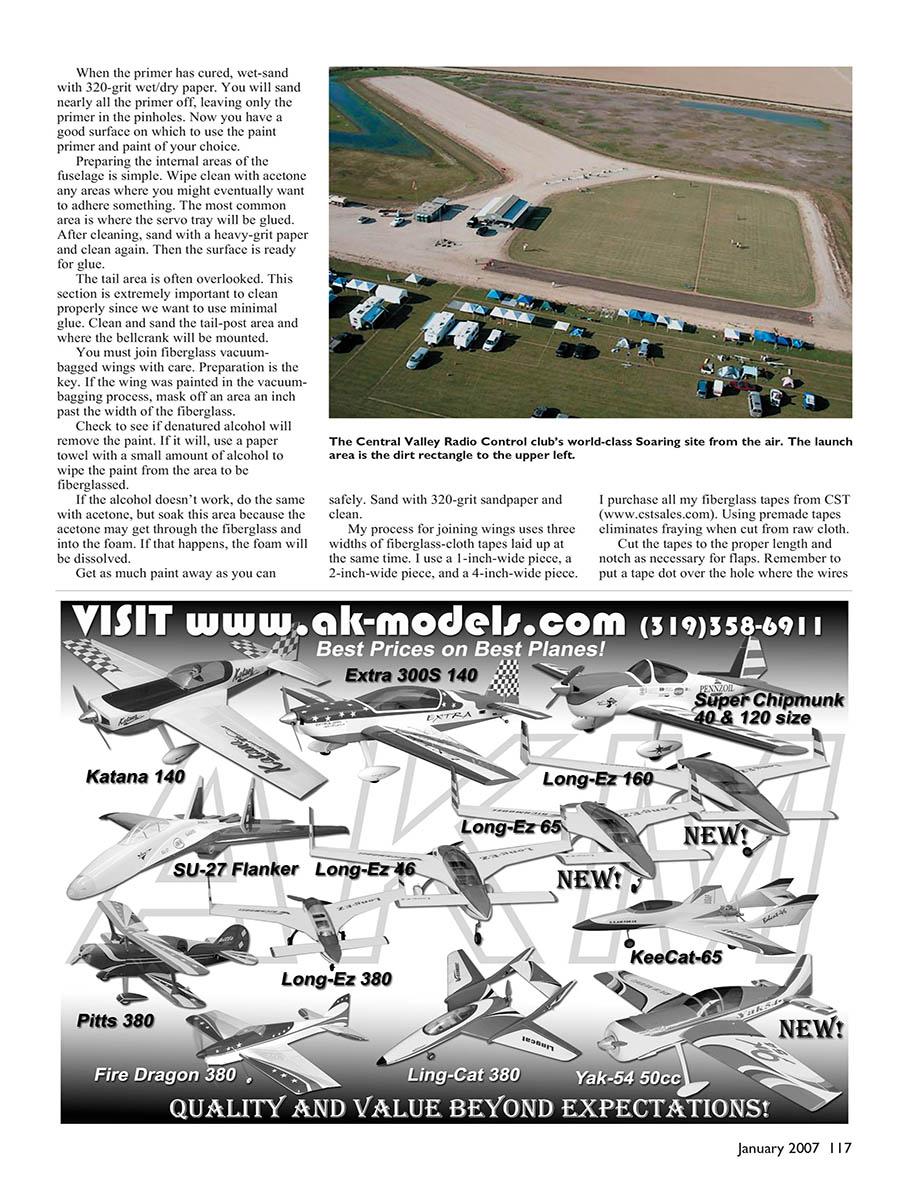
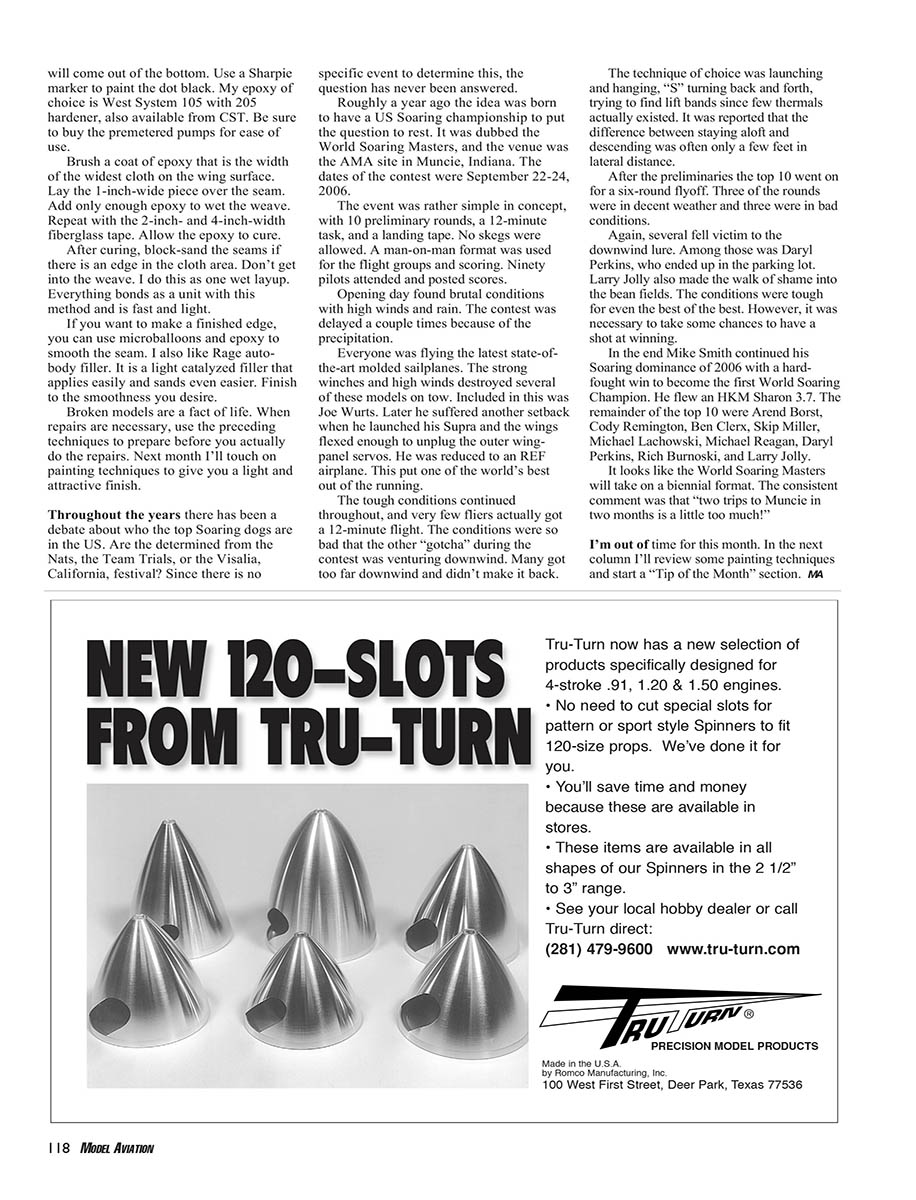
Radio Control Soaring — Darwin Barrie [ktlkrn@cox.net]
Building and repairing fiberglass fuselages for sailplanes
Many of our modern models are made from fiberglass, whether it’s the fuselage and/or vacuum-bagged wings. Some are finished and others are in natural form.
There are two types of layups: polyester resin and epoxy fiberglass. Polyester is not as widely used anymore. I’m going to discuss a few things to assist you in building a fiberglass model and making repairs when they become necessary.
I’m going to start with a disclaimer that the methods discussed here have worked well for me throughout the years. They are not the only methods by any means. So if you don’t agree with me or know of other techniques, use them and forward them to me for inclusion in future columns.
Let’s start with a fiberglass fuselage on a typical Thermal Duration kit. Unless it is a molded European style, it will most likely be in natural “see-through” form. You must thoroughly clean anywhere in or on the fuselage you want to paint or glue.
I inspect the fuselage for any voids in the layup, cracks, or anything that is not a smooth surface. Then I give the fuselage a good wipe-down with acetone. The acetone removes the release agent used in the layup process. I give special attention to cracks and voids. The release agent keeps anything from sticking to the fuselage. Then I scrub thoroughly with a stiff nylon brush and soap and water, followed by another acetone wipe-down.
I have observed airplanes that have been painted, only to have the paint chip and peel away. The reason is likely a failure to prepare the surface.
Many modelers will start by sanding any imperfections and then sanding for priming. Well, that has just sanded the release agent into the surface. Nothing will stick for very long. Heavy cleaning with acetone will help remove much of the agent, but this may be a problem for the life of the model.
Once cleaned, fill the voids with microballoons and epoxy and then sand after curing. The next step, if you want to paint, is to sand with progressively finer sandpaper until you are down to 320 grit. There is no need to go to a finer grit than 320 because the primer needs something to grab onto.
I like Evercoat Feather Fill sandable primer. You can get it at any automotive supply house or from Aircraft Spruce (www.aircraftspruce.com). This primer will fill the pinholes and be a good base for the paint. It is catalyzed, easy to use, and sands easily. The primer can be sprayed or brushed on.
The first coat will usually reveal pinholes. If I observe a fairly large area of pinholes, I’ll rub the primer into the holes with my finger.
When the primer has cured, wet-sand with 320-grit wet/dry paper. You will sand nearly all the primer off, leaving only the primer in the pinholes. Now you have a good surface on which to use the paint primer and paint of your choice.
Preparing the internal areas of the fuselage is simple. Wipe clean with acetone any areas where you might eventually want to adhere something. The most common area is where the servo tray will be glued. After cleaning, sand with a heavy-grit paper and clean again. Then the surface is ready for glue.
The tail area is often overlooked. This section is extremely important to clean properly since we want to use minimal glue. Clean and sand the tail-post area and where the bellcrank will be mounted.
You must join fiberglass vacuum-bagged wings with care. Preparation is the key. If the wing was painted in the vacuum-bagging process, mask off an area an inch past the width of the fiberglass. Check to see if denatured alcohol will remove the paint. If it will, use a paper towel with a small amount of alcohol to wipe the paint from the area to be fiberglassed.
If the alcohol doesn't work, do the same with acetone, but soak this area because the acetone may get through the fiberglass and into the foam. If that happens, the foam will be dissolved.
Get as much paint away as you can safely. Sand with 320-grit sandpaper and clean.
My process for joining wings uses three widths of fiberglass-cloth tapes laid up at the same time. I use:
- 1-inch-wide piece
- 2-inch-wide piece
- 4-inch-wide piece
I purchase all my fiberglass tapes from CST (www.cstsales.com). Using premade tapes eliminates fraying when cut from raw cloth.
Cut the tapes to the proper length and notch as necessary for flaps. Remember to put a tape dot over the hole where the wires go through (they will come out of the bottom). Use a Sharpie marker to paint the dot black. My epoxy of choice is West System 105 with 205 hardener, also available from CST. Be sure to buy the pre-metered pumps for ease of use.
Brush a coat of epoxy that is the width of the widest cloth on the wing surface. Lay the 1-inch-wide piece over the seam. Add only enough epoxy to wet the weave. Repeat with the 2-inch- and 4-inch-width fiberglass tape. Allow the epoxy to cure.
After curing, block-sand the seams if there is an edge in the cloth area. Don't get into the weave. I do this as one wet layup. Everything bonds as a unit with this method and is fast and light.
If you want to make a finished edge, you can use microballoons and epoxy to smooth the seam. I also like Rage autobody filler. It is a light catalyzed filler that applies easily and sands even easier. Finish to the smoothness you desire.
Broken models are a fact of life. When repairs are necessary, use the preceding techniques to prepare before you actually do the repairs. Next month I'll touch on painting techniques to give you a light and attractive finish.
World Soaring Masters — Muncie, Indiana (September 22–24, 2006)
Throughout the years there has been a debate about who the top soaring pilots are in the U.S. Are they determined from the Nats, the Team Trials, or the Visalia festivals? Since there is no specific event to determine this, the question has never been answered.
Roughly a year ago the idea was born to have a U.S. Soaring championship to put the question to rest. It was dubbed the World Soaring Masters, and the venue was the AMA site in Muncie, Indiana. The dates of the contest were September 22–24, 2006.
The event was rather simple in concept, with 10 preliminary rounds, a 12-minute task, and a landing tape. No skegs were allowed. A man-on-man format was used for the flight groups and scoring. Ninety pilots attended and posted scores.
Opening day found brutal conditions with high winds and rain. The contest was delayed a couple of times because of the precipitation.
Everyone was flying the latest state-of-the-art molded sailplanes. The strong winches and high winds destroyed several of these models on tow. Included in this was Joe Wurts. Later he suffered another setback when he launched his Supra and the wings flexed enough to unplug the outer wing-panel servos. He was reduced to an REF airplane. This put one of the world's best out of the running.
The tough conditions continued throughout, and very few fliers actually got a 12-minute flight. The conditions were so bad that the other "gotcha" during the contest was venturing downwind. Many got too far downwind and didn't make it back.
The technique of choice was launching and hanging, "S" turning back and forth, trying to find lift bands since few thermals actually existed. It was reported that the difference between staying aloft and descending was often only a few feet in lateral distance.
After the preliminaries the top 10 went on for a six-round flyoff. Three of the rounds were in decent weather and three were in bad conditions.
Again, several fell victim to the downwind lure. Among those was Daryl Perkins, who ended up in the parking lot. Larry Jolly also made the walk of shame into the bean fields. The conditions were tough for even the best of the best. However, it was necessary to take some chances to have a shot at winning.
In the end Mike Smith continued his soaring dominance of 2006 with a hard-fought win to become the first World Soaring Champion. He flew an HKM Sharon 3.7. The remainder of the top 10 were:
- Arend Borst
- Cody Remington
- Ben Clerk
- Skip Miller
- Michael Lachowski
- Michael Reagan
- Daryl Perkins
- Rich Burnoski
- Larry Jolly
It looks like the World Soaring Masters will take on a biennial format. The consistent comment was that "two trips to Muncie in two months is a little too much!"
I'm out of time for this month. In the next column I'll review some painting techniques and start a "Tip of the Month" section. MA
Transcribed from original scans by AI. Minor OCR errors may remain.

