
RADIO CONTROL SOARING
Skip Miller, 3629 21st St., Boulder, CO 80304-1607
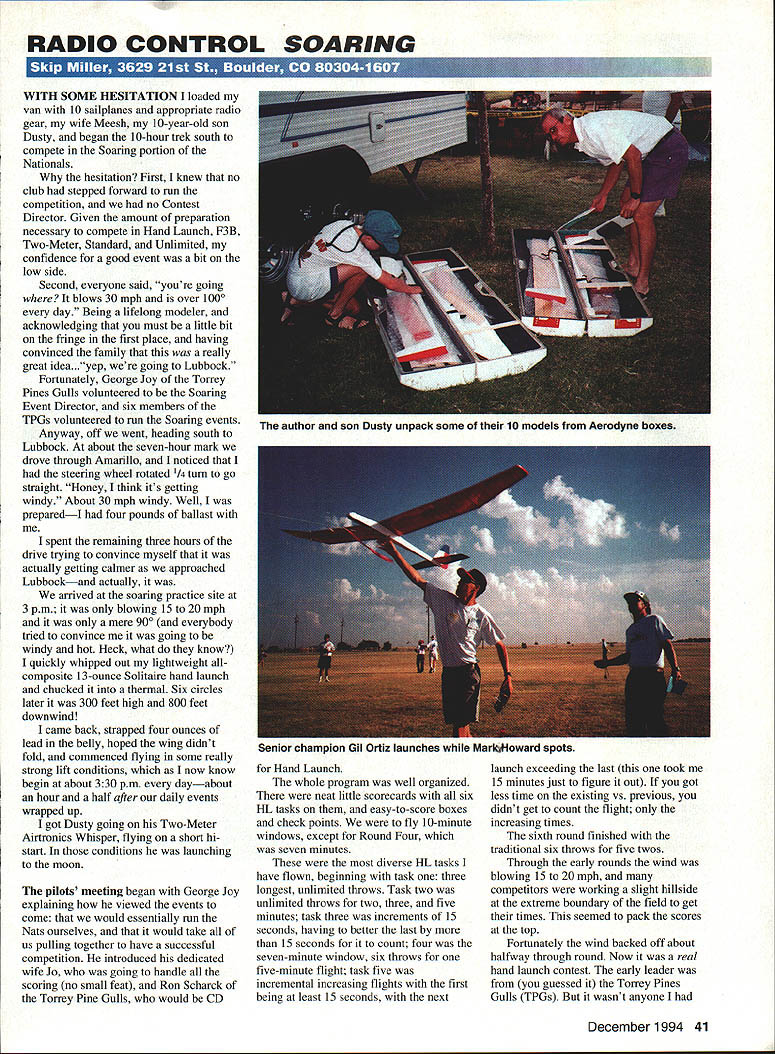
With some hesitation I loaded my van with 10 sailplanes and appropriate radio gear, my wife Meesh, my 10-year-old son Dusty, and began the 10-hour trek south to compete in the Soaring portion of the Nationals.
Why the hesitation? First, I knew that no club had stepped forward to run the competition, and we had no Contest Director. Given the amount of preparation necessary to compete in Hand Launch, F3B, Two‑Meter, Standard, and Unlimited, my confidence for a good event was a bit on the low side.
Second, everyone said, "you're going where? It blows 30 mph and is over 100° every day." Being a lifelong modeler, and acknowledging that you must be a little bit on the fringe in the first place, and having convinced the family that this was a really great idea, "yep, we're going to Lubbock."
Fortunately, George Joy of the Torrey Pines Gulls volunteered to be the Soaring Event Director, and six members of the TPGs volunteered to run the Soaring events.
We arrived at the soaring practice site at 3 p.m.; it was only blowing 15 to 20 mph and it was only a mere 90° (and everybody tried to convince me it was going to be windy and hot). I quickly whipped out my lightweight all-composite 13-ounce Solitaire hand-launch and chucked it into a thermal. Six circles later it was 300 feet high and 800 feet downwind. I came back, strapped four ounces of lead in the belly, hoped the wing didn't fold, and commenced flying in some really strong lift conditions, which, as I now know, begin at about 3:30 p.m. every day—about an hour and a half after our daily events wrapped up.
I got Dusty going on his Two‑Meter Airtronics Whisper, flying on a short hi-start. In those conditions he was launching to the moon.
The pilots' meeting began with George Joy explaining how he viewed the events to come: that we would essentially run the Nats ourselves, and that it would take all of us pulling together to have a successful competition. He introduced his dedicated wife Jo, who was going to handle all the scoring (no small feat), and Ron Scharck of the Torrey Pines Gulls, who would be CD for Hand Launch.
The whole program was well organized. There were neat little scorecards with all six HL tasks on them, and easy-to-score boxes and check points. We were to fly 10‑minute windows, except for Round Four, which was seven minutes.
Hand Launch
These were the most diverse Hand Launch (HL) tasks I have flown, beginning with:
- Task 1: three longest, unlimited throws.
- Task 2: unlimited throws for two, three, and five minutes.
- Task 3: increments of 15 seconds, having to better the last by more than 15 seconds for it to count.
- Task 4: the seven-minute window.
- Task 5: incremental increasing flights with the first being at least 15 seconds, with the next launch exceeding the last (this one took me 15 minutes just to figure out). If you got less time on the existing vs. previous, you didn't get to count the flight.
- Task 6: six throws for five two-minute flights.
Through the early rounds the wind was blowing 15 to 20 mph, and many competitors were working a slight hillside at the extreme boundary of the field to get their times. This seemed to pack the scores at the top.
Fortunately the wind backed off about halfway through the contest. Now it was a real hand-launch contest. The early leader was, you guessed it, the Torrey Pines Gulls (TPGs). But it wasn't anyone I had heard of.
I heard the name Don Richmond, 59 years old. What? You must be kidding — he isn't hand-launch stuff; that's supposed to be the domain of the gorilla-armed athletes with thermal noses. Don decided to take up Hand Launch and fly the Nats. He began training—three days, 30 throws. As the training program progressed, he found he could fly during the day, actually raise his arm to brush his teeth at night, and was actually getting in shape, making his success at the Nats much greater.
He was great in the first three rounds, three points perfect. Unfortunately the fourth round brought disaster—his airplane broke. Although he hurriedly repaired it and put it back in the air, the rest of the field left him behind the early leaders: Richmond, Scharck, Joy, Stricklett, Shelby, and myself.
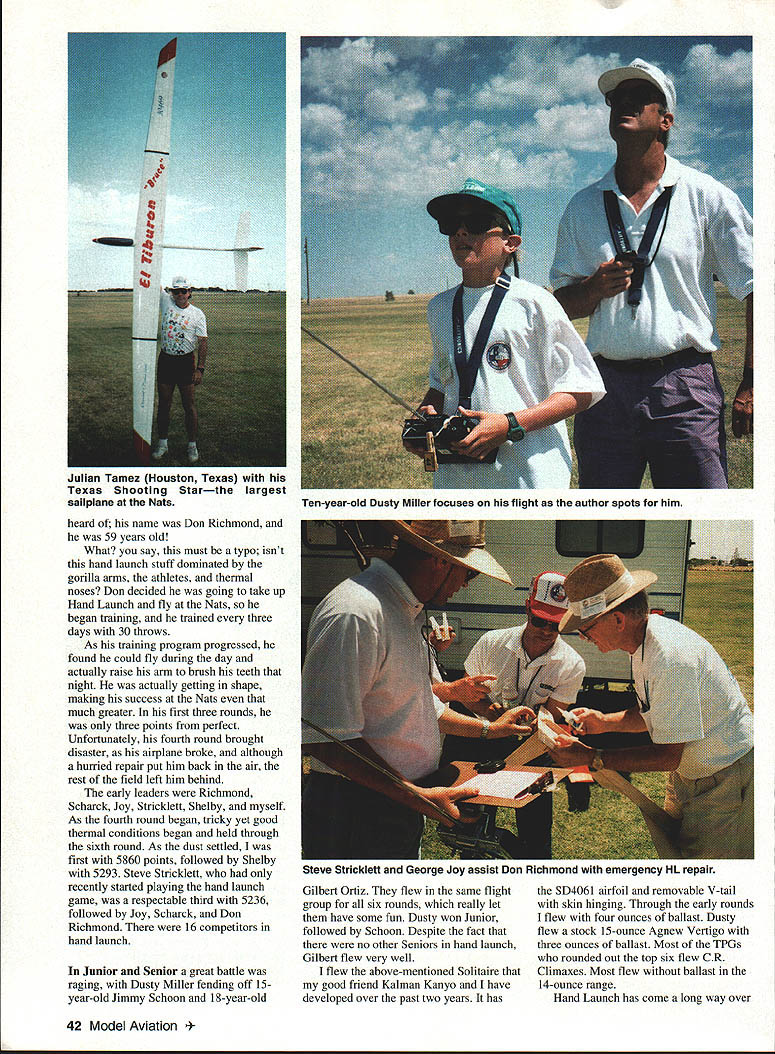
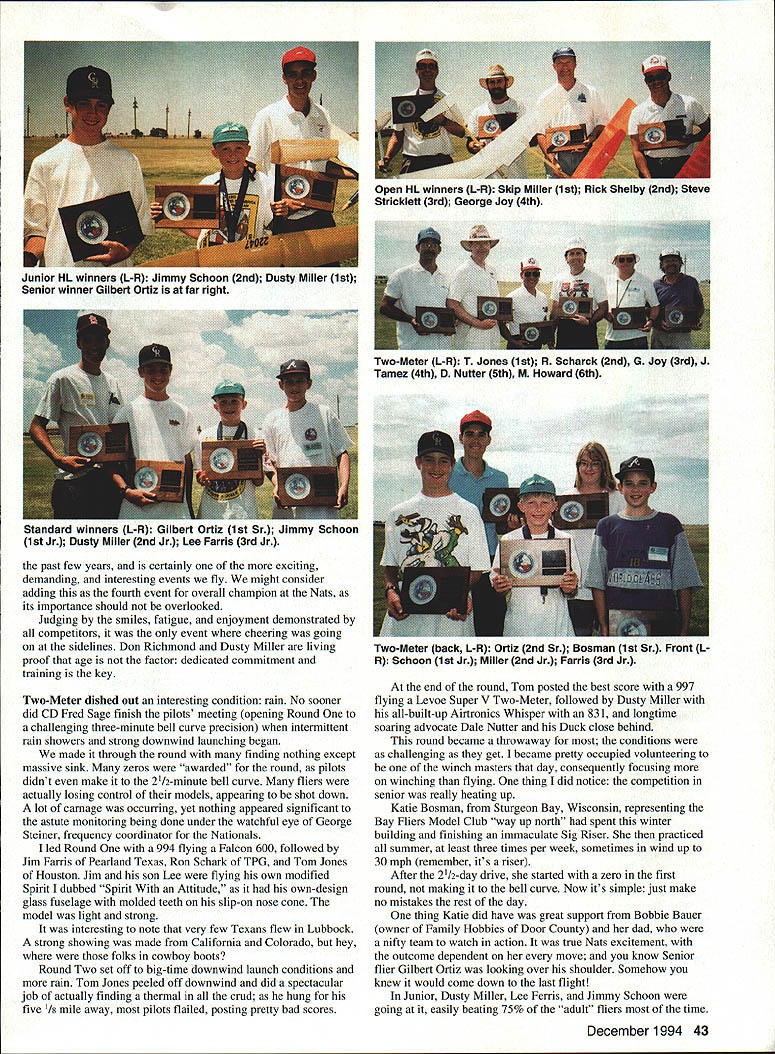
As the fourth round began, tricky yet good thermal conditions began and held through the sixth round. As the dust settled, first place had 5,860 points followed by Shelby with 5,293. Steve Stricklett, who recently started playing the hand-launch game, had a respectable third with 5,236, followed by Joy, Scharck, and Don Richmond. Sixteen competitors flew Hand Launch—Junior and Senior—and a great battle was raging. Dusty Miller fended off 15‑year-old Jimmy Schoon. Eighteen‑year‑old Gilbert Ortiz flew the same flight group for six rounds and really had some fun. Dusty won the Junior title, followed by Schoon.
I flew the above-mentioned Solitaire that my good friend Kalman Kanyo and I have developed over the past two years. It has the SD4061 airfoil and removable V-tail with skin hinging. Through the early rounds I flew with four ounces of ballast. Dusty flew a stock 15‑ounce Agnew Vertigo with three ounces of ballast. Most of the TPGs who rounded out the top six flew C.R. Climaxes. Most flew without ballast in the 14‑ounce range.
Hand Launch has come a long way over the past few years, and is certainly one of the more exciting, demanding, and interesting events we fly. We might consider adding this as the fourth event for overall champion at the Nats, as its importance should not be overlooked.
Judging by the smiles, fatigue, and enjoyment demonstrated by all competitors, it was the only event where cheering was going on at the sidelines. Don Richmond and Dusty Miller are living proof that age is not the factor; dedicated commitment and training is the key.
Hand Launch — Top Results (Senior and Junior)
- Senior top finishers: 1st — Don Richmond (5,860), 2nd — Shelby (5,293), 3rd — Steve Stricklett (5,236), followed by George Joy and Ron Scharck.
- Junior top finishers: 1st — Dusty Miller, 2nd — Jimmy Schoon.
Two‑Meter
Two‑Meter dished out an interesting condition: rain. No sooner did CD Fred Sage finish the pilots' meeting (opening Round One to a challenging three-minute bell-curve precision) when intermittent rain showers and strong downwind launching began.
We made it through the round with many finding nothing except massive sink. Many zeros were awarded for the round, as pilots didn't even make it to the 2 1/2‑minute bell curve. Many fliers were actually losing control of their models, appearing to be shot down. A lot of carnage was occurring, yet nothing appeared significant to the astute monitoring being done under the watchful eye of George Steiner, frequency coordinator for the Nationals.
I led Round One with a 994 flying a Falcon 600, followed by Jim Farris of Pearland, Texas, Ron Scharck of TPG, and Tom Jones of Houston. Jim and his son Lee were flying his own modified Spirit I dubbed "Spirit With an Attitude," as it had his own-design glass fuselage with molded teeth on his slip-on nose cone. The model was light and strong.
It was interesting to note that very few Texans flew in Lubbock. A strong showing was made from California and Colorado, but hey, where were those folks in cowboy boots?
Round Two set off to big-time downwind launches and more rain. Tom Jones peeled off downwind and did a spectacular job of actually finding a thermal in all the crud; as he hung for his five-and-a-half minutes away, most pilots flailed, posting pretty bad scores.
At the end of the round, Tom posted the best score with a 997 flying a LeVoe Super V Two‑Meter, followed by Dusty Miller with his all-built-up Airtronics Whisper with an 831, and longtime soaring advocate Dale Nutter and his Duck close behind.
This round became a throwaway for most; the conditions were as challenging as they get. It became pretty common to volunteer to be one of the winch masters that day, consequently focusing more on winching than flying. One thing I did notice: the competition in Senior was really heating up.
Katie Bosman, from Sturgeon Bay, Wisconsin, representing the Bay Fliers Model Club, had spent this winter building and finishing an immaculate Sig Riser. She then practiced all summer, at least three times per week, sometimes in wind up to 30 mph. After the 2 1/2‑day drive, she started with a zero in the first round; now it's simple: just make no mistakes the rest of the day.
One thing Katie did have was great support from Bobbie Bauer (owner of Family Hobbies of Door County) and her dad, who were a nifty team to watch in action. It was true Nats excitement, with the outcome dependent on her every move; and you know senior flier Gilbert Ortiz was looking over his shoulder. Somehow you knew it would come down to the last flight!
In Junior, Dusty Miller, Lee Ferris, and Jimmy Schoon were going at it, easily beating 75% of the "adult" fliers most of the time. Jimmy, a Nats veteran, was showing his style, improving on every launch and landing. He had to recover from a zero in the first round. He was one of the unfortunates to total his model due to what he thought was an interference problem.
Because of the pounding dished out to many in the first round, the bell curve was eliminated starting the second round, as well as going to a 25‑foot circle instead of a line landing downwind (which proved to be dangerous). This remained for the next two days of flying.
We tried to keep things going, but by 11:00 we went to lunch/rain delay; Mother Nature was just not cooperating. I was huddling under the organizers' tent staying dry when up leaped George Steiner from his frequency-monitoring equipment, dancing a little jig, and exclaiming, "I've got it!" He had pinned down the interference problem, and had the proof.
He isolated two frequencies that generated 455 kHz that were strong enough to cause interference to single-conversion receivers. As the day went on the signals became stronger and stronger, and pilots were notified after the rain delay: if you are flying single conversion, don't — or you will probably lose your model.
Most listened, and begged dual-conversion receivers from friends and fellow competitors, but some didn't and paid the consequences. Those who got shot down were offered re-flights if they brought up their receivers and showed them to George. Guess what? They were all single conversion.
Write George c/o AMA if you want the details. All I know is if he hadn't been there giving his expert support to soaring, we would have had a serious situation.
After the rain delay, and switching to winches compliments of the TPGs, contestants, and the "old buzzard" himself, Dave Thornburg (he drove six hours just to see what was going on and to help out), things got underway again.
As winch master, I got up on the bullpen inspiring pilots to launch—or was that pressuring them? At any rate, 14 airplanes got up in this huge air mass. It was truly a great sight. Unfortunately, I got caught in the sink afterward, which sunk my model in the Two‑Meter category.
Dale Nutter was first to launch in the next round (six-minute), displaying his strong thermal skills, and netted a 6:02 and a 9:2; definitely a keeper. Houston's Julian Tamez, flying a Mariah, was posting great scores, as was Ron Scharck flying a loaner Shadow prototype from Tekoa. George Joy was getting dialed on his brand-new R&R Evolution, an all-composite ready-to-fly.
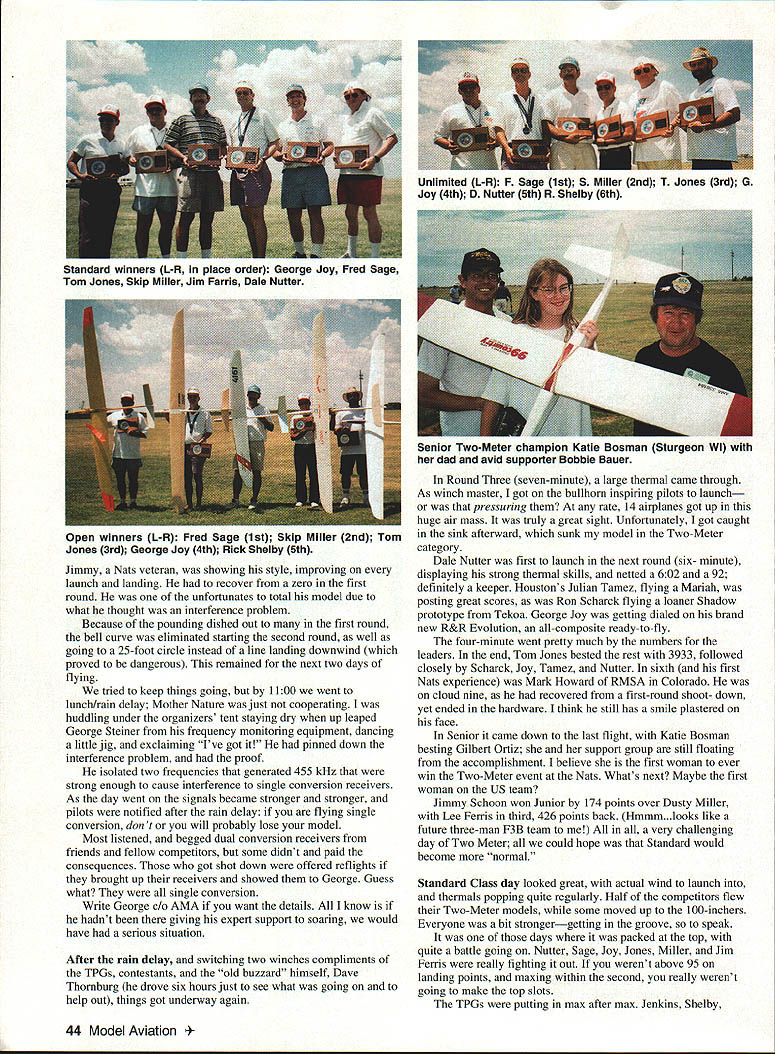
The four-minute went pretty much by the numbers for the leaders. In the end, Tom Jones bested the rest with 3,933, followed closely by Scharck, Joy, Tamez, and Nutter. In sixth (and his first Nats experience) was Mark Howard of RMSA in Colorado. He was on cloud nine, as he had recovered from a first-round shoot-down, yet ended in the hardware.
In Senior it came down to the last flight, with Katie Bosman besting Gilbert Ortiz; she and her support group are still floating from the accomplishment. I believe she is the first woman to ever win the Two‑Meter event at the Nats.
Jimmy Schoon won Junior by 174 points over Dusty Miller, with Lee Ferris in third, 246 points back.
Two‑Meter — Top Results
- Overall: 1st — Tom Jones (3,933), 2nd — Ron Scharck, 3rd — George Joy, 4th — Julian Tamez, 5th — Dale Nutter, 6th — Mark Howard.
- Senior: 1st — Katie Bosman, 2nd — Gilbert Ortiz.
- Junior: 1st — Jimmy Schoon, 2nd — Dusty Miller, 3rd — Lee Ferris.
Standard Class
Standard Class day looked great, with actual wind to launch into, and thermals popping quite regularly. Half of the competitors flew their Two‑Meter models, while some moved up to the 100‑inchers. Everyone was a bit stronger—getting into the groove, so to speak.
It was one of those days where it was packed at the top, with quite a battle going on. Nutter, Sage, Joy, Jones, Miller, and Jim Ferris were really fighting it out. If you weren't above 95 on landing points, and maxing within the second, you really weren't going to make the top slots.
The TPGs were putting in max after max. Jenkins, Shelby, Sage, Joy, Jones, Miller, and Jim Ferris were really fighting it out. Scharck and Dee Thompson were putting in high-quality flights time after time. In Junior, Dusty Miller, Jimmy Schoon, and Lee Ferris were also going at it. The only secure flier was Gilbert Ortiz, who was doing some excellent flying, but had no Seniors to compete with.
George Joy won, flying his Evolution, followed by Fred Sage with his own design. Tom Jones was third with his Super V Two‑Meter, and I was fourth with an Airtronics Falcon 600. Jim Ferris reeled in fifth with his Spirit. To give you an idea of how immaculate George Joy's flying was, only a scant 25 points (out of 4,000) separated first from fourth—and my worst landing was a 92!
In Junior it was even tighter. Jimmy Schoon outpaced Dusty Miller by two points! That's less than a second of time difference. Lee Ferris was third, 145 points back. If these kids flew against the adults, they would have been seventh, eighth, and 13th overall. In Senior, Ortiz won the trophy, and would have been 16th overall.
I could see some strong rivalry brewing between Joy and Sage; after all, only six points separated those two.
Standard Class — Top Results
- Overall: 1st — George Joy, 2nd — Fred Sage, 3rd — Tom Jones, 4th — Skip Miller, 5th — Jim Ferris.
- Senior: 1st — Gilbert Ortiz.
Unlimited
Unlimited began with no typical patterns other than medium wind. Air proved to be quite tricky, with many of the top pilots taking hits in the early rounds. This day belonged to Fred Sage from start to finish; he was the only pilot with no throwaway.
I'd like to say there was no competition on the field, but with local favorite Tom Jones in the hunt; two former US Team members (Nutter and myself); along with Joy and Rick Shelby really starting to hit stride, Fred really won Unlimited with his original V‑tailed design. He was relentless.
Going into the last round, Tom Jones and I were tied. I ended up second, keeping my string of second-place finishes in Unlimited going for my last three Nationals. Tom Jones finished third, followed by Joy, Nutter, Shelby, and Steve Stricklett.
In Senior, the competition was won by Ortiz. In Junior, turnabout would become fair play, with it being settled in the final landing. Dusty Miller (flying a Thermal Eagle) won by 254 points over Schoon (flying a clipped‑wing Falcon).
Unlimited — Top Results
- Overall: 1st — Fred Sage, 2nd — Skip Miller, 3rd — Tom Jones, followed by George Joy, Dale Nutter, Rick Shelby, Steve Stricklett.
- Senior: 1st — Gilbert Ortiz.
- Junior: 1st — Dusty Miller, 2nd — Jimmy Schoon.
Overall and Awards
The all-important Lee Renaud Memorial trophy (Two‑Meter, Standard, and Unlimited scores added together) went deservedly to Tom Jones, who demonstrated the necessary consistency over three days.
Overall top five (Lee Renaud Memorial):
- Tom Jones
- George Joy
- Fred Sage
- Skip Miller
- Dale Nutter
Other awards and team honors:
- Dan Pruss Memorial Team Trophy: Torrey Pines Gulls (TPGs) — they ran the competition from start to finish and set the flying standard.
- Hi Johnson Award: George J. Joy.
- Senior: Gilbert Ortiz first, Katie Bosman second.
- Junior: Dusty Miller first overall, slipping ahead of Jimmy Schoon by a scant 77 points out of 12,000; Lee Ferris placed third.
My personal award for dedication above and beyond the call of duty goes to George and Jo Joy, who really made it all happen, along with the rest of their TPG contingent. The Torrey Gulls should be quite proud to have such dedicated individuals represented so well in organizing the event. The soaring portion of the Nats would not have occurred without them! On behalf of all the competitors, our soaring wing is tipped to you.
Of course, a big thanks goes to the AMA for providing the best soaring site of the last four years, complete with full-service concessions. For those of you who didn't attend, you really missed it!
Transcribed from original scans by AI. Minor OCR errors may remain.

