
RADIO CONTROL Soaring
Daryl Perkins, 940 Baird Rd., Santa Rosa, CA 95409
Slope flying
Hi, everyone. I just got back from the slope and, honestly, the conditions were marginal. Wil Byers writes the Slope column and I try not to infringe on his expertise, but I really love to slope fly.
We have a slope here in Santa Rosa that we kind of share with the cows. It doesn't face directly into the wind, but the landowner likes us, which basically means he doesn't mind our tramping around on his property. The most interesting thing about this slope is that it is often more like ridge-assisted thermal flying than pure sloping: you can be cruising the face and then suddenly encounter sink because thermals are forming somewhere in front of the hill.
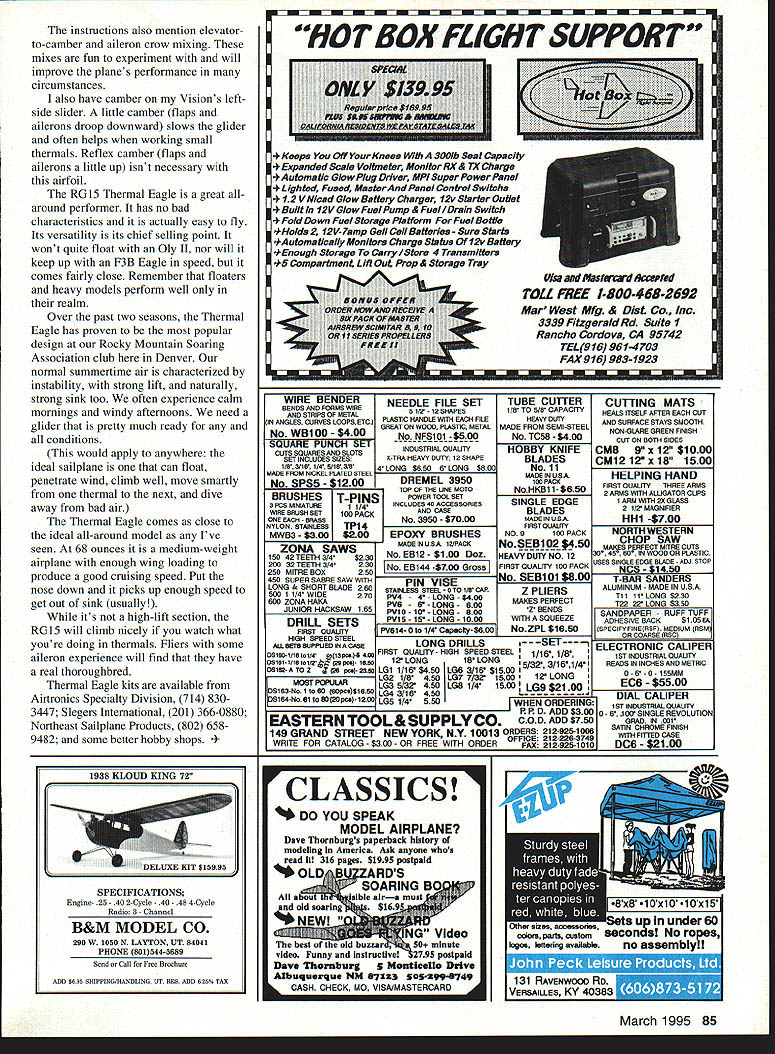
Anyone can fly when the ridge is pumping, but you learn more about your abilities and your sailplane's capabilities in mediocre conditions. I do most of my test flying in this kind of air because it gives me a real feel for each model. Recently, Mike Popescu of Inventec Corp. sent his new sailplane, the Esteem, for me to test.
Inventec Esteem
I am not easily impressed with any model — I've been spoiled by flying the all-molded F3B Eagle and my Maverick, which are truly world-class. That said, I was very impressed with the Esteem's flight performance and handling. The SD7080 airfoil is an excellent choice for a thermal-duration model: the Esteem climbs in the lightest lift and cruises efficiently between small thermals. I was surprised by the wide speed range of this airfoil; I liked it so much I had a prototype wing made from obechi for my Maverick.
My one criticism is balance: I am a center-of-gravity (CG) connoisseur and the performance of a good sailplane can be ruined by a less-than-optimal CG. With the prototype I had to tape $2.25 in quarters to the very long tailboom to reach the correct CG. (I understand Mike has since addressed this on the plans.)
Availability:
- Ed Slegers, Slegers International: (201) 366-0880
- Northeast Sailplane Products: (802) 658-9482
Thermal Eagle (Airtronics)
Byron Blakeslee provided the write-up on Airtronics' Thermal Eagle.
Overview The Thermal Eagle is a Mark Allen–designed Open Class thermal-duration competition model with flaps and ailerons. It uses four servos in the wings, so a computer radio such as an Airtronics Vision, JR X-3885, or Futaba 9ZAP is recommended. D/P is necessary.
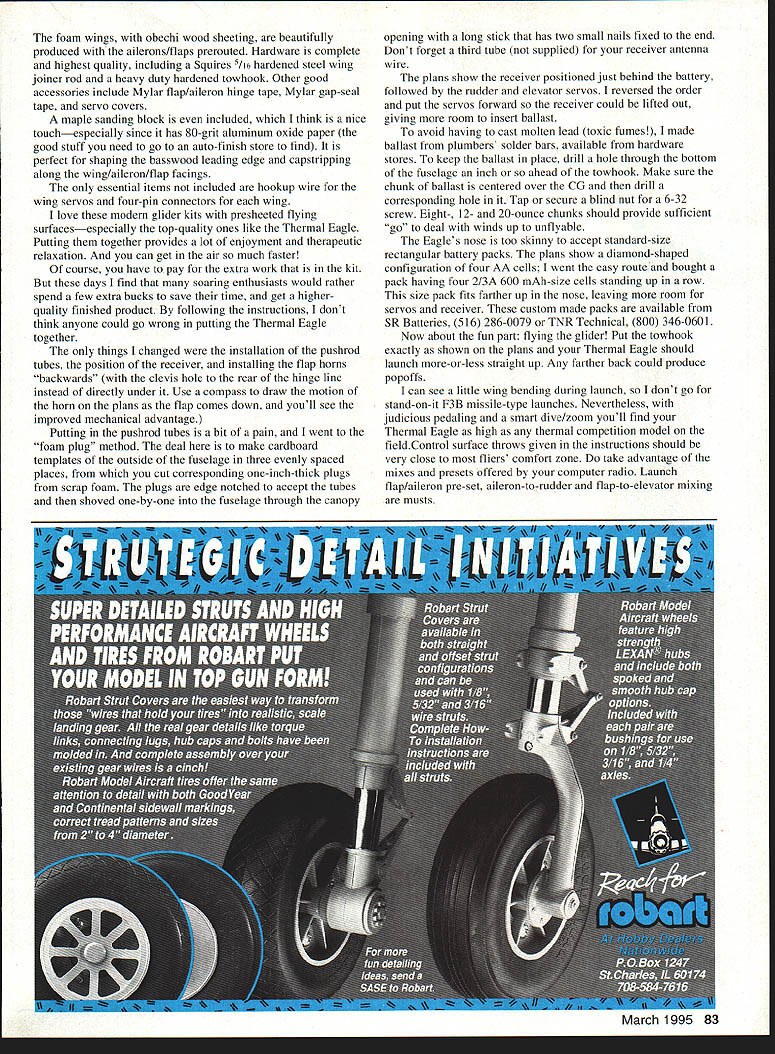
The Thermal Eagle descends from Mark's successful F3B Eagle and uses the same ultra-slim fiberglass fuselage. Key specs:
- Wingspan: 118 inches
- Wing area: 915 sq. in.
- Flying weight: 68 ounces
- Wing loading: 10.6 oz./sq. ft.
Kits and price Kits come with obechi presheeted wings and stabs; the rudder is built-up balsa construction. The kit price is $400.
Airfoil history and characteristics My first Thermal Eagle was an early kit that used the SD8000 airfoil: 8.9% thickness with 1.7% camber. Like the SD7003 used on the original F3B Eagle (they now use the RG15), SD8000 likes to go fast. In straight flight it cruised well, but I had trouble keeping it fast enough in thermal turns — if the speed bled off it would lose energy quickly.
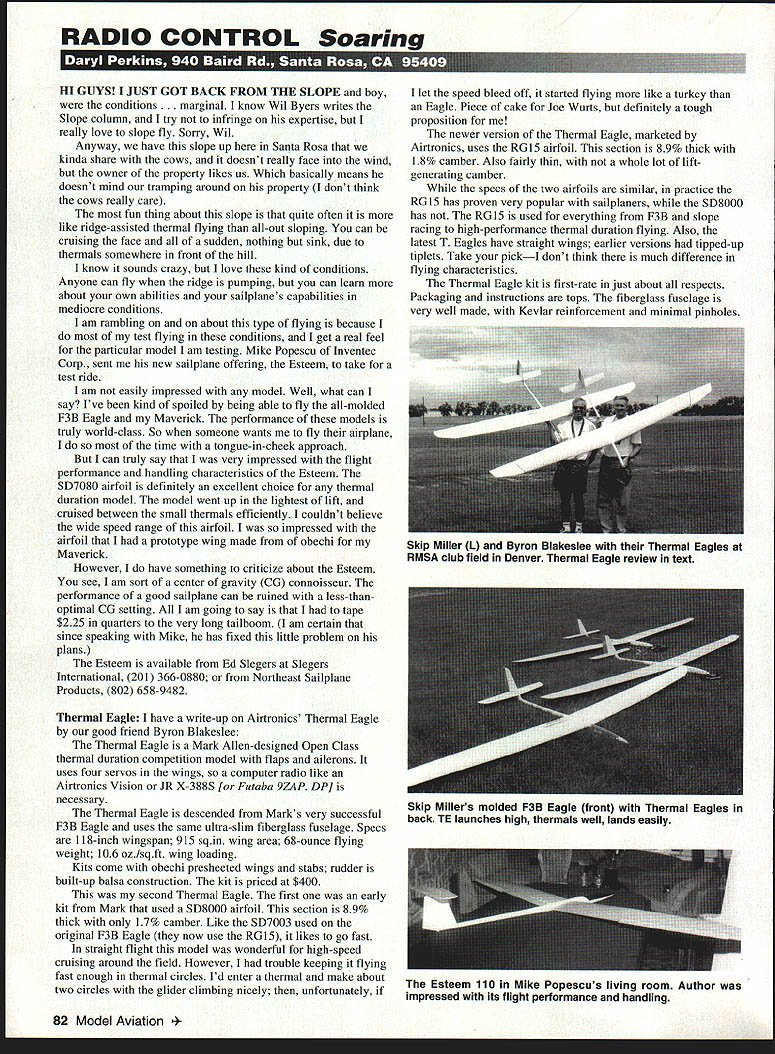
The newer Thermal Eagle marketed by Airtronics uses the RG15 airfoil (8.9% thick, 1.8% camber). While similar on paper, the RG15 has proven very popular: it is used from F3B and slope racing to high-performance thermal-duration flying. The latest Thermal Eagles have straight wings; earlier versions had tipped-up tiplets. In practice, there's not much difference in flying characteristics.
Kit quality and included hardware The Thermal Eagle kit is first-rate. Packaging and instructions are excellent. The fiberglass fuselage is well made, with Kevlar reinforcement and minimal pinholes. Foam wings with obechi wood sheeting are beautifully produced, with ailerons and flaps prerouted. Hardware is complete and high quality, including:
- Squires 1/16" hardened steel wing joiner rod
- Heavy-duty hardened tow hook
- Mylar flap/aileron hinge tape and gap-seal tape
- Servo covers
A maple sanding block is included with 80-grit aluminum-oxide paper — a nice touch for shaping the basswood leading edge and capstriping. The only essential items not included are hookup wire for the wing servos and four-pin connectors for each wing.
Why presheeted surfaces are nice Modern glider kits with presheeted flying surfaces save time and produce a higher-quality finish. Many fliers prefer paying a bit more for the convenience and superior result. By following the instructions, most people should assemble the Thermal Eagle without problems.
Builder modifications and tips The only changes I made were:
- Installation of pushrod tubes (I used the foam-plug method)
- Repositioning the receiver so it can be lifted out more easily
- Installing the flap horns "backwards" (clevis hole to the rear of the hinge line) to improve mechanical advantage
Foam-plug method for pushrod tubes:
- Make cardboard templates of the fuselage outside at three evenly spaced stations.
- Cut corresponding 1-inch-thick plugs from scrap foam.
- Edge-notch the plugs to accept the tubes and push them into the fuselage through the canopy opening with a long stick that has two small nails fixed to the end.
Don't forget a third tube (not supplied) for the receiver antenna wire.
Receiver and ballast The plans show the receiver positioned just behind the battery, followed by the rudder and elevator servos. I reversed the order and put the servos forward so the receiver could be lifted out, giving more room to insert ballast.
To avoid casting molten lead, I made ballast from plumbers' solder bars available at hardware stores. To secure the ballast:
- Drill a hole through the bottom of the fuselage about 1/2 inch ahead of the tow hook.
- Ensure the ballast chunk is centered over the CG and drill a corresponding hole through it.
- Tap or secure a blind nut for a 6-32 screw.
Eight-, 12-, and 20-ounce chunks provide sufficient ballast to handle various wind conditions.
Battery pack The Eagle's nose is too narrow for standard rectangular battery packs. The plans show a diamond-shaped configuration of four AA cells; I bought a pack of four 2/3A 600 mAh cells standing in a row. This pack fits farther back in the nose, leaving room for servos and the receiver. Custom packs are available from:
- SR Batteries: (516) 286-0709
- TNR Technical: (800) 346-0601
Flying the Thermal Eagle
- Install the tow hook exactly as shown on the plans for a straight tow. Any farther back could produce pop-offs.
- I avoid stand-on-it F3B-style launches because I can see a little wing bending during launch. With judicious peaking and a smart dive/zoom you'll get the Thermal Eagle as high as other thermal competition models.
- Use the control-surface throws recommended in the instructions as a starting point.
- Take advantage of mixes and presets on a computer radio: launch flap/aileron preset, aileron-to-rudder, and flap-to-elevator mixes are essential. The instructions also suggest elevator-to-camber and aileron crow mixes; these are useful to experiment with.
- I use camber on my Vision's left-side slider: a little camber (flaps and ailerons drooped) helps when working small thermals. Reflex camber (flaps and ailerons a little up) isn't necessary with this airfoil.
Performance and suitability The RG15 Thermal Eagle is a great all-around performer with no bad characteristics and is relatively easy to fly. It won't quite float like an Oly II nor will it match the F3B Eagle top speed, but it comes close. At 68 ounces it is a medium-weight sailplane with enough wing loading for good cruising speed; it penetrates wind and picks up speed to escape sink.
Our Rocky Mountain Soaring Association club in Denver has found the Thermal Eagle to be the most popular design over the past two seasons. Our summertime air is characterized by instability with strong lift and sink, and we often have calm mornings and windy afternoons. We need a glider ready for varied conditions; the Thermal Eagle comes as close to an ideal all-around model as any I've seen.
Where to buy Thermal Eagle kits
- Airtronics Specialty Division: (714) 830-3447
- Slegers International: (201) 366-0880
- Northeast Sailplane Products: (802) 658-9482
- Some better hobby shops
Transcribed from original scans by AI. Minor OCR errors may remain.

