
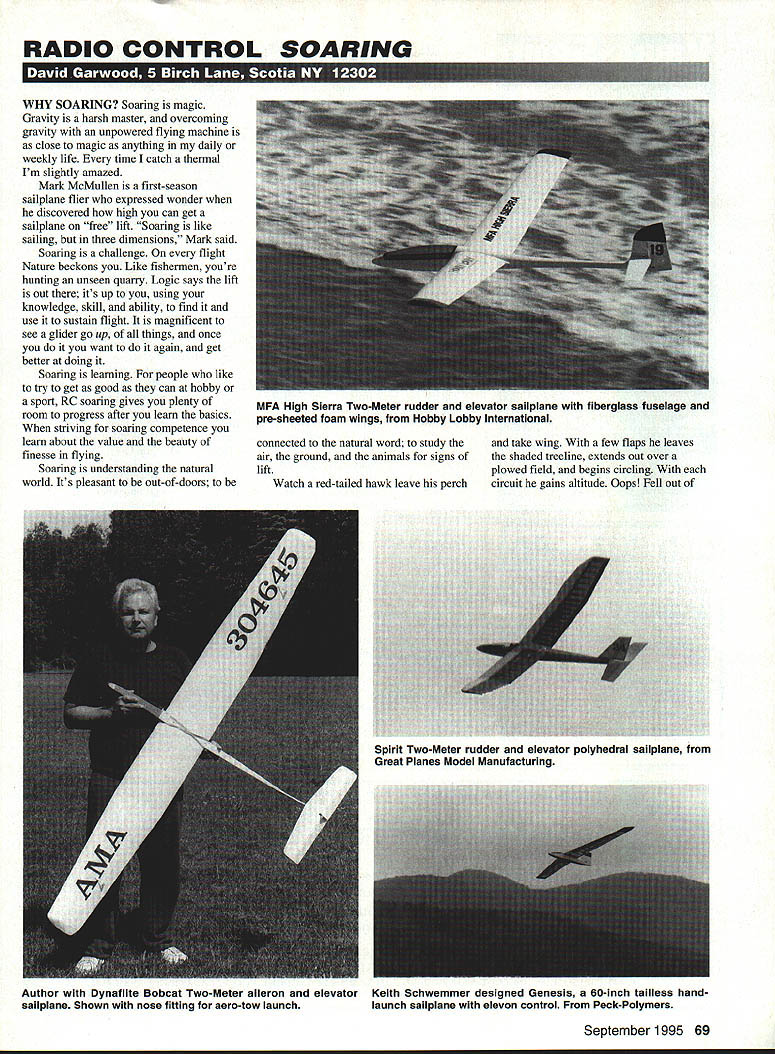
RADIO CONTROL: SOARING
David Garwood 5 Birch Lane, Scotia, NY 12302
Why Soaring?
- Soaring is magic.
Gravity is a harsh master, and overcoming gravity with an unpowered flying machine is as close to magic as anything in my daily or weekly life. Every time I catch a thermal I'm slightly amazed.
- Soaring is a challenge.
On every flight nature beckons you. Like fishermen, you're hunting an unseen quarry. Logic says the lift is out there; it's up to you, using your knowledge, skill, and ability, to find it and use it to sustain flight. It is magnificent to see a glider go up, of all things, and once you do it you want to do it again—and get better at doing it.
- Soaring is learning.
For people who like to improve at a hobby or sport, RC soaring offers plenty of room to progress after you learn the basics. In striving for competence you learn the value and beauty of finesse in flying.
- Soaring is understanding the natural world.
It's pleasant to be outdoors; to be connected to the natural world; to study the air, the ground, and the animals for signs of lift.
Watch a red-tailed hawk leave his perch and take wing. With a few flaps he leaves the shaded treeline, extends out over a plowed field, and begins circling. With each circuit he gains altitude. Oops—fell out of lift. A few flaps get him back to the center of the thermal. Now up, up, circling tightly, climbing confidently. Soon the sailplane tucks its wings slightly and races toward the horizon, maybe looking for the next thermal. RC sailplane pilots borrow a hawk's flight plan and attempt to emulate that achievement.
How Soaring Changes Life
Soaring has a way of changing your life and your hobbies. In the few years since discovering soaring I've stopped changing hobbies. RC soaring has taken precedence over other types of modeling and other interests — model building and flying, old-car repair, police-patch collecting, darts, computers, and even full-size aviation. Unfortunately for the rest of the family, it's also taken the edge off home repairs. I've learned a lot about soaring.
Bob Powers, who flew fuel-powered Scale Pattern for 20 years, discovered soaring five years ago. An officer of the fuel-power club, he now flies 50 days of soaring a year. At the flying field last spring I asked Bob what about soaring keeps us interested. "Thermal flying is like golf," he said. "You can get good, but you can never master it. The soaring task is easy to understand but difficult to perform to the proficiency you'd like to have. Just because you've played a par-four hole before doesn't mean you can do it in four every time."
Why It's Compelling
Soaring is compelling for several reasons. First, they're airplanes—people have always been fascinated by things that fly. Second, it's a constant challenge. In powered flight, once you get to know the plane, each flight can feel much the same; soaring is different. Some days there's lift everywhere; some days there's nothing but sink. Some days thermal tops are clearly marked by puffy cumulus clouds; other days stratus clouds indicate little vertical development in the atmosphere and you must fly smoother to make use of tiny pockets of weak lift. You can soar in weather that really makes you feel like you're the pilot.
My Background
Like many modelers, I started with rubber-powered models in elementary school, plastic control-line models that barely flew in junior high, and balsa control-line models in high school. I flew CL Stunt and CL Combat for years. In adult life, seven years ago I first tried radio control. I taught myself to fly a Carl Goldberg Electra, flew powered models, and soon discovered gliders.
I've built and flown 36 RC models, 31 of them sailplanes. I've flown a sailplane every month for the last six years, and have flown sailplanes in seven states, both sides of the Mississippi. I hope to fly in 50 states before I'm done.
Five years ago I went to a thermal contest and quickly became bitten by the thermal-competition bug. I'm a solid middle-of-the-pack thermal-duration pilot, finishing first once five years ago. I'm a League of Silent Flight aspirant, currently working on Level IV. I have crewed on the TeamEast F3B team, and competed at the 1992 AMA Nationals and the World Soaring Jamboree.
Starting with the House of Balsa Two-by-Four, and progressing through longer wings, more servos, stronger construction, and more advanced radios, I'm flying an Airtronics Peregrine in the 1995 contest season in New York and New England.
What This Column Will Do
I believe the columnist's job is to bring you information that you would likely not get from another source. I will have done my job if you learn something useful about soaring from each column, and if I'm interesting to read as well, so much the better.
If you have seen the likes of Joe Wurts, Larry Jolly, or Daryl Perkins fly thermal duration, you've seen soaring at the highest level. If you have helped a sailplane newcomer learn to take a stall on hand launch, you've been reminded of your own first thermal. There is room in the sport for all skill levels.
If you have flown in a contest, you've experienced the extra edge that competition adds to your flying skills. If you have hand-launched into a thermal and climbed the sailplane until it was almost too small to see, you've broken the world's widest grin at triumphing over gravity with skill, experience, and a bag of balsa.
I'll try to keep you in touch with the extremes of this rich spectrum, and also cover that vast middle ground occupied by RC soaring buffs who want to learn how to find thermals a little better, who appreciate knowing about a successful construction technique, and who are interested in new sailplane designs and technical advances that make thermal soaring more interesting, more relaxing, or more successful.
It's impossible to say which is the most enjoyable or the most important part of RC soaring. Reader surveys tell us that sport flying is the most common practice of model aviation, so we shall pay much attention to airplanes and equipment that make sailplanes fun to fly. Competition improves the breed and sharpens the edge of your soaring skill like no other learning method, so we'll try to learn what we can from club contests and national contests.
If we can learn from it, I'm interested in finding out about it and writing about it. After this introduction I'll write about methods of successful soaring clubs, and about preparing a basic sailplane for competition flying. After that, I hope to hear from readers and to be guided by their input to further shape the direction of this column. Please write and say what you're interested in reading about. If you'd like a reply to your letter, please enclose an SASE.
To paraphrase the fisherman's expression, "A bad day of soaring is better than a good day at work."
Transcribed from original scans by AI. Minor OCR errors may remain.

