
RADIO CONTROL: SOARING
David Garwood 5 Birch Lane, Scotia, NY 12302
You're thinking about entering a contest, and you're wondering what you need to do to prepare your sailplane for competition. Should you build the spoiler option? What about wheels and skegs?
This column discusses performance improvements for thermal-duration sailplanes, with an emphasis on building and preparing a sailplane for your first contest. Even glider pilots who never fly in contests can benefit from these modifications and construction choices.
If you launch higher, you'll have more time to find thermals. All of these tips will work whether you launch with a hi-start or a winch.
1. Stronger Fuselage
Most sailplanes need nose weight to balance at the center of gravity (CG), and there are few models that cannot benefit from fuselage strengthening forward of the wing. As long as you're adding weight to the nose, the weight may as well add strength.
My technique is to add a layer of light fiberglass cloth to the inside of the fuselage, from the nose back to the leading-edge location. In a wooden model use cyanoacrylate (CyA) glue to fix the cloth in place; in a fiberglass model use epoxy resin. For even more toughness, add a second layer of fiberglass cloth from the nose back to the wing's trailing-edge line. A stronger fuselage will tolerate rougher landings and will last longer. If you can land more precisely, you can fly from smaller fields.
2. Bolt-On Wing
You can increase a sailplane's flying speed and flatten its glide by reducing drag. The wing's rubber-band pegs stick out into the slipstream, creating drag. Eliminate the rubber bands and attach the wing with nylon bolts to reduce drag and to give a more positive mount in an accident.
Some kits provide the option of attaching the wing with nylon bolts rather than rubber bands; if yours doesn't, consult an experienced modeler or study other models to help design a bolt-on wing mount.
3. Spoilers
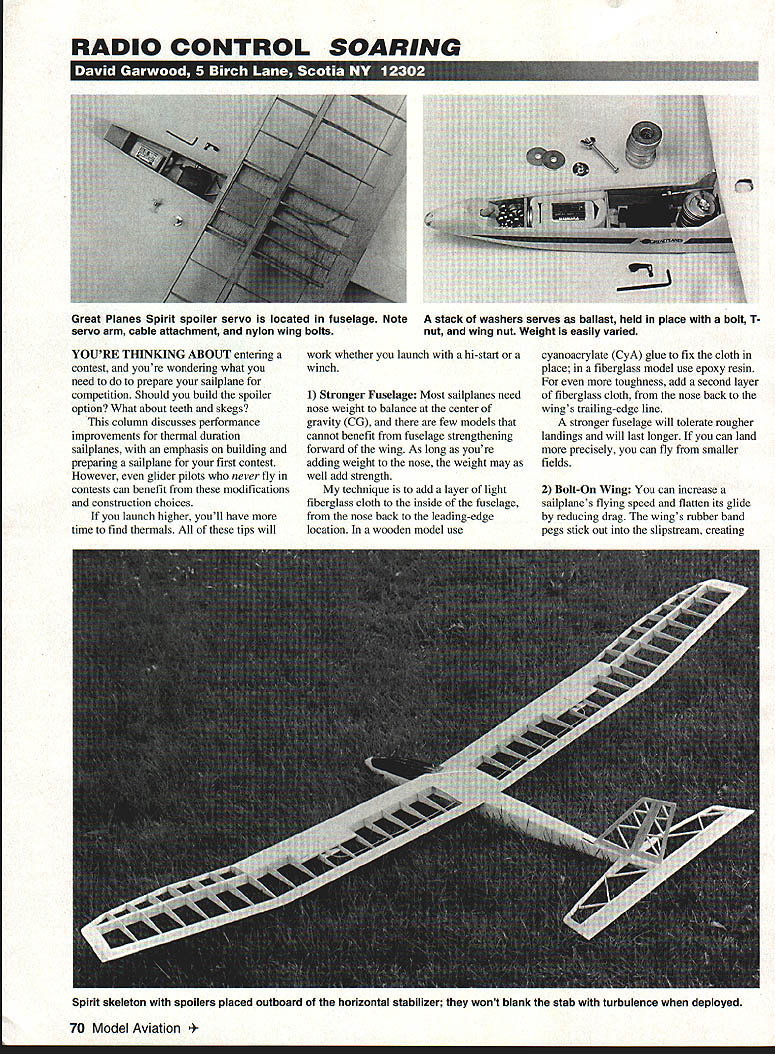
During landing sailplanes often have too much lift and want to dump the excess lift to get the glider to settle on the landing spot. Pointing the nose down increases speed and requires skill. Spoilers act like brakes, slowing the airplane and giving the pilot greater control over the sailplane's rate of descent, greatly improving spot-landing accuracy.
Spoilers deploy to spoil lift over a portion of the wingspan; the sailplane flies like it has a shorter wingspan and the sink rate increases. Raised spoilers tend to make the airplane pitch down; elevator compensation is needed to maintain smooth flight. It takes time to install spoilers, but improved landings are worth the effort.
I use Sullivan 507 Gold-N-Rod control cables instead of string to connect spoilers. A third servo in the fuselage cable allows the servo to open and close spoilers; the string-pull method requires springs or rubber bands to retract the spoiler blades.
4. Tow Hook Position
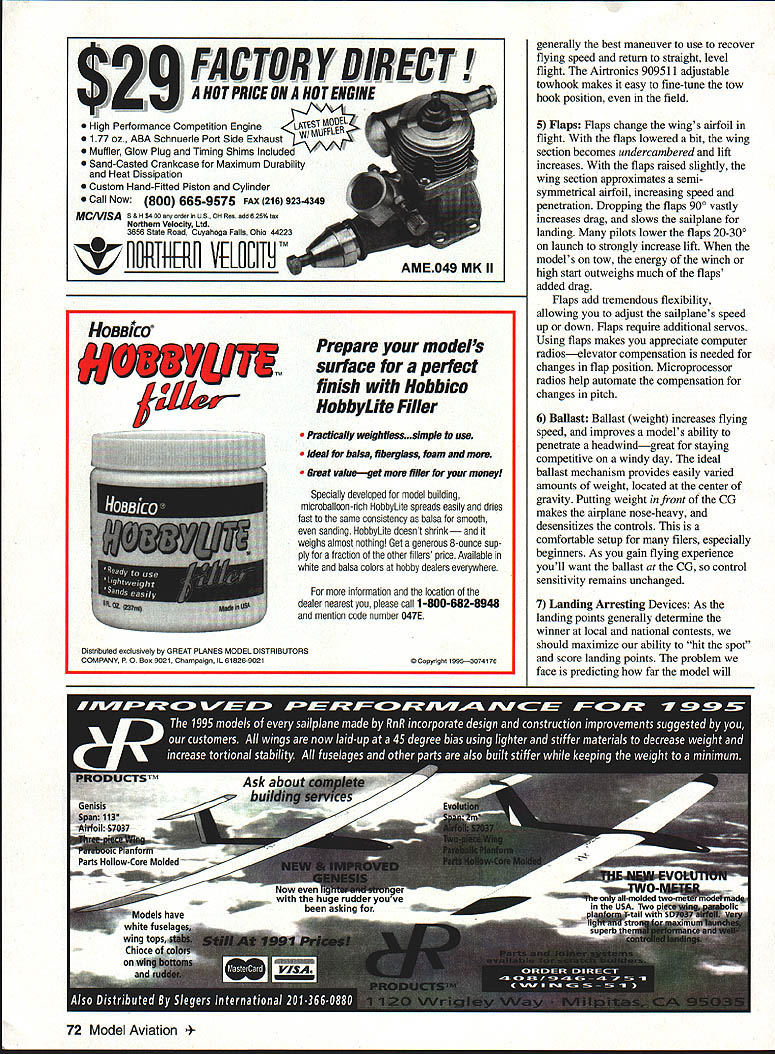
Moving the tow hook position farther back will give a steeper launch. A steeper launch provides a higher sailplane release. The problem is moving the tow hook back too far makes the model wildly sensitive to the tow and increases the chances it will pop off and leave the tow line prematurely.
A trick is to move the tow hook back in small increments, perhaps 1/4 inch at a time, and observe the launch performance change. As the hook moves rearward the climb will become steeper; when the model will no longer tow straight and a back-stick causes a popoff, it's time to stop experimenting and move the hook forward a little.
When you experience a popoff, a loop is generally the best maneuver to recover flying speed and return to straight, level flight. The Airtronics 909511 adjustable tow hook makes it easy to fine-tune the tow hook position, even in the field.
5. Flaps
Flaps change the wing's airfoil in flight. With the flaps lowered a bit, the wing section becomes undercambered and lift increases. With the flaps raised slightly, the wing section approximates a semi-symmetrical airfoil, increasing speed and penetration. Dropping the flaps 90° vastly increases drag and slows the sailplane for landing.
Many pilots lower the flaps 20–30° on launch to strongly increase lift. When the model is on tow, the energy of the winch or hi-start outweighs much of the flaps' added drag.
Flaps add tremendous flexibility, allowing you to adjust the sailplane's speed up or down. Flaps require additional servos. Using flaps makes you appreciate computer radios—elevator compensation is needed for changes in flap position. Microprocessor radios help automate the compensation for changes in pitch.
6. Ballast
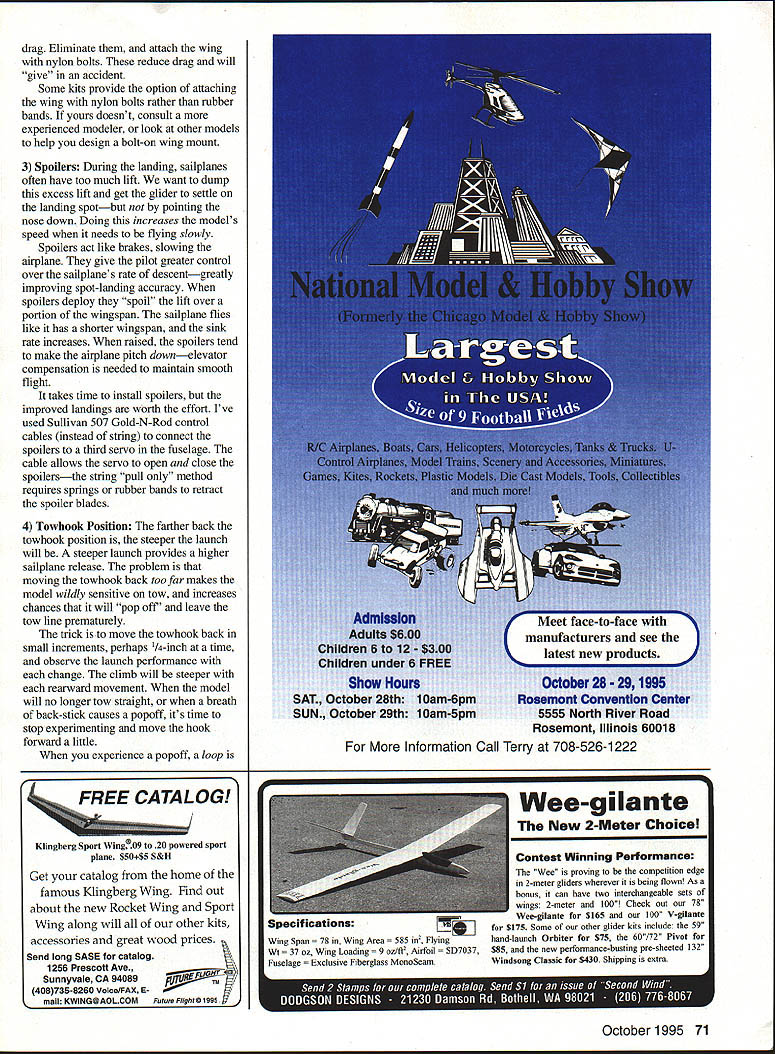
Ballast (weight) increases flying speed and improves a model's ability to penetrate a headwind—great for staying competitive on a windy day. The ideal ballast mechanism provides easily varied amounts of weight, located at the center of gravity.
Putting weight in front of the CG makes the airplane nose-heavy and desensitizes the controls. This is a comfortable setup for many fliers, especially beginners. As you gain flying experience you'll want the ballast at the CG so control sensitivity remains unchanged.
7. Landing Arresting Devices
Landing points generally determine the winner at local and national contests, so we should maximize our ability to "hit the spot" and score landing points. The problem we face is predicting how far the model will slide after touchdown. This distance will change during the day as dew evaporates and grass dries.
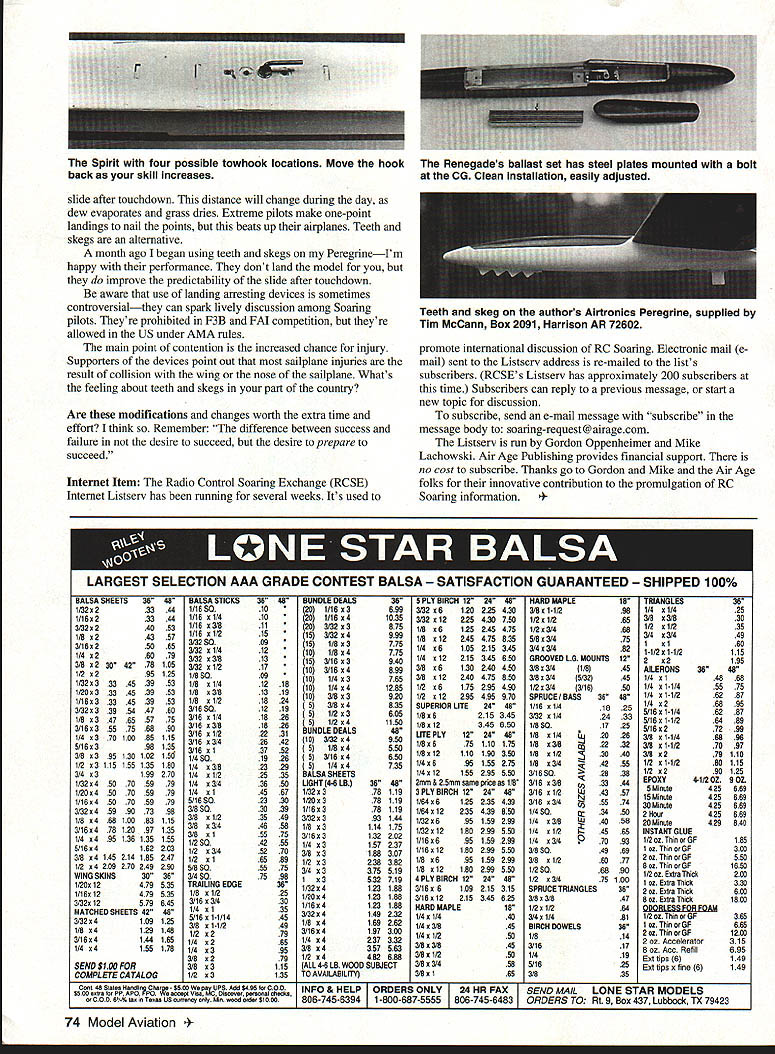
Extreme pilots make one-point landings to nail the points, but this beats up their airplanes. Teeth and skegs are an alternative.
A month ago I began using teeth and skegs on my Peregrine—I'm happy with their performance. They don't land the model for you, but they do improve the predictability of the slide after touchdown.
Be aware that use of landing arresting devices is sometimes controversial—they can spark lively discussion among soaring pilots. They're prohibited in F3B and FAI competition, but they're allowed in the U.S. under AMA rules.
The main point of contention is the increased chance for injury. Supporters of the devices point out that most sailplane injuries result from collision with the wing or nose of the sailplane. What's the feeling about teeth and skegs in your part of the country?
Are these modifications and changes worth the extra time and effort? I think so. Remember: "The difference between success and failure is not the desire to succeed, but the desire to prepare to succeed."
Internet Item
The Radio Control Soaring Exchange (RCSE) Internet Listserv has been running for several weeks. It's used to promote international discussion of RC soaring. Electronic mail (e-mail) sent to the Listserv address is re-mailed to the list's subscribers. RCSE's Listserv has approximately 200 subscribers at this time. Subscribers can reply to a previous message or start a new topic for discussion.
To subscribe, send an e-mail message with the single word "subscribe" in the message body to: soaring-request@airage.com
The Listserv is run by Gordon Oppenheimer and Mike Lachowski. Air Age Publishing provides financial support. There is no cost to subscribe. Thanks go to Gordon and Mike and the Air Age folks for their innovative contribution to the dissemination of RC soaring information.
Transcribed from original scans by AI. Minor OCR errors may remain.

