
Radio Control: Soaring
Dave Garwood, 5 Birch Lane, Scotia NY 12302
THE LARGEST Soaring Nationals in recent years was held July 29–August 5 at the AMA National Flying Site in Muncie, Indiana. The AMA site, the LSF contest management, the volunteer workers, and the enthusiastic participation of 154 contestants from 32 states made for an impressive and enjoyable event.
This was the first time that the AMA and LSF national soaring competitions were combined, which worked well in my observation. In recent years separate AMA and LSF Nats were held at almost the same time in nearby locations, which tended to split the national pool of soaring pilots and created two smaller events. This year the Academy, the League of Silent Flight, and the National Soaring Society combined energies into a single national competition.
The introduction of man-on-man competition into all events and organization from outside the AMA by a soaring group were innovations. I heard no complaints about the LSF management of the AMA Nats, and I believe the AMA and NSS were happy to have the LSF participation.
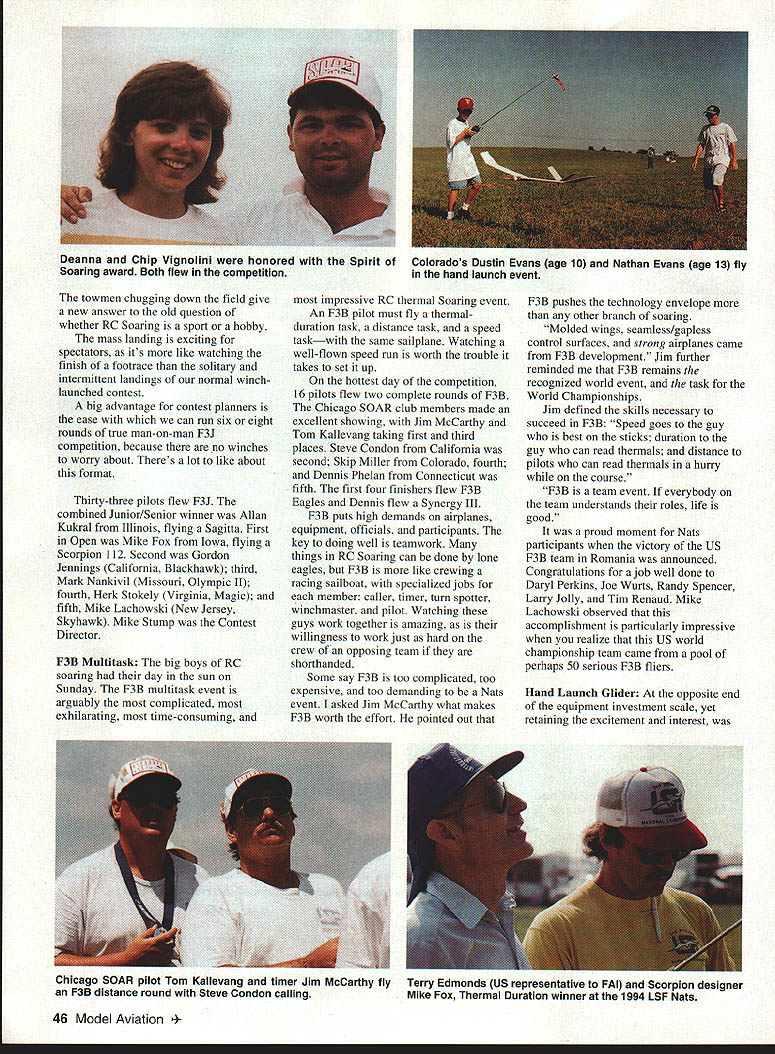
Weather was a factor, with hot and humid conditions every day; the high temperature Sunday reached 102°. Winds were calm most mornings, rising to 5–8 mph from the southwest most days. Thunderstorms ended flying early on Thursday, and steady rains from the edge of Hurricane Erin shut down flying the last two days of the contest.
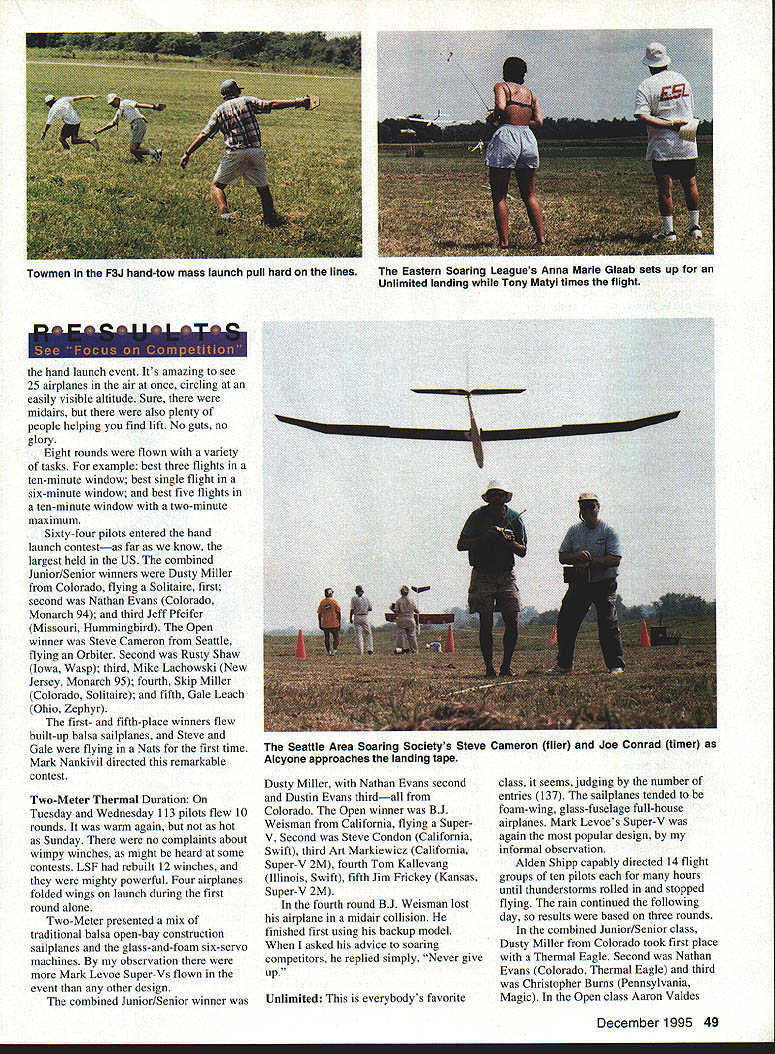
Standard class was not flown this year, while the Two-Meter and Unlimited classes were scheduled for two days each to allow the anticipated number of fliers to fly more than just a few rounds. The feeling was that a champion should be determined in an eight-to-twelve-round contest. We also flew F3B, F3J, and two distinct forms of HLG.
F3J Hand-Tow
Competition opened Saturday, July 29 with a bit of British culture imported into the United States. F3J hand-tow pits three-man teams (pilot, timer, and runner) against each other in a thermal-duration contest. The event differs dramatically from our traditional format with the addition of a mass launch and a mass landing. Competitors are given a 10-minute window to score a single long flight, and they must land before the end of the round for any score to count. Landing bonus points are added, and relaunches are allowed.
A mass launch of 10 sailplanes is something to see, as it adds intensity and excitement to the beginning of the round.
F3B
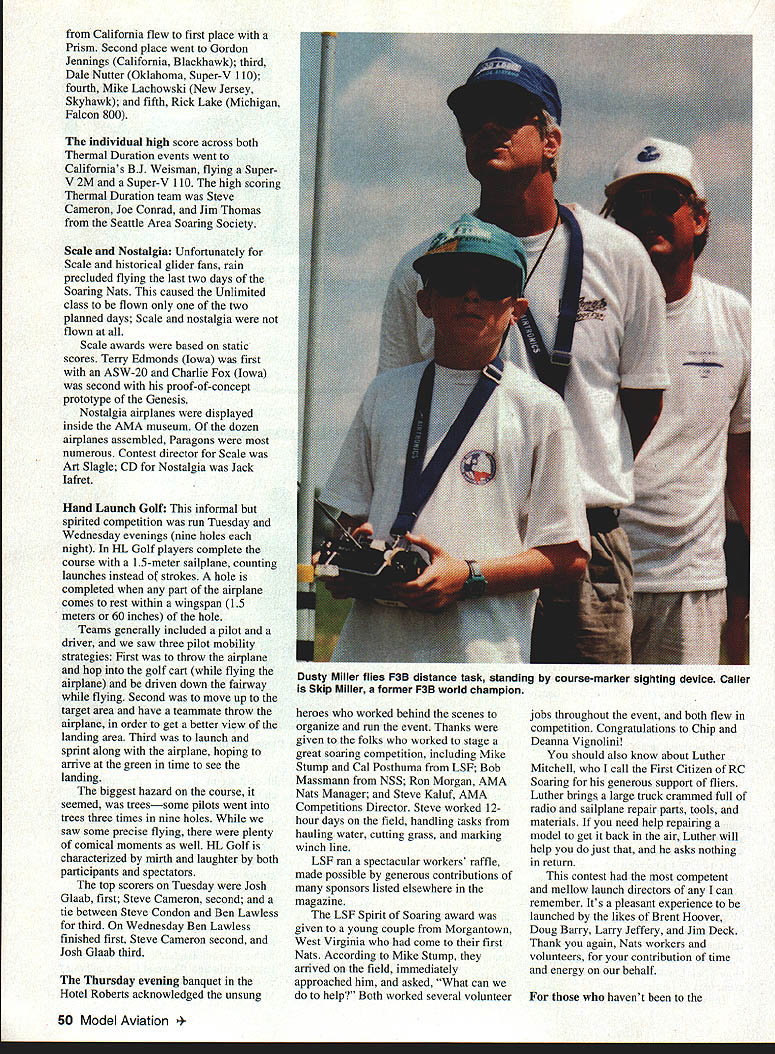
Multitask big boys — on Sunday the F3B multitask event, arguably the most complicated, exhilarating, time-consuming and impressive RC thermal-soaring event, was flown. An F3B pilot must fly a thermal-duration task, a distance task, and a speed task with the same sailplane. Watching a well-flown speed run is worth the trouble; it takes set-up. On the hottest day of the competition, 16 pilots flew two complete rounds.
Chicago SOAR club members made an excellent showing:
- Jim McCarthy — 1st
- Steve Condon (California) — 2nd
- Tom Kallevang — 3rd
- Skip Miller (Colorado) — 4th
- Dennis Phelan (Connecticut) — 5th
The first four finishers flew F3B Eagles; Dennis flew a Synergy III.
F3B puts high demands on airplanes, equipment, officials and participants. Key to doing well is teamwork — things in RC soaring can be done by lone eagles, but F3B is like crewing a racing sailboat with specialized jobs: member, caller, timer, turn spotter, winchmaster and pilot. Watching guys work together — the amazing willingness to work just as hard for a crew when the opposing team is shorthanded — was notable.
Some say F3B is too complicated, too expensive, too demanding. At the Nats we asked Jim McCarthy what makes F3B worth the effort; he pointed out that F3B pushes the technology envelope for other branches of soaring. Molded wings, seamless/gapless control surfaces and strong airplanes came from F3B development. Jim further reminded that F3B remains a recognized world event; the task is the World Championships. Jim defined the skills necessary to succeed in F3B: "Speed goes to the guy who is best on the sticks; duration to the guy who can read thermals; and distance to pilots who can read thermals in a hurry while on the course."
"F3B is a team event. If everybody on the team understands their roles, life is good."
It was a proud moment for Nats participants when the victory of the US F3B team in Roma was announced. Congratulations for a job well done to Daryl Perkins, Joe Wurts, Randy Spencer, Larry Jolly, and Tim Renaud. Mike Lachowski observed that this accomplishment is particularly impressive when you realize that this US world championship team came from a pool of perhaps 50 serious F3B fliers.
Hand Launch Glider
At the opposite end of the equipment investment scale, yet retaining the excitement and interest, was the hand-launch glider event.
Results
See "Focus on Competition."
The hand-launch event: it's amazing to see 25 airplanes in the air at once, circling at an easily visible altitude. Sure, there were midairs, but there were also plenty of people helping you find lift. No guts, no glory.
Eight rounds were flown with a variety of tasks. For example: best three flights in a ten-minute window; best single flight in a six-minute window; and best five flights in a ten-minute window with a two-minute maximum.
Sixty-four pilots entered the hand-launch contest — as far as we know, the largest held in the US. The combined Junior/Senior winners were:
- 1st: Dusty Miller (Colorado), flying a Solitaire
- 2nd: Nathan Evans (Colorado), Monarch 94
- 3rd: Jeff Pfeifer (Missouri), Hummingbird
Open class:
- 1st: Steve Cameron (Seattle), flying an Orbiter
- 2nd: Rusty Shaw (Iowa), Wasp
- 3rd: Mike Lachowski (New Jersey), Monarch 95
- 4th: Skip Miller (Colorado), Solitaire
- 5th: Gale Leach (Ohio), Zephyr
The first- and fifth-place winners flew built-up balsa sailplanes, and Steve and Gale were flying in a Nats for the first time. Mark Nankivil directed this remarkable contest.
Two-Meter Thermal Duration
On Tuesday and Wednesday 113 pilots flew 10 rounds. It was warm again, but not as hot as Sunday. There were no complaints about wimpy winches, as might be heard at some contests. LSF had rebuilt 12 winches, and they were mighty powerful. Four airplanes folded wings on launch under their first round alone.
Two-Meter presented a mix of traditional balsa open-bay construction sailplanes and the glass-and-foam six-servo machines. By my observation there were more Mark Levee Super-Vs flown in the event than any other design.
Combined Junior/Senior:
- 1st: Dusty Miller
- 2nd: Nathan Evans
- 3rd: Dustin Evans
(all from Colorado)
Open class:
- 1st: B.J. Weisman (California), Super-V
- 2nd: Steve Condon (California), Swift
- 3rd: Art Markiewicz (California), Super-V 2M
- 4th: Tom Kallevang (Illinois), Swift
- 5th: Jim Frickey (Kansas), Super-V 2M
In the fourth round B.J. Weisman lost his airplane in a midair collision. He finished first using his backup model. When I asked his advice to some competitors, he replied simply, "Never give up."
Unlimited
This is everybody's favorite class, it seems, judging by the number of entries (137). The sailplanes tended to be foam-wing, glass-fuselage full-house airplanes. Mark Levee's Super-V was again the most popular design, by my informal observation.
Alden Shipp capably directed 14 flight groups of ten pilots each for many hours until thunderstorms rolled in and stopped flying. The rain continued the following day, so results were based on three rounds.
Combined Junior/Senior:
- 1st: Dusty Miller (Colorado), Thermal Eagle
- 2nd: Nathan Evans (Colorado), Thermal Eagle
- 3rd: Christopher Burns (Pennsylvania), Magic
Open class:
- 1st: Aaron Valdes (California), Prism
- 2nd: Gordon Jennings (California), Blackhawk
- 3rd: Dale Nutter (Oklahoma), Super-V 110
- 4th: Mike Lachowski (New Jersey), Skyhawk
- 5th: Rick Lake (Michigan), Falcon 800
The individual high score across both Thermal Duration events went to B.J. Weisman (California), flying a Super-V 2M and a Super-V 110. The high scoring Thermal Duration team was Steve Cameron, Joe Conrad, and Jim Thomas from the Seattle Area Soaring Society.
Scale and Nostalgia
Unfortunately for Scale and historical glider fans, rain precluded flying the last two days of the Soaring Nats. This caused the Unlimited class to be flown only one of the two planned days; Scale and Nostalgia were not flown at all.
Scale awards were based on static scores:
- 1st: Terry Edmonds (Iowa), ASW-20
- 2nd: Charlie Fox (Iowa), proof-of-concept prototype of the Genesis
Nostalgia airplanes were displayed inside the AMA museum. Of the dozen airplanes assembled, Paragons were most numerous. Contest director for Scale was Art Slagle; CD for Nostalgia was Jack Tafret.
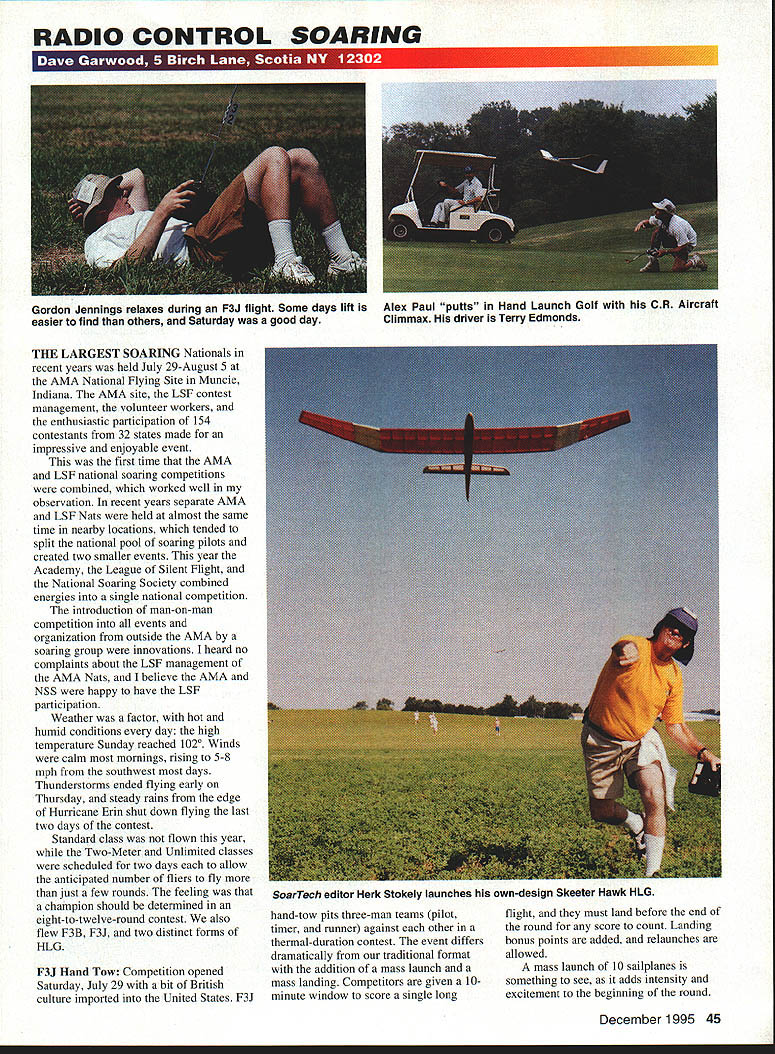
Hand Launch Golf
This informal but spirited competition was run Tuesday and Wednesday evenings (nine holes each night). In H.L. Golf players complete the course with a 1.5-meter sailplane, counting launches instead of strokes. A hole is completed when any part of the airplane comes to rest within a wingspan (1.5 meters or 60 inches) of the hole.
Teams generally included a pilot and a driver, and we saw three pilot mobility strategies:
- Throw the airplane and hop into the golf cart (while flying the airplane) and be driven down the fairway while flying.
- Move up to the target area and have a teammate throw the airplane, to get a better view of the landing area.
- Launch and sprint along with the airplane, hoping to arrive at the green in time to see the landing.
The biggest hazard on the course, it seemed, was trees — some pilots went into trees three times in nine holes. While we saw some precise flying, there were plenty of comical moments as well. H.L. Golf is characterized by mirth and laughter by both participants and spectators.
Top scorers on Tuesday:
- 1st: Josh Glaab
- 2nd: Steve Cameron
- 3rd (tie): Steve Condon and Ben Lawless
Wednesday:
- 1st: Ben Lawless
- 2nd: Steve Cameron
- 3rd: Josh Glaab
The Thursday evening banquet in the Hotel Roberts acknowledged the unsung heroes who worked behind the scenes to organize and run the event. Thanks were given to the folks who worked to stage a great soaring competition, including Mike Stump and Cal Posthuma from LSF; Bob Massmann from NSS; Ron Morgan, AMA Nats Manager; and Steve Kaluf, AMA Competitions Director. Steve worked 12-hour days on the field, handling tasks from hauling water, cutting grass, and marking winch line.
LSF ran a spectacular workers' raffle, made possible by generous contributions of many sponsors listed elsewhere in the magazine.
The LSF Spirit of Soaring award was given to a young couple from Morgantown, West Virginia who had come to their first Nats. According to Mike Stump, the pair arrived on the field, immediately approached him, and asked, "What can we do to help?" Both worked several volunteer jobs throughout the event, and both flew in competition. Congratulations to Chip and Deanna Vignolini!
You should also know about Luther Mitchell, who I call the First Citizen of RC Soaring for his generous support of fliers. Luther brings a large truck crammed full of radio and sailplane repair parts, tools, and materials. If you need help repairing a model to get it back in the air, Luther will help you do just that, and he asks nothing in return.
This contest had the most competent and mellow launch directors of any I can remember. It's a pleasant experience to be launched by the likes of Brent Hoover, Doug Barry, Larry Jeffery, and Jim Deck. Thank you again, Nats workers and volunteers, for your contribution of time and energy on our behalf.
For those who haven't been to the National Flying Site, note that it's quite a good spot for flying sailplanes. It's not perfect—some pointed out that the turf is bumpy, and the power lines can be worrisome—but it has plenty of space, and site improvement work is ongoing.
The AMA museum is magnificent; its centerpiece is "Middle-Town Models" — a mythical 1950s hobby shop. If you were born before 1950, you may have a hard time getting in and out of the shop with dry eyes. On top of this, AMA staff are supportive of visiting RC pilots. If you haven't seen it, you may want to make the pilgrimage before you make your final judgment about the expenditure of our AMA funds for the purpose of land acquisition and development. It's impressive.
If you have yet to attend a Soaring Nats, please realize that the event tends to be inclusive rather than exclusive. A couple of people mentioned that they hesitated to come because they feared the competition might be overwhelmingly hot; they'd been advised to go to other large contests before coming to the AMA Nationals.
In my view this is a misconception. Sure, there are highly skilled fliers that you won't be able to beat unless you fly seriously every day for a few years, but most of them are there to have a good time as well. The majority of us are sailplane lovers with ordinary soaring skills.
The Nats has as much in common with a company picnic as it does with a contest. People at the Nats tend to be open and friendly, and the emphasis is on learning and cooperating, while actual competition is a lesser priority.
Do not fear participating in the Nats simply because you are not a top-10% flier. If you are comfortable with winch launches and spot landings, you'll fit in fine. You'll learn more about finding thermals, contest strategy, and sailplane design in a week at the Nats than in a year at home.
Jim Thomas, 1990 Nats overall winner, summed it up perfectly when he said, "The Nats is summer camp for grown children." Come join us in Muncie next year.
Transcribed from original scans by AI. Minor OCR errors may remain.

