
RADIO CONTROL SOARING
Dave Garwood, 5 Birch Lane, Scotia NY 12302
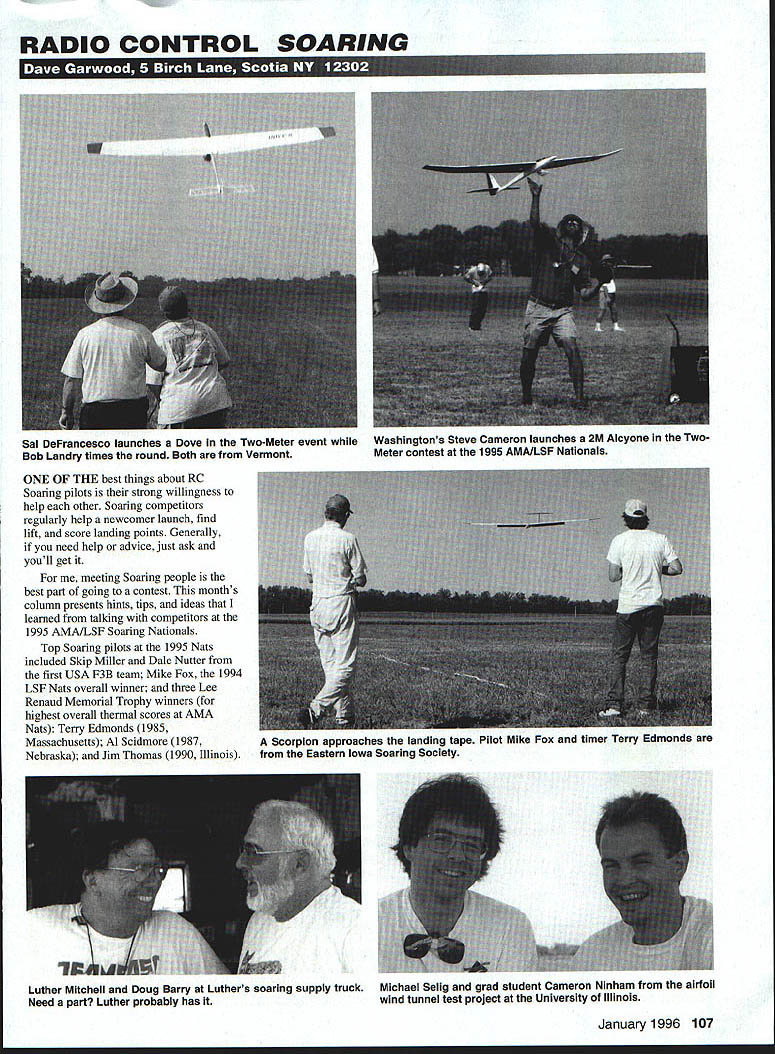
One of the best things about RC soaring pilots is their strong willingness to help each other. Soaring competitors regularly help a newcomer launch, find lift, and score landing points. Generally, if you need help or advice, just ask and you'll get it.
For me, meeting soaring people is the best part of going to a contest. This column presents hints, tips, and ideas I learned from talking with competitors at the 1995 AMA/LSF Soaring Nationals.
1995 AMA/LSF Soaring Nationals — highlights
Top pilots and award winners:
- Skip Miller and Dale Nutter — members of the first USA F3B team.
- Mike Fox — 1994 LSF Nats overall winner.
- Lee Renaud Memorial Trophy winners (highest overall thermal scores at AMA Nats): Terry Edmonds (1985, Massachusetts), Al Scidmore (1987, Nebraska), Jim Thomas (1990, Illinois).
Terry Edmonds also is the U.S. representative to the FAI (CIAM).
Designers, makers, and notable flyers present included Doug Buchanan (Hawk, PSS), Sal DeFrancesco (Alcyone, Dove), Mike Fox (Scorpion, Wasp HLG), Joe Hahn (Monarch HLG), Mark LeVoe (Super-V), Alex Paul (Warthog, PSS), Norm Wider and Jeff Pfeifer (Hummingbird), Mike Popescu (Esteem), and Rusty Shaw (Chuperosa). Soaring software publishers Lee Murray, Chuck Anderson, and Bob Champine were also there.
Walt Good, radio-control pioneer and tireless worker in securing radio frequencies for RC use, spoke briefly at the banquet. Airfoil designer Michael Selig (director of Low-Speed Airfoil Tests at the University of Illinois, Urbana–Champaign) attended with graduate student Cameron Ninham. The book Summary: Low Speed Airfoil Data, Volume 1 is available from Soartech; current project information is at http://uxhcs.uiuc.edu/~selig.
Impressive flying and incidents
I saw some impressive "hot-dogger" moves:
- Jeff Pfeifer axial-rolling the Hummingbird on a hand launch out over the golf course — crisp, precise four-point rolls.
- Don Edberg and Aaron Valdes making precise four-point rolls while returning to the landing zone during the Unlimited contest.
Notable quick thinking and safe recoveries:
- Doug Buchanan lost both horizontal stabs on launch but landed safely. His first words: "Boy, winches are strong." He said the plane "wanted to go inverted" and he flew it by pulling flaps and treating it like an inverted flying wing. Norm Wider had a similar incident two days later and also landed safely.
Ron Stanfield (Arkansas) advocates record-keeping. He has logged thousands of flights and numerous contest appearances and wins. His point: watch the airplane closely — it will tell you when it's in lift. Those who seem to "see" thermals are simply watching their model intently.
Young Jeff Pfeifer (Missouri) produced some of the smoothest HLG flights seen in the competition.
Learning and technique
Hand-launch (HLG) advice
- Get a good, stable airplane. If it's overly light you must have speed to learn to fly; about 15 ounces is a good weight.
- Get Dave Thornburg's Old Buzzard's Soaring book and videotape.
- Practice, practice, practice.
The Dayton Area Thermal Soarers (DARTS) have held hand-launch contests for nearly two decades. DARTS members Joe Hahn and Bob Massmann offered five tips to improve your HLG technique:
- Wear shorts. This lets you more accurately feel wind shifts.
- Know your airplane and fly it in various weather conditions.
- Watch your airplane — it will give indications of being in lift.
- Ballast is cool. Don't be afraid to add weight to an HLG.
- Practice launch technique. If your arm hurts, you're doing it wrong. Coordinate hand, wrist, arm, body twist, and a short run for forward motion.
General contest and flying tips from top pilots
Dale Nutter (Oklahoma), a versatile champion in multiple RC disciplines, stressed:
- Sailplane competition is pure competition; winners are decided by performance, not price.
- To improve quickly, go to competitions and observe everything — you'll progress far faster.
- Watch the model intently for subtle signs of being in lift (wing up, tail up, slight climb) — that's when to slow and turn.
Doug Buchanan (Washington State) offered two contest tips:
- Come prepared.
- Observe.
Jim Bonk (Connecticut): Get an experienced flier as your timer — forget your buddy; get someone who knows more than you.
Don Smith and Chicago's F3B champions Jim McCarthy and Tom Kallevang suggested:
- Get a durable airplane.
- Fly with good pilots.
- Ask lots of questions — most people will answer them.
- Maintain the right attitude: this isn't work. It's hard sometimes, but try to remember that it's supposed to be fun.
Sal DeFrancesco — common advice to new sailplane pilots
- Avoid tip stalls in a turn. Don't pull the nose up in a turn. Remember: bank then yank, not yank then bank.
- Avoid landing mistakes. Don't turn near the ground; practice a true airplane-type landing approach.
- Don't fly too slow near the ground. It's better to drop the nose on landing than to cartwheel the airplane.
- Launching at dusk is a fast way to build airplane awareness. Watching the model in calm air teaches you a lot.
- Hand-launch as much as possible. If you fly less than once a week your learning curve will be long; fly three times a week to learn quickly.
Mental preparation and winning
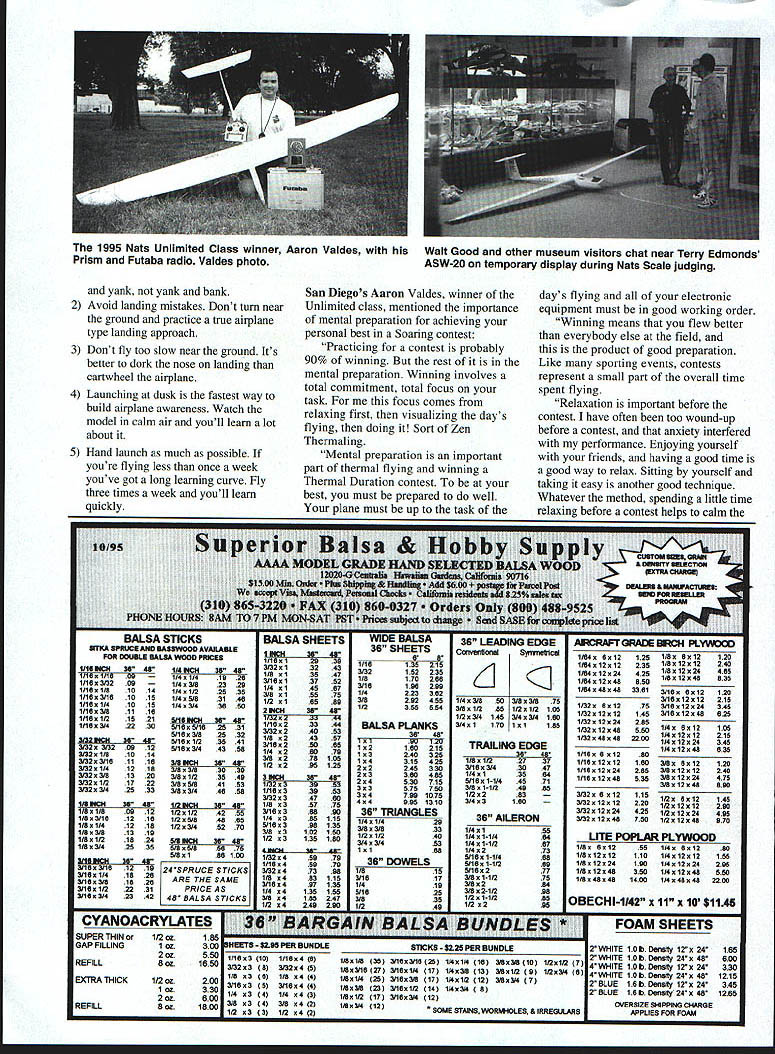
Aaron Valdes (San Diego), Unlimited class winner, emphasized mental preparation:
- Practicing for a contest is probably 90% of winning. The remainder is mental preparation: total commitment and focus.
- Relax first, visualize the day's flying, then execute — "sort of Zen thermaling."
- Ensure your plane and electronics are in good working order; good preparation breeds confidence.
- Relaxation before the contest helps calm nerves. Spend time enjoying yourself or sitting quietly to prepare mentally.
- During the contest, stay optimistic and focus on what you can do next, even after mistakes. A positive attitude helps maintain performance.
- After the contest, analyze what you can improve for the next event (e.g., air awareness, winch timing, positioning).
He also practices visualization before each flight — picturing a perfect landing or a perfect duration helps focus on tasks and identify areas for improvement.
Designing and making sailplanes
Mike Fox (designer of the Scorpion and Wasp kits) offered advice for prospective designers and manufacturers:
- Compromise is the key — balance performance with simplicity, buildability, and cost. Think about weight versus durability.
- Plan ahead for manufacturing: decide what you'll make in-house and what you'll subcontract (balsa cutting, fiberglass molding, etc.).
- If you haven't manufactured before, be prepared for many details: packaging, advertising, distribution.
- Practice hard and show the airplane at contests or put it in the hands of an excellent flier — success breeds demand.
- Decide whether you want this as a hobby or a full-time business. Turning it into a job can take the fun out of it.
Resources
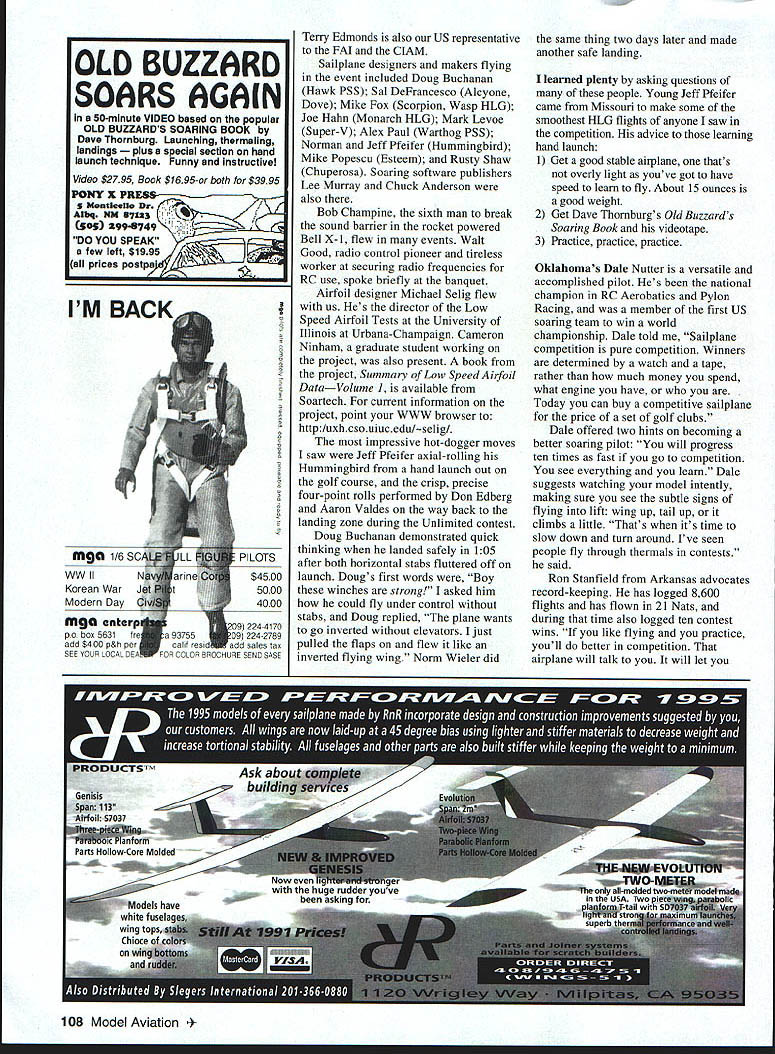
I strongly recommend Dave Thornburg's Old Buzzard's Soaring book and companion videotape. These are excellent for advanced beginner and intermediate sailplane pilots.
- Book: $16.95; Video: $27.95; Both: $39.95 (postpaid).
- Order from Pony X Press, 5 Monticello Drive, Albuquerque, NM 87123; Tel.: (505) 299-8749.
From Old Buzzards: "Thermal is Nature's elevator: a magic bubble of warm air that breaks loose from the earth and floats casually and amorphously toward those cool‑gray regions at the base of cumulus clouds. A million thermals a day make this silent and invisible journey alone. Only a lucky few find themselves accompanied by a hawk or a crow or a buzzard, by a dandelion puff, a piece of stray newspaper — or an RC sailplane."
Transcribed from original scans by AI. Minor OCR errors may remain.

