
RADIO CONTROL SOARING
Dave Garwood, 5 Birch Lane, Scotia, NY 12302
SAILPLANE LAUNCHING METHODS:
"What's a hi-start? Does that mean you get up on a high place and launch the sailplane?" "How big a field do I need to fly my sailplane?" These questions in my mail suggested I should discuss the basics of launching sailplanes.
We have several ways to launch RC sailplanes, including human muscle, hi-start, winch, and aero-tow by another model airplane.
Hand-launch gliders and HLG techniques are specialized, and will be treated separately in an upcoming column. F3B hand-tow was discussed in the Nats coverage in the December 1995 issue. There are esoteric methods like rocket power and tow by RC car, but they are not in widespread use.
This column introduces the three most common launch techniques for thermal sailplanes, and gives some insight on what it's like to pilot a full-scale sailplane on aero-tow.
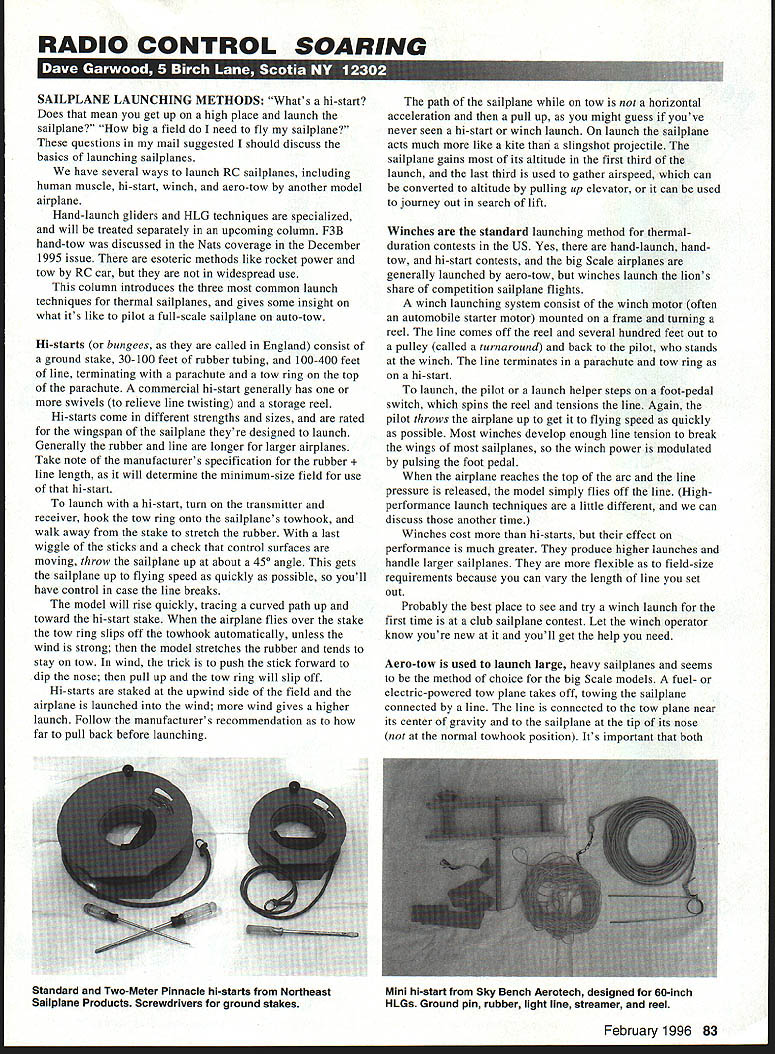
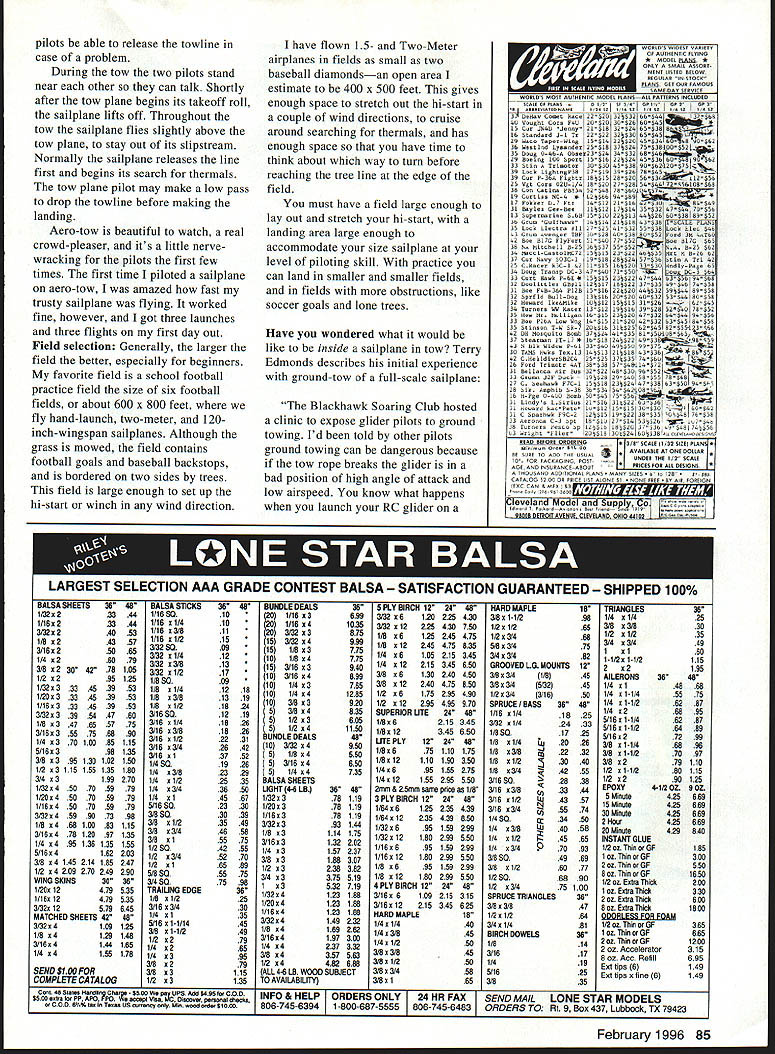
Hi-starts (or bungees, as they are called in England) consist of a ground stake, 30–100 feet of rubber tubing, and 100–400 feet of line, terminating in a parachute with a tow ring. A commercial hi-start generally has one or more swivels (to relieve line twisting) and a storage reel.
Hi-starts come in different strengths and sizes, and are rated for the wingspan of the sailplane they're designed to launch. Generally the rubber and line are longer for larger airplanes. Take note of the manufacturer's specification for the rubber + line length, as it will determine the minimum-size field for use of that hi-start.
To launch with a hi-start, turn on the transmitter and receiver, hook the tow ring onto the sailplane's tow hook, and walk away from the stake to stretch the rubber. With a last wiggle of the sticks and a check that control surfaces are moving, throw the sailplane up at about a 45° angle. This gets the sailplane up to flying speed as quickly as possible, so you'll have control in case the line breaks.
The model will rise quickly, tracing a curved path up and toward the hi-start stake. When the airplane flies over the stake the tow ring slips off the tow hook automatically, unless the wind is strong; then the model stretches the rubber and tends to stay on tow. In wind, the trick is to push the stick forward to dip the nose; then pull up and the tow ring will slip off.
Hi-starts are staked at the upwind side of the field and the airplane is launched into the wind; more wind gives a higher launch. Follow the manufacturer's recommendation as to how far to pull back before launching.
The path of the sailplane while on tow is not a horizontal acceleration and then a pull up, as you might guess if you've never seen a hi-start or winch launch. On launch the sailplane acts much more like a kite than a slingshot projectile. The sailplane gains most of its altitude in the first third of the launch, and the last third is used to gather airspeed, which can be converted to altitude by pulling up elevator, or it can be used to journey out in search of lift.
Winches are the standard launching method for thermal-duration contests in the US. Yes, there are hand-launch, hand-tow, and hi-start contests, and the big scale airplanes are generally launched by aero-tow, but winches launch the lion's share of competition sailplane flights.
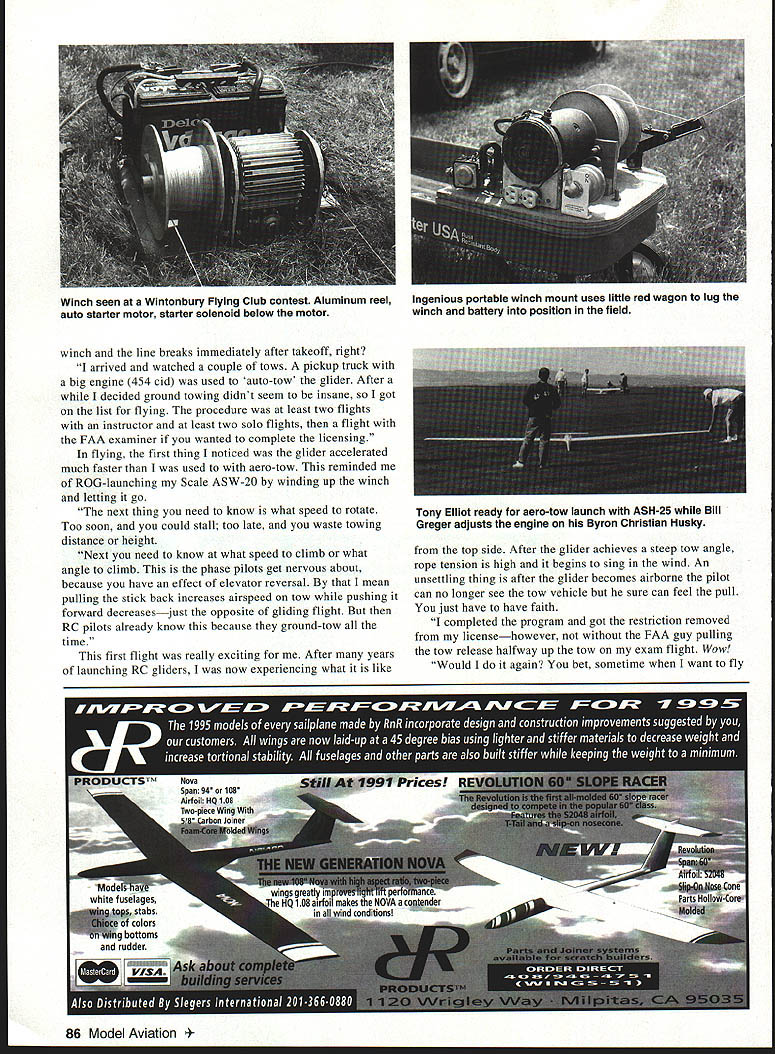
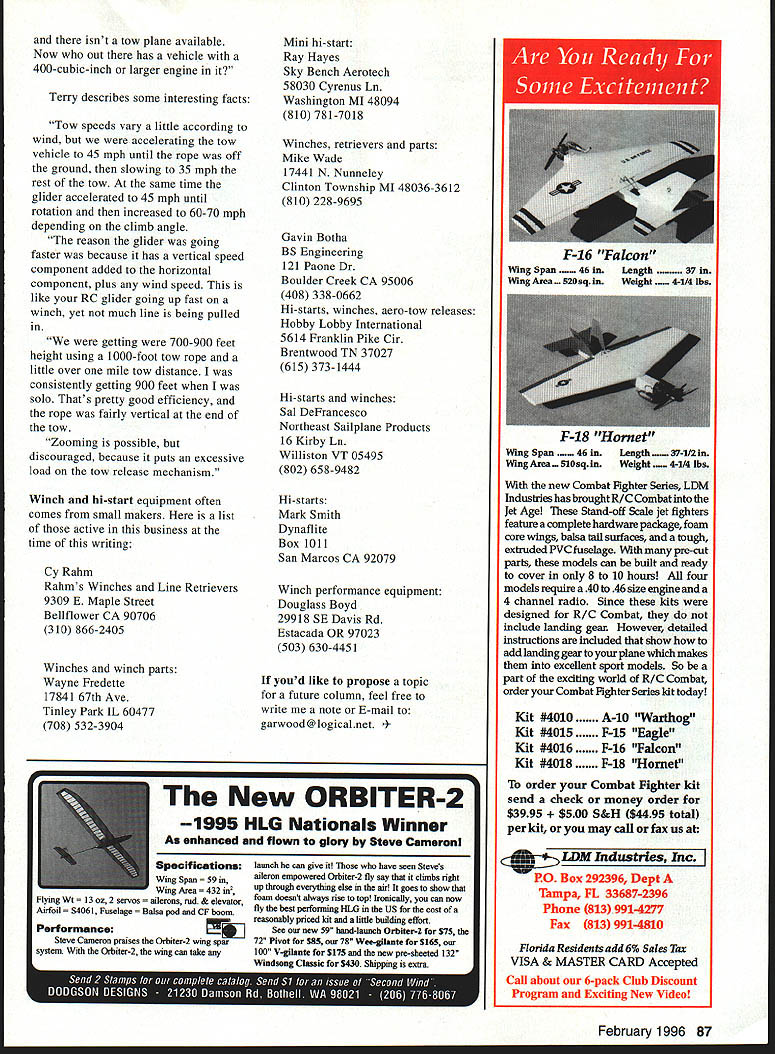
A winch launching system consists of the winch motor (often an automobile starter motor) mounted on a frame and turning a reel. The line comes off the reel and several hundred feet out to a pulley (called a turnaround) and back to the pilot, who stands at the winch. The line terminates in a parachute and tow ring as on a hi-start.
To launch, the pilot or a launch helper steps on a foot-pedal switch, which spins the reel and tensions the line. Again, the pilot throws the airplane up to get it to flying speed as quickly as possible. Most winches develop enough line tension to break wings on sailplanes; winch power is modulated by pulsing the foot pedal. When the airplane reaches the top of the arc and the line pressure is released, the model simply flies off the line. (High-performance launch techniques are a little different, and we can discuss those another time.)
Winches cost more than hi-starts, but their effect on performance is much greater. They produce higher launches and handle larger sailplanes. They are more flexible as to field-size requirements because you can vary the length of line you set out.
Probably the best place to see and try a winch launch for the first time is at a club sailplane contest. Let the winch operator know you're new at it and you'll get the help you need.
Aero-tow is used to launch large, heavy sailplanes and seems to be the method of choice for the big scale models. A fuel- or electric-powered tow plane takes off, towing the sailplane connected by a line. The line is connected to the tow plane near its center of gravity and to the sailplane at the tip of its nose (not at the normal tow-hook position). It's important that both pilots be able to release the towline in case of a problem.
During the tow the two pilots stand near each other so they can talk. Shortly after the tow plane begins its takeoff roll, the sailplane lifts off. Throughout the tow the sailplane flies slightly above the tow plane, to stay out of its slipstream. Normally the sailplane releases the line first and begins its search for thermals. The tow plane may make a low pass to drop the towline before making the landing.
Aero-tow is beautiful to watch, a real crowd-pleaser, and it's a little nerve-wracking for the pilots the first few times. The first time I piloted a sailplane on aero-tow, I was amazed how fast my trusty sailplane was flying. It worked fine, however, and I got three launches and three flights on my first day out.
Field selection
Generally, the larger the field the better, especially for beginners. My favorite field is a school football practice field the size of six football fields, or about 600 x 800 feet, where we fly hand-launch, two-meter, and 120-inch-wingspan sailplanes. Although the grass is mowed, the field contains football goals and baseball backstops, and is bordered on two sides by trees. This field is large enough to set up the hi-start or winch in any wind direction.
I have flown 1.5-meter and two-meter airplanes in fields as small as two baseball diamonds—an open area I estimate to be 400 x 500 feet. This gives enough space to stretch out the hi-start in a couple of wind directions, to cruise around searching for thermals, and has enough space so that you have time to think about which way to turn before reaching the tree line at the edge of the field.
You must have a field large enough to lay out and stretch your hi-start, with a landing area large enough to accommodate your size sailplane at your level of piloting skill. With practice you can land in smaller and smaller fields, and in fields with more obstructions, like soccer goals and lone trees.
Have you wondered what it would be like to be inside a sailplane in tow? Terry Edmonds describes his initial experience with ground-tow of a full-scale sailplane:
"The Blackhawk Soaring Club hosted a clinic to expose glider pilots to ground towing. I'd been told by other pilots ground towing can be dangerous because if the tow rope breaks the glider is in a bad position of high angle of attack and low airspeed. You know what happens when you launch your RC glider on a winch and the line breaks immediately after takeoff, right?
"I arrived and watched a couple of tows. A pickup truck with a big engine (.454 cid) was used to 'auto-tow' the glider. After a while I decided ground towing didn't seem to be insane, so I got on the list for flying. The procedure was at least two flights with an instructor and at least two solo flights, then a flight with the FAA examiner if you wanted to complete the licensing.
"In flying, the first thing I noticed was the glider accelerated much faster than I was used to with aero-tow. This reminded me of ROG-launching my Scale ASW-20 by winding up the winch and letting it go.
"The next thing you need to know is what speed to rotate. Too soon, and you could stall; too late, and you waste towing distance or height.
"Next you need to know at what speed to climb or what angle to climb. This is the phase pilots get nervous about, because you have an effect of elevator reversal. By that I mean pulling the stick back increases airspeed on tow while pushing it forward decreases—just the opposite of gliding flight. But then RC pilots already know this because they ground-tow all the time.
"This first flight was really exciting for me. After many years of launching RC gliders, I was now experiencing what it is like from the top side. After the glider achieves a steep tow angle, rope tension is high and it begins to sing in the wind. An unsettling thing is after the glider becomes airborne the pilot can no longer see the tow vehicle but he sure can feel the pull. You just have to have faith.
"I completed the program and got the restriction removed from my license—however, not without the FAA guy pulling the tow release halfway up the tow on my exam flight. Wow!
"Would I do it again? You bet, sometime when I want to fly and there isn't a tow plane available. Now who out there has a vehicle with a 400-cubic-inch or larger engine in it?
"Terry describes some interesting facts:
"Tow speeds vary a little according to wind, but we were accelerating the tow vehicle to 45 mph until the rope was off the ground, then slowing to 35 mph the rest of the tow. At the same time the glider accelerated to 45 mph until rotation and then increased to 60–70 mph depending on the climb angle.
"The reason the glider was going faster was because it has a vertical speed component added to the horizontal component, plus any wind speed. This is like your RC glider going up fast on a winch, yet not much line is being pulled in.
"We were getting 700–900 feet height using a 1,000-foot tow rope and a little over one mile tow distance. I was consistently getting 900 feet when I was solo. That's pretty good efficiency, and the rope was fairly vertical at the end of the tow.
"'Zooming is possible, but discouraged, because it puts an excessive load on the tow release mechanism.'"
Winch and hi-start equipment
Winch and hi-start equipment often comes from small makers. Here is a list of those active in this business at the time of this writing:
- Cy Rahm; Rahm's Winches and Line Retrievers; 9309 E. Maple Street, Bellflower, CA 90706; (310) 866-2405
- Wayne Fredette; Winches and winch parts; 17841 67th Ave., Tinley Park, IL 60477; (708) 532-3904
- Ray Hayes; Mini hi-start; Sky Bench Aerotech; 58030 Cyrenus Ln., Washington, MI 48094; (810) 781-7018
- Mike Wade; Winches, retrievers and parts; 17441 N. Nunneley, Clinton Township, MI 48036-3612; (810) 228-9695
- Gavin Botha; BS Engineering; 121 Paone Dr., Boulder Creek, CA 95006; (408) 338-0662
- Hobby Lobby International; Hi-starts, winches, aero-tow releases; 5614 Franklin Pike Cir., Brentwood, TN 37027; (615) 373-1444
- Sal DeFrancesco; Hi-starts and winches; Northeast Sailplane Products; 16 Kirby Ln., Williston, VT 05495; (802) 658-9482
- Mark Smith; Hi-starts; Dynaflite; Box 1011, San Marcos, CA 92079
- Douglass Boyd; Winch performance equipment; 29918 SE Davis Rd., Estacada, OR 97023; (503) 630-4451
If you'd like to propose a topic for a future column, feel free to write me a note or e-mail to: garwood@logical.net
Transcribed from original scans by AI. Minor OCR errors may remain.

