
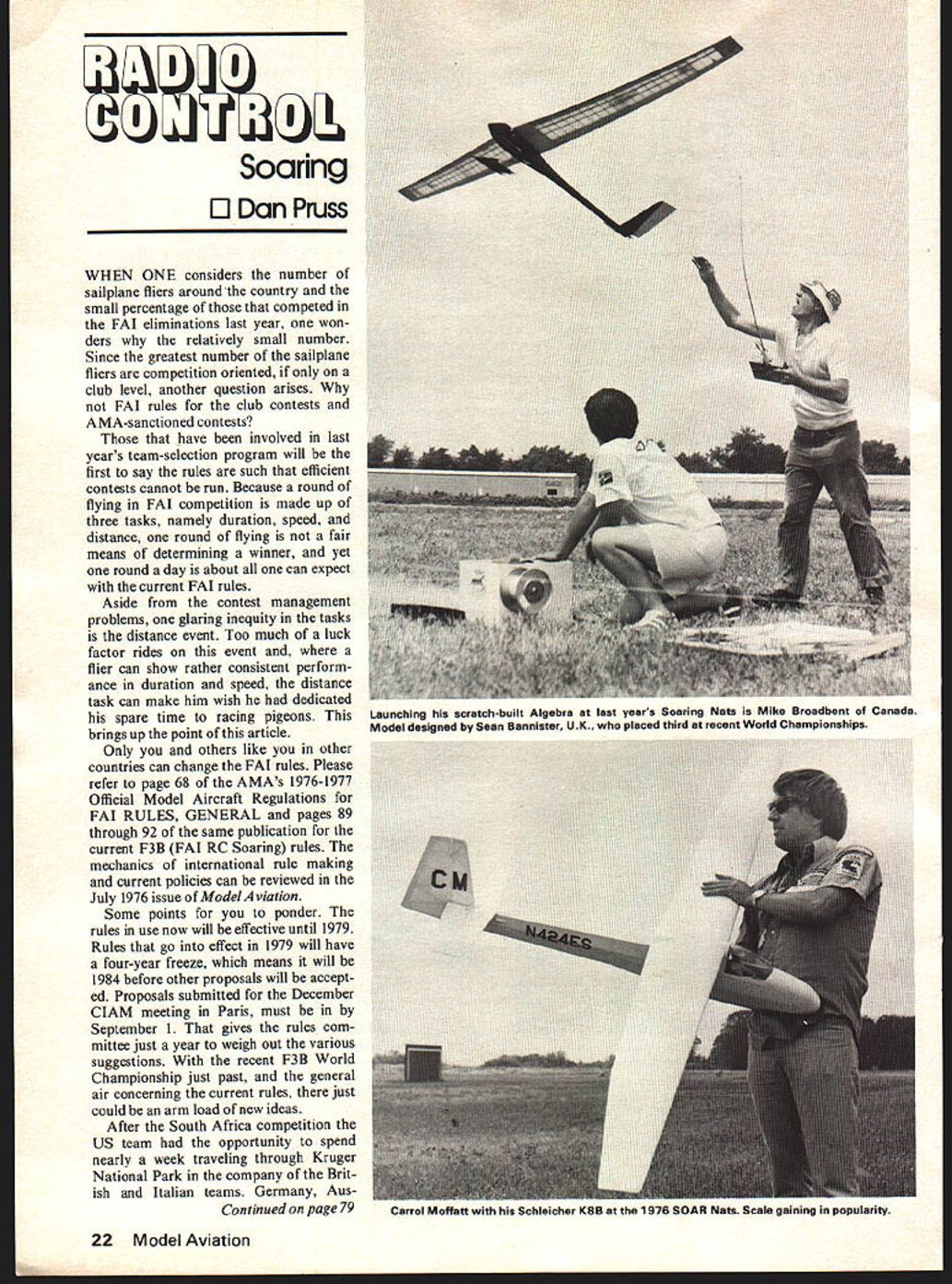
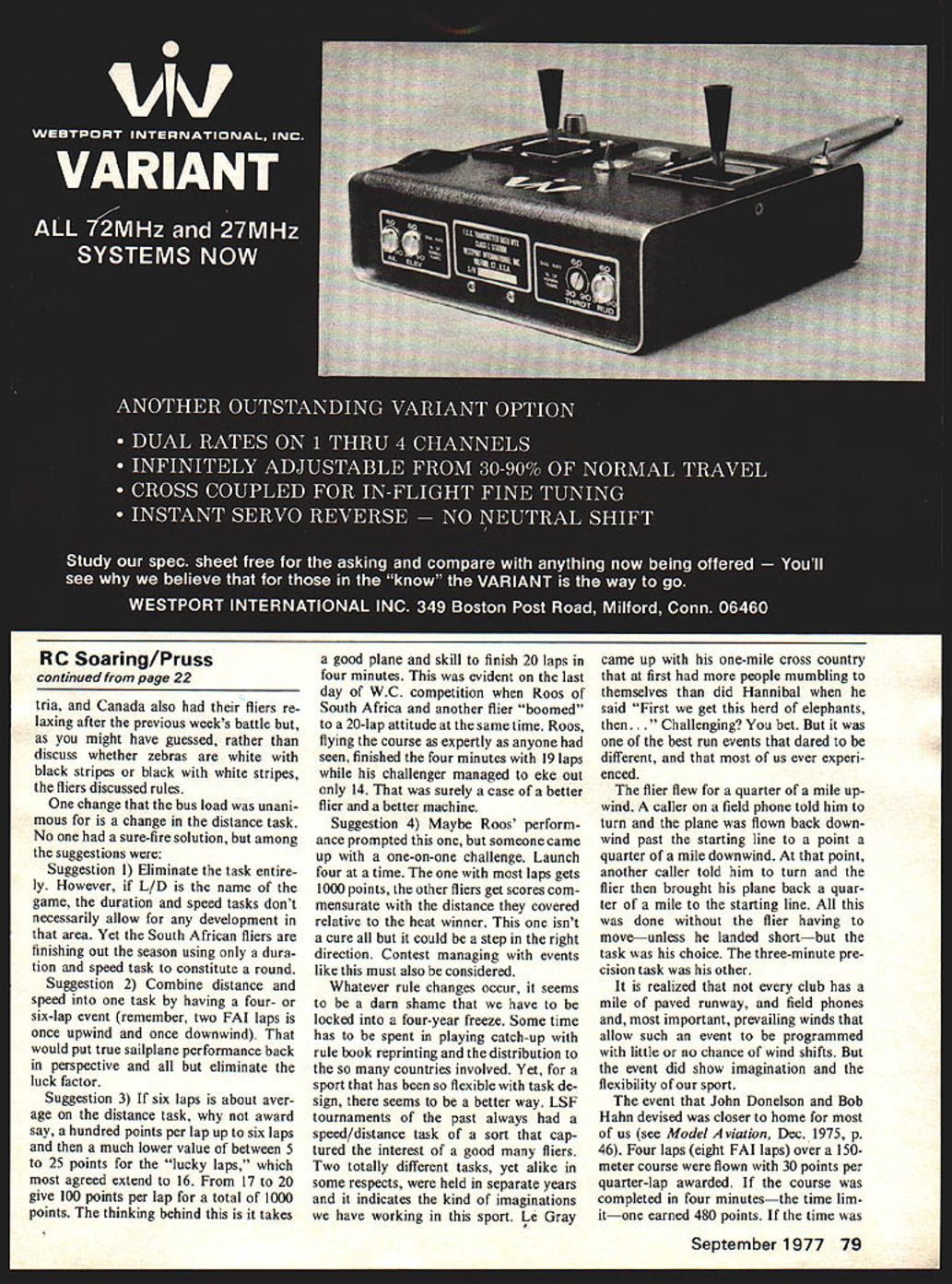
Radio Control: Soaring
Dan Pruss
WHEN ONE considers the number of sailplane fliers around the country and the small percentage of those that competed in the FAI eliminations last year, one wonders why the relatively small number. Since the greatest number of the sailplane fliers are competition oriented, if only on a club level, another question arises. Why not FAI rules for the club contests and AMA-sanctioned contests?
Those that have been involved in last year's team-selection program will be the first to say the rules are such that efficient contests cannot be run. Because a round of flying in FAI competition is made up of three tasks, namely duration, speed, and distance, one round of flying is not a fair means of determining a winner, and yet one round a day is about all one can expect with the current FAI rules.
Aside from the contest management problems, one glaring inequity in the tasks is the distance event. Too much of a luck factor rides on this event and, where a flier can show rather consistent performance in duration and speed, the distance task can make him wish he had dedicated his spare time to racing pigeons. This brings up the point of this article.
Only you and others like you in other countries can change the FAI rules. Please refer to page 68 of the AMA's 1976-1977 Official Model Aircraft Regulations for FAI RULES, GENERAL and pages 89 through 92 of the same publication for the current F3B (FAI RC Soaring) rules. The mechanics of international rule making and current policies can be reviewed in the July 1976 issue of Model Aviation.
Some points for you to ponder. The rules in use now will be effective until 1979. Rules that go into effect in 1979 will have a four-year freeze, which means it will be 1984 before other proposals will be accepted. Proposals submitted for the December CIAM meeting in Paris must be in by September 1. That gives the rules committee just a year to weigh out the various suggestions. With the recent F3B World Championship just past, and the general air concerning the current rules, there just could be an arm load of new ideas.
After the South Africa competition the US team had the opportunity to spend nearly a week traveling through Kruger National Park in the company of the British and Italian teams. Australia, and Canada also had their fliers relaxing after the previous week's battle but, as you might have guessed, rather than discuss whether zebras are white with black stripes or black with white stripes, the fliers discussed rules.
One change that the bus load was unanimous for is a change in the distance task. No one had a sure-fire solution, but among the suggestions were:
Suggestion 1) Eliminate the task entirely. However, if L/D is the name of the game, the duration and speed tasks don't necessarily allow for any development in that area. Yet the South African fliers are finishing out the season using only a duration and speed task to constitute a round.
Suggestion 2) Combine distance and speed into one task by having a four- or six-lap event (remember, two FAI laps is once upwind and once downwind). That would put true sailplane performance back in perspective and all but eliminate the luck factor.
Suggestion 3) If six laps is about average on the distance task, why not award, say, a hundred points per lap up to six laps and then a much lower value of between 5 to 25 points for the "lucky laps," which most agreed extend to 16. From 17 to 20 give 100 points per lap for a total of 1000 points. The thinking behind this is it takes a good plane and skill to finish 20 laps in four minutes. This was evident on the last day of W.C. competition when Roos of South Africa and another flier "boomed" to a 20-lap attitude at the same time. Roos, flying the course as expertly as anyone had seen, finished the four minutes with 19 laps while his challenger managed to eke out only 14. That was surely a case of a better flier and a better machine.
Suggestion 4) Maybe Roos' performance prompted this one, but someone came up with a one-on-one challenge. Launch four at a time. The one with most laps gets 1000 points, the other fliers get scores commensurate with the distance they covered relative to the heat winner. This one's not a cure-all but it could be a step in the right direction. Contest managing with events like this must also be considered.
Whatever rule changes occur, it seems to be a darn shame that we have to be locked into a four-year freeze. Some time has to be spent playing catch-up with the rule book reprinting and the distribution to the so many countries involved. Yet, for a sport that has been so flexible with task design, there seems to be a better way. LSF tournaments of the past always had a speed/distance task of a sort that captured the interest of good many fliers. Two totally different tasks, yet alike in some respects, were held in separate years and it indicates the kind of imaginations we have working in this sport. Le Gray came up with his one-mile cross country that at first had more people mumbling to themselves than did Hannibal when he said "First we get this herd of elephants, then..." Challenge? You bet. But it was one of the best run events that dared to be different, and that most of us ever experienced.
The flier flew for a quarter of a mile upwind. A caller on a field phone told him to turn and the plane was flown back downwind past the starting line to a point a quarter of a mile downwind. At that point, another caller told him to turn and the flier then brought his plane back a quarter of a mile to the starting line. All this was done without the flier having to move—unless he landed short—but the task was his choice. The three-minute precision task was his other.
It is realized that not every club has a mile of paved runway, and field phones and, most important, prevailing winds that allow such an event to be programmed with little or no chance of wind shifts. But the event did show imagination and the flexibility of our sport.
The event that John Donelson and Bob Hahn devised was closer to home for most of us (see Model Aviation, Dec. 1975, p. 46). Four laps (eight FAI laps) over a 150-meter course were flown with 30 points per quarter-lap awarded. If the course was completed in four minutes—the time limit—one earned 480 points. If the time was less than four minutes, then a bonus was earned based on a curve that netted 1000 points near the once-minute mark. That the system had merit was evident by the top scorer of the meet who earned just over the 1000 points. (Duration scores were normalized to 1000 points.)
All this brings up the following point. With a four-year freeze on rules and three-year wait between world championships for specific classes (the W.C. in South Africa were considered a 1976 contest for scheduling purposes), perhaps we in soaring could come up with a rule that would establish a basic set of task criteria that would be flexible enough to be used to the best advantage of the host country (not necessarily their fliers), based on manageability, geography, weather conditions, etc. Such criteria could possibly include duration: a task whose time is of six minutes minimum. Speed/distance: a task whose time is of six minutes minimum. Speed/distance: a task of no less than 900 meters with no leg less than 150 meters. Precision: the two or three minute as per AMA rules now.
With a basic set of rules that are simple, the host country could provide "home rules" relative to specifically devised tasks. With three years between world championships it would give all countries a time to gear themselves to whatever program is offered.
Perhaps this last suggestion sounds like a naive approach to rules for international competition, but the South African contest showed that modelers—RC sailplane modelers anyway—all speak the same language.
For the past several sessions at the CIAM meetings at the FAI headquarters in Paris, it was rather difficult to gain much support for what were good proposals from the USA. The main arguments from some of the European countries were "How many FAI contests has the USA run with these rules?" The US experience in FAI (F3B) contests up until a year or so ago was practically nil. Last year's team selection program changed all that and Miller, Nutter, and Payne got the F3B world to sit up and take notice. Let's follow through!
Dan Pruss, Box 490, Plainfield, IL 60544.
Transcribed from original scans by AI. Minor OCR errors may remain.

