
Radio Control: Soaring
Women in Soaring
Like many Soaring pilots, I've tried to interest my wife and daughter in the sport and hobby. Both gave it an honest try, but neither became engaged in flying models. My daughter Sarah helped build a Chuperosa, test flew it a few times, and has not built or flown another model since. My wife Paula has made half-hour slope flights and has taken 23 published sailplane photographs, but isn't much interested in building or flying sailplanes.
Both have been to sailplane contests and are tremendously supportive of my Soaring habit—offering time, money, assistance, schedule accommodation, and photography support—but neither has a continuing interest in flying, much less Soaring competition.
In 1995 I flew with four women—more than any previous year—and by talking to them I hoped to learn more about why we see so few women Soaring pilots.
Trish Glaab
I met Trish Glaab at a Long Island Silent Flyers (LISF) contest in June 1995. She came into RC Soaring by choice: she ordered a Gentle Lady and a radio, and flew within a month. She remembers her first "complete flight"—launch, fly and land without help. That was about three years ago; now she flies on the Eastern Soaring League contest circuit.
Trish on how she started in competition:
- "My husband Josh competes, and since I'm going to contests anyway, I might as well compete."
Why Soaring?
- "Because it's quiet. I hate noise."
Advice and tips from Trish:
- Make enjoyment your top priority at contests. "If you allow tension or disappointment to overshadow that, it quickly becomes just a very expensive hobby."
- Recommended starter plane: Gentle Lady—relatively inexpensive and flies well.
- Current favorite: WACO Merlin—combines high performance with a forgiving nature, which builds confidence and competitiveness.
- Navigation tip for students: substitute "clockwise" and "counterclockwise" for "right" and "left" to avoid confusion when the airplane is coming toward or going away from you.
- On competition: once confident solo, enter model glider competitions—competition is demanding and a bit expensive, but it is the fastest way to improve skills and meet people.
- On getting started: many women are discouraged by the mechanical skills and time required. Men can be supportive by helping to build and set up airplanes.
- Encourage women to approach the hobby in their own style; avoid forcing them to do things another person's way.
Anna Marie Glaab
Anna Marie (Trish's sister-in-law) flew the second day at the LISF contest and again at the 1995 Muncie Nats. She also pilots full-scale gliders. She started in free flight and fuel-powered RC about 20 years ago, gave it up for college, then returned to flying. Her favorite competition sailplane is the old T-tailed nine-percent WACO Magic.
Anna's advice for beginners:
- A Gentle Lady floater will work as a trainer plane.
- Get a coach or tutor. Learning to fly when someone in the family is helping can be extra difficult.
- Join a club—people will help you learn to build and learn to fly. Most people want you to succeed; if you're a girl you'll be accepted easily.
- Be forthright: just ask for help. Don't be intimidated.
- To men: "Don't laugh so hard when we crash; we're really paranoid about crashing."
Anna finished 12th in Expert class in the 1995 Eastern Soaring League overall standings.
Deanna Vignolini
Deanna started watching RC soaring in 1989 and first flew in competition in 1991 with an Airtronics Olympic 650. She placed third in Open class at the 1992 Canadian Nats (London, Ontario). During the 1995 season she flew an Airtronics Sagitta 900.
Deanna on women in RC Soaring:
- "While it's dominated by men, there's no reason women can't do it, and be competitive at it. Especially if you have a husband or boyfriend flying, you might as well fly with them, and beat them once in a while."
- To men: treat lady fliers like any other flier and don't talk down to them. "We just want to fly and get the respect that other pilots get."
Katie Martin
Katie Martin (namesake of the Bob Martin RC Models Katie and the Dynaflite Katie II) lives in West Virginia and I finally met her at Soar-Utah-95. She first flew a Hobie Hawk after being introduced to soaring near the Rose Bowl in Pasadena by members of the Pasadena Soaring Society. Her first slope flight left a lasting impression and convinced her to pursue slope flying while learning basics on a more forgiving trainer.
Katie's advice to potential women fliers:
- Get as much information as possible; talk to people flying the birds you're excited about.
- Learn the basics with the proper trainer and get stick time—everyone crawls before they walk.
- Study available books on soaring; understanding why and how a sailplane flies is very helpful.
- Never be afraid to ask questions or ask for help. Everyone has been a beginner.
- Get your own bird—build or buy one. Hand-me-downs are often useful because they're already "broken in."
- Choose your instructor carefully; the person holding your plane during early flights matters.
- Take your time selecting help; the worst that can happen is someone says "no," and most experienced fliers will help a beginner.
Katie's advice to men about helping women:
- If she's interested, encourage her. Get or build a plane for her, teach her, or help her find an instructor.
- Recognize that females may be at a disadvantage initially because they may not have had early hands-on building experience; patience and encouragement help.
Observations
Not all soaring contests have women competitors, though many have women workers. In earlier decades women often participated in the hobby mainly as models in advertisements or cover photos; in the 1990s we are seeing more women enjoying sport and competition flying. Karen Yeager, who flew RC Pylon at the 1995 Nats and announced her retirement as a worker, put it simply: "From now on, I'm competing."
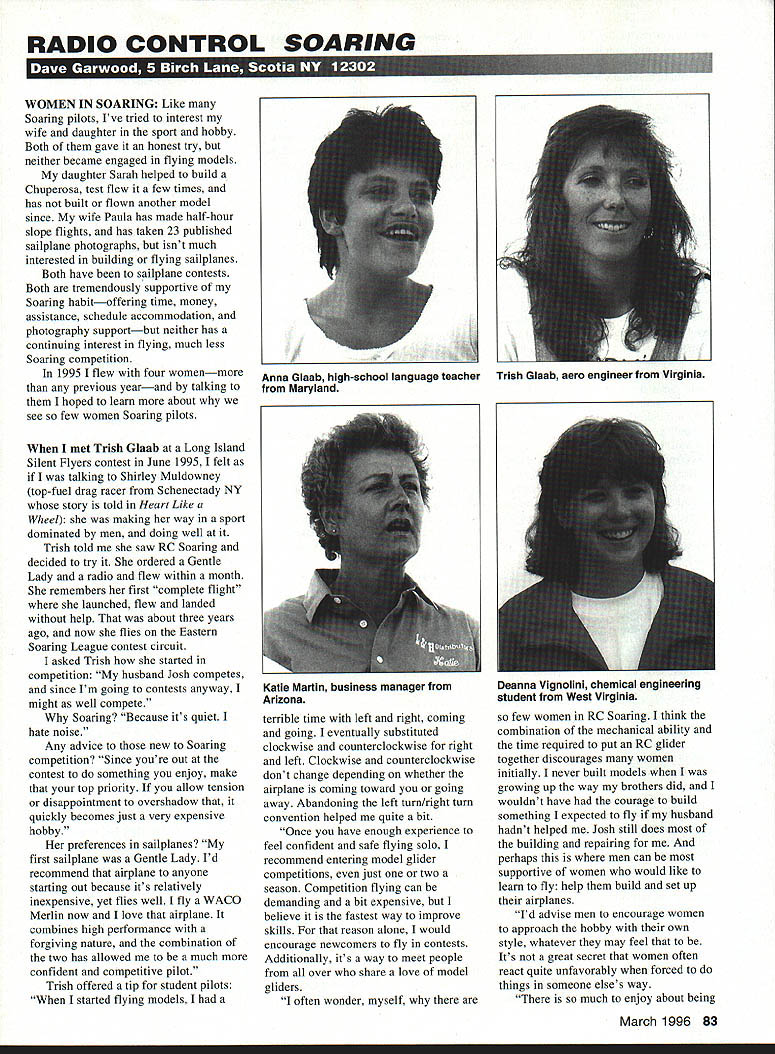
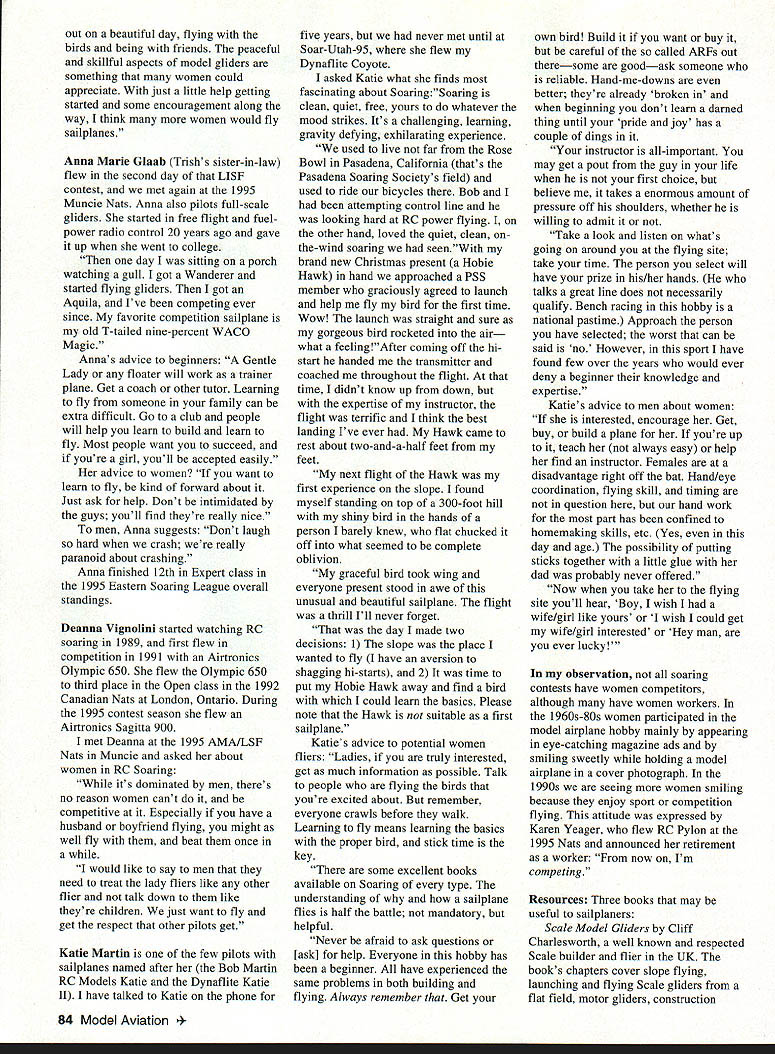
Anna Glaab (high-school language teacher, Maryland), Trish Glaab (aero engineer, Virginia), Katie Martin (business manager, West Virginia), and Deanna Vignolini (chemical engineering student, Arizona) illustrate that out on a beautiful day—flying "birds" and being friends—many women appreciate the peaceful, skillful aspects of model gliders. With a little help getting started and some encouragement along the way, I think more women would fly sailplanes.
Resources
- Scale Model Gliders by Cliff Charlesworth — chapters cover slope flying, launching and flying scale gliders from a flat field, motor gliders, construction and set-up, and lists of manufacturers and suppliers.
Just ask for help. Don't be intimidated.
Transcribed from original scans by AI. Minor OCR errors may remain.

