
RADIO CONTROL SOARING
Dave Garwood, 5 Birch Lane, Scotia NY 12302
We have a building season in my part of the country. With five inches of new snow on the ground and a wind-chill factor in the single digits, I didn't get to fly today. I did join some balsa sheets to make a skin for a foam wing, and in this season of short days and cold weather many of you may also be spending more time in the shop.
This month I'll discuss some of the tools that I've come to rely on, and I've listed and described four specialized RC Soaring magazines. But first, a note about Bob Harold's aluminum gliders.
Bob Harold's aluminum gliders I met Bob at the 1995 Muncie Nats. While we chatted, he cut a tiny glider from an aluminum drink can, shaped it, and launched it — all within five minutes. After a few test flights (trimming after each) he got surprising flight distances and times with the minuscule model.
Bob has written about these gliders for Boys' Life and will send instructions and full-size patterns for eight configurations for the cost of copying and mailing. To receive yours, send $1, a self-addressed business-size envelope, and two first-class stamps to: Bob Harold 519 N. Youlon Street West Salem, WI 54669-1108 Tel: (608) 786-0856 E-mail: BobCanMan@aol.com
Now, a brief discussion of some important workshop tools.
Modeling pins
An indispensable tool for building model airplanes. Pins hold parts in place while they are being assembled or while glue dries. You'll use a handful of pins for a built-up balsa rib-and-spar wing, or to hold a fin at right angles to a horizontal stab while epoxy cures.
The problem with common household pins is that their heads are too small for you to get a good grip when inserting or removing them. You can use pliers to overcome this problem, but a superior solution is to use modelers' pins — these have larger heads. Wire T-pins come in three sizes. Plastic-handled pins are a little harder to find but are even more comfortable to grip.
Specialized knife blades
A hobby knife with a #11 blade is essential. If you build more than one model a year, you'll appreciate buying them in packs of 100; it's less expensive and you'll always have sharp blades on hand. Larger knives with heavier blades and bigger handles are useful too.
For carving wingtip blocks, try the long #26 blade (part no. HLT026 from Hobby Lobby). Single-edge razor blades from the paint department of the hardware store are also useful for cutting and scraping tasks.
Razor saw
To precisely cut larger sticks and balsa sheeting, nothing beats a fine-tooth razor saw. Many of these saws can be used with a small miter box if desired. They will also neatly cut off servo arms and trim brass and aluminum tubing. Zona saws have comfortable wooden handles, replaceable blades, and strong blade holders.
Motor tool
Considered by many a luxury item, the motorized hobby tool quickly becomes one of the most-often-used tools in the shop. While a power drill is a low-speed, high-torque tool, the motor tool delivers high speed at low torque. It excels at cutting, grinding, sanding, and polishing. It accepts a large variety of grinding stones, cutting burrs, abrasive cut-off wheels, polishing pads, and sanding disks or cylinders.
I use two in my shop: one with a coarse sanding wheel permanently affixed and the other kept in a case with a variety of cutting tools. Even with a multi-speed motor tool, I use the highest speed more than 95% of the time. Both of my drills are 120-volt units, but portable models with rechargeable batteries are available.
I have used a Dremel Moto-Tool to cut rusted automotive U-bolts and to remove hopelessly damaged stainless-steel hose clamps. I know of no better way to cut music wire and hardened wing rod stock, and I prefer the motor tool over a tubing cutter for small-diameter tubing. Remember to wear eye protection with this (or any) power tool.
Sandbags
Sandbags are one of the most useful items in the model-building shop. They can act as a third hand on the workbench, holding a wing while you work on it or while the glue on the dihedral brace sets up. Nothing holds a round fuselage as well without the risk of scratches or other damage. I don't know a commercial source for sandbags; mine was made by my wife.
Covering iron and heat gun
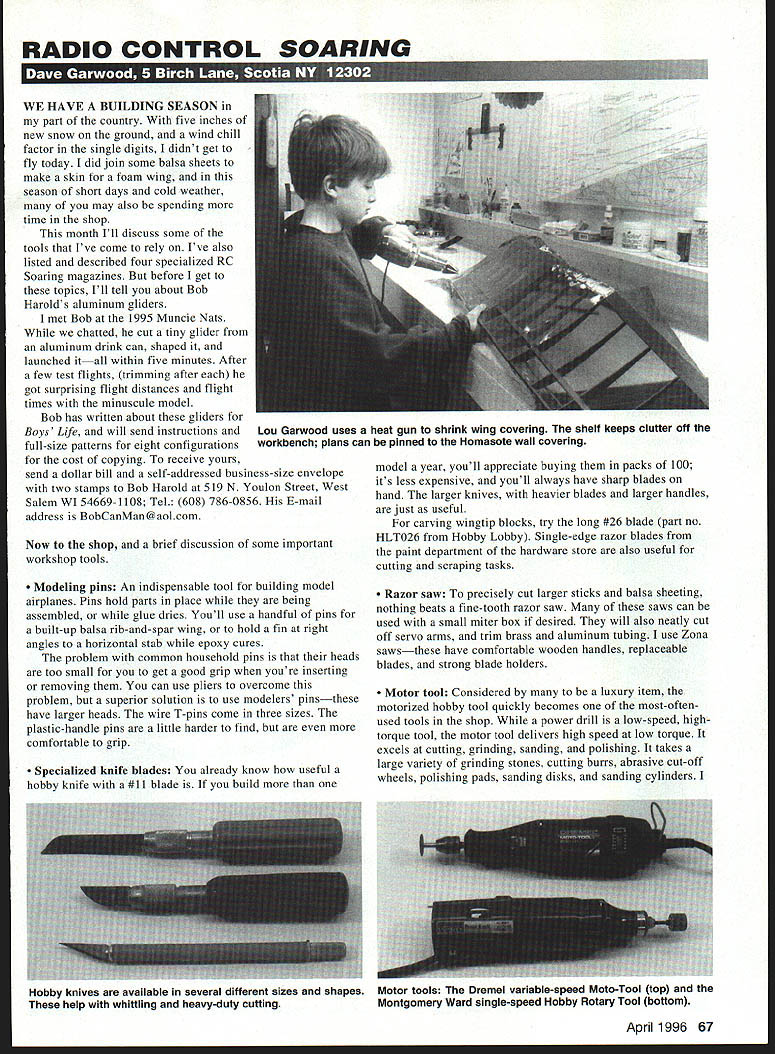
Heat-shrink covering and its heat-activated adhesive are small miracles of the modern modeling era. Although some covering manufacturers show application with a household clothing iron, a covering iron makes the job faster and easier.
A covering iron alone will get you through most jobs, but a heat gun is helpful for shrinking large areas of covering after the edges have been sealed. It's particularly useful for removing warps from built-up wings — an essential step in building sweet-flying models.
Workbench
Many modelers work on the kitchen table and build fine models with a temporary bench, and some have used portable building boards in motel rooms. If you can, find the space for a dedicated building area — life becomes easier.
My bench is a simple 2 x 4 frame topped with 3/4-inch plywood covered with Homasote so plans can be pinned to it. Use building material that takes pins well. A 2 x 8-foot piece is luxurious, although my first six RC airplanes were built on a 24 x 48-inch bench.
A bench attached to the wall will be wiggle-free, but a free-standing bench can be accessed from all sides. Plan for drawers or shelves for tool and material storage. An immensely useful addition is a pinnable surface on the wall to display plans, notes, lists, and other written material.
Soaring Resources
Here are four specialized soaring magazines that RC soaring pilots should find interesting and helpful. Be aware that soaring organizations also have specialized newsletters and periodicals.
- RC Soaring Digest (RCSD)
- Published by Judy and Jerry Slates, RCSD is the longest-running journal and voice of US soaring activity, with some international coverage. It is "reader written" and has been criticized for minimal editing, but to some readers that is a strength. RCSD includes regular columns, event reports, how-tos, travel articles, and frank kit reviews. Contact: RCSD, Box 2108, Wylie, TX 75098-2108; Tel: (214) 442-3910; Fax: (214) 442-5258. The only monthly publication among the specialty magazines, RCSD costs $30 per year.
- Sailplane Modeler (formerly Scale, Slope & FAI)
- Premiering in August 1995, Sailplane Modeler is the newest RC soaring magazine. Published by Soaring enthusiasts Wil Byers and Greg Vasgerdsian, it's a beautifully produced quarterly with some pages in full color. Contact: Sailplane Modeler, Box 4267, West Richland, WA 99353; Tel: (509) 627-0456. E-mail: WilByers@aol.com. Annual subscription: $19.95 for four issues.
- Quiet Flight International (QFI)
- Since 1994 QFI has been a bold and colorful publication edited by Dave Jones and published by Traplet in England. QFI strives for balanced content among thermal, slope, scale, and electric. The writing often includes dry British humor. For information contact the US agent: QFI USA, Box 167, Florham Park, NJ 07932; Tel/Fax: (201) 765-0881. E-mail: tjdjr@vader.co.uk. Subscription cost: $30 per year for six issues.
- Silent Flight
- First published in 1991, Silent Flight set a high editorial bar with color and a knack for innovative and unusual designs. It concentrates on soaring in the UK and Europe, covering both sailplanes and electrics. Published by Argus House in England; US agent: Wise-Owl Worldwide Publications, 4314 West 238th Street, Torrance, CA 90505-4509; Tel: (310) 375-6258; Fax: (310) 375-0548. Annual subscription: $34 for six issues.
This is a difficult time for the soaring magazines, with paper costs increasing and readership leveling off. The best thing we can do to support them is to subscribe. Try one (or more) of these magazines — it will increase your enjoyment of the hobby.
Transcribed from original scans by AI. Minor OCR errors may remain.

