

RADIO CONTROL SOARING
Dave Garwood, 5 Birch Lane, Scotia NY 12302
Newcomers to Soaring
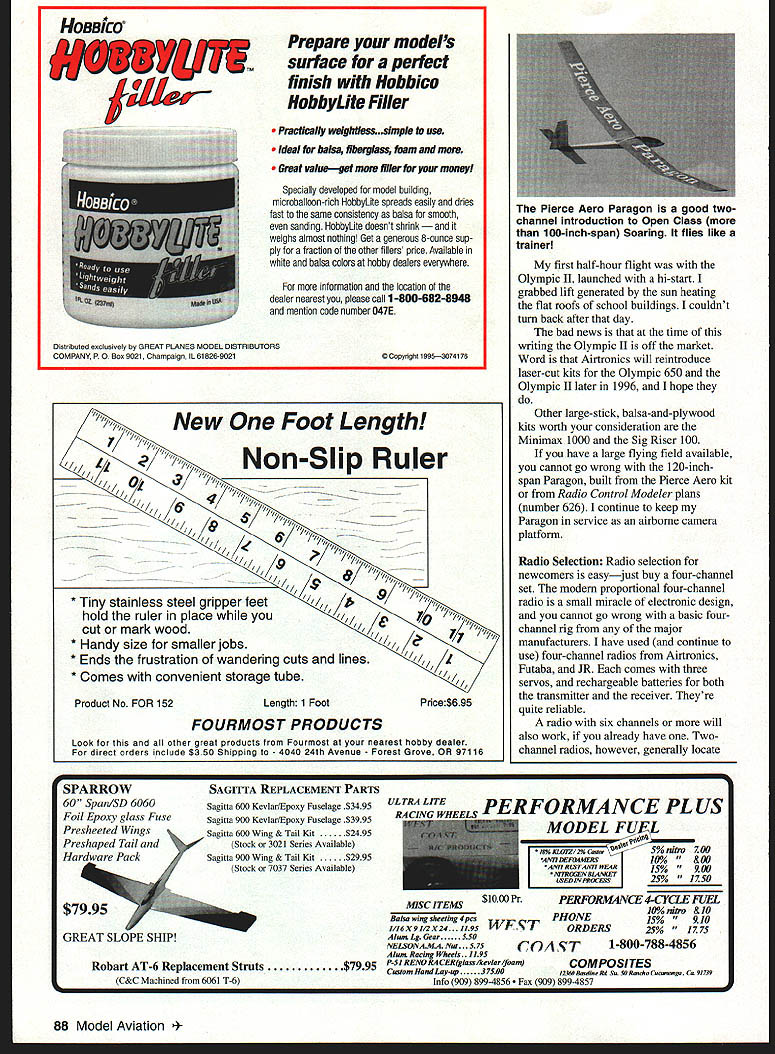
One of this month's photos shows two Soaring newcomers in 1988—myself and my son Louis. At the time Louis was 10 years old and I was 40; we were both starting in RC Soaring. We flew together for several years, and then Lou left town; he's in college now and has put sailplanes aside, at least for the time being. I stayed with it, became addicted to it, and have flown sailplanes exclusively for the last six years.
This column concentrates on what newcomers need to know to get started Soaring. Newcomers may be any age, and not all are new to RC—some may have extensive power-flying experience.
First-time visitors to the Soaring field often ask two questions when they discover the model airplanes "way up there" don't have engines.
- "How do they fly without an engine?" The answer is that they are powered by gravity. For an airplane to fly it must go forward through the air, and for a sailplane to go forward it must go slightly down, giving up a foot of altitude for every 20–40 feet of forward progress (depending on the efficiency of the model). A glider is always descending relative to the parcel of air it's in. To gain altitude, the pilot must put the model into air that's rising faster than the sailplane sinks; this is the elemental challenge of unpowered flight.
- "How do you get them up there to search for lift?" Most beginning glider pilots launch with a hi-start—a combination of rubber tubing, light cord, a small parachute, and a tow ring. The ring is hooked to the airplane's tow hook. The flier walks backward with the model, stretching the rubber tubing; it is released with a vigorous toss. The contracting tubing pulls the airplane forward, the forward speed causes the wing to generate lift, and the airplane rises 200–400 feet. Near the point where the rubber's stored energy is exhausted, the line slackens and the tow ring falls away as the airplane flies off the line; the parachute brings the line down. The pilot's next task is to search for lift or rising air to sustain the glider and make a longer flight.
Flat-field launch methods were covered in the February 1996 column. Specialized hand-launch was covered in the May 1996 Model Aviation; columnist Wil Byers covers Slope Soaring.
Finding thermal lift is an extensive topic, and I'll be talking about "reading the air" in future columns. It takes years for some of us to become proficient at finding and using lift. Right now, let's discuss the basic skills involved in flying and landing.
Sailplane Selection
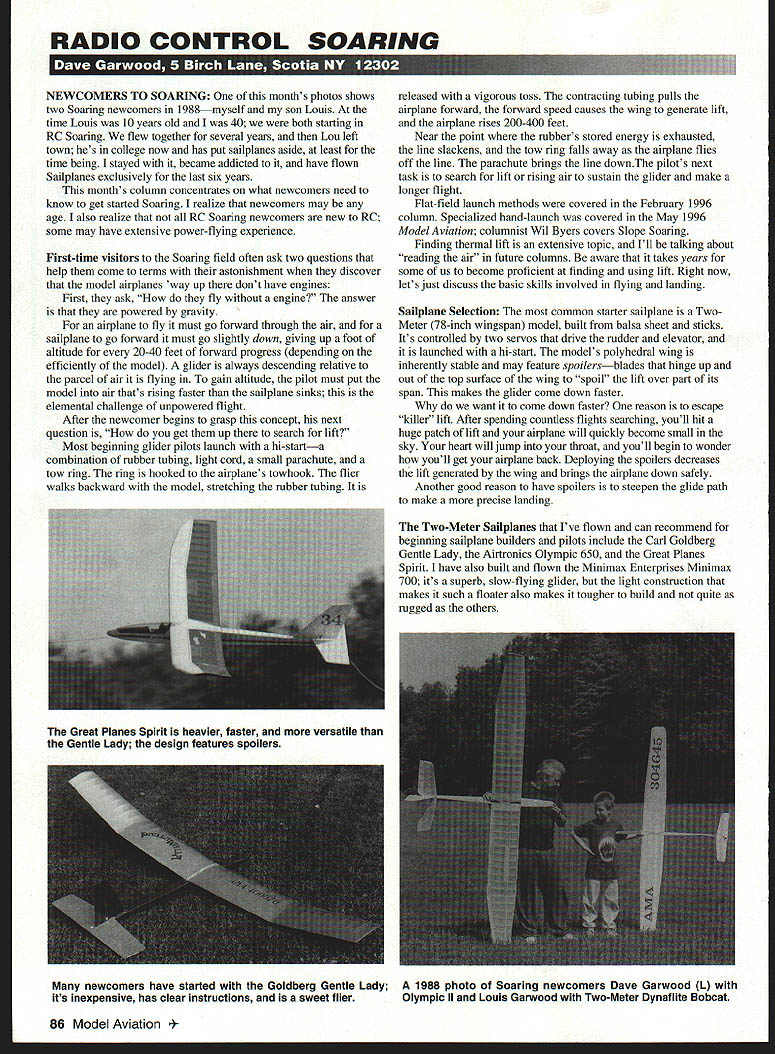
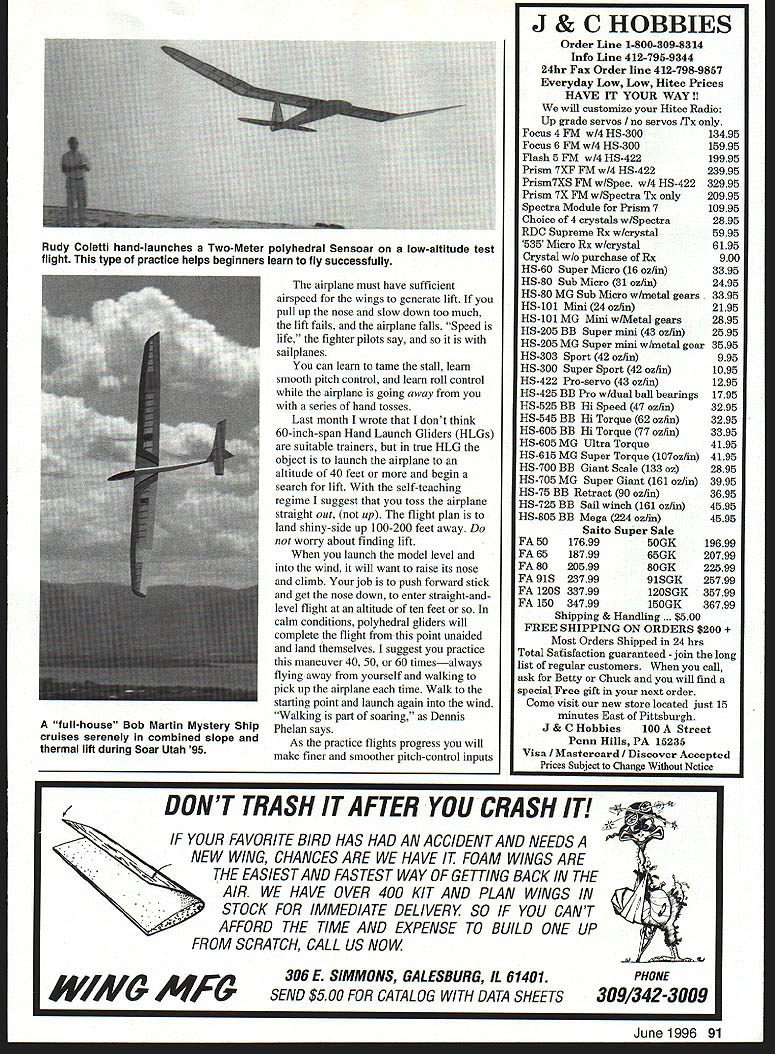
The most common starter sailplane is a Two-Meter (78-inch wingspan) model, built from balsa sheet and sticks. It's commonly controlled by two servos that drive the rudder and elevator, and launched with a hi-start. The model's polyhedral wing is inherently stable and may feature spoilers—blades that hinge up and out of the top surface of the wing to "spoil" the lift over part of its span. Spoilers make the glider descend faster.
Why do we want it to come down faster? One reason is to escape "killer" lift. After spending countless flights searching, you'll hit a huge patch of lift and your airplane will quickly become a small speck in the sky. Deploying the spoilers decreases the lift generated by the wing and brings the airplane down safely. Another good reason to have spoilers is to steepen the glide path for a more precise landing.
Two-Meter sailplanes that I recommend for beginning builders and pilots include:
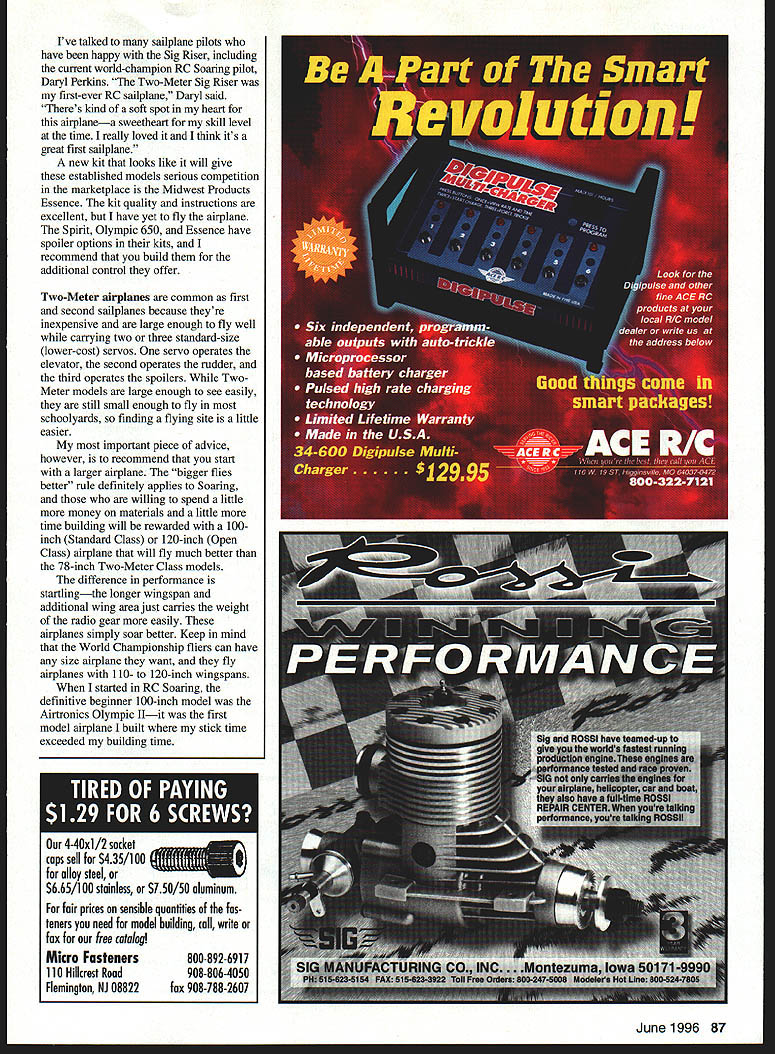
- Carl Goldberg Gentle Lady
- Airtronics Olympic 650
- Great Planes Spirit
- Minimax Enterprises Minimax 700 (a superb slow-flying glider; light construction makes it a good floater but a bit less rugged)
A new kit that looks like it will give these established models serious competition is the Midwest Products Essence. The kit quality and instructions are excellent; I have yet to fly the airplane. The Spirit, Olympic 650, and Essence have spoiler options in their kits, and I recommend building them for the additional control they offer.
Two-Meter airplanes are common as first and second sailplanes because they're inexpensive and large enough to fly well while carrying two or three standard-size servos (one for elevator, one for rudder, and a third for spoilers). They are still small enough to fly in most schoolyards, making it easier to find a flying site.
My most important advice is to consider starting with a larger airplane. The "bigger flies better" rule definitely applies to Soaring. Those willing to spend a little more on materials and building time will be rewarded with a 100-inch (Standard Class) or 120-inch (Open Class) airplane that will fly much better than a 78-inch Two-Meter. The difference in performance is startling—the longer wingspan and additional wing area carry the weight of the radio gear more easily. World Championship fliers often fly 110- to 120-inch wingspans.
When I started in RC Soaring, the definitive beginner 100-inch model was the Airtronics Olympic II — it was the first model I built where my stick time exceeded my building time. My first half-hour flight was with the Olympic II; I launched with a hi-start, grabbed lift generated by the sun heating flat roofs, and couldn't turn back after that day. At the time of this writing the Olympic II was off the market; word is Airtronics will reintroduce laser-cut kits for the Olympic 650 and the Olympic II later in 1996.
Other large stick, balsa-and-plywood kits worth considering:
- Minimax 1000
- Sig Riser 100
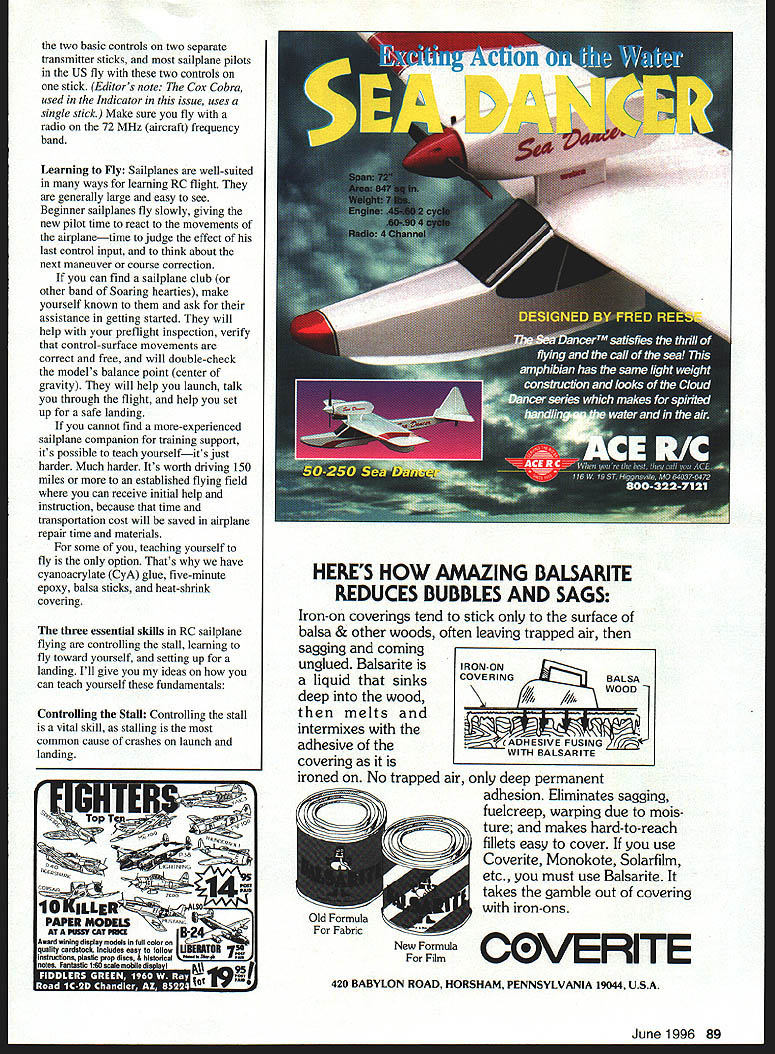
If you have a large flying field, consider the 120-inch-span Paragon (Pierce Aero kit or Radio Control Modeler plans number 626). I continue to use my Paragon as an airborne camera platform.
Radio Selection
Radio selection for newcomers is easy—buy a four-channel set. Modern proportional four-channel radios are reliable; I have used four-channel radios from Airtronics, Futaba, and JR. Each comes with three servos and rechargeable batteries for both transmitter and receiver.
A six-channel radio will also work if you already have one. Two-channel radios generally place the two basic controls on two separate transmitter sticks, but most sailplane pilots in the U.S. fly with these two controls on one stick. Make sure you fly on the 72 MHz (aircraft) frequency band.
Learning to Fly
Sailplanes are well-suited for learning RC flight. They are generally large and easy to see. Beginner sailplanes fly slowly, giving the new pilot time to react to control movements and to judge the effect of each input.
If you can find a sailplane club or group, ask them for assistance. They will help with preflight inspection, verify control-surface movements, double-check the model's balance point (center of gravity), help you launch, talk you through the flight, and help set up for a safe landing.
If you cannot find experienced support, it is possible to teach yourself—it's just harder. It may be worth driving a distance to an established flying field where you can receive initial help: the time and transportation cost can be saved in airplane repair time and materials. If self-teaching is your only option, you'll make use of cyanoacrylate (CA) glue, five-minute epoxy, balsa sticks, and heat-shrink covering.
The three essential skills in RC sailplane flying are:
- Controlling the stall
- Learning to fly toward yourself
- Setting up for a landing
Controlling the Stall
Controlling the stall is vital—stalling is the most common cause of crashes on launch and landing. The airplane must have sufficient airspeed for the wings to generate lift. If you pull up the nose and slow down too much, lift fails and the airplane falls. "Speed is life," as fighter pilots say.
You can learn to tame the stall, smooth pitch control, and roll control while the airplane is going away from you with a series of hand tosses. Toss the airplane straight out (not up). The flight plan is to land shiny-side up 100–200 feet away. Do not worry about finding lift.
When you launch the model level and into the wind, it will want to raise its nose and climb. Your job is to push forward stick and get the nose down to enter straight-and-level flight at an altitude of about ten feet. In calm conditions, polyhedral gliders will complete the flight from this point and land themselves. Practice this maneuver 40, 50, or 60 times—always flying away from yourself and walking to pick up the airplane each time. Walk to the starting point and launch again into the wind. "Walking is part of soaring," as Dennis Phelan says. As practice progresses you will make finer and smoother pitch-control inputs.
Flying Toward Yourself
Learning to fly toward yourself is the next goal. A strong hand-toss that gives 10 or 15 feet of altitude will give you time to make a 180° turn and head the model back toward you. Keep the speed up in the turn to avoid stalling. With the airplane turned back toward you the pitch controls are the same, but the turning controls will be reversed—control reversal is the second-most-common cause of a crash.
Three ways to adapt:
- Imagine you are seated in the airplane; from that viewpoint the controls won't be reversed.
- Use self-counseling—remind yourself to "Move the transmitter stick to prop up the low wing" when the airplane is coming toward you.
- Turn your back to the oncoming airplane and look over your shoulder at it—stick movements will not be reversed. Keep the transmitter pointed parallel to the nose of the airplane.
With practice you will internalize compensation for control reversal and will fly away and back without thinking about it.
Making the Landing
Making the landing defines a successful flight and is a good measure of your growing ability. Hitting a tree or other obstacle is the third-most-common cause of damage, so accurate landings are important.
By now you know the sink rate of your sailplane and can judge where the model will meet the ground from a given altitude. Plan to land near the middle of your landing area to allow for recovery from wind effects. Try flying through lift on final approach and compensate for downdrafts and misjudgments.
Land directly into the wind to minimize ground speed. You can slow the airplane by pulling back slightly on the stick, but be careful to avoid stalling. When the airplane gets within a few inches of the ground, add a little more back-stick pressure to bring the nose up slightly and "flare" the landing.
Switch-Hitters
Some come to Soaring from powered flight seeking the peace of silent flight or the challenge of finding lift. People good at powered flight are generally good at unpowered flight, but they must adjust to several differences:
- You can't advance a throttle to go faster; you must push the nose down to gain speed and reach rising air.
- You can't pull up elevator to gain altitude; you must find rising air, and often push the nose down to gather speed to get to that air.
- Sailplanes have slower airspeed and slower control response; while this benefits rank beginners, it can be disconcerting to experienced RC pilots.
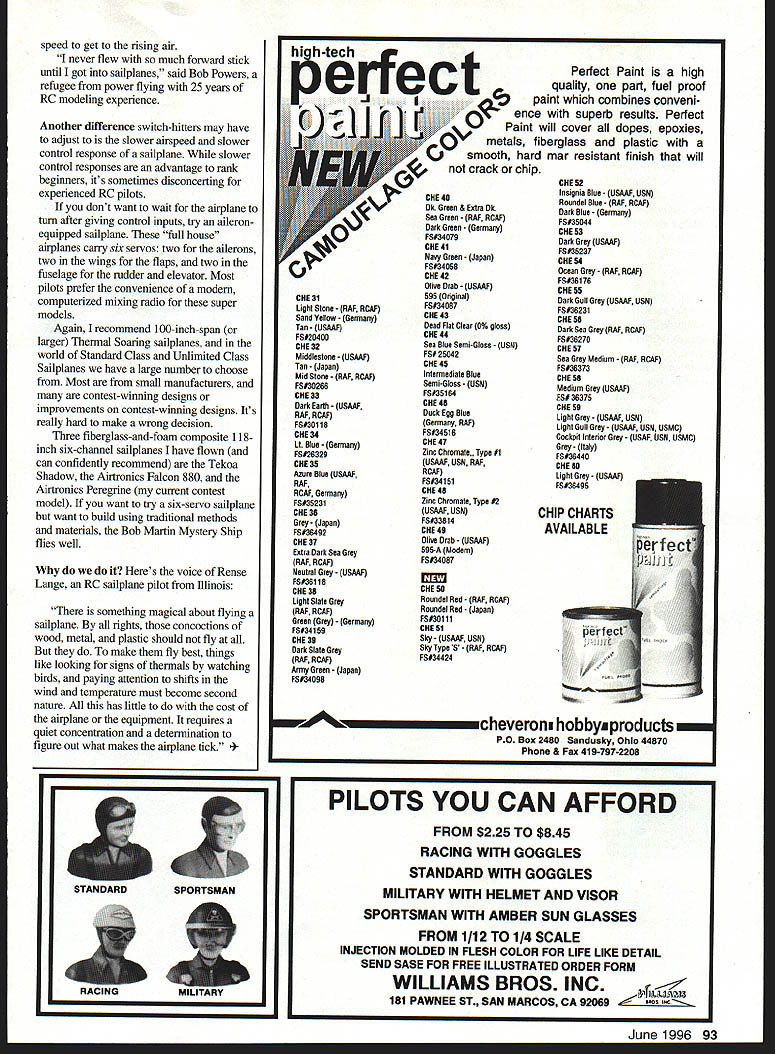
If you want quicker roll response, try an aileron-equipped sailplane. These "full house" airplanes carry six servos: two for ailerons, two for flaps, and two for rudder and elevator. Most pilots prefer a modern computerized mixing radio for these models.
I recommend 100-inch-span (or larger) Thermal Soaring sailplanes. In the Standard Class and Unlimited Class there are many contest-winning designs and well-regarded kits. Three fiberglass-and-foam composite 118-inch six-channel sailplanes I have flown and can recommend are:
- Tekoa Shadow
- Airtronics Falcon 880
- Airtronics Peregrine (my current contest model)
If you want a six-servo sailplane built with traditional methods, the Bob Martin Mystery Ship is a good choice.
Why We Do It
"There is something magical about flying a sailplane. By all rights, those concoctions of wood, metal, and plastic should not fly at all. But they do. To make them fly best, things like looking for signs of thermals by watching birds, and paying attention to shifts in the wind and temperature must become second nature. All this has little to do with the cost of the airplane or the equipment. It requires a quiet concentration and a determination to figure out what makes the airplane tick." — Rense Lange, RC sailplane pilot, Illinois
Transcribed from original scans by AI. Minor OCR errors may remain.

