

Radio Control: Soaring
Dave Garwood, 5 Birch Lane, Scotia NY 12302
Winter Soaring in Southern California
Joe Chovan and I got a chance to escape the ice and snow in the Northeast and spend a week in Los Angeles and San Diego flying sailplanes in T-shirts and sandals. In addition to sampling some famous slope-soaring sites, trip highlights included a hand-launch practice session with two Torrey Pines Gulls members and flying in an Inland Soaring Society monthly contest.
Hand Launch Lesson
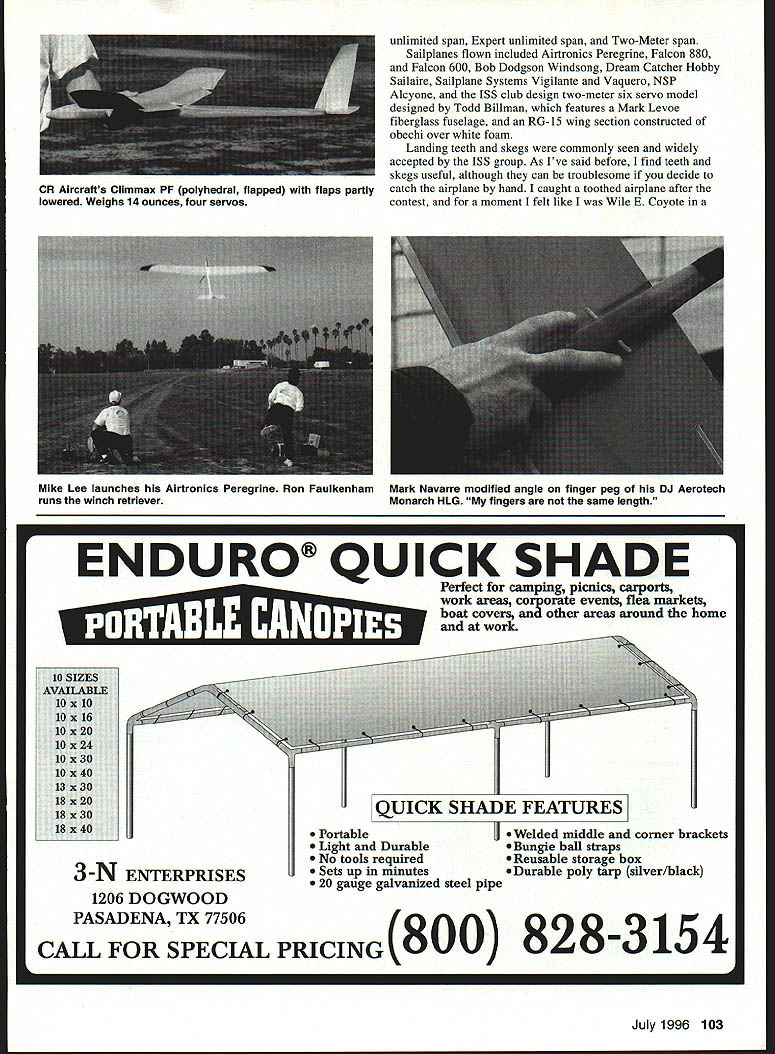
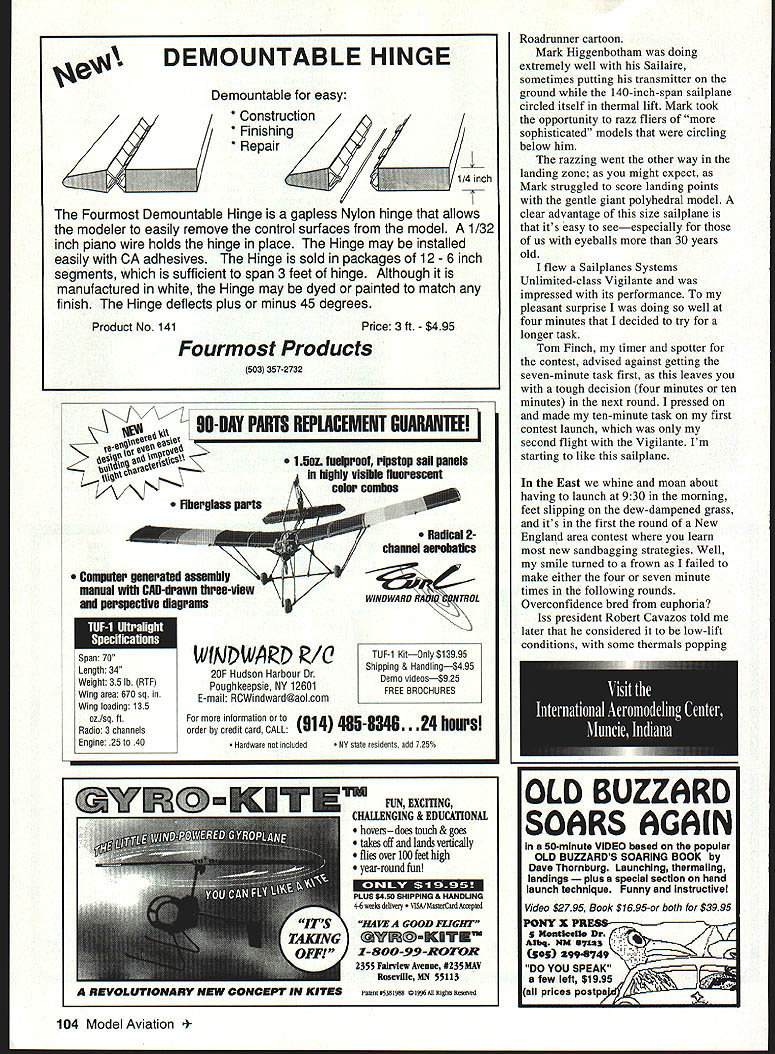
Joe and I spent a morning with a couple of Torrey Pines Gulls—Rick Shelby practicing with his Ron Vann/Ed Slegers Prism, and Charlie Richardson flying a prototype of a new HLG variation, the Climmax PF (Polyhedral, Flapped). Joe flew his four-servo flat-wing WACO Mosquito and I flew a two-servo polyhedral Climmax.
With four servos on board, the hand-launch Climmax PF can make good use of a computer-mixing transmitter to dial in reflex for launch, camber for thermalling, reflex for penetration, and flaps for landing. The flaps can also be mixed with rudder as flaperons if desired. The PF model weighs 13.5–14.5 ounces with micro radio equipment and a 400 mAh battery pack.
While Charlie may be best known as a slope racer, he's an accomplished thermal flier and designer as well. He was hitting thermals on more than half his launches and riding them far up and away downwind. The camber-changing capabilities of the PF model help the airplane penetrate the wind to get back to the field, and lowering the flaps allows it to slow down for a hand catch.
When I asked him to talk about what he was seeing, thinking, and doing as he hunted for small thermals near the ground, he said, "Okay, we'll hit one on this next throw,"—just about like a pool player calling, "Eight ball in the side pocket." And we did.
Charlie narrated the flight and offered this guidance for finding thermals:
- Let the airplane fly by itself, like a Free Flight model.
- Watch the model for signs of lift: it speeds up, it vibrates, it twitches, it looks nervous. When you find lift, pull tight circles near the ground.
- When you lose the lift, let it fly free to find the next bump, then circle again.
- When you get higher, open up the circles and look for more thermals.
"With a polyhedral plane you have to learn to let it fly free, because when you hit rudder, the plane sinks."
ISS Monthly Contest — California
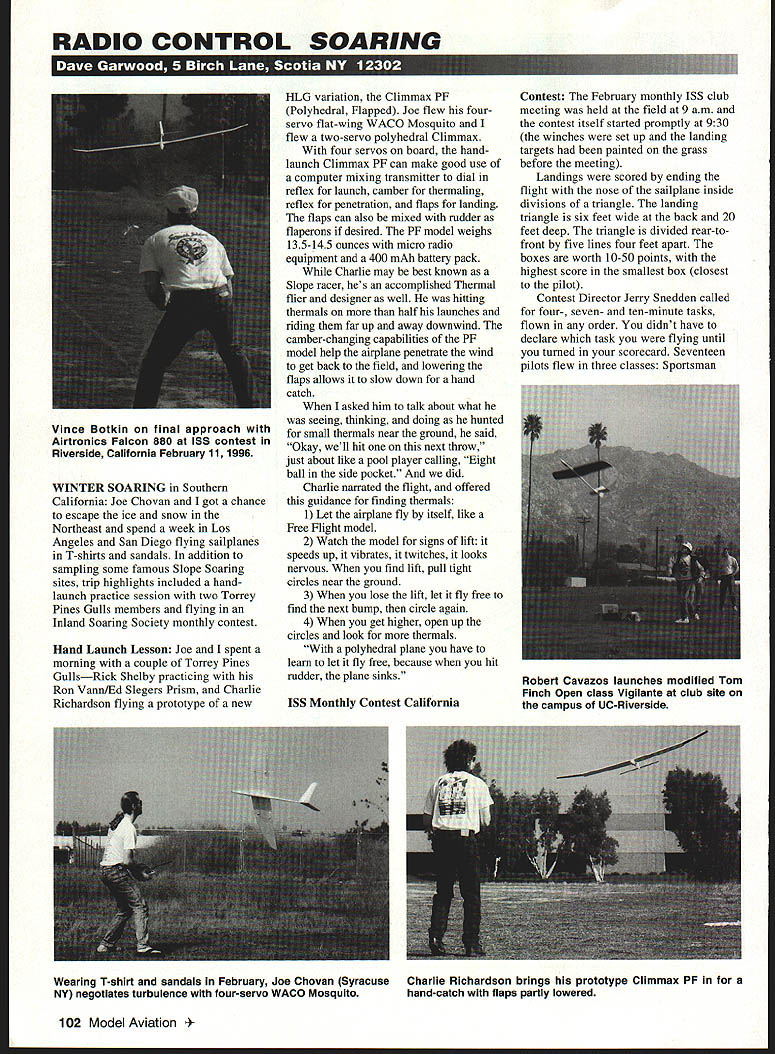
The February monthly ISS club meeting was held at the field at 9 a.m., and the contest itself started promptly at 9:30 (the winches were set up and the landing targets had been painted on the grass before the meeting).
Landings were scored by ending the flight with the nose of the sailplane inside divisions of a triangle. The landing triangle is six feet wide at the back and 20 feet deep. The triangle is divided rear-to-front by five lines four feet apart. The boxes are worth 10–50 points, with the highest score in the smallest box (closest to the pilot).
Contest Director Jerry Snedden called for four-, seven-, and ten-minute tasks, flown in any order. You didn't have to declare which task you were flying until you turned in your scorecard. Seventeen pilots flew in three classes: Sportsman, Expert, and Unlimited Span.
Sailplanes flown included:
- Airtronics Peregrine
- Airtronics Falcon 880
- Airtronics Falcon 600
- Bob Dodgson Windsong
- Dream Catcher Hobby Sailaire
- Sailplane Systems Vigilante
- Sailplane Systems Vaquero
- NSP Alcyone
- The ISS club two-meter six-servo model designed by Todd Billman, featuring a Mark Levoe fiberglass fuselage and an RG-15 wing section constructed of obechi over white foam
Landing teeth and skegs were commonly seen and widely accepted by the ISS group. As I've said before, I find teeth and skegs useful, although they can be troublesome if you decide to catch the airplane by hand. I caught a toothed airplane after the contest, and for a moment I felt like I was Wile E. Coyote in a Roadrunner cartoon.
Mark Higgenbotham was doing extremely well with his Sailaire, sometimes putting his transmitter on the ground while the 140-inch-span sailplane circled itself in thermal lift. Mark took the opportunity to razz fliers of "more sophisticated" models that were circling below him.
The razzing went the other way in the landing zone; as you might expect, Mark struggled to score landing points with the gentle giant polyhedral model. A clear advantage of this size sailplane is that it's easy to see—especially for those of us with eyeballs more than 30 years old.
I flew a Sailplane Systems Unlimited-class Vigilante and was impressed with its performance. To my pleasant surprise I was doing so well at four minutes that I decided to try for a longer task.
Tom Finch, my timer and spotter for the contest, advised against getting the seven-minute task first, as this leaves you with a tough decision (four minutes or ten minutes) in the next round. I pressed on and made my ten-minute task on my first contest launch, which was only my second flight with the Vigilante. I'm starting to like this sailplane.
In the East we whine and moan about having to launch at 9:30 in the morning, feet slipping on the dew-dampened grass, and it's in the first round of a New England area contest where you learn most new sandbagging strategies. Well, my smile turned to a frown as I failed to make either the four- or seven-minute times in the following rounds. Overconfidence bred from euphoria?
ISS president Robert Cavazos told me later that he considered it to be low-lift conditions, with some thermals popping up here and there. Not a good flying day by most of the club members' reckoning, he said.
Those ISS guys sure know how to make a visitor feel welcome. Not everybody lost concentration like I did, and some flew to near-perfect scores. The top pilots were:
- Mike Lee — won the Expert class flying an Airtronics Peregrine
- Gary Rainsbarger — took first in the Two-Meter class flying an Airtronics Olympic 650
- Stan Koszelak — won the Sportsman class flying a Northeast Sailplanes Alcyone
Interestingly, the sailplanes flown by these winners represent high, low, and medium tech, as shown by the six-servo, two-servo, and four-servo designs.
We quit at 1 p.m., allowing people some time remaining in the day to pursue other activities.
My three strongest impressions of the contest are:
- How well organized it was
- The palm trees
- The fact it was a monthly contest — these guys do this every month of the year!
California Soaring Products
Joe and I got a chance to visit California Soaring Products in Covina. We had a pleasant conversation with Paul Ikona and Curt Nehring (two of the "Three Peas in a Pod" columnists for R/C Soaring Digest) and we also met Ben Matsumoto, custom wing-maker extraordinaire.
CSP is the only all-soaring store I know of in this country. It's a relatively new operation—just over a year in business—and worth a look or a phone call for sailplane kits, prebuilt and prepowered airframes, plus radios and parts.
California Soaring Products 1010 North Citrus, Covina CA 91722 Orders: (800) 520-SOAR Inquiries: (818) 966-7215
The good news is that by the time you read this, we'll be soaring in all 50 states.
Transcribed from original scans by AI. Minor OCR errors may remain.

