
RADIO CONTROL SOARING
Dave Garwood, 5 Birch Lane, Scotia NY 12302
"Friends don't let friends fly Two-Meter." — Fred Mallett.
What we need is a good-performing Two-Meter-class sailplane. Even if you don't compete, you may be interested in a medium-size thermal sailplane that goes both fast and slow, penetrates wind, slows down for coring a thermal, and hits a landing spot.
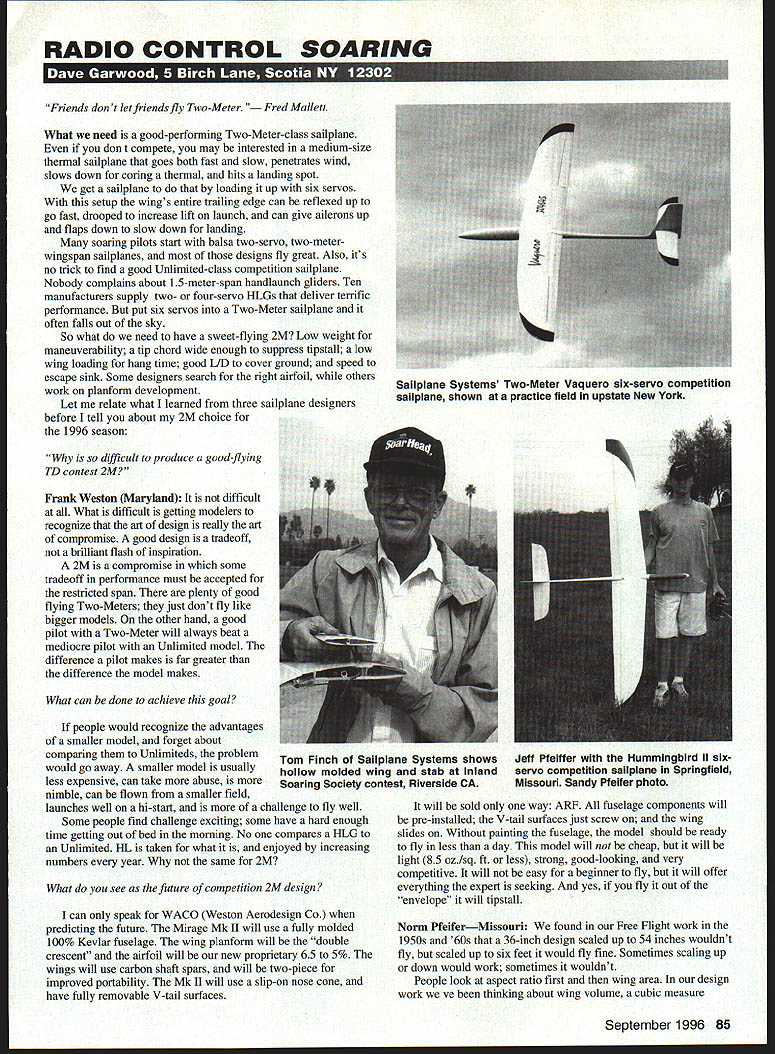
We get a sailplane to do that by loading it up with six servos. With this setup the wing's entire trailing edge can be reflexed up to go fast, drooped to increase lift on launch, and can give ailerons up and flaps down to slow down for landing.
Many soaring pilots start with balsa two-servo, two-meter-wingspan sailplanes, and most of those designs fly great. Also, it's no trick to find a good Unlimited-class competition sailplane. Nobody complains about 1.5-meter-span handlaunch gliders. Ten manufacturers supply two- or four-servo HLGs that deliver terrific performance. But put six servos into a Two-Meter sailplane and it often falls out of the sky.
So what do we need to have a sweet-flying 2M?
- Low weight for maneuverability
- A tip chord wide enough to suppress tip stall
- Low wing loading for hang time
- Good L/D to cover ground
- Speed to escape sink
Some designers search for the right airfoil, while others work on planform development. Below are observations from three sailplane designers and the author's choice for the 1996 season.
Frank Weston (Maryland)
"It is not difficult at all. What is difficult is getting modelers to recognize that the art of design is really the art of compromise. A good design is a tradeoff, not a brilliant flash of inspiration.
A 2M is a compromise in which some tradeoff in performance must be accepted for the restricted span. There are plenty of good flying Two-Meters; they just don't fly like bigger models. On the other hand, a good pilot with a Two-Meter will always beat a mediocre pilot with an Unlimited model. The difference a pilot makes is far greater than the difference the model makes.
If people would recognize the advantages of a smaller model, and forget about comparing them to Unlimiteds, the problem would go away. A smaller model is usually less expensive, can take more abuse, is more nimble, can be flown from a smaller field, launches well on a hi-start, and is more of a challenge to fly well.
Some people find challenge exciting; some have a hard enough time getting out of bed in the morning. No one compares an HLG to an Unlimited — HLG is taken for what it is and enjoyed by increasing numbers every year. Why not the same for 2M?
The Mirage Mk II will use a fully molded 100% Kevlar fuselage. The wing planform will be the 'double crescent' and the airfoil will be a new proprietary 6.5 to 5%. The wings will use carbon shaft spars, and will be two-piece for improved portability. The Mk II will use a slip-on nose cone and have fully removable V-tail surfaces.
It will be sold only one way: ARF. All fuselage components will be pre-installed; the V-tail surfaces just screw on, and the wing slides on. Without painting the fuselage, the model should be ready to fly in less than a day. This model will not be cheap, but it will be light (8.5 oz./sq. ft., or less), strong, good-looking, and very competitive. It will not be easy for a beginner to fly, but it will offer everything the expert is seeking. And yes, if you fly it out of the 'envelope' it will tip stall."
Norm Pfeifer (Missouri)
"We found in our free flight work in the 1950s and '60s that a 36-inch design scaled up to 54 inches wouldn't fly, but scaled up to six feet it would fly fine. Sometimes scaling up or down would work; sometimes it wouldn't.
People look at aspect ratio first and then wing area. In our design work we've been thinking about wing volume — a cubic measure: wing area times thickness — because the structure has to push through the air. Moving a wing through the air involves wave action, harmonics, and Reynolds numbers. Unfortunately, the Two-Meter span is right in the dead band where aspect ratio and small chords interact, which explains why some scaled designs did and didn't work at certain spans.
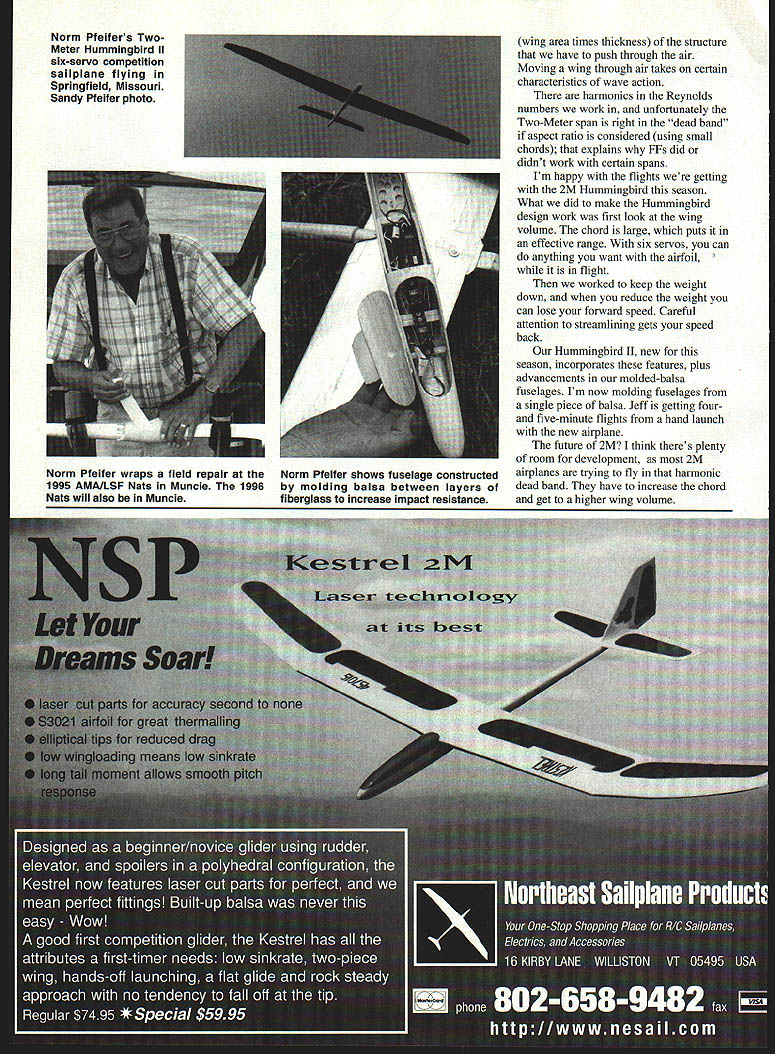
What made the Hummingbird design work? First, look at wing volume. The chord is large, which puts the effective range where six servos can do anything you want. The airfoil and flight coupling worked. Keep weight down; reduce drag. You may lose some forward speed, but careful attention to streamlining gets the speed back.
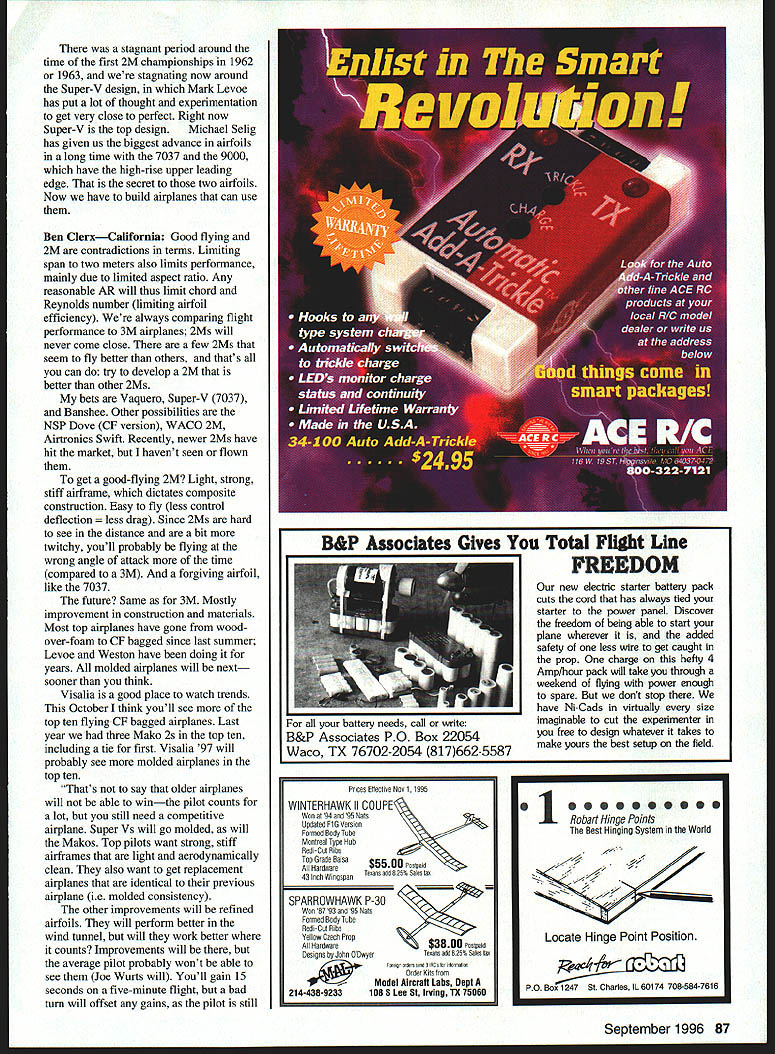
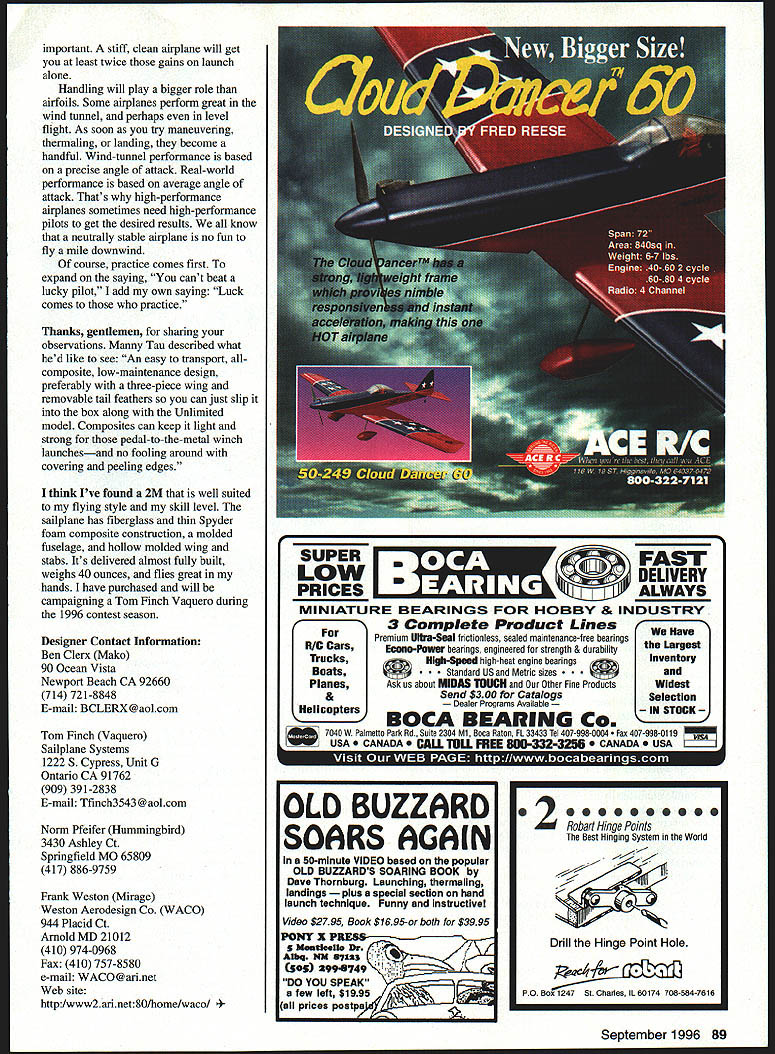
Our Hummingbird II, new for this season, incorporates these features, plus advancements in molded-balsa fuselages. I'm now molding fuselages from a single piece of balsa. Jeff is getting four- and five-minute flights from a hand launch with the new airplane.
The future of 2M? I think there's plenty of room for development, as most 2M airplanes are trying to fly in that harmonic dead band. They have to increase the chord and get to a higher wing volume. There was a stagnant period around the time of the first 2M championships in 1962 or 1963, and we're stagnating now around the Super-V design, in which Mark Levee has put a lot of thought and experimentation to get very close to perfect. Right now Super-V is the top design. Michael Selig has given us the biggest advance in airfoils in a long time with the 7037 and the 9000, which have the high-rise upper leading edge. That is the secret to those two airfoils. Now we have to build airplanes that can use them."
Ben Clerx (California)
"Good flying and 2M are contradictions in terms. Limiting span to two meters also limits performance, mainly due to limited aspect ratio. Any reasonable AR will thus limit chord and Reynolds number (limiting airfoil efficiency). We're always comparing flight performance to 3M airplanes; 2Ms will never come close. There are a few 2Ms that seem to fly better than others, and that's all you can do: try to develop a 2M that is better than other 2Ms.
My bets are Vaquero, Super-V (7037), and Banshee. Other possibilities are the NSP Dove (CF version), WACO 2M, Airmonics Swift. Recently, newer 2Ms have hit the market, but I haven't seen or flown them.
To get a good-flying 2M:
- Light, strong, stiff airframe, which dictates composite construction
- Easy to fly (less control deflection = less drag)
- A forgiving airfoil, like the 7037
Since 2Ms are hard to see at distance and are a bit more twitchy, you'll probably be flying at the wrong angle of attack more of the time (compared to a 3M). Handling will play a bigger role than airfoils. Some airplanes perform great in the wind tunnel, and perhaps even in level flight. As soon as you try maneuvering, thermaling, or landing, they become a handful. Wind-tunnel performance is based on a precise angle of attack. Real-world performance is based on average angle of attack. That's why high-performance airplanes sometimes need high-performance pilots to get the desired results.
Most top airplanes have gone from wood-over-foam to carbon-fiber (CF) bagged construction. Levee and Weston have been doing it for years. All molded airplanes will be next — sooner than you think. Visalia is a good place to watch trends. Expect to see more CF bagged and molded airplanes in the top ten. Top pilots want strong, stiff, light, and aerodynamically clean airplanes. They also want replacement airplanes identical to their previous airplanes (i.e., molded consistency).
Improvements will come in refined airfoils, but the average pilot may not be able to use them fully. Handling and a stiff, clean airplane often yield larger real-world gains than marginal airfoil improvements. Practice matters: 'Luck comes to those who practice.'"
Thanks to the designers for sharing their observations. Manny Tau described what he'd like to see: "An easy-to-transport, all-composite, low-maintenance design, preferably with a three-piece wing and removable tail feathers so you can just slip it into the box along with the Unlimited model. Composites can keep it light and strong for those pedal-to-the-metal winch launches — and no fooling around with covering and peeling edges."
I think I've found a 2M that is well suited to my flying style and my skill level. The sailplane has fiberglass and thin Spyder foam composite construction, a molded fuselage, and hollow molded wing and stabs. It's delivered almost fully built, weighs 40 ounces, and flies great in my hands. I have purchased and will be campaigning a Tom Finch Vaquero during the 1996 contest season.
Designer Contact Information:
Ben Clerx (Mako)
- 90 Ocean Vista
- Newport Beach, CA 92660
- (714) 721-8848
- E-mail: BCLERX@aol.com
Tom Finch (Vaquero)
- Sailplane Systems
- 1222 S. Cypress, Unit G
- Ontario, CA 91762
- (909) 391-2838
- E-mail: Tfinch3543@aol.com
Norm Pfeifer (Hummingbird)
- 3430 Ashley Ct.
- Springfield, MO 65809
- (417) 886-9759
Frank Weston (Mirage)
- Weston Aerodesign Co. (WACO)
- 944 Placid Ct.
- Arnold, MD 21012
- (410) 974-0968
- Fax: (410) 757-8580
- E-mail: WACO@ari.net
- Web site: http://www2.ari.net/home/waco/
Transcribed from original scans by AI. Minor OCR errors may remain.

