
RADIO CONTROL SOARING
Dave Garwood 5 Birch Lane, Scotia NY 12302
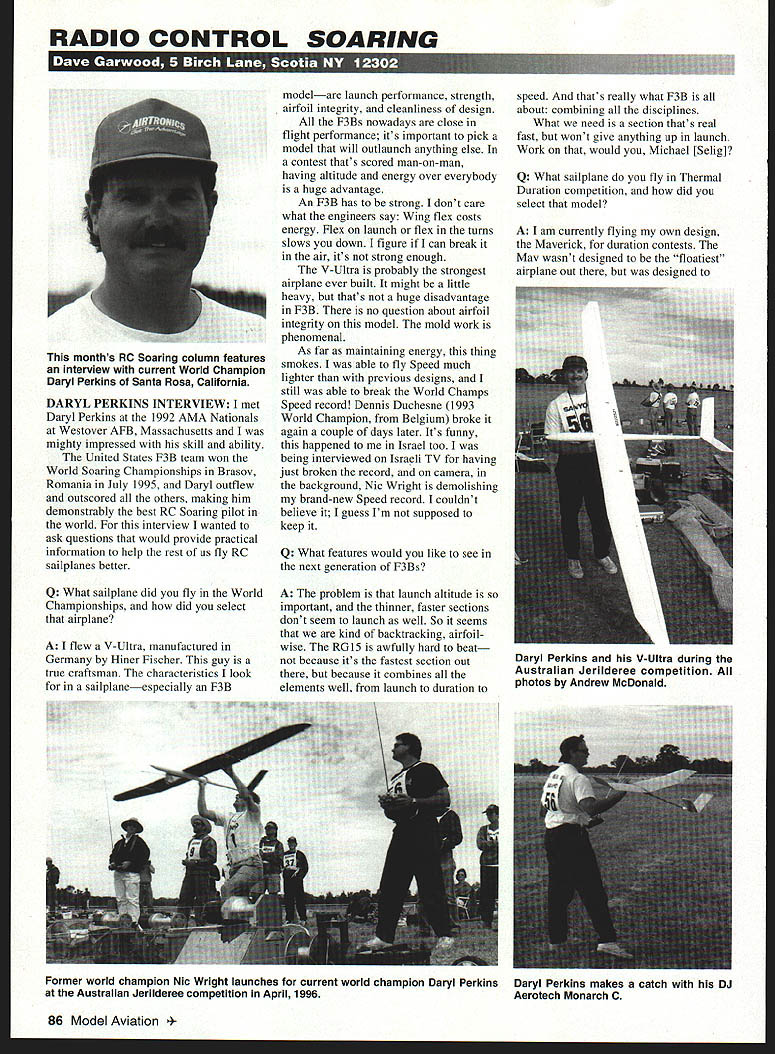
Daryl Perkins Interview
I met Daryl Perkins at the 1992 AMA Nationals at Westover AFB, Massachusetts and I was mighty impressed with his skill and ability.
The United States F3B team won the World Soaring Championships in Brașov, Romania in July 1995, and Daryl outflew and outscored all the others, making him demonstrably the best RC soaring pilot in the world. For this interview I wanted to ask questions that would provide practical information to help the rest of us fly RC sailplanes better.
Q: What sailplane did you fly in the World Championships, and how did you select that airplane?
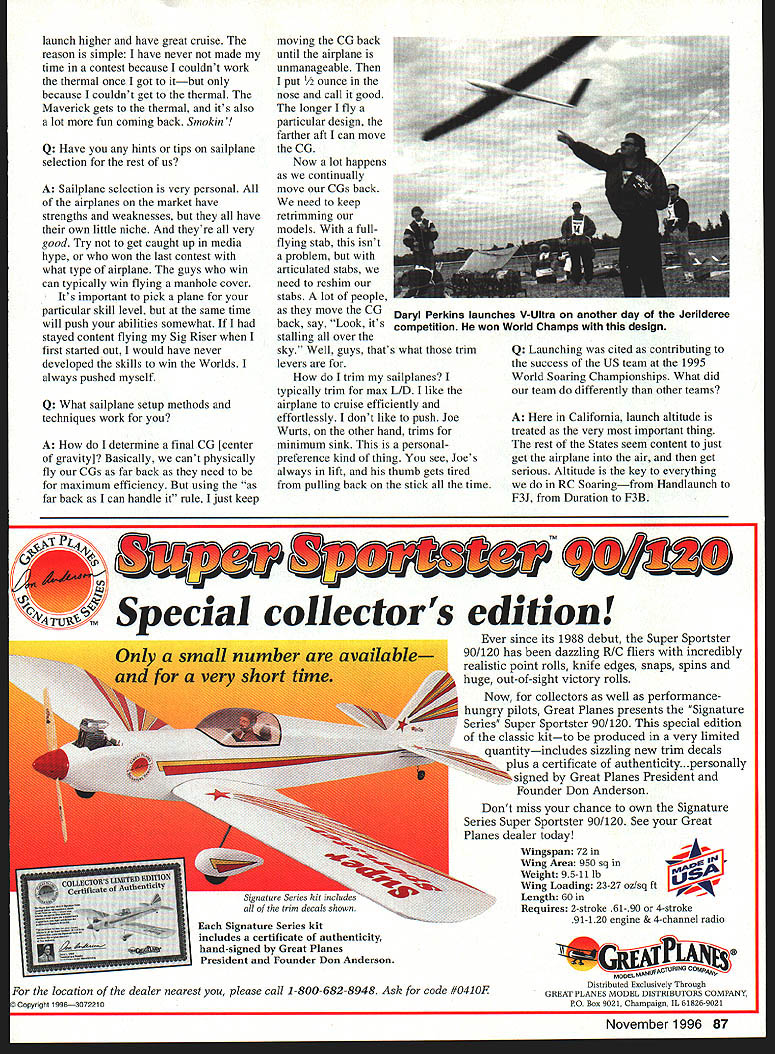
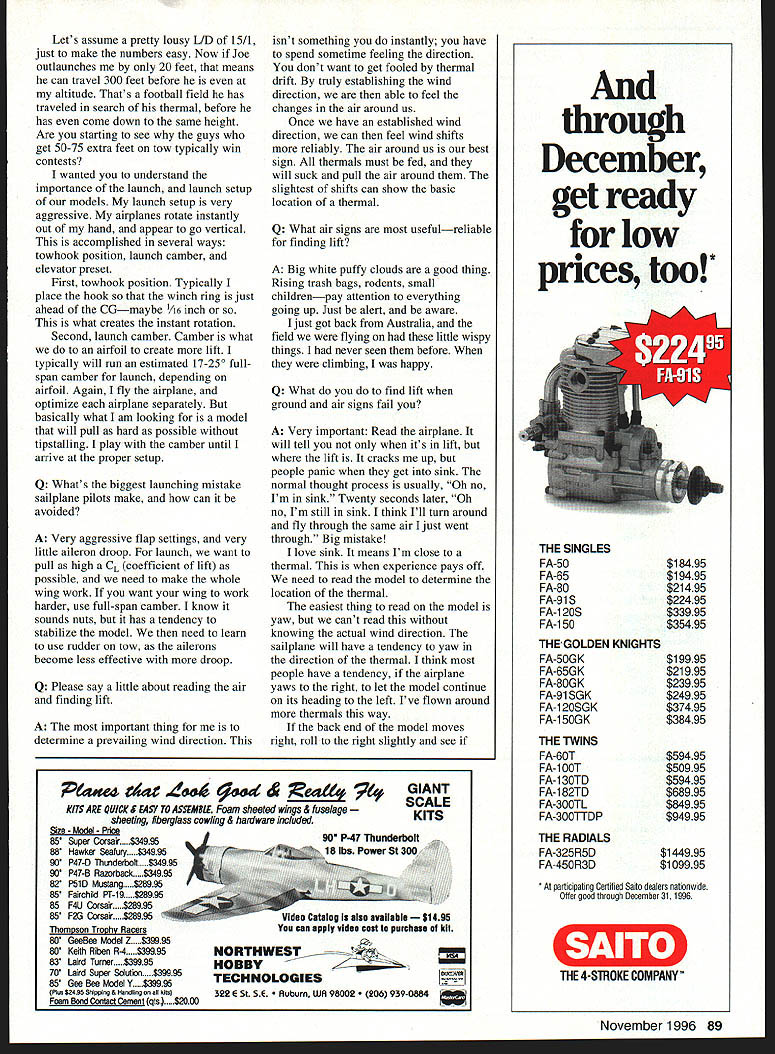
A: I flew a V-Ultra, manufactured in Germany by Heiner Fischer. This guy is a true craftsman. The characteristics I look for in a sailplane—especially an F3B model—are:
- launch performance
- strength
- airfoil integrity
- cleanliness of design
All the F3Bs nowadays are close in flight performance; it's important to pick a model that will outlaunch anything else. In a contest that's scored man-on-man, having altitude and energy over everybody is a huge advantage.
An F3B has to be strong. I don't care what the engineers say: wing flex costs energy. Flex on launch or flex in the turns slows you down. I figure if I can break it in the air, it's not strong enough.
The V-Ultra is probably the strongest airplane ever built. It might be a little heavy, but that's not a huge disadvantage in F3B. There is no question about airfoil integrity on this model. The mold work is phenomenal.
As far as maintaining energy, this thing smokes. I was able to fly Speed much lighter than with previous designs, and I was still able to break the World Champs Speed record! Dennis Duchesne (1993 World Champion, from Belgium) broke it again a couple of days later. It's funny; this happened to me in Israel too. I was being interviewed on Israeli TV for having just broken the record, and, on camera, in the background, Nic Wright was demolishing my brand-new Speed record. I couldn't believe it; I guess I'm not supposed to keep it.
Q: What features would you like to see in the next generation of F3Bs?
A: The problem is that launch altitude is so important, and the thinner, faster sections don't seem to launch as well. So it seems that we are kind of backtracking, airfoil-wise. The RG15 is awfully hard to beat not because it's the fastest section out there, but because it combines all the elements well, from launch to duration to speed. And that's really what F3B is all about: combining all the disciplines.
What we need is a section that's really fast, but won't give anything up in launch. Work on that, would you, Michael Selig?
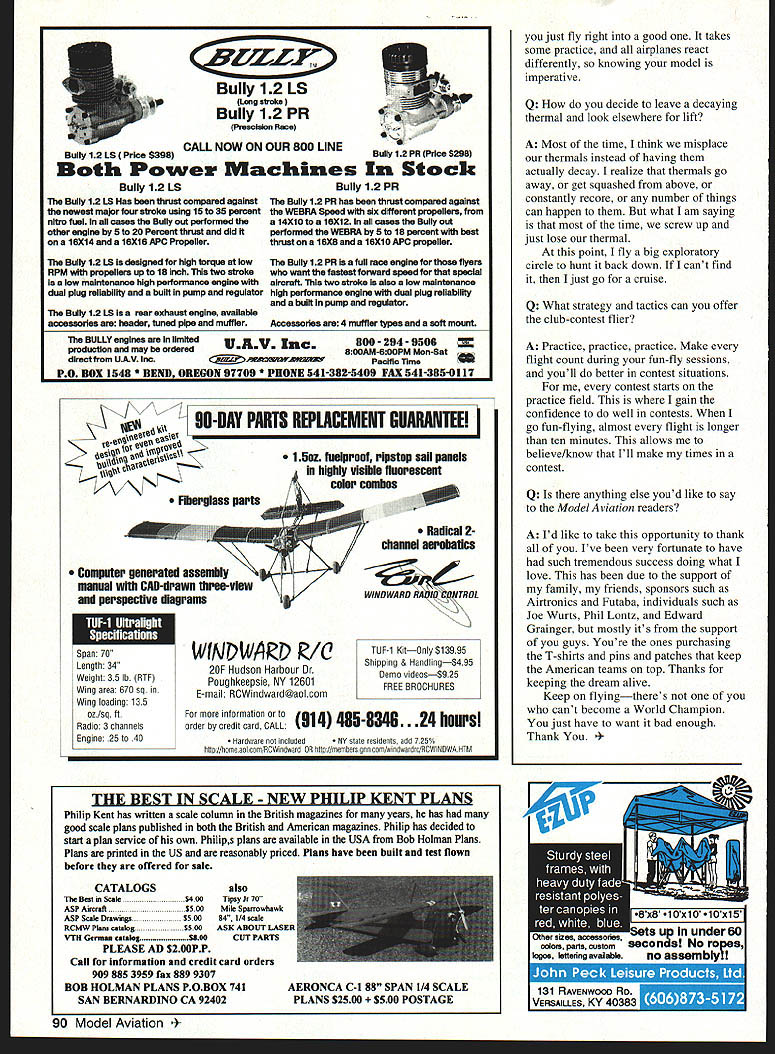
Q: What sailplane do you fly in Thermal Duration competition, and how did you select that model?
A: I am currently flying my own design, the Maverick, for duration contests. The Maverick wasn't designed to be the "floatiest" airplane out there, but was designed to have great cruise. The reason is simple: I have never made time in contests because I couldn't work a thermal once I got it, but because I couldn't get into a thermal. The Maverick gets into thermals; it's also a lot of fun coming back—smokin'.
Q: Have hints/tips on sailplane selection for the rest of us?
A: Sailplane selection is very personal. Airplanes on the market have strengths and weaknesses and have their own little niche; they're very good. Try not to get caught up in media hype like "I won the last contest with this type airplane." Guys can typically win flying a manhole cover. It's important to pick a plane that fits your particular skill level, and at the same time will push your abilities somewhat. I stayed content flying the Sig Riser when I first started out and would have never developed the skills to win Worlds if I had always stayed content. I always pushed myself.
Q: What sailplane setup methods/techniques work?
A: How do I determine final C.G.? Basically, you can't physically fly C.G.s far back. You need maximum efficiency using the C.G. as far back as you can handle. Keep moving the C.G. back until the airplane becomes unmanageable—put the nose down and call it good. The longer you fly a particular design, the farther aft you can move the C.G.
A lot happens: I continually move C.G.s back and need to keep retrimming models. Full-flying stabilizers aren't a problem; articulated stabilizers need re-shimming. A lot of people move the C.G. back and say, "Look, it's stalling over the sky." Well, guys, that's what trim levers are for. Trim sailplanes typically to trim for maximum L/D—so the airplane cruises efficiently and effortlessly. I don't like to push. Joe Wurts, on the other hand, trims for minimum sink. It's a personal preference thing. Joe's always lifting—the thumb gets tired pulling back on the stick all the time.
Q: Launching was cited as a contributing success to the US team at the 1995 World Soaring Championships. What did our team do differently than other teams?
A: Here in California, launch altitude is treated as the very most important thing. The rest of the States seem content to just get the airplane into the air, and then get serious. Altitude is the key to everything we do in RC soaring—from handlaunch to F3J, from duration to F3B.
Let's assume a pretty lousy L/D of 15:1, just to make the numbers easy. Now if Joe outlaunches me by only 20 feet, that means he can travel 300 feet before he is even at my altitude. That's a football field he has traveled in search of his thermal, before he has even come down to the same height. Are you starting to see why the guys who get 50–75 extra feet on tow typically win contests?
I wanted you to understand the importance of the launch, and launch setup of our models. My launch setup is very aggressive. My airplanes rotate instantly out of my hand, and appear to go vertical. This is accomplished in several ways:
- tow-hook position
- launch camber
- elevator preset
First, tow-hook position. Typically I place the hook so that the winch ring is just ahead of the C.G.—maybe 1/16 inch or so. This is what creates the instant rotation.
Second, launch camber. Camber is what we do to an airfoil to create more lift. I typically will run an installed 17–25' full-span camber for launch, depending on airfoil. Again, I fly the airplane and optimize each airplane separately. But basically what I am looking for is a model that will pull as hard as possible without tip-stalling. I play with the camber until I arrive at the proper setup.
Q: What's the biggest launching mistake sailplane pilots make, and how can it be avoided?
A: Very aggressive flap settings and very little aileron droop. For launch, we want to pull as high a CL (coefficient of lift) as possible, and we need to make the whole wing work. If you want your wing to work harder, use full-span camber. I know it sounds nuts, but it has a tendency to stabilize the model. We then need to learn to use rudder on tow, as the ailerons become less effective with more droop.
Q: Please say a little about reading the air and finding lift.
A: The most important thing for me is to determine a prevailing wind direction. This isn't something you do instantly; you have to spend some time feeling the direction.
You don't want to get fooled by thermal drift. By truly establishing the wind direction, we are then able to feel the changes in the air around us.
Once we have an established wind direction, we can then feel wind shifts more reliably. The air around us is our best sign. All thermals must be fed, and they will suck and pull the air around them. The slightest of shifts can show the basic location of a thermal.
Q: What air signs are most useful—reliable for finding lift?
A: Big white puffy clouds are a good thing. Rising trash bags, rodents, small children—pay attention to everything going up. Just be alert, and be aware.
I just got back from Australia, and the field we were flying on had these little wispy things. I had never seen them before. When they were climbing, I was happy.
Q: What do you do to find lift when ground and air signs fail you?
A: Very important: read the airplane. It will tell you not only when it's in lift, but where the lift is. It cracks me up, but people panic when they get into sink. The normal thought process is usually, "Oh no, I'm in sink." Twenty seconds later, "Oh no, I'm still in sink. I think I'll turn around and fly through the same air I just went through." Big mistake!
I love sink. It means I'm close to a thermal. This is when experience pays off. We need to read the model to determine the location of the thermal.
The easiest thing to read on the model is yaw, but we can't read this without knowing the actual wind direction. The sailplane will have a tendency to yaw in the direction of the thermal. I think most people have a tendency, if the airplane yaws to the right, to let the model continue on its heading to the left. I've flown around more thermals this way.
If the back end of the model moves right, roll to the right slightly and see if it will suck up. If not, try the other side. If you do it properly, you just fly right into a good one. It takes some practice, and all airplanes react differently, so knowing your model is imperative.
Q: How do you decide to leave a decaying thermal and look elsewhere for lift?
A: Most of the time, I think we misplace our thermals instead of having them actually decay. I realize that thermals go away, or get squashed from above, or get scattered, or any number of things can happen to them. But what I am saying is that most of the time, we screw up and just lose our thermal.
At this point, I fly a big exploratory circle to hunt it back down. If I can't find it, then I just go for a cruise.
Q: What strategy and tactics can you offer the club-contest flier?
A: Practice, practice, practice. Make every flight count during your fun-fly sessions, and you'll do better in contest situations.
For me, every contest starts on the practice field. This is where I gain the confidence to do well in contests. When I go fun-flying, almost every flight is longer than ten minutes. This allows me to believe and know that I'll make my times in a contest.
Q: Is there anything else you'd like to say to the Model Aviation readers?
A: I'd like to take this opportunity to thank all of you. I've been very fortunate to have had such tremendous success doing what I love. This has been due to the support of my family, my friends, sponsors such as Airtronics and Futaba, and individuals such as Joe Wurts, Phil Lontz, and Edward Grainger, but mostly it's from the support of you guys. You're the ones purchasing the T-shirts and pins and patches that keep the American teams on top. Thanks for keeping the dream alive.
Keep on flying—there's not one of you who can't become a World Champion. You just have to want it bad enough. Thank you.
Transcribed from original scans by AI. Minor OCR errors may remain.

