
RADIO CONTROL SOARING
Dave Garwood, 5 Birch Lane, Scotia NY 12302
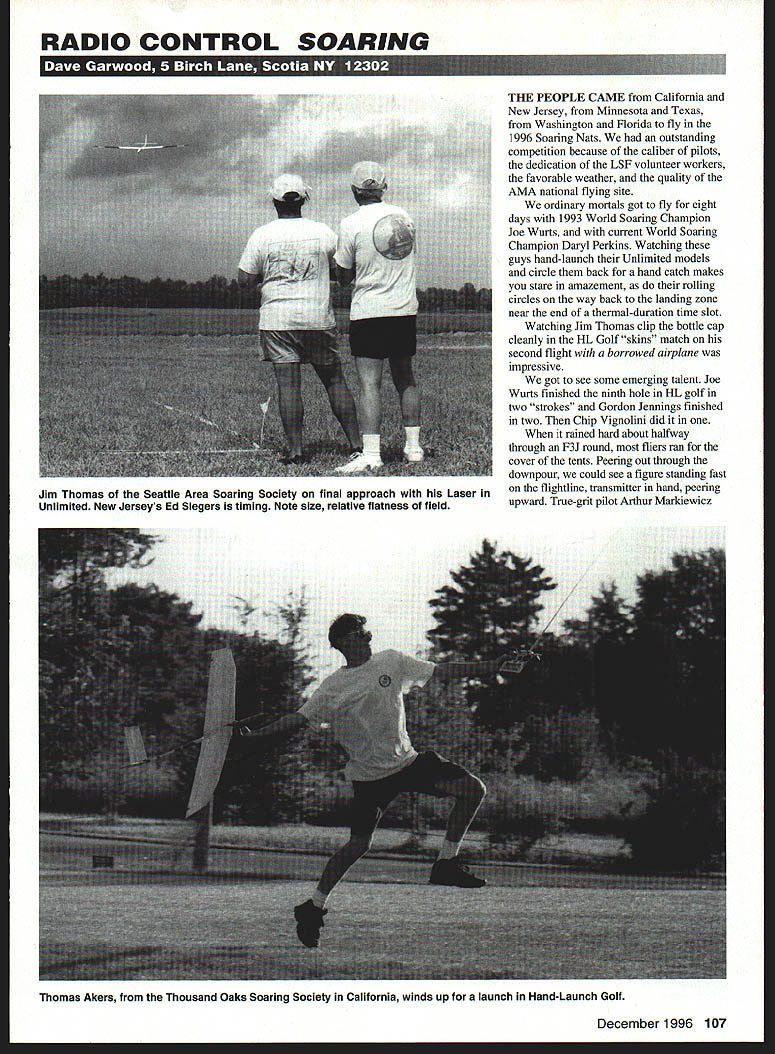
The people came from California and New Jersey, from Minnesota and Texas, from Washington and Florida to fly in the 1996 Soaring Nats. We had an outstanding competition because of the caliber of pilots, the dedication of the League of Silent Flight (LSF) volunteer workers, the favorable weather, and the quality of the AMA national flying site.
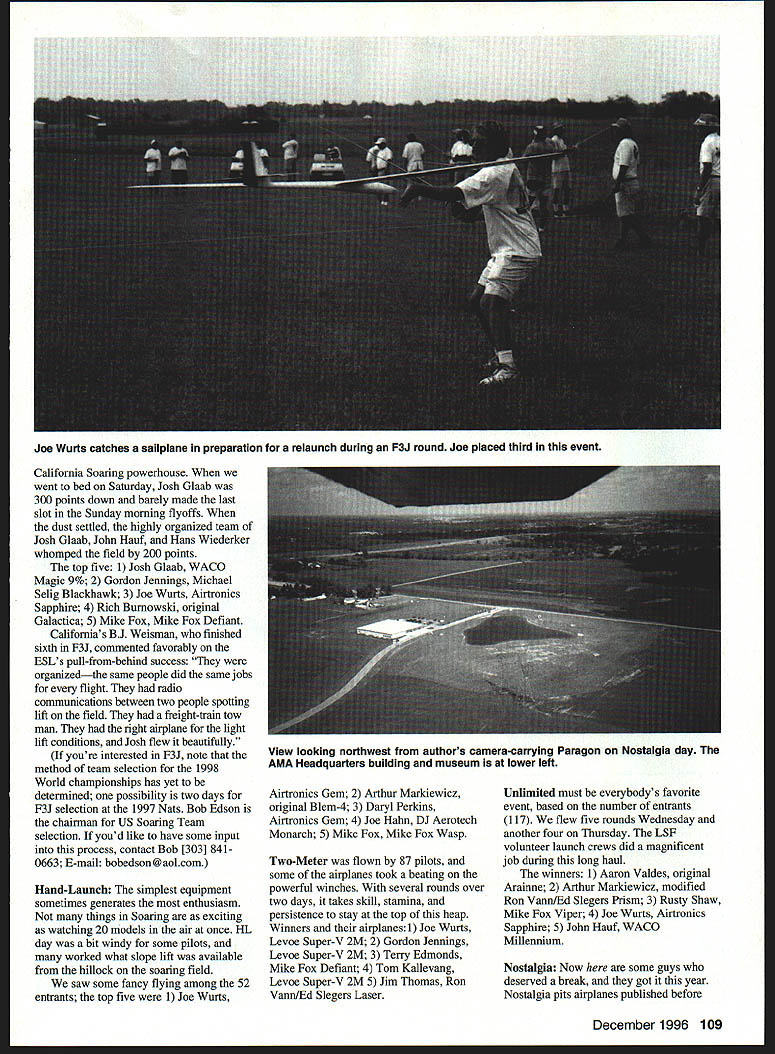
We ordinary mortals got to fly for eight days with 1993 World Soaring Champion Joe Wurts and current World Soaring Champion Daryl Perkins. Watching these guys hand-launch their Unlimited models and circle them back for a hand catch makes you stare in amazement, as do their rolling circles on the way back to the landing zone near the end of a thermal-duration time slot.
Watching Jim Thomas clip the bottle cap cleanly in the HL Golf "skins" match on his second flight with a borrowed airplane was impressive. We also saw some emerging talent: Joe Wurts finished the ninth hole in HL golf in two "strokes" and Gordon Jennings finished in two. Then Chip Vignolini did it in one.
When it rained hard about halfway through an F3J round, most fliers ran for the cover of the tents. Peering out through the downpour, we could see a figure standing fast on the flightline, transmitter in hand, peering upward. True-grit pilot Arthur Markiewicz finished the flight and won the round. Why he didn't come in out of the rain? "There's lift out there. I can't believe it."
Approximately 200 fliers and volunteers came from about 20 states, providing a cultural mix. Counting "Mad Romanian" Mike Popescu and the Japan Soaring Team's Tsutomu Matsumoto, contestants came from across the Atlantic and Pacific Oceans to fly at this Nats. Mike now runs Inventec in Pennsylvania, and Tsutomu flies with the Cincinnati Soaring Society while on assignment in the U.S. with Honda Motors.
The weather really cooperated this year. Daytime highs were in the 70s all week, with mostly sunny skies and plenty of cumulus clouds. Of course the same vertical development that creates thermal lift produces afternoon thundershowers, which appeared briefly on most days. Only one day dawned rainy, and that delayed the Two-Meter contest start for a few hours.
Last year there was some grousing about the uneven flying field, but not so this year—the field had been rolled. Joe Wurts, who has flown from many fields, said, "On a scale from one to ten, this field is a nine‑point‑five." Even so, AMA plans to move the soaring field to the east (to get more distance from the power lines), to put in a road, and to enlarge the mowed area from 600 feet square to 1,000 feet square.
For the second consecutive year, the League of Silent Flight did an exceptional job of organizing and running the contest. Amazingly, this event runs almost entirely on volunteer power. LSF's Mike Stump and Cal Posthuma put in hundreds of hours before, during, and after the contest. Transmitter‑impound staff like Bob and Kathy Massman, Mama Jefferies, and Sue Stump worked tirelessly for days.
The contest directors are among the most visible volunteers. Who can forget Alden Shipps' CD style, which is part Marine drill instructor, part coach, and part comedian? Sample call: "Why do they call it golf? Because all the other four‑letter words were already used."
We also enjoyed the benefit of AMA staff support from Steve Kaluf and Ron Morgan for up to 12 hours a day. Thank you again, volunteers and AMA staff, for your contributions on our behalf.
Now, to the events:
F3B Multitask
F3B, the queen of soaring events, is used to decide the World Championships. The multitask event consists of thermal duration, distance on a closed course, and speed on a closed course — all with the same sailplane. This is an awesome event to watch; seeing the airplanes, the equipment, and the teamwork is pretty inspiring.
Twelve pilots flew two rounds of multitask. The top five and their sailplanes were:
- Rich Burnowski, original V-Eagle
- Daryl Perkins, original Whiplash
- Steve Condon, SMaL Enterprises Molded Eagle
- Gordon Jennings, Airtronics Thermal Eagle
- Tom Kallevang, SMaL Enterprises Molded Eagle
F3J Hand-Tow
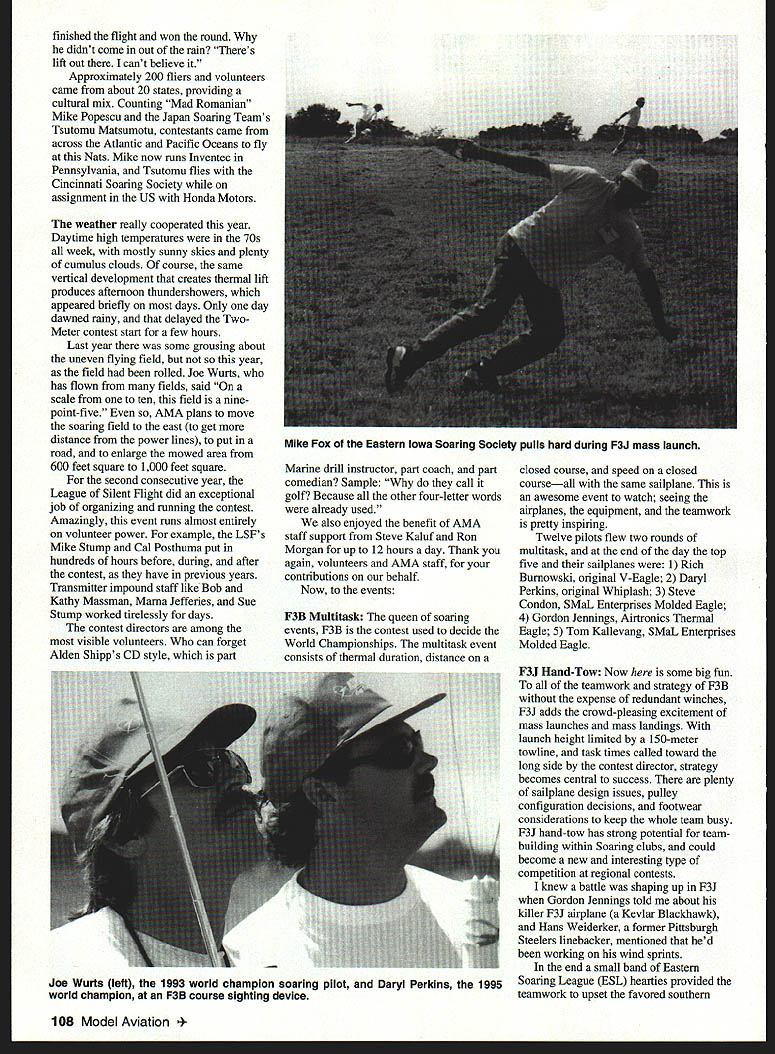
F3J delivers the teamwork and strategy of F3B without the expense of redundant winches, and it adds the crowd-pleasing excitement of mass launches and mass landings. With launch height limited by a 150‑meter towline and task times often long, strategy becomes central to success. There are sailplane design issues, pulley configuration decisions, and footwear considerations to keep the whole team busy. F3J hand‑tow has strong potential for team‑building within soaring clubs and could become a popular regional contest event.
A small band of Eastern Soaring League (ESL) hearties provided the teamwork to upset the favored Southern California powerhouse. When we went to bed on Saturday, Josh Glaab was 300 points down and barely made the last slot in the Sunday morning flyoffs. When the dust settled, the highly organized team of Josh Glaab, John Hauf, and Hans Weidecker whomped the field by 200 points.
The top five:
- Josh Glaab, WACO Magic 9%
- Gordon Jennings, Michael Selig Blackhawk
- Joe Wurts, Airtronics Sapphire
- Rich Burnowski, original Galactica
- Mike Fox, Mike Fox Defiant
California's B.J. Weisman, who finished sixth in F3J, commented favorably on the ESL's pull‑from‑behind success: "They were organized—the same people did the same jobs for every flight. They had radio communications between two people spotting lift on the field. They had a freight‑train tow man. They had the right airplane for the light lift conditions, and Josh flew it beautifully."
If you're interested in F3J, note that the method of team selection for the 1998 World Championships has yet to be determined; one possibility is two days for F3J selection at the 1997 Nats. Bob Edson is the chairman for U.S. Soaring Team selection. If you'd like to have some input into this process, contact Bob at (303) 841‑0663 or E‑mail: bodedson@aol.com.
Hand-Launch
The simplest equipment sometimes generates the most enthusiasm. Not many changes in soaring are as exciting as watching many models in the air at once. HL day was a bit windy for some pilots, and many worked what slope lift was available from the hillock on the soaring field.
We saw some fancy flying among the 52 entrants. The top five were:
- Joe Wurts, Airtronics Gem
- Arthur Markiewicz, original Blem‑4
- Daryl Perkins, Airtronics Gem
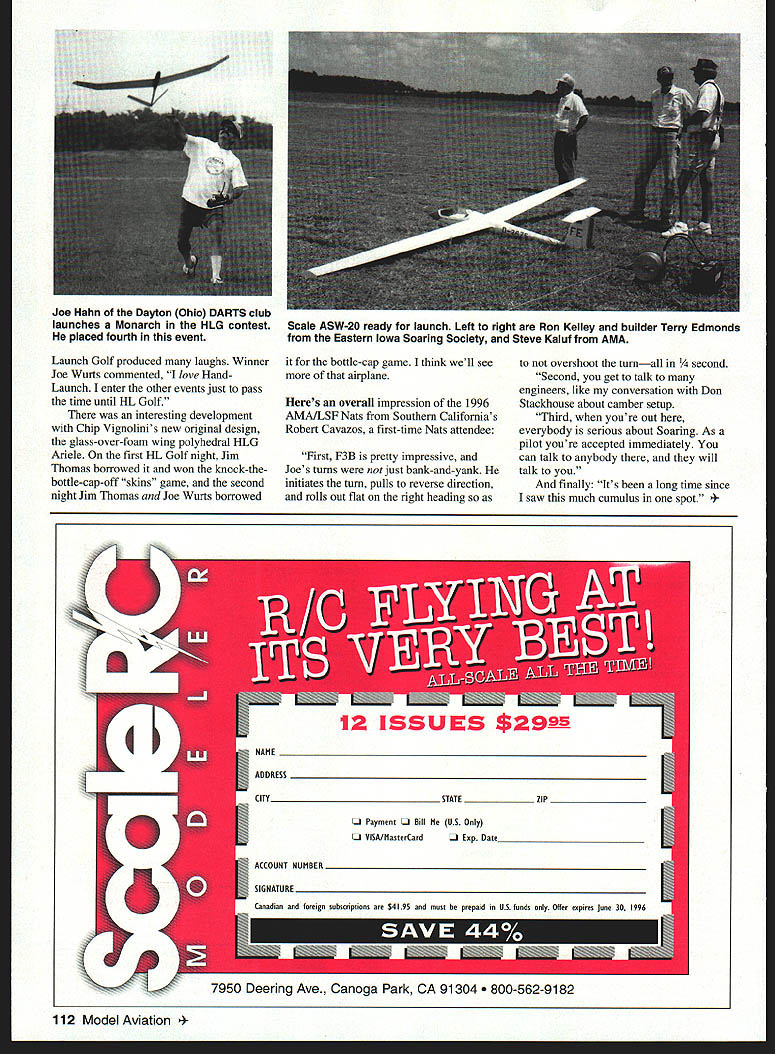
- Joe Hahn, DJ Aerotech Monarch
- Mike Fox, Mike Fox Wasp
Like last year, the two nights of Hand‑Launch Golf provided plenty of entertainment and some memorable moments. Watching airplanes circle back on a hand launch and then watching the pilot roll back to the landing zone near the end of the thermal‑duration time slot makes spectators stare in amazement. Jim Thomas clipped a bottle cap cleanly on one HL Golf skin match; on a second night a borrowed airplane again impressed. Joe Wurts finished nine holes of HL Golf two strokes ahead; Gordon Jennings finished two strokes back; Chip Vignolini also played well.
Two-Meter
Two‑Meter was flown by 87 pilots, and some airplanes took a beating on the powerful winches. With several rounds over two days, it takes skill, stamina, and persistence to stay at the top. Winners and their airplanes:
- Joe Wurts, Levoe Super‑V 2M
- Gordon Jennings, Levoe Super‑V 2M
- Terry Edmonds, Mike Fox Defiant
- Tom Kallevang, Levoe Super‑V 2M
- Jim Thomas, Ron Vann/Ed Slegers Laser
Unlimited
Unlimited must be everybody's favorite event, based on the number of entrants (117). We flew five rounds Wednesday and another four on Thursday. The LSF volunteer launch crews did a magnificent job during this long haul. The winners:
- Aaron Valdes, original Arianne
- Arthur Markiewicz, modified Ron Vann/Ed Slegers Prism
- Rusty Shaw, Mike Fox Viper
- Joe Wurts, Airtronics Sapphire
- John Hauf, WACO Millennium
Nostalgia
Nostalgia pits airplanes published before January 1, 1980 against each other in a modern thermal‑duration task. This provisional AMA contest event was rained out at the last two Nats, but this year it enjoyed probably the best soaring weather of the eight days.
Twenty‑two pilots flew eight rounds, with some of the most colorful models in soaring; five of them circling in the same thermal is a magnificent sight. The top pilots and their airplanes:
- Don Harris, Gulf Coaster
- Cal Posthuma, Sailaire
- Johnny Berlin, Bird of Time
- Chuck Anderson, Sailaire
- Larry Storie, SD‑100
Scale
There was only a single entry in Scale, down from two entries last year. There are conflicting impressions about whether Scale soaring is growing or shrinking in the U.S. in the mid‑1990s. There seems to be an increase in the number of Scale events held, but Nats Scale entries have dwindled in recent years.
Terry Edmonds subjected his Glasflügel ASW‑20 1/4‑scale sailplane to static judging and made the two required prototypical judged flights during the lunch break on Nostalgia day. Most observers were favorably impressed with the appearance and performance of the big white model. Arthur Markiewicz, pressed into service as a Scale judge, commented, "There's something majestic about the real deal."
Does this mean there's an opportunity for Scale competitors? Will Scale die out at the Nats? What should AMA do to encourage Scale competition?
Attendee Impressions
Southern California's Robert Cavazos, a first‑time Nats attendee, summarized his impressions:
- "First, F3B is pretty impressive, and Joe's turns were not just bank‑and‑yank. He initiates the turn, pulls to reverse direction and rolls out flat on the right heading so as to not overshoot the turn—all in 1/4 second."
- "Second, you get to talk to many engineers, like my conversation with Don Stackhouse about camber setup."
- "Third, when you're out here, everybody is serious about soaring. As a pilot you're accepted immediately. You can talk to anybody there, and they will talk to you."
- "It's been a long time since I saw this much cumulus in one spot."
Thanks again to the volunteers, LSF organizers, and AMA staff for making the 1996 Soaring Nats a memorable event.
Transcribed from original scans by AI. Minor OCR errors may remain.

