
Radio Control: Soaring
Dan Pruss
NEIL NOLTE, LSF/586, meets Level V accomplishments — only the fourth out of 2400 members to achieve the highest level in the League of Silent Flight's accomplishment program. After over two years of efforts on Level V, Neil Nolte of Carmichael, California, finished the last task on Memorial Day.
His goal and return flight was 12.80 miles (6.40 goal) and was flown with a stretched wing Craft-Air SD-100 loaded to 9 oz./sq. ft. Neil's version had a wingspan of 125 inches. The flight, according to Neil, wasn't without its dramatic moments. The flight lasted just seconds over one and one-half hours and included about ten stops to work light lift. Two of those times he was down to less than 40 feet but was able to work his ship back up and continue.
The first time he was only about 2.5 miles into the flight and terminating (an experience more than a few Level V aspirants have experienced), the second time, just three-quarters of a mile from the finish point — a real heart stopper. The flight was made in Winters, CA, temperature 90 degrees. Plus, wind was light and Neil estimates he was never over 1500 feet the entire flight.
Further details about his Level V show all of his contest wins (you must have three out of six contests with 20 or more people) were with a Soarcraft/Windspiel Kestral 19, a plane he has flown competitively for three years. The only modification to the kit was his own gap-type spoiler system. Neil recorded 11 contests in order to get wins and points required from six. One of them just happened to be the LSF Tournament of last year where he took second place out of 124.
His two-hour thermal flight was one of those "grabbed" opportunities, as Neil tells it. "I was out at our local field for a sport flying weekend and launched my wife's Centurion II to check it out before turning her loose with it, grabbed a bubble and went with it. At 15-20 minutes she suggested I try for my two-hour thermal flight rather than bring it down for her to fly, so I continued working the lift." Neil goes on, "At about one hour I was on final approach to the landing area, about 20 feet high when I got a bump, circled several times and found the core and climbed back up for the remaining hour.
Nolte's eight-hour slope flight was done with his first RC sailplane, "a good ole Graupner Cirrus—six years old and still competitive in the right hands." Because most standard 450-500-mil nicad battery packs will last about four hours at most, Neil used a 1200-mil pack. For transmitter a Kraft three-channel with a nine-volt dry cell was used, changing the "snap-in cell" about every two hours while using a second Kraft three-channel on the same frequency. After the flight, the 1200-mil pack was cycled and found to have used only about 40% of its capacity. Neil advises a fresh alkaline pack. The physical size of a 500-mil nicad pack would probably be more than enough for an airborne pack. Neil further points out that the last half of the eight hours gets to be grueling and more than one flier who has lived through this task says you do start mumbling to yourself.
To prevent possible fatigue and provide as relaxed a condition as possible, Nolte says to set up the plane so you can trim it out and fly on trim tabs as much as possible. As long as you're not moving the sticks, you're only pulling idle drain, obviously extending battery life. Transmitter packs are another matter. His own use of the Kraft three-channel sets was based on the fact he had two at the time and felt the switching of packs would be a safe way for endurance. He advises that, although one 9-volt dry pack might be enough, you should make a dry run on the bench before attempting the "for real" eight hours.
As for the physiological aspects of flying for eight hours, your common sense should prevail. Don't plan the flight during your church choir's picnic because you just might embarrass the sopranos at about the six-hour mark!
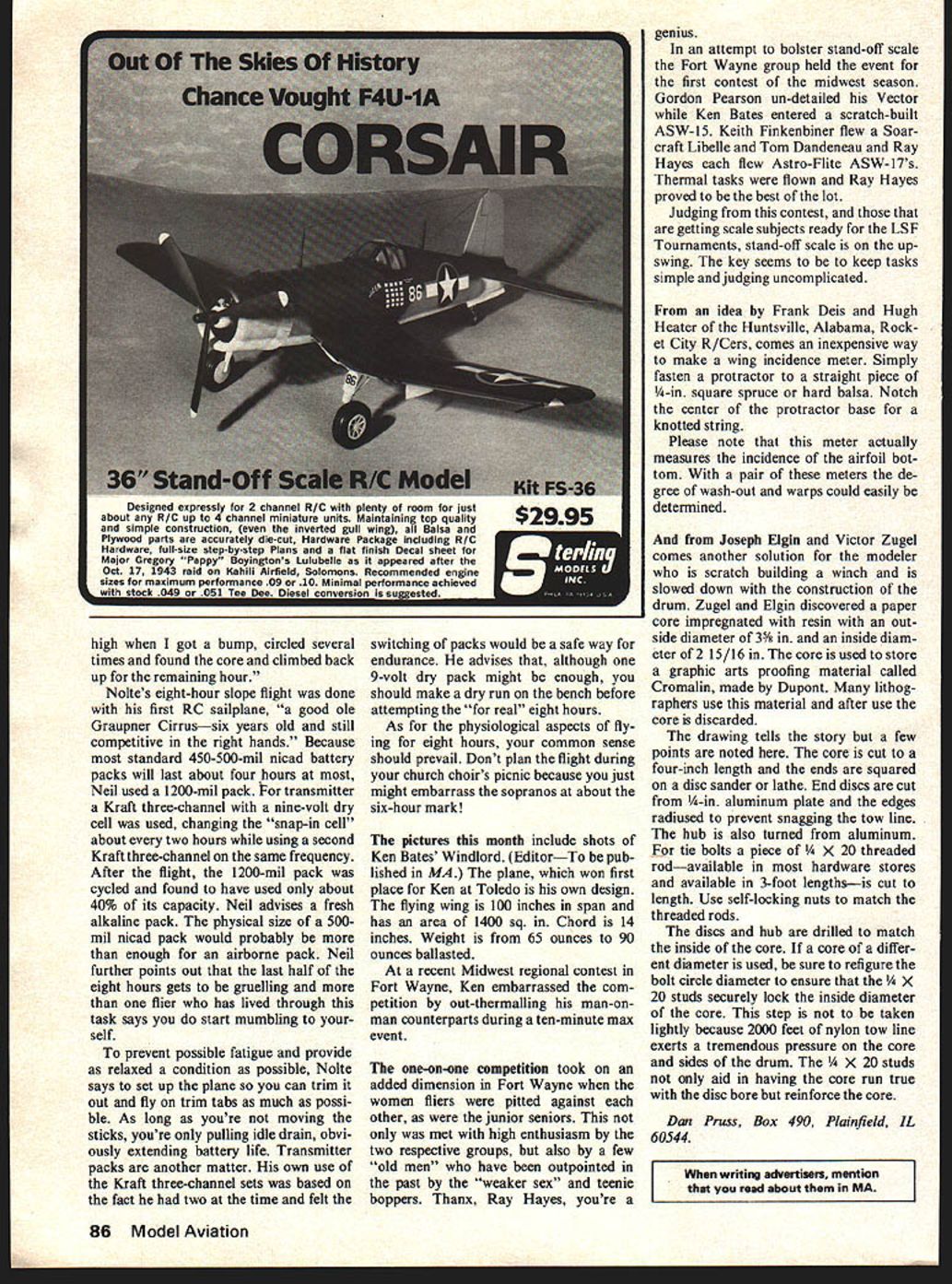
The pictures this month include shots of Ken Bates' Windlord. (Editor—To be published in M.A.) The plane, which won first place for Ken at Toledo is his own design. The flying wing is 100 inches in span and has an area of 1400 sq. in. Chord is 14 inches. Weight is from 65 ounces to 90 ounces ballasted.
At a recent Midwest regional contest in Fort Wayne, Ken embarrassed the competition by out-thermalling his man-on-man counterparts during a ten-minute max event.
The one-on-one competition took on an added dimension in Fort Wayne when two women fliers were pitted against each other, as were the junior seniors. This not only was met with high enthusiasm by the two respective groups, but also by a few "old men" who have been outpointed in the past by the "weaker sex" and teenie boppers. Thanx, Ray Hayes, you're a genius.
In an attempt to bolster stand-off scale the Fort Wayne group held the event for the first contest of the midwest season. Gordon Pearson un-detailed his Vector while Ken Bates entered a scratch-built ASW-15. Keith Finkenbiner flew a Soarcraft Libelle and Tom Dandeneau and Ray Hayes each flew Astro-Flite ASW-17's. Thermal tasks were flown and Ray Hayes proved to be the best of the lot.
Judging from this contest, and those that are getting scale subjects ready for the LSF Tournaments, stand-off scale is on the upswing. The key seems to be to keep tasks simple and judging uncomplicated.
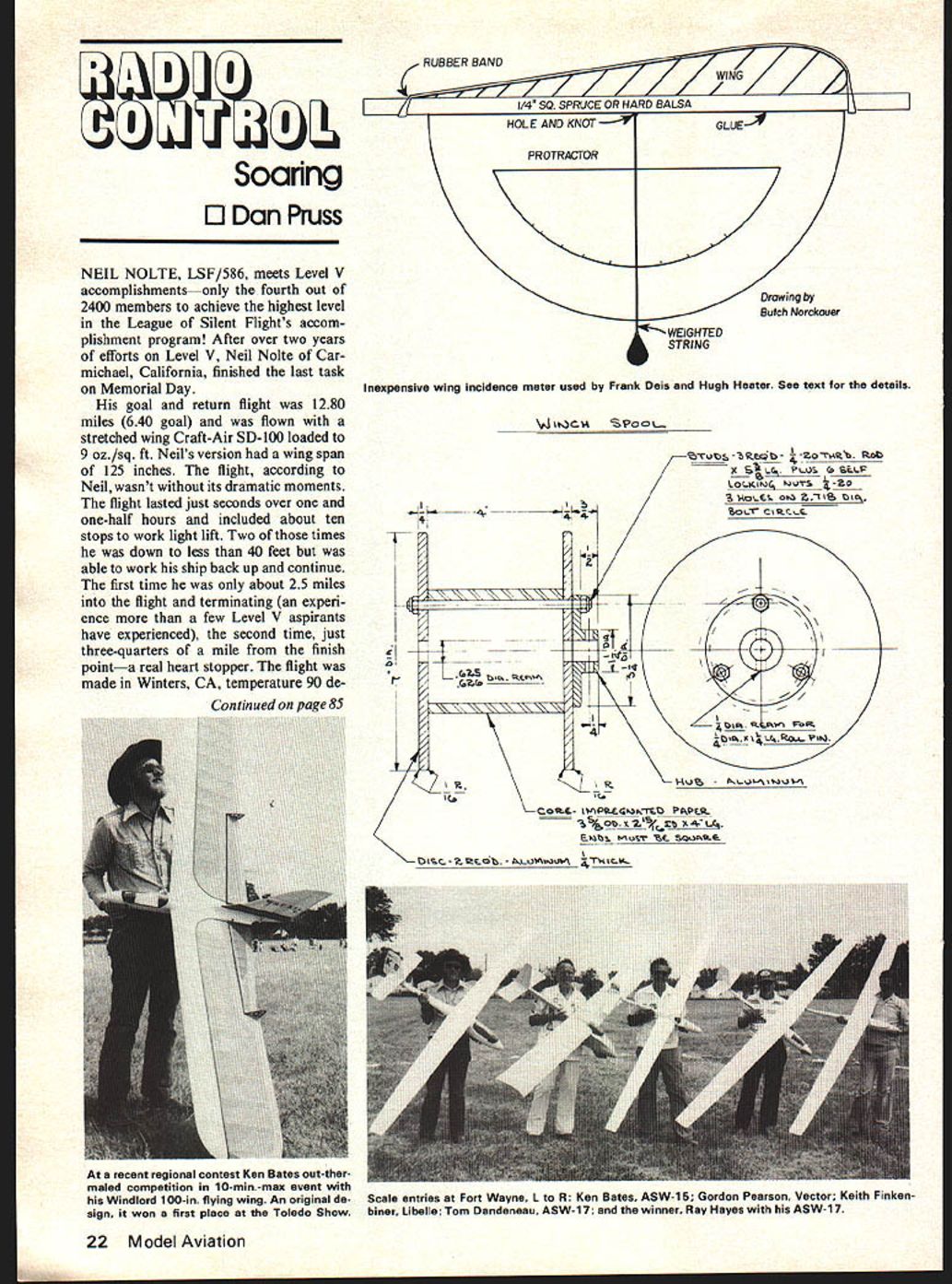
From an idea by Frank Deis and Hugh Heater of the Huntsville, Alabama, Rocket City R/Cers, comes an inexpensive way to make a wing incidence meter. Simply fasten a protractor to a straight piece of 1/4-in. square spruce or hard balsa. Notch the center of the protractor base for a knotted string.
Please note that this meter actually measures the incidence of the airfoil bottom. With a pair of these meters the degree of wash-out and warps could easily be determined.
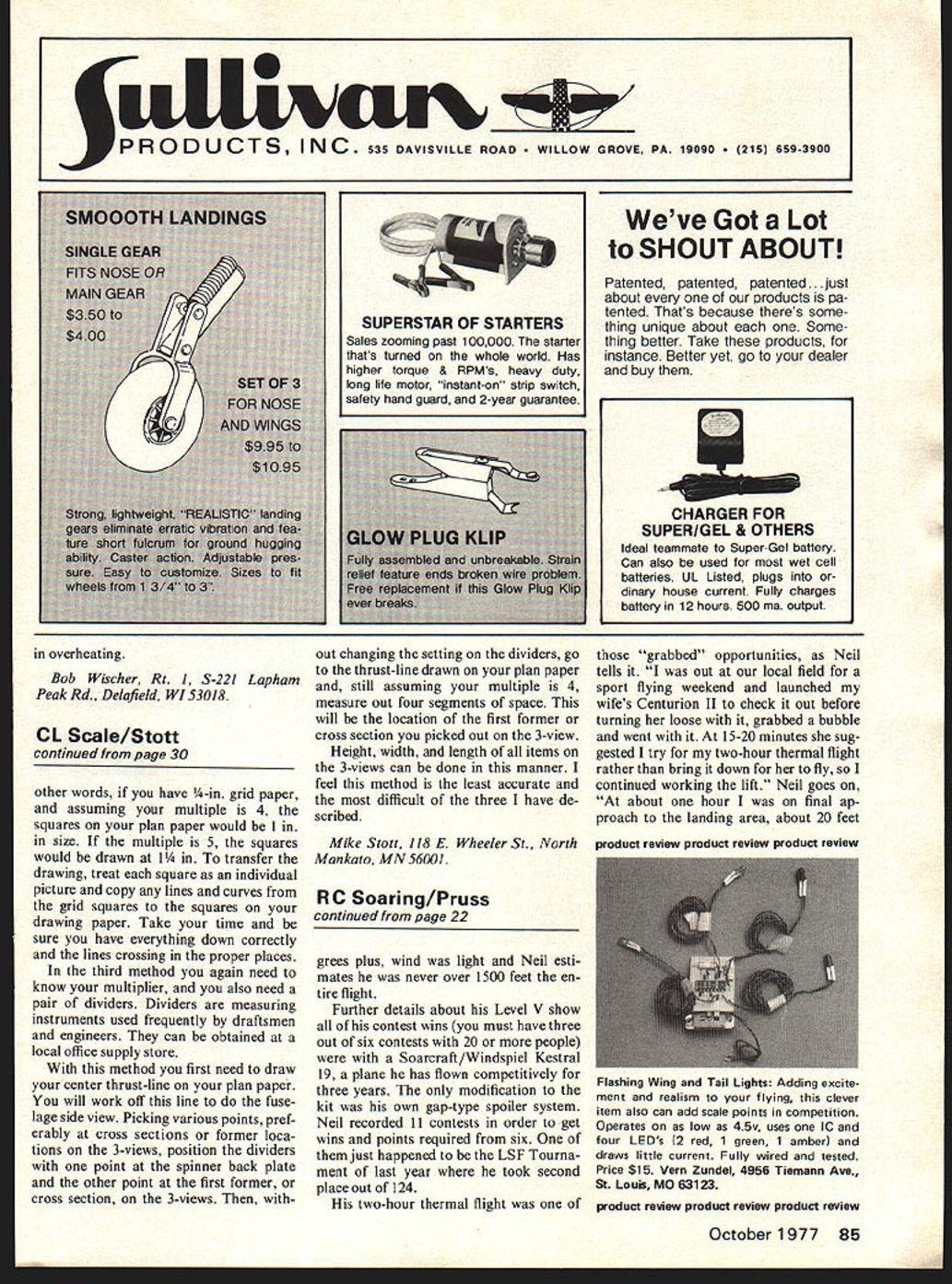
And from Joseph Elgin and Victor Zugel comes another solution for the modeler who is scratch building a winch and is slowed down with the construction of the drum. Zugel and Elgin discovered a paper core impregnated with resin with an outside diameter of 3 5/8 in. and an inside diameter of 2 15/16 in. The core is used to store a graphic arts proofing material called Cromalin, made by DuPont. Many lithographers use this material and after use the core is discarded.
The drawing tells the story but a few points are noted here. The core is cut to a four-inch length and the ends are squared on a disc sander or lathe. End discs are cut from 1/4-in. aluminum plate and the edges radiused to prevent snagging the tow line. The hub is also turned from aluminum.
For tie bolts a piece of 1/4 x 20 threaded rod—available in most hardware stores and available in 3-foot lengths—is cut to length. Use self-locking nuts to match the threaded rods.
The discs and hub are drilled to match the inside of the core. If a core of a different diameter is used, be sure to refigure the bolt circle diameter to ensure that the 1/4 x 20 studs securely lock the inside diameter of the core. This step is not to be taken lightly because 2000 feet of nylon tow line exerts a tremendous pressure on the core near the edges of the drum and side of the core.
The 1/4 x 20 studs not only aid in having the core run true on the disc but reinforce the core.
Dan Pruss, Box 490, Plainfield, IL 60544.
Transcribed from original scans by AI. Minor OCR errors may remain.

